By Franck Essi
There is a comfortable intellectual temptation when facing major geopolitical crises: to read them as external events, of which Africa is simply collateral damage. Surging oil prices, disrupted maritime corridors, imported inflation — all shocks endured, to which one must respond. This reading is not wrong. It is incomplete.
What the USA–Israel–Iran war reveals, if we accept to look it in the face, is less what it does to Africa than what it says about Africa. It strikes a continent already traversed by deep fault lines — geopolitical, institutional, strategic — which successive crises illuminate without ever sufficing to correct.
The thesis of this article is simple: the way African states respond to this conflict is not anecdotal. It is the most concrete test, to date, of their strategic maturity. Understanding these responses — and understanding through which channels this war reaches the continent — is a prerequisite for identifying the real room for manoeuvre available to each category of country.
1. Iran in Africa: The Discreet Actor That Has Become Structural
We must begin with a blind spot. In most African analyses of the conflict, one actor is absent: Iran. Yet Tehran is not a distant power for Africa. It is an active partner, present on the continent for several years, whose commitments directly bear on how certain African states perceive this conflict — and whose vulnerabilities, born from this same conflict, create new risks.
A Methodical Diplomatic Offensive
Under the impetus of President Raïssi (elected in 2021), then his successor Pezeshkian, Tehran has conducted a systematic diplomatic offensive across the African continent. Three Iran–Africa economic cooperation summits were held in Tehran between 2023 and 2025. The last one displayed a precise ambition: to integrate Iran into the African Continental Free Trade Area (AfCFTA)¹. Foreign Minister Abbas Araghchi publicly declared that « Africa, with its 1.4 billion inhabitants, represents a complementary economic partner for Iran »².
This offensive unfolds on three simultaneous registers.
On the religious register: Iran manages more than a hundred Islamic centres, schools, seminaries and mosques in more than thirty African countries, targeting a Muslim community estimated at 500 million people. Media outlets like Hausa TV — broadcasting in the Hausa language, spoken by tens of millions in West Africa — are part of this apparatus³.
On the economic register: partnerships in industry, agriculture, health, energy and infrastructure. Iran’s commercial positioning is explicitly presented as a less costly alternative to Western or even Chinese offers⁴. For countries facing severe budgetary constraints, the argument carries weight.
On the security and military register — the most significant in the current context.
The Iran–AES Axis: A Security Partnership Developing Rapidly
To understand this axis, we must go back to 2023. That year, the Alliance of Sahel States (AES) — Mali, Burkina Faso, Niger — embarked on a radical reorientation of its security partnerships. French and American forces were expelled⁵. This withdrawal created a real operational void: these countries are engaged in active armed conflicts against jihadist groups and require equipment, training and technical support. Russia was the first beneficiary of this repositioning. Turkey followed. Iran progressively inserted itself into this space⁶.
The documented facts — to be read with the caution that partially verified sources impose — are as follows.
In Burkina Faso, the Minister of Defence travelled to Tehran in late February 2026 for high-level talks. Iran proposed combat drones, technical assistance and the construction of an oil refinery, in exchange for gold and access to strategic infrastructure⁷.
In Niger, reports indicate an agreement covering deliveries of Iranian military equipment in exchange for uranium ore⁸ — a highly strategic resource for any nuclear programme. The exact contours of this agreement remain to be independently verified.
In Mali, Iranian technicians are reported to have been deployed to support drone operations and aeronautical maintenance, in exchange for access to the country’s gold reserves⁹. The Iranian ambassador to Mali was received by Prime Minister General Abdoulaye Maïga with a proposal for cooperation at the confederal level — encompassing the entire AES in the domains of security, defence and technology¹⁰.
These partnerships took shape within a precise internal political context. The military regimes in power in the Sahel have built part of their internal legitimacy around the rejection of what they call imperialist foreign military presence — a position deeply rooted in public opinions shaped by decades of external military presence and its contested results¹¹. In this environment, diversifying security partners is a decision consistent with publicly stated positions. This context makes any reversal of course politically costly today.
The Strategic Question This Conflict Poses to the AES
The documented military weakening of Iran since the beginning of hostilities raises a direct strategic question for Sahelian countries: how much is a weakened partner worth?
If Iran emerges durably affected from this conflict, its capacity to honour its African commitments — equipment deliveries, technology transfers, infrastructure projects — will be mechanically reduced. AES countries could then find themselves in an aggravated vulnerability: having broken with their former Western partners, with no guarantee that new partners can hold their commitments under military pressure.
This is not an abstract hypothesis. It is a risk calculation that Sahelian leaders must integrate into their decisions now — for if diversifying alliances can be an act of sovereignty, it can also, if poorly calibrated, become a new form of dependence¹².
2. Israel in Africa: A Normalisation Under Growing Tension
Africa’s relationship with Israel is one of the clearest indicators of continental fractures — because it brings into play history, interests and ideology simultaneously.
46 Diplomatic Relations and a Growing Fracture
Israel maintains diplomatic relations with 46 of the 54 African states. This figure, impressive on its face, conceals a fracture that has widened since 2023 — and that this conflict is deepening.
On one side, the Abraham Accords, signed in 2020 under Trump’s first presidency, integrated two African countries into the normalisation process with Israel. Morocco, in December 2020: the direct counterpart was American recognition of Moroccan sovereignty over Western Sahara — a geopolitical deal that Rabat is firmly maintaining in 2026, including amid the current bombardments. Sudan, in January 2021: this agreement was signed by a transitional government since overthrown by civil war, rendering its status uncertain¹³.
On the other side, the inverse movement has accelerated. In February 2024, the African Union Commission withdrew Israel’s observer status — acquired only two years earlier after a decade of diplomatic effort. The decision was driven by Algeria and South Africa¹⁴. Four countries — South Africa, Namibia, Algeria, Senegal — joined the action brought before the International Court of Justice to qualify Israel’s military operations in Gaza as genocidal¹⁵.
The Historical Roots of an Ideological Fracture
These positions are not isolated gestures. They are inscribed in a long history.
Following the 1973 war, virtually all African states broke diplomatic relations with Israel. This movement followed a precise logic: within the Non-Aligned Movement and Pan-African conferences, the struggle for African liberation and the Palestinian cause were explicitly linked in a shared anti-colonial grammar¹⁶.
The progressive normalisation of the 1990s and 2000s restored diplomatic ties, driven by security, technological and agricultural interests. But it never erased this ideological substrate. The events in Gaza since 2023 have reactivated it with remarkable force. Analysts at the Transnational Institute note that the pan-Africanist current that structures part of Sahelian and West African public opinion today — the same current that drives the rejection of foreign military presence — explicitly includes in its programme the refusal of normalisation with Israel¹⁷.
It is no coincidence that the countries which have repositioned their security partnerships are also those expressing the most distant position from Israel. These fault lines are coherent. They are not accidental.
3. Five African Postures Facing the Conflict: Geopolitics Without a Common Doctrine
The Middle East war has accelerated a mapping of African positions. Reading these postures, we better understand what the continent’s 54 states are — and what they are not yet.
Methodological note: the five poles presented here are analytical ideal-types, not rigid blocs. The classification criterion is the dominant public diplomatic posture, crossed with the underlying alliance architecture. The boundaries between poles are porous: some states hold different positions on different issues. Senegal, for example, aligns with the pro-international law pole on the Gaza issue, but adopts a pragmatic, non-aligned posture on other dimensions of the conflict.
First Pole: The Tradition of International Law
South Africa, Algeria, Namibia
These countries adopt the firmest position. They qualify the American-Israeli strikes as violations of international law and call for their immediate cessation. The ANC has demanded an end to « US intimidation tactics ». South Africa plays a continental leadership role: its action at the ICJ against Israel is inscribed in a tradition of legal diplomacy dating back to the struggle against apartheid¹⁸.
But this position carries a cost. ISS Africa warns that Washington could « react punitively to any sign of sympathy towards Iran ». Pretoria thus navigates a tightrope between its BRICS commitments — of which Iran is now a member — and its commercial interests with the West¹⁹.
South Africa is not opposing the United States out of emotion or ideology. It is defending a coherent doctrine according to which international law is the only structural safeguard for states that lack the military power to impose themselves otherwise. Abandoning this terrain means giving up the most effective negotiating instrument available to mid-sized states.
Second Pole: Assumed Alignment with Israel and the United States
Morocco, Rwanda
Morocco has chosen a calculated silence on the American-Israeli strikes, while condemning Iranian reprisals against Gulf Arab states. This posture is consistent with the Abraham Accords and the American recognition of Moroccan sovereignty over Western Sahara — a strategic asset that Rabat is not prepared to jeopardise²⁰. Rwanda, a discreet security partner of Israel in the technological and military domains, adopts a similar posture of verbal withdrawal.
These countries are making a clear and assumed interest calculation. Their relationship with Washington and Tel-Aviv provides tangible security, technological and diplomatic dividends. They will not sacrifice them in the name of a continental solidarity whose contours remain vague.
Third Pole: Diversified Partnerships of the AES
Mali, Burkina Faso, Niger
As analysed in section 1, these countries have built active security partnerships with Iran, Russia and Turkey. The weakening of Iran represents a direct strategic risk for them — not out of ideological sympathy, but through operational dependence. What makes their situation particularly complex is that any reversal of course is now politically difficult: publicly stated positions have generated expectations in internal public opinion²¹.
Fourth Pole: Pragmatic Non-Alignment
Nigeria, Kenya, Tanzania, Côte d’Ivoire, Ghana, Ethiopia
The majority of the continent falls into this category. Nigeria called for a ceasefire and issued consular alerts. These countries seek to preserve their relations with all partners without alienating anyone. It is a functional posture in calm periods. It becomes costly when crises demand choices: it gives no real leverage over the course of events²².
This pole also conceals very different realities. Nigeria, with its demographic weight of 220 million inhabitants and its oil reserves, has room for manoeuvre incomparable to that of Tanzania or Ghana.
Chad, Egypt
Chad maintains relations with multiple parties to the conflict while avoiding exposure to any one of them. Egypt is in an even more constrained situation: it must appease Washington — its principal military donor, providing more than one billion dollars in annual aid — the Arab world which is its strategic hinterland, and its own massively pro-Palestinian public opinion²³.
This diplomacy of ambiguity is an ancient African tradition. Egypt applied a similar positioning throughout the Cold War to maximise its external resources. In a more polarised world, this posture is increasingly costly: it does not allow influence over decisions, only attenuation of immediate consequences.
These five poles do not constitute a coherent system. They reveal an Africa without a common geopolitical doctrine — or more precisely, an Africa whose doctrine has remained fragmented, contradictory and non-institutionalised, despite the heritage of the Non-Aligned Movement.
The African Union illustrates this diagnosis. It published communiqués successively condemning the American-Israeli strikes and the Iranian reprisals — a symmetry carefully calculated to offend no one. A diplomacy that preserves relations with everyone, but weighs on nothing²⁴.
4. Strategic Imperatives Under Real Conditions
A solid strategic positioning is not a discourse. It is the capacity of a state to orient its alliances according to its vital interests — food, energy, security, industrial — and not according to emotional solidarities or non-updated historical reflexes.
Yet what the five poles reveal is that Africa predominantly practices forms of false non-alignment.
The AES alignment is real but operational — built around concrete security needs, not a defined hierarchy of vital interests. The incantatory neutrality of the pragmatic bloc is a preservation posture, not a strategy. The balancing act of Chad and Egypt is a management of immediate survival. None of these positions rests on an explicit and defended hierarchy of national interests²⁵.
This war does not create these deficits. It illuminates them. Violently.
The second lesson is more discreet, but more fundamental: each of the practical responses one can formulate for navigating this crisis presupposes a state capable of executing them. Building strategic reserves, mobilising preventive credit lines, evaluating exposure to secondary sanctions — these actions are not complex on paper. They become so in states where planning is fragmented, budgets unpredictable and decision chains opaque. This is precisely the capacity that is lacking in the most exposed countries — and which transforms each crisis into an endured catastrophe rather than a managed risk²⁶.
The third lesson concerns anticipation. The warning signals of this conflict were readable since at least late 2025: rising tensions in the Strait of Hormuz, escalating Houthi attacks in the Red Sea, tightening of American sanctions against Iran. Yet most African states waited for the crisis to materialise before beginning to react. Mastering cycles means reading before markets panic, anticipating before prices spiral, deciding before options close²⁷.
5. How This War Concretely Reaches the Continent: Five Channels
A war in the Middle East produces its effects on Africa through precise, identifiable mechanisms, whose intensity varies by country.
These five channels are analytically distinct but interconnected in reality. The practical responses in the next section directly address the vulnerabilities identified here.
The Strait of Hormuz is the maritime passage between the Persian Gulf and the rest of the world. Approximately 20% of global oil supplies transit through it daily²⁸. Any threat to this passage — and the current war is precisely one — drives oil prices higher on global markets.
For African countries that are net oil importers — the majority of the continent — the shock is double: the energy bill rises, and the transport costs of all goods rise with it. For African producers — Nigeria, Angola, Algeria, Libya, Gabon, Congo — the price surge appears to be a windfall. But this opportunity is conditional: it only materialises if export volumes are not themselves disrupted and if alternative buyers can be rapidly mobilised²⁹.
The Red Sea is a critical maritime route for global supplies of wheat, vegetable oil and fertilisers. Already disrupted since late 2023 by Yemeni Houthi attacks, it carries a significant share of trade between Asia, the Gulf and East Africa³⁰.
In many African economies, food represents between 40 and 60% of the budgets of the poorest households. A rise in the price of wheat or oil does not translate into a simple consumption trade-off: it translates into fewer meals. The most exposed countries combine high dependence on food imports, limited foreign exchange reserves and currencies under pressure: Ethiopia, Sudan, Somalia, and several West African countries³¹.
Channel 3 — Maritime Logistics
The Strait of Bab-el-Mandeb, between Djibouti and Yemen, and the Suez Canal, linking the Red Sea to the Mediterranean, together manage between 12 and 15% of global maritime trade. Any lasting disruption forces shipping companies to reroute around Africa via the Cape of Good Hope, at the continent’s southern tip³².
This detour extends journeys by two to three weeks and increases freight costs by 30 to 50%. This surcharge particularly penalises East and Southern African countries, whose ports are the first affected by traffic diversions, as well as landlocked Sahelian countries whose entire supplies transit overland from coastal ports³³.
In periods of geopolitical crisis, investors retreat to the safest assets: the US dollar, US bonds, gold. This mechanism is automatic and universal³⁴.
For African currencies, this translates into depreciation pressure. A stronger dollar makes the servicing of dollar-denominated external debt more expensive — and many African countries borrow in dollars. It also reduces the room for manoeuvre of central banks to support their economies. The most vulnerable countries are those that already carry high levels of foreign currency debt: Ghana, Kenya, Zambia, Ethiopia³⁵.
The weakening of Iran has direct security implications for several African countries. Iran supports — through financing, weapons and training — several armed networks active in Africa, including the Yemeni Houthis, and indirectly certain groups in the Sahelo-Saharan band³⁶.
This weakening can produce two contradictory effects. On one hand, a reduction in financing and weapons supply for certain groups active in Africa. On the other, a radicalisation of these same groups, seeking to demonstrate their operational autonomy through spectacular attacks. The history of Sahelian jihadist groups shows they know how to feed on international crises to recruit, raise funds and relocate their operations³⁷.
Exposure levels: Low — Moderate — High — Very High. These levels reflect the combination of structural dependence and shock absorption capacity. High exposure signals a serious risk requiring a response — which is the subject of the next section.
| Country / Group | Energy | Food | Logistics | Finance | Security |
| Oil producers (Nigeria, Angola, Algeria) | Conditional opportunity | Moderate | Moderate | Moderate | Low to moderate |
| Resilient importers (Senegal, Côte d’Ivoire, Kenya) | High | Moderate to high | Moderate | High | Moderate |
| AES (Mali, Burkina Faso, Niger) | High | High | High | High | Very high |
| Fragile states (Sudan, Somalia, Ethiopia) | High | Very high | High | Very high | Very high |
| African BRICS+ (South Africa, Egypt) | Moderate | Moderate | High (Egypt) | High | Moderate |
Washington imposed new economic sanctions against Iran as early as 25 February 2026³⁸. This mechanism is poorly understood, including by the actors it directly threatens.
A secondary sanction does not only target Iranian entities. It targets any entity in the world that maintains commercial relations with a sanctioned Iranian entity. An African bank that executes a transaction with an Iranian entity can find itself cut off from the international dollar financial system. For a bank whose operations pass through the dollar — which is the case for virtually all African financial actors — this is an existential threat³⁹.
African banks, shipping companies or insurance firms insufficiently informed of these mechanisms face this risk today. The risk is particularly acute for AES countries, whose partnerships with Iran involve financial flows.
The Expansionist Temptation Under Cover of Global Disorder
ISS Africa formulates a warning rarely heard in African analyses of the conflict: a world that « abandons international law for brute force » can « encourage African leaders with territorial ambitions »⁴⁰.
This is not an abstract hypothesis. Ethiopia under Abiy Ahmed exerts persistent pressure to obtain sovereign access to the Red Sea. Rwanda under Kagame is directly involved in eastern Democratic Republic of Congo. Morocco under Mohammed VI is consolidating its position in Western Sahara. These dynamics pre-existed this conflict. They find in the current global disorder a more permissive context.
The Silent Reorientation of European Development Funds
The European Union Agency for Asylum has already flagged the potential migration flows linked to the destabilisation of the region⁴¹. Faced with a migration influx, European governments — under pressure from their domestic audiences — could redirect part of the development funds allocated to Africa towards managing this crisis closer to their borders. For African countries significantly dependent on European aid, this indirect effect is a real risk — and one rarely integrated into crisis analyses.
The Risk of Sectarian Tensions in Nigeria
ISS Africa raises a possibility rarely mentioned in African analyses of the conflict: Nigerian Shia groups could take action in solidarity with Iran. The Islamic Movement of Nigeria (IMN), led by Ibrahim El-Zakzaky, has historically maintained close ties with Tehran⁴². In a context of intense religious emotion, the risk of internal sectarian tensions is not negligible — in a country already managing the Boko Haram insurgency and chronic ethno-religious tensions.
7. What Can Be Done Now, by Country Category
These recommendations flow directly from the vulnerabilities identified in sections 4 and 5. They all presuppose a minimum state capacity. For fragile states, this capacity is precisely what is most lacking: responses must be carried by regional organisations and external partners.
The urgency is to reassess the risk of dependence on an operationally weakened partner. This is not an ideological question: it is a risk management question. Concretely:
- Diversify military equipment supply sources, so as not to depend on a single partner whose delivery capacity is uncertain.
- Have specialised lawyers evaluate exposure to US secondary sanctions linked to transactions with Iran — before a national bank or company is cut off from the international financial system.
- Prepare a strategic communication that distinguishes security cooperation — a legitimate domain of sovereignty — from bloc diplomatic positions, in order to preserve access to humanitarian aid and multilateral financing⁴³.
The commercial window is real. Brent has surged since the beginning of hostilities. OPEC+ has opened its quotas by 206,000 barrels per day from April. Asian buyers are actively seeking alternative suppliers⁴⁴. But situations are not identical. Nigeria, with a more developed industrial fabric and a domestic market of 220 million people, can envisage petrochemical investments that Gabon or Congo cannot scale to the same level.
Concretely:
- Negotiate long-term contracts now with Chinese, Indian, European and Japanese buyers — using existing CNOOC and Sinopec implantations as immediate leverage.
- Update budget scenarios with assumptions at $85, $95 and $100 per barrel, but also with sharp downside assumptions — and calibrate spending on the median scenario, not the optimistic one.
- Convert a fraction of the resource windfall into structural investments: petrochemicals, refining, economic diversification⁴⁵.
- Secure stocks of fuels, critical medicines and agricultural inputs covering a minimum of three months of consumption, and diversify suppliers and supply routes.
- Activate preventive credit lines with the AfDB, the IMF and the World Bank — before the crisis worsens, not after. Financing conditions tighten precisely when they are most needed.
- Monitor macroeconomic indicators in real time: inflation, exchange rates, interest rates, and quickly trigger anti-shortage mechanisms if necessary⁴⁶.
- Activate humanitarian emergency mechanisms with WFP, FAO and bilateral donors in anticipation of food price surges — not in reaction to them.
- Secure alternative land corridors for landlocked countries whose supplies transit through ports exposed to maritime disruptions.
- Avoid any bloc diplomatic positioning that would deprive these countries of the aid on which they remain structurally dependent⁴⁷.
- Define a clear line on the African position vis-à-vis Iran within BRICS+ — before the group’s dynamics impose default choices and Washington interprets them as a declaration of hostility.
- Prepare American retaliation scenarios and evaluate their real cost: suspension of military aid for Egypt, commercial sanctions for South Africa, restrictions on access to financial markets for Ethiopia.
- Use the BRICS lever to push for collective mediation rather than unilateral positions that expose without protecting⁴⁸.
The ECOWAS issued the right signals as early as 1 March 2026⁴⁹. The AU called for de-escalation and supported the Omani mediation⁵⁰. These are good signals. They are not enough.
The challenge is to transform this crisis into an institutional lever, through four concrete actions: claiming African representation in global energy negotiations, where decisions on oil prices, maritime routes and sanctions are made without Africa; adopting a collective diplomatic line on compliance with secondary sanctions to protect African banking systems; officially raising the question of the continental implications of the Iran–AES partnership — not to condemn it, but to collectively evaluate its consequences; formalising a mandatory consultation mechanism before any security agreement with an external power.
This last point deserves particular attention. Ambitious coordination mechanisms can emerge under the pressure of a crisis. The ECOWAS Non-Aggression Protocol (1999) and the Cotonou Agreement (2000) came into being in contexts of acute regional instability⁵¹. This crisis may be the opportunity for a similar movement.
8. What This War Says About Us — and What It Should Compel Us to Build
It would be comfortable to conclude this article with a call for « African sovereignty » and « continental unity ». These formulas have their place in official speeches. They have none in strategic analysis.
What the Middle East war reveals about Africa is more troubling: a continent whose internal geopolitical fractures are so deep that it is incapable of producing a common position on a conflict that directly affects it.
A continent where states exchange strategic resources for military equipment without Pan-African institutions engaging with the issue. Where normalisation with Israel and partnership with Iran coexist without their cross-implications ever being put on the table. Where AU communiqués are drafted to offend no one — and therefore weigh on nothing.
This is not a problem of discourse. It is a problem of institutional architecture, strategic analytical capacity and collective political will.
What a Minimal African Doctrine Would Look Like
Calling for an « African doctrine » is not an academic exercise. It is an operational necessity — because without doctrine, each crisis forces the reinvention of a position from zero, under pressure, without preparation.
This doctrine need not be ideological. It could rest on three guidelines — difficult to apply, but in principle acceptable to a majority of states with very different positions.
First, the protection of vital economic interests takes precedence over any camp alignment. No security partnership should compel an African state to expose itself to US secondary sanctions or to mortgage its strategic resources in opacity. This principle does not condemn any particular partnership; it requires that they be collectively evaluated, not concluded outside any institutional oversight⁵².
Second, Africa’s strategic resources are not military currency. Uranium for missiles, gold for drones: these transactions reproduce, in other forms, exactly the extractive logic the continent claims to reject. A minimal African doctrine should require that such exchanges fall under a continental supervisory framework — not the sole discretion of the regimes in power⁵³.
Third, international law is not a rhetorical option. It cannot be invoked to condemn the United States or Israel and implicitly suspended when it comes to one’s own practices. This tension is politically difficult to manage: coherence costs more than selectivity in the short term. But a credible African doctrine must be coherent — it loses all moral and diplomatic authority if perceived as instrumentalised⁵⁴.
Implementing even this minimal doctrine would require three capacities the AU does not yet possess: a mandatory consultation mechanism before any security agreement with an external power; a genuine shared strategic analysis capacity — a continental intelligence centre with permanent analysts, not reactive communiqués; and a political will among member states to accept collective constraints in exchange for collective protection.
These conditions are difficult. They are not impossible. And this crisis — if read correctly — may be the opportunity to begin building them.
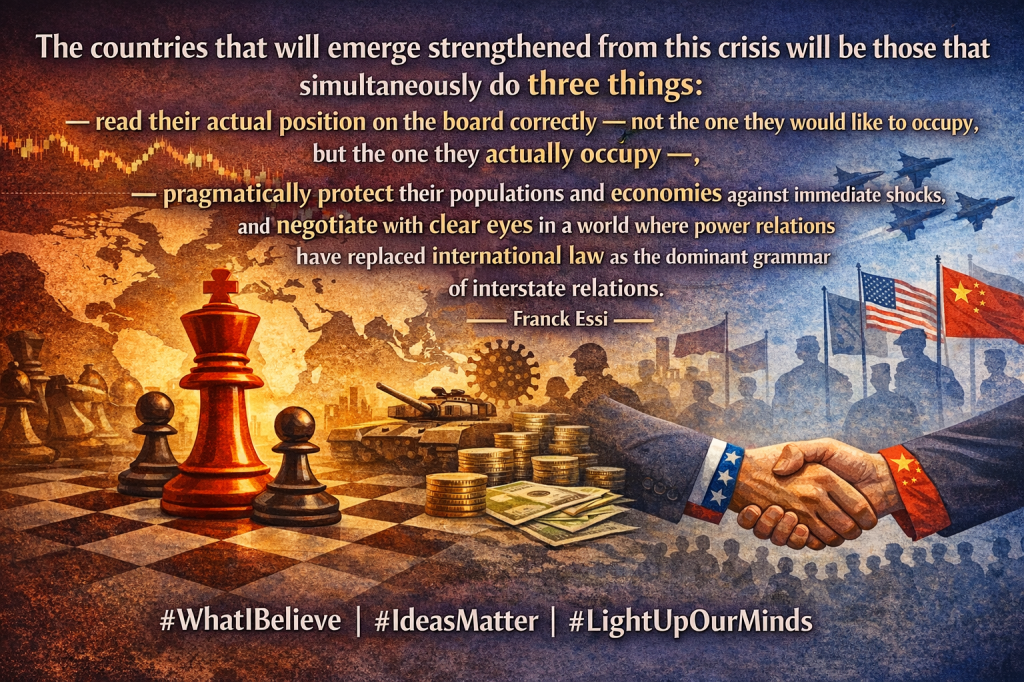
The countries that will emerge strengthened from this crisis will be those that simultaneously do three things: read their actual position on the board correctly — not the one they would like to occupy, but the one they actually occupy —, pragmatically protect their populations and economies against immediate shocks, and negotiate with clear eyes in a world where power relations have replaced international law as the dominant grammar of interstate relations.
Those who settle for deploring and declaring will emerge, once again, weakened. Those who use this crisis to lay the foundations of minimal coordination will have, for the first time, transformed an external shock into a lever for internal construction. It is by this difference that, in ten years, the quality of today’s African leadership will be measured.
Franck Essi
#WhatIBelieve | #IdeasMatter | #LightUpOurMinds
¹ African Business (2025). « Iran eyes AfCFTA integration at third Iran–Africa economic summit. » African Business Magazine, March 2025.
² Statement by Abbas Araghchi, Iranian Foreign Minister, Iran–Africa Summit, Tehran, 2024. Cited in: Iran Press Agency (2024). « Future of world trade will be determined in Africa, Iranian officials say. » IPA, October 2024.
³ BBC Monitoring (2024). « How Iran’s Hausa TV targets West African audiences. » BBC Monitoring, April 2024; Thurston, A. (2023). « Iran’s religious networks in sub-Saharan Africa. » Carnegie Endowment for International Peace, Working Paper.
⁴ Al-Monitor (2025). « Iran offers Africa cheaper alternatives to Western infrastructure deals. » Al-Monitor, January 2025.
⁵ International Crisis Group (2024). « The Sahel’s new security partnerships: Russia, Turkey, Iran. » ICG Report No. 315, July 2024.
⁶ Lebovich, A. (2025). « Iran and the Alliance of Sahel States: a new axis in the making? » ECFR Policy Brief, January 2025.
⁷ Reuters (2026). « Burkina Faso defence minister visits Tehran, discusses drones and refinery deal. » Reuters, 27 February 2026.
⁸ The Africa Report (2026). « Niger uranium deal with Iran: 300 metric tonnes for missiles. » The Africa Report, March 2026.
⁹ Le Monde Afrique (2026). « Des techniciens iraniens déployés au Mali pour les opérations de drones. » Le Monde Afrique, February 2026.
¹⁰ Agence de Presse Malienne (2026). « L’ambassadeur iranien reçu par le Premier ministre Maïga: vers une coopération confédérale. » APM, January 2026.
¹¹ Cotler-Wunsh, M. & Larémont, R. (2024). « Social media, panafricanism and anti-Western sentiment in the Sahel. » Journal of African Security, vol. 17, no. 2.
¹² ISS Africa (2026). « Iran weakened: strategic implications for the AES partnership. » ISS Today, March 2026.
¹³ US Department of State (2021). « Abraham Accords: Morocco and Sudan normalization agreements. » State Department Fact Sheet, January 2021; Tubiana, J. (2024). « Sudan’s Abraham Accords: a dead letter? » Crisis Group Commentary, August 2024.
¹⁴ African Union (2024). Decision on the withdrawal of Israel’s observer status. Doc. AU/COM/Dec.2024/02, February 2024.
¹⁵ International Court of Justice (2024). Application of the Convention on the Prevention and Punishment of the Crime of Genocide in the Gaza Strip (South Africa v. Israel). Order on provisional measures, 26 January 2024.
¹⁶ Walters, R. (1987). Pan Africanism in the African Diaspora. Wayne State University Press; Byrne, J. (2016). Mecca of Revolution: Algeria, Decolonization, and the Third World Order. Oxford University Press.
¹⁷ Transnational Institute (2024). « Sahelian pan-Africanism and the rejection of Israel normalization. » TNI Report, October 2024.
¹⁸ African National Congress (2026). Statement on US-Israeli strikes and Iranian conflict. Official communiqué, March 2026; Nathan, L. (2025). « South Africa’s foreign policy tradition: from anti-apartheid to international law. » South African Journal of International Affairs, vol. 32.
¹⁹ ISS Africa (2026). « South Africa on a tightrope: BRICS commitments versus Western commercial interests. » ISS Today, March 2026.
²⁰ Boukhars, A. (2024). « Morocco’s balancing act: Abraham Accords, Western Sahara, and the Gaza war. » Carnegie Middle East Center, Policy Brief.
²¹ ISS Africa (2026). Op. cit., note 12.
²² Fanta, E. et al. (2013). « Interdependence and conflict in African international relations. » African Affairs, vol. 112, no. 447.
²³ Cafiero, G. (2024). « Iran’s military diplomacy in Africa. » Middle East Institute, Policy Brief, September 2024.
²⁴ African Union (2026). Communiqué on the situation in the Middle East. March 2026.
²⁵ Essi, F. & Dodo, B. (2026). « Les impératifs stratégiques de l’Afrique face à la recomposition mondiale. » Blog Franck Essi, January 2026.
²⁶ Ibid.
²⁷ Ibid.
²⁸ International Energy Agency (2024). Oil Market Report, December 2024.
²⁹ Essi, F. (2026). « Guerre au Moyen-Orient: impacts potentiels sur le Cameroun et réponses possibles. » Blog Franck Essi, March 2026.
³⁰ UNCTAD (2024). Review of Maritime Transport 2024. Geneva: UNCTAD.
³¹ FAO (2024). The State of Food Security and Nutrition in the World. Rome: FAO.
³² UNCTAD (2024). Op. cit.
³³ Ibid.
³⁴ IMF (2025). Regional Economic Outlook: Sub-Saharan Africa. Washington: IMF.
³⁵ Ibid.
³⁶ Cafiero, G. (2024). Op. cit.
³⁷ ISS Africa (2026). Op. cit., note 12.
³⁸ US Department of the Treasury (2026). « OFAC sanctions against Iran: secondary sanctions advisory. » Press release, 25 February 2026.
³⁹ Ibid.
⁴⁰ ISS Africa (2026). « Expansionist risks under cover of global disorder. » ISS Policy Brief, March 2026.
⁴¹ EU Agency for Asylum (2026). Alert on potential migration flows from Iran. Communiqué, March 2026.
⁴² ISS Africa (2026). Op. cit., note 40.
⁴³ ISS Africa (2026). Op. cit., note 12.
⁴⁴ OPEC (2026). Production quota opening decision. Press release, March 2026.
⁴⁵ AfDB (2025). African Economic Outlook 2025. Abidjan: AfDB.
⁴⁶ Ibid.
⁴⁷ WFP & FAO (2026). Food Situation Bulletin — East Africa and Sahel. January 2026.
⁴⁸ ISS Africa (2026). Op. cit., note 19.
⁴⁹ ECOWAS (2026). Statement on the « serious repercussions on international stability and African economies. » Communiqué, 1 March 2026.
⁵⁰ AU (2026). Call for de-escalation and support for Omani mediation. Communiqué, March 2026.
⁵¹ ECOWAS (1999). Protocol Relating to the Mechanism for Conflict Prevention, Management, Resolution, Peace-Keeping and Security. Lomé; European Commission & ACP (2000). Cotonou Partnership Agreement. Cotonou.
⁵² Nathan, L. (2025). Op. cit.
⁵³ Transnational Institute (2024). Op. cit.
⁵⁴ Ibid.
 franckessi.com