By Franck Essi
—
There are moments in history when illusions fall all at once. We are living through one of those moments.
In less than two years, the world has watched the United States conduct Operation Absolute Resolve in Venezuela — bombing infrastructure, capturing Nicolás Maduro and transferring him to New York to stand trial.¹ ² ³ Together with Israel, they launched a massive air campaign against Iran that resulted in the assassination of Supreme Leader Ali Khamenei and much of the Iranian high command, without a United Nations Security Council mandate.⁴ ⁵ ⁶ In the same sweep, Washington withdrew from multilateral agreements, cut its contributions to several international institutions, and redefined its foreign policy around one openly stated principle: peace through strength.⁷ ⁸
This formula is not merely a slogan. It is a doctrine.
—
What « Peace Through Strength » Really Means
« Peace through strength » rests on a simple conviction: negotiations, multilateralism, and law are only worth something when backed by indisputable military and economic superiority. Without that superiority, rules are just paper. With it, you choose which ones you apply.⁷ ⁸
In this worldview, peace is no longer the product of a negotiated balance among sovereign nations. It is the product of domination by an actor powerful enough to impose its own terms. This logic runs through the entire history of American foreign policy since the Cold War. What Trump has done is strip it of its liberal veneer — removing the rhetoric of human rights and exported democracy to reveal the naked structure of raw power.⁷ ⁸
Meanwhile, neither Gaza, nor Ukraine, nor Taiwan, nor the African Great Lakes region has been stabilized by classical multilateral frameworks.⁴ ⁵ The UN produces resolutions. States ignore them or use them selectively. The institutions still exist, but their capacity to constrain the powerful is eroding in plain sight.
And above all, we are no longer in a simple Africa–West face-off. Two other powers now structure the game:
- Russia combines mercenaries, disinformation, and arms sales to prop up authoritarian African regimes in exchange for resources, military bases, and diplomatic votes.⁹ ¹⁰
- China links financing, infrastructure, and political support to governments with little regard for pluralism, under the banner of non-interference and South-South cooperation.¹⁰ ¹¹
Trump, Xi Jinping, Putin: three different faces of the same idea — power overrides rules, and rules serve power.⁹ ¹⁰
For us — Africa’s fighters for democracy and good governance — this shift is not a distant backdrop. It is the real terrain on which our struggles will now unfold. And that terrain has fundamentally changed in nature.
It is time to draw the lessons, plainly — and without comforting illusions.
—
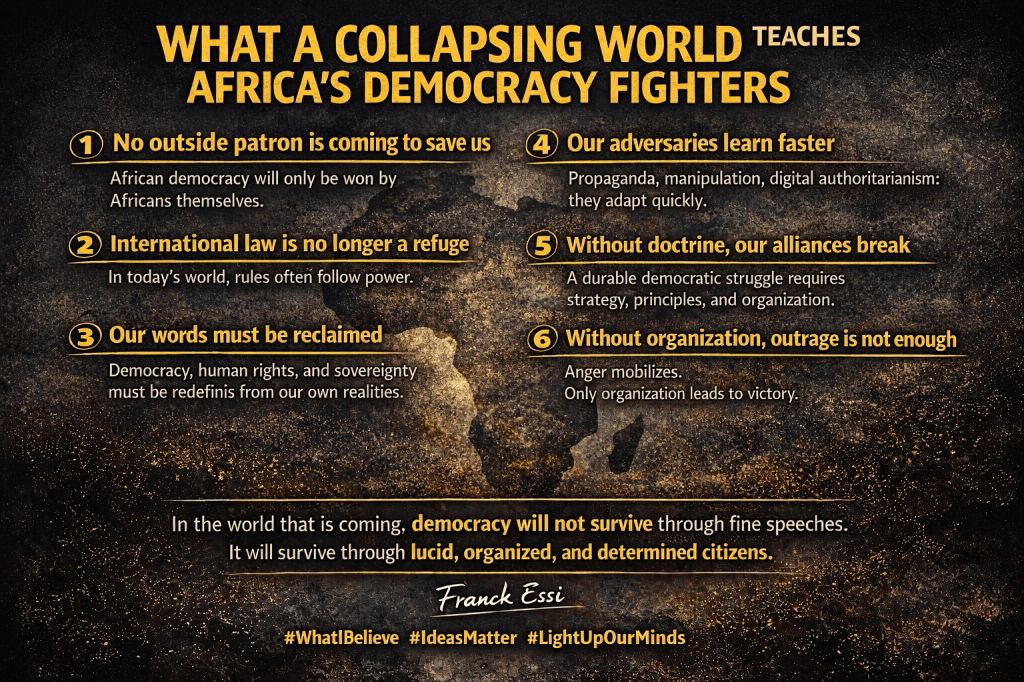
First Lesson: No Outside Patron Is Coming to Save Us
For thirty years, many of us have clung to a comfortable illusion: that sufficient international pressure — from Washington, Brussels, international financial institutions, major non-governmental organizations — would eventually force authoritarian regimes to back down.¹² ¹³
That illusion was already questionable. It is now dangerous.
A power that organizes the world around « peace through strength » has no structural reason to fight for the political rights of populations living in states that carry no weight in its strategic calculus.⁷ ⁸ Washington has never been a disinterested promoter of democracy: it backed Mobutu, Ben Ali, Mubarak, Biya whenever its interests demanded it. What is new is that it no longer even bothers to maintain the facade. Democratic conditionalities are disappearing from cooperation agreements. Sermons on the rule of law ring hollow. Transaction has replaced principle.
We would be equally naive to believe that Russia or China offer us a better alternative. Replacing one patron with another does not change the logic: none of these capitals prioritizes the political freedom of Africans — only the stability of its allies and access to resources, markets, and diplomatic support.⁹ ¹⁰
This does not mean we have no allies left. It means that no one will fight in our place. Durable political transformations are born from within, or they are not born at all.
Appeals to the « international community » are not useless. They serve a purpose:
- Documenting violations and building archives of repression.
- Publicly shaming failing regimes.
- Creating symbolic and diplomatic costs for those in power.
But they cannot replace our internal organization, the construction of an internal balance of forces, or the patient work of building social coalitions. If our strategy rests on an imaginary outside patron, we have already lost.
—
Second Lesson: International Law Is a Battlefield, Not a Refuge
Normative multilateralism is giving way to a selective multilateralism in which rules apply fully only to the weakest, while powerful states opt out the moment it suits their interests.¹⁴ ¹⁵
The American-Israeli strikes on Iran were conducted without a Security Council mandate. The operation against Maduro was a frontal violation of Venezuelan sovereignty.¹ ² ⁴ ⁵ Courts condemn, reports accumulate, but no force comes to enforce the decisions. Sanctions exist only for those who cannot refuse them.
This is not a reason for us to abandon the legal terrain. It is a reason to fight on it differently.
The International Criminal Court has prosecuted African heads of state while remaining largely silent on crimes committed by powers holding veto rights or wielding massive economic weight.¹³ ¹⁵ This asymmetry is real, it is scandalous, and we must denounce it. But if, in the name of this injustice, we reject all international norms wholesale as mere instruments of domination, we hand our own authoritarian regimes the perfect argument to escape any accountability.
Our posture must be more demanding. It rests on three simultaneous axes:
- Defending certain principles as goods in themselves — the prohibition of torture, enforced disappearances, mass crimes — regardless of any geopolitical calculation.
- Using every remaining opening in the international architecture: African regional courts, UN human rights mechanisms, special procedures, strategic litigation.¹³ ¹⁵
- Denouncing without letup the political selectivity with which these norms are applied — naming those responsible and the asymmetries involved.
This is not naivety. It is tactics — and it is coherence: you cannot defend human dignity while abandoning the rare, imperfect instruments that still make it possible to protect it, at least a little.
—
Third Lesson: Our Own Words Have Become Minefields
A less visible attack than physical repression strikes us directly: the attack on the very concepts we defend.
Democracy, human rights, multilateralism have suffered a fourfold degradation:
- Instrumentalized by Western powers that invoke them selectively according to strategic interest.⁷ ⁸
- Discredited by interventions that sowed lasting chaos in Iraq, Libya, and Syria in the name of those same values.
- Rhetorically hijacked by authoritarian African regimes to denounce external interference, while violating these principles daily.
- Repeated mechanically by some of us, without the effort of grounding them in the lived realities of our populations.
The result is an intellectual and political disaster: a growing part of African public opinion — especially younger generations — now associates democracy with instability, human rights with Western hypocrisy, and multilateralism with a system of control dressed up as cooperation.¹³ ¹⁵ This confusion was manufactured. It is not an innocent misunderstanding. And we bear part of the responsibility for this erosion, every time we repeated these words without filling them with concrete meaning for the societies in which we live.
We must therefore redefine them from our own African realities:
- Democracy does not mean abstract elections organized under international pressure. For a farmer in the Noun Division, a trader in Douala, a female head of household in Ouagadougou, it means above all: real accounts of how public money is spent, basic services that actually work, institutions that protect against arbitrary power, justice that is not for sale, a free press that speaks to ordinary people’s lives.
- Human rights cannot be reduced to civil and political liberties — as fundamental as these are. They include access to education, healthcare, decent work, and protection against predation by state agents.¹² ¹³ A conception of human rights that ignores the material conditions of existence of our populations will always be suspected of being a luxury reserved for disconnected intellectuals.
- Multilateralism can no longer be defended in its current form, which is deeply unequal. We must claim it in a reformed version — one in which African states carry real weight in decisions on international financial governance, collective security, and global commons: climate, digital, and health.¹⁴ ¹⁵
If we do not do this work of reappropriation, we cede the ground to two symmetrical enemies: local authoritarian regimes that dismiss these concepts as neocolonial imports, and foreign powers that continue to hollow them out for their own purposes. Our democracy does not need to be validated by Washington or Brussels to be legitimate. It must be desired and defined by those who live it.
—
Fourth Lesson: Our Adversaries Are Learning Faster Than We Are
Over the past decade, African authoritarian regimes have become significantly more sophisticated.
The military regimes of the Sahel — in Mali, Burkina Faso, and Niger — have grasped something fundamental: in the age of « peace through strength, » whoever controls the narrative of sovereignty controls the political debate.⁹ ¹⁶ By presenting themselves as defenders of national independence against foreign tutelage, they tap into legitimate anger — against foreign military bases, externally controlled currency, and the corruption of civilian governments long shielded by Western powers.
Their operational playbook in the information space follows a now-familiar sequence:
- Before arresting an opponent, publicly tarnish and morally disqualify them.
- Before shutting down a media outlet, drown it in disinformation until it becomes unreadable.
- Before repressing, construct an imaginary in which any criticism becomes treason against the homeland.
They are also learning from illiberal great powers: digital surveillance, platform control, targeted use of violence to terrorize without causing too much scandal.⁹ ¹⁰
This rhetorical reversal is devastatingly effective against us. It will only be dismantled if we are capable of clearly separating two things our adversaries deliberately conflate: national sovereignty, which must be defended, and internal authoritarianism, which must be fought. These are distinct questions — and blurring them is precisely their strategy.
We must therefore anticipate, document, and counter-narrate. This requires concrete investment:
- Real competencies in political communication and counter-narrative production.
- Structured monitoring of social networks and media ecosystems.
- The capacity to respond to sovereigntist discourses by acknowledging the legitimate grievances they mobilize, while exposing the authoritarian project they serve.
We must become as professional in the defense of freedom as our adversaries are in the organization of servitude.
—
Fifth Lesson: Without a Doctrine, Our Alliances Will Break
No African country in isolation can carry durable weight in the world that is coming. Neither can any of our movements, if they remain isolated.
Fragmentation is our structural problem, and it operates at three simultaneous levels:
- Between African states and rival regional blocs, incapable of building common positions on major geopolitical questions.
- Within our societies, along the ethnic, regional, religious, or linguistic fault lines that our adversaries know how to activate at will.
- Within our own camp: between civil society organizations and political parties, between generations, between resource-endowed activists and precarious militants who bear the heaviest risks.¹² ¹⁷
Our adversaries govern through polarization: they cultivate identity fractures, fuel rumors, finance puppet opposition movements, and infiltrate what they cannot yet openly crush.
We have too often responded to this strategy with a rhetoric: « we must unite. » But unity proclaimed without institutional architecture is a posture, not a project.
What the moment demands of us is a doctrine — not a rigid ideology, but a set of operational principles that answer concrete questions¹³ ¹⁷:
- What is our position on civil disobedience — its forms and its limits?
- How do we manage our leadership conflicts, generational divides, and diverging agendas? Who arbitrates, according to what rules we have all agreed to?
- What funding do we accept, under what conditions, with what transparency toward our social base?
- How do we link our critique of ruling regimes to the production of credible programmatic alternatives on economics, security, justice, decentralization, and the role of the military?
- How do we position ourselves toward major powers — Western and non-Western alike — without naivety or servile alignment?
This doctrine will not come from donors, foreign think tanks, or consultants. It can only be born from our own intellectual and organizational work — carried out by actors rooted in their societies, capable of confronting their disagreements without destroying one another. Three building sites are essential for any serious movement among us:
- A doctrinal building site: redefining democracy, rights, and sovereignty from concrete African experience.
- An organizational building site: constructing a living territorial network and materially protecting our activists and their families.
- A strategic building site: rethinking our relationships with state apparatuses — the military, administration, judiciary — and with external powers.
—
Sixth Lesson: Our Endurance Is First and Foremost a Question of Organization
In a world where brute force is openly proclaimed, our emotional mobilizations — as legitimate as they are — are not enough.
Our own continent already offers us both scenarios. In Senegal in 2024, the attempt to unilaterally postpone the presidential election was thwarted by a rare combination: long-established civil organizations, networks like Aar Sunu Election, mobilized lawyers, independent media, and a tradition of civic engagement built over decades.¹⁸ ¹⁹ ²⁰ Senegalese society did not save its democracy by miracle — it did so through accumulated organizational capital. Elsewhere, massive mobilizations have been crushed or hijacked by forces even more authoritarian than those they sought to combat, for lack of infrastructures capable of converting anger into durable political power.¹⁴ ¹⁵
Outrage mobilizes us. Only organization makes us last.
Our endurance rests on concrete choices, too often deferred to « later »:
- Politically training our members and supporters, even without an electoral deadline in sight.
- Building a territorial network that lives outside of crisis periods and mobilization cycles.
- Establishing protection mechanisms — legal, material, social — for our activists and the families exposed to repression.
- Diversifying our financial resources to reduce dependence on donor funding lines whose agendas do not always align with ours.¹² ¹⁷
- Preparing concrete reform programs so we are not caught off guard if a political transition window opens.
These three building sites — doctrinal, organizational, strategic — are not luxuries. They are the minimum conditions for survival for any movement that claims to exist beyond one electoral cycle or one wave of protests.
—
What This Brutal World Demands of Us
We are not living through an orderly transition between an old and a new order. We are in an era of discontinuity: discontinuity of norms, alliances, value chains, and dominant narratives.¹⁴ ¹⁵
In a world where « peace through strength » is openly embraced by the world’s leading power, we must avoid two symmetrical traps:
- Realist capitulation: imitating the methods of our adversaries in the name of effectiveness, gradually sliding toward authoritarian postures.
- Moral incantation: repeating principles without strategy, without a balance of forces, without organization — consoling ourselves with fine words in the face of defeat.
Our adversaries — whether their names are Trump, Putin, Xi Jinping, Netanyahu, or whether they lead military regimes on the African continent — share three things: a doctrine of power, however contestable; organizations capable of executing that doctrine; and a strategic patience that we, their democratic opponents, match far too rarely.⁹ ¹⁰
Our response cannot be permanent improvisation, nor the indignant commentary on others’ crimes. It must be, like theirs, organized, equipped, and doctrinally grounded — carried by women and men who understand that in the world of 2026, defending democracy is not an act of abstract faith. It is a political act that demands competence, lucidity, discipline, and duration.
We still have a window of opportunity. It is narrow. It will not stay open indefinitely.
Franck Essi
#WhatIBelieve
#IdeasMatter
#LightUpOurMinds
References
¹ 2026 United States intervention in Venezuela. Wikipedia. https://en.wikipedia.org/wiki/2026_United_States_intervention_in_Venezuela
² 2026 United States strikes in Venezuela. Wikipedia. https://en.wikipedia.org/wiki/2026_United_States_strikes_in_Venezuela
³ « Spies, drones and blowtorches: How the US captured Maduro. » BBC News. https://www.bbc.com/news/articles/cdred61epg4o
⁴ 2026 Israeli–United States strikes on Iran. Wikipedia. https://en.wikipedia.org/wiki/2026_Israeli%E2%80%93United_States_strikes_on_Iran
⁵ 2026 Iran war. Wikipedia. https://en.wikipedia.org/wiki/2026_Iran_war
⁶ « What we know about the US-Israeli attack on Iran and Tehran’s retaliation. » CNN, February 28, 2026. https://www.cnn.com/2026/02/28/middleeast/israel-attack-iran-intl-hnk
⁷ « The US capture of President Nicolás Maduro — and attacks on Venezuela — have no justification. » Chatham House, 2026. https://www.chathamhouse.org/2026/01/us-capture-president-nicolas-maduro-and-attacks-venezuela-have-no-justification
⁸ « Making sense of the US military operation in Venezuela. » Brookings Institution, 2026. https://www.brookings.edu/articles/making-sense-of-the-us-military-operation-in-venezuela/
⁹ « Russia in Africa. » Africa Center for Strategic Studies. https://africacenter.org/in-focus/russia-in-africa/
¹⁰ « The New Scramble for Africa: How Russia and China are reshaping the continent. » Defense.info. https://defense.info/highlight-of-the-week/the-new-scramble-for-africa-how-russia-and-china-are-reshaping-the-continent/
¹¹ « Africa-China Relations and the Future of Democracy on the Continent. » YouTube. https://www.youtube.com/watch?v=eBfnI_0OQ34
¹² Civil Society and Democratic Consolidation in Africa. African Journal of Democracy and Accountability, 2024. https://afea-jad.com/article/civil-society-and-democratic-consolidation-in-africa-13/
¹³ Civil Society and Democratic Consolidation in Africa [PDF]. African Journal of Democracy and Accountability, 2024. https://afea-jad.com/article/download/pdf/13/
¹⁴ Rethinking Strategies for a Peaceful, Secure, and Resilient Africa [PDF]. Foresight Africa 2026, Brookings Institution, January 2026. https://www.brookings.edu/wp-content/uploads/2026/01/Foresight-Africa-2026-CHAPTER-4.pdf
¹⁵ « Prospects for democratic resilience in Africa during uncertain times. » CGIAR, 2025. https://cgspace.cgiar.org/items/70f0af34-d5a9-4d42-9b6c-6e3bd67ba874
¹⁶ Democratic Resilience and Civil Society Responses to Military Rule in Africa [PDF]. Spring Journals, 2025. https://springjournals.net/articles/pdf/619611072025
¹⁷ Governance in Southern Africa: Insights from Civil Society. SAIIA, 2025. https://saiia.org.za/wp-content/uploads/2025/10/SAIIA_SR_GovernanceCivilSociety.pdf
¹⁸ « After a Senegalese Constitutional Crisis, Civil Society Leads the Way. » National Democratic Institute, 2024. https://www.ndi.org/our-stories/after-senegalese-constitutional-crisis-civil-society-leads-way
¹⁹ « Senegal’s elections were a triumph for democracy — what went right. » The Conversation, 2024. https://theconversation.com/senegals-elections-were-a-triumph-for-democracy-what-went-right-243488
²⁰ « Senegal: From Constitutional Crisis to Democratic Restoration. » Carnegie Endowment for International Peace, April 2024. https://carnegieendowment.org/research/2024/04/senegal-from-constitutional-crisis-to-democratic-restoration
 franckessi.com