By Franck Essi
—
It is 11:14 PM. Somewhere in Yaoundé, a man I know well — let us simply call him the man of the night — is lying on his bed, phone in hand. He is not sleepy. Or rather, he is sleepy, but something is keeping him awake. He scrolls. A war somewhere. A famine elsewhere. One president insulting another. Death tolls presented like sports scores. A video he should not have watched but watched to the end, breathless. He puts down the phone. Picks it up again thirty seconds later. Puts it down again. Past midnight, he finally falls asleep — not at peace, but exhausted. Emptied. Like after a fight he can no longer quite remember getting into.
That man is me. That man is you. That man is almost everyone, today, in this century that has given us access to everything and the peace of nothing.
—
Has the World Actually Gotten Worse — or Have We Simply Lost Our Distance?
Let us be honest with ourselves before being honest about the world: human history has never been a quiet, peaceful river. Wars, famines, tyrannies, epidemics, the collapse of empires — all of this existed long before our smartphones and our news feeds. What has radically changed is not the world’s cruelty. It is our permanent, unfiltered exposure to that cruelty. We are now summoned to every planetary catastrophe, in real time, without preparation, without distance, without anyone asking whether we are psychologically ready to receive what we are about to see.
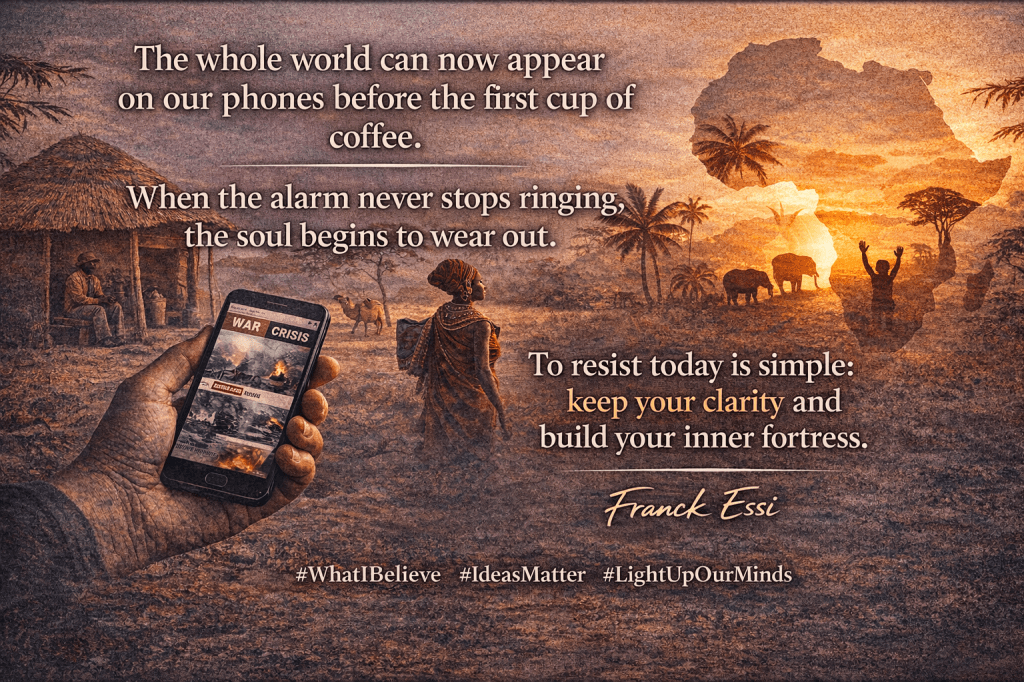
The generations before us also lived through turbulent times — world wars, colonisation, independence wrested from the grip of violence. But their pain had a geography. It had borders. It left them breathing spaces, pockets of shadow where ordinary life could continue to exist. Today, there are no more pockets of shadow. The suffering of the entire world arrives in our bedroom, between waking and the first coffee, without knocking.
This is not trivial. This is not neutral. And it is certainly not without consequences for who we become.
—
What Screens Do to Our Brains Without Asking Permission
Neuroscience is unambiguous: our brains are biologically programmed to assign more weight to bad news than to good. Specialists call this the negativity bias. It is an evolutionary inheritance — the prehistoric man who ignored the suspicious rustling in the tall grass generally did not survive long. This reflex of vigilance kept us alive for millennia.
But that same brain, designed to detect a predator on the savanna, now finds itself simultaneously processing bombardments in Eastern Europe, an institutional crisis in Kinshasa, an absurd controversy on social media, and the latest inflammatory outburst from some head of state. It can no longer tell the difference between a real danger and a mediated one. It sounds the alarm for everything. And when the alarm sounds permanently, the entire soul begins to wear down — like an engine left running at full throttle with the ignition never turned off.
Doomscrolling — that compulsive and apparently irresistible scrolling through bad news — is not merely another bad habit. It is a neurological loop, carefully exploited: bad news stimulates our amygdala, releases cortisol, creates an inner tension that seeks resolution. But the resolution never comes — because the world does not repair itself between two scrolls. So we keep descending, descending further, in the unconscious hope of finding a reassuring bottom. There is no bottom. And the engineers who designed these platforms know this better than anyone.
—
A Business Model Built on Our Anxiety
Here is what must be said clearly, and said with names attached: this is not an accident. It is not an unfortunate side effect of an otherwise beneficial technology. It is a documented, deliberate, fully assumed design choice.
The platforms — Meta, TikTok, X, YouTube — built their engagement architectures around a simple principle: negative emotions generate more interactions than positive ones. Anger shares more than joy. Outrage comments more than admiration. Fear returns faster than serenity. Their algorithms were trained to amplify precisely these emotions — not despite the harm this causes, but in full knowledge of it. Internal whistleblowers from Facebook, Google, and Twitter said as much under oath before parliamentary committees. Internal documents — the Facebook Papers, the Twitter Files — established it in black and white. This is not a conspiracy theory. It is the attention economy, described with precision by its own architects.
The more afraid we are, the more we come back to check. The more we come back to check, the more advertising they sell. The more advertising they sell, the more resources they have to refine the algorithms that keep us afraid. It is a loop. It is a system. And as long as the rules of the game do not change — serious regulation, legal accountability for platforms regarding documented psychological harm, alternative economic models — this system will continue to function exactly as it was designed to function, regardless of our individual goodwill.
But I will return to this.
—
The World We Are Not Shown
What we are not shown is the immense, silent expanse of ordinary good being made every day, everywhere, without cameras and without hashtags. While a war occupies every screen, millions of teachers walk into their classrooms and change destinies. Doctors operate through the night in hospitals no one films. Mothers raise brilliant children alone in neighbourhoods that news channels drive through without ever stopping. Young people invent, build, plant, repair — in silence, without Breaking News, without an international platform.
That world exists. It is, if we are honest with ourselves, the overwhelming majority of what is. It is simply unsellable — because it does not raise cortisol levels, does not provoke reflexive outrage, does not drive compulsive sharing. Reconciliation does not trend. Tenderness does not feed the algorithm. The slow, patient rebuilding of a dignified life has never interrupted a primetime broadcast.
Refusing to confuse the media stream with the totality of the real — that is the first act of intellectual resistance we can all make, tonight, before turning off the light.
—
Building Our Inner Fortress — Without Pretending It Is Enough
I will now say something that may seem to contradict everything that came before — but which is not a contradiction at all: we must build our inner fortress. We truly must. And I say this knowing full well that this fortress will not regulate Meta, will not write the laws that are missing, will not change TikTok’s source code.
I say it because systemic resistance always begins in an individual who has decided not to be swept away. Because one does not change the world from a state of drowning. Because Marcus Aurelius was not reforming Rome from his private journal — but it was that journal that allowed him to keep governing without losing his mind. The inner fortress is not a solution. It is a precondition for working toward real solutions. That is not the same thing.
It is built stone by stone, over time, through daily choices that are often invisible. It is the choice to begin each morning with a thought that belongs to us — rather than with the latest catastrophe the algorithm selected during the night. It is the discipline of reading, thinking, engaging with ideas that broaden our world rather than shrinking it to the size of a notification. It is the practice of silence — meditation, prayer, contemplation, or simply being present without doing anything — that allows the soul to find itself again before facing the noise outside. It is the cultivation of real, deep relationships, stripped of the noise.
This fortress, once carefully built, does not make us indifferent to the world. It makes us stable in the face of it. It is the difference between the deep-rooted tree that bends in the storm without breaking, and the dead leaf the first wind carries away without resistance.
—
Anchoring Ourselves in the Living
The great African traditions have something to tell us here. Ubuntu — I am because we are — is not merely a beautiful philosophy of communal solidarity. It is a technique of psychological survival of formidable effectiveness: anchoring our existence in real relationships, in a concrete collective project, in the living warmth of a human community that reminds us each day that we are not alone facing the chaos of the world.
When the virtual world crushes us with its weight, the real world restores our proper scale. A real conversation — not an exchange of messages, a real conversation, with a voice and eyes. A service rendered to someone who needed it. A shared meal. A child laughing for no reason. These simple things carry a power that digital platforms will never replace — that of reminding us that life, real life, is not up there in the cloud. It is here. It is now.
And then there is the project. Having something we get up for — something sufficiently alive, sufficiently loved, to function as a gravitational anchor when everything wavers. Not necessarily something grandiose. But something that stretches us a little, that pulls us forward, that gives our days a direction and our existence a meaning no one can take from us.
—
Holding Our Course — and Demanding That the Rules Change
There is an image that comes back to me often. That of the sailor on a stormy sea. The storm does not ask his opinion. The waves do not stop because he is exhausted. But the good sailor does not spend his time cursing the sea. He trims his sails. He holds his course. And it is that course — that clarity about meaning and destination — that makes all the difference between the one who sinks and the one who reaches port.
But here is what that image does not say, and what must be added without hesitation: a reasonable sailor, returning to port after the storm, also demands that weather forecasting systems be improved, that lighthouses be reinforced, that maritime traffic be regulated. He does not content himself with perfecting his sailing technique in the hope that the sea will become more clement on its own. He knows that certain dangers cannot be overcome individually — they are reduced collectively, politically, institutionally.
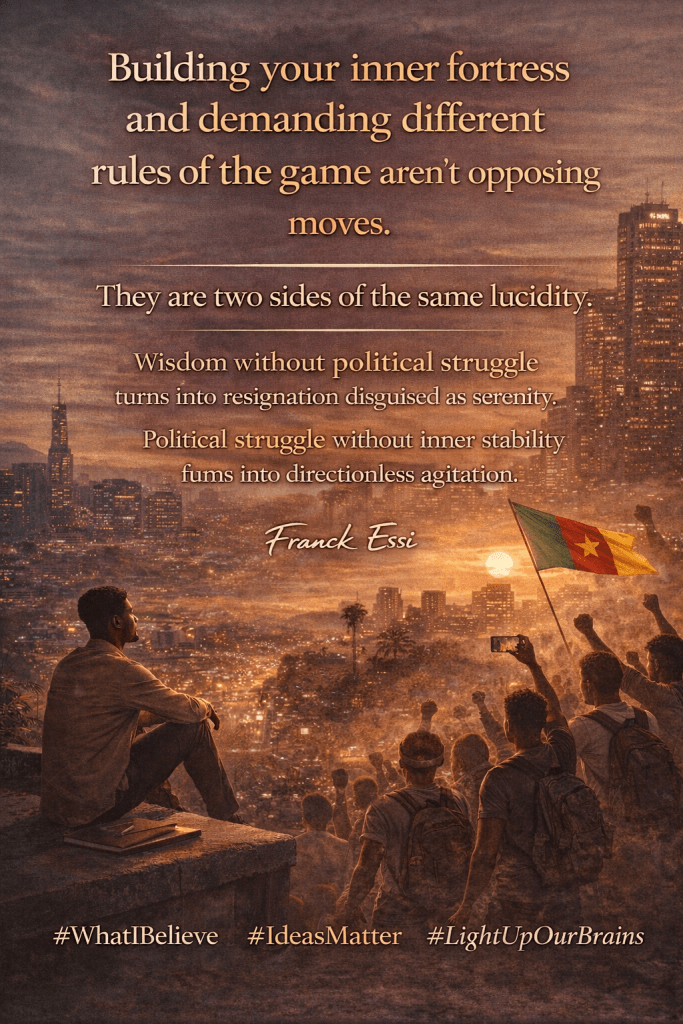
Building one’s inner fortress and demanding different rules of the game are not two opposing gestures. They are the two faces of a single lucidity. One without the other is incomplete. Wisdom without political struggle becomes resignation dressed as serenity. Political struggle without inner stability becomes agitation without direction.
So yes — let us trim our sails. Let us hold our course. Let us keep our fortress standing.
And let us name, together, with precision and without restraint, the architects of the system that makes this fortress necessary. Let us demand that they be held accountable. Let us support those who are working to change the rules. Let us educate our children to understand what is at stake when they open an application.
The rest is the sea — and the sea did not choose to be dangerous.
Certain storms did.
Franck Essi
An African from Cameroon
#WhatIBelieve
#IdeasMatter
#LightUpOurMinds
 franckessi.com