March 15, 1966 – March 15, 2026: 60 Years Already
By Franck Essi
—
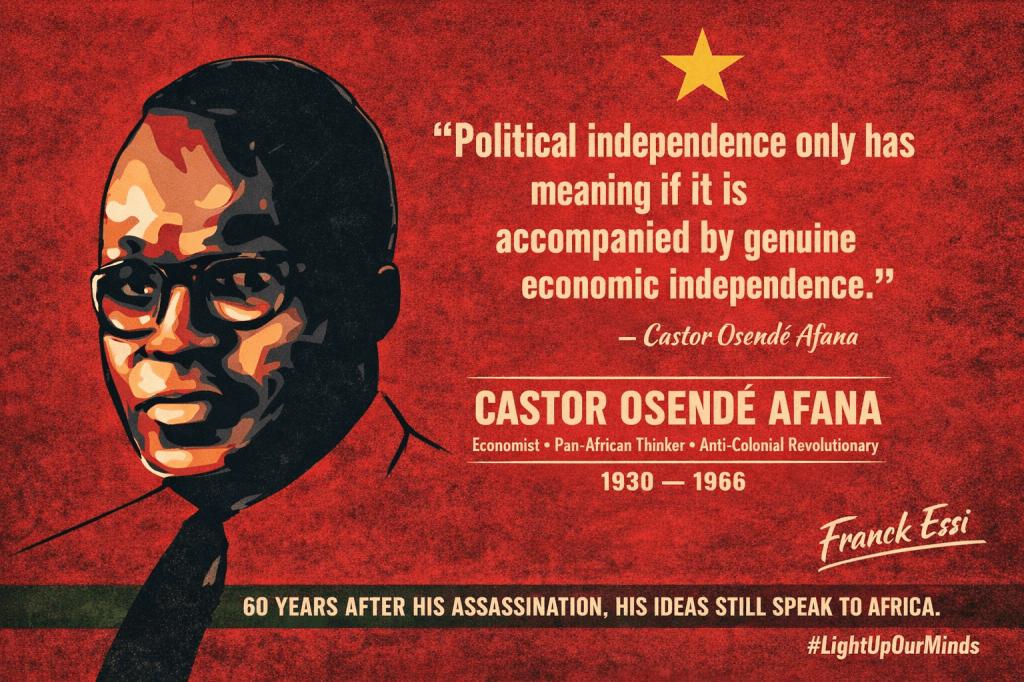
Sixty years ago today, the Cameroonian state had Castor Osendé Afana shot and beheaded in the forest of Moloundou. He was 36 years old. His head was brought to Yaoundé to prove his death to President Ahidjo. Sixty years later, his body has still not been laid to rest in an official, recognized grave.
This text is not merely a tribute. It is a demonstration: Osendé Afana was right about the essentials — and that is precisely why he was eliminated. The blind spots in his thinking exist, and we will examine them honestly. But they do not diminish the lucidity of his structural diagnosis of African economies — a diagnosis that sixty years of reality have confirmed point by point.
—
1. A Man, a Trajectory
Castor Osendé Afana was born in 1930 in Ngoksa, in the Lékié department — the sixth of twelve children, son of Dominique Afana and Martine Mpesse. His deeply devout parents enrolled him from school age at the Catholic private school of Ngoksa, then at that of Nkol Mebanga. He successfully passed the entrance examination to the minor seminary of Efok in 1940, continued at the minor seminaries of Otelé and then Akono, and finally reached the grand seminary of Mvolyé in 1949 — where he wore the black cassock of the sub-deacon order.
In 1950, he was expelled from Mvolyé for publicly denouncing the mistreatment of African students by the colonists. He enrolled in a philosophy class at the Lycée Leclerc in Yaoundé, from which he was also expelled in 1952 for leading a student demonstration against living conditions in the dormitory. He sat the baccalaureate as an independent candidate — passing it the same year — and won a scholarship to study in France.
In France, his academic journey was exceptional. He obtained his degree in law and economics in 1955, his postgraduate diploma in 1956, and defended his doctoral thesis in economics — becoming the first African from francophone sub-Saharan Africa to hold that distinction. His thesis would be published by Éditions Maspero in March 1966, the very month of his assassination.
But his intellectual and political journeys were inseparable. As early as 1954, he joined the Association of Cameroonian Students in France, then the Federation of Black African Students in France (Fédération des Étudiants d’Afrique Noire en France — FEANF), of which he became 1st vice-president in 1956 and editor of L’Étudiant d’Afrique Noire. It was in these circles that he met men who would become major figures in postcolonial Africa: the Guinean Alpha Condé, the Congolese Pascal Lissouba and Ambroise Noumazalaye, the Ivorian Henri Konan Bédié, and the Cameroonian mathematician Henri Hogbe Nlend. The generation that would take the destiny of the continent into its hands was forming there, in the political debates of France in the 1950s. Afana would make a different choice from most of them.
In February 1957, he was sent to the United Nations as a delegate to demand the reunification and independence of Cameroon. The response was immediate: André Marie Mbida, then Prime Minister, had his scholarship revoked. This detail reveals the mechanics of colonial power under formal decolonization: one does not answer the argument — one cuts the funding of the person who makes it.
In 1958, he left France for Egypt and joined the leadership of the Union of the Peoples of Cameroon (Union des Populations du Cameroun — UPC) in exile. Following the assassination of Ruben Um Nyobè on September 13, 1958, he formed with Félix Roland Moumié, Ernest Ouandié and Abel Kingué the four-person leadership of the movement. He was appointed UPC representative at the permanent secretariat of the Afro-Asian Peoples’ Solidarity Organization (Organisation de Solidarité des Peuples Afro-Asiatiques — OSPAA) in Cairo, and served as a technical advisor to Gamal Abdel Nasser.
In 1965, he settled in Brazzaville and prepared to open a guerrilla front in eastern Cameroon. On September 1, 1965, he entered the southeastern forest at the head of a detachment of thirteen fighters. Their mission was not solely military: it was also to politically educate local populations and rebuild a revolutionary base. He would be killed six months later.
He was thirty-six years old. His life companion and fellow fighter, Mballa Élisabeth, gave him four children: Joseph Osendé, Alice Ngaska Osendé, Um Nyobè Osendé and Moumié Osendé. The names of the last two are themselves a political programme.
—
2. A Diagnosis Nobody Wanted to Hear
The argument Osendé Afana develops in his thesis is of relentless coherence.
African economies rest on export monoculture — cocoa, coffee, groundnuts — which makes them structurally dependent on world prices set elsewhere. This commercial dependence is compounded by monetary dependence: the franc of the African Financial Community (franc de la Communauté Financière Africaine — CFA franc) is not a currency of sovereignty but a mechanism allowing France to access African foreign exchange reserves and maintain structural control over the economies of its former colonies. To this is added what he calls the « illusions of external aid »: foreign capital and development aid do not create autonomy — they defer it, reproducing circuits of dependence in different forms.
His conclusion is inescapable: there can be no political independence without economic and monetary sovereignty. Industrialization, productive diversification, planning and the break with neo-colonial structures are not options — they are preconditions. And he warns with equal clarity against regimes that co-opt socialist vocabulary to dress up state capitalism in the service of the same interests:
« The popular masses will not be long in realizing through their own experience that state capitalism worsens their living conditions, despite the conquest of political independence and recourse to socialist slogans. »
These lines describe with striking precision what several decades of so-called progressive African regimes would go on to confirm.
We must, however, honestly acknowledge the limits of his thinking. The preface to the Maspero reprint notes this itself: his model remains too heavily marked by a priority given to heavy industry, and too little attentive to the dangers of an accumulation resting on the excessive drainage of the peasant surplus. His refusal of any state capitalism — even when implemented by progressive regimes — sometimes placed him at odds with the real political constraints faced by young African states. These limitations do not diminish the value of his work. They simply remind us that all strategic thinking is embedded in a particular historical context — and that a thinker who is wrong on certain points can still be right on the essentials.
—
3. A Pioneering Thinker: The Intellectual Lineage on the Monetary Question
What Osendé Afana established constitutes the founding act of a Cameroonian and African current of economic thought that has never ceased to confirm, deepen and amplify his diagnosis.
The first to take up and systematize this torch was Joseph Tchundjang Pouemi. Als Cameroonian, the country’s first economics agrégé in 1971, he published in 1980 his masterwork: Money, Servitude and Freedom — The Monetary Repression of Africa (Monnaie, Servitude et Liberté — La répression monétaire de l’Afrique). His verdict is unsparing: « France is the only country in the world to have achieved the extraordinary feat of circulating its currency, and nothing but its currency, in politically free countries. » What Tchundjang Pouemi calls the « self-repressing currency » is the rigorous theoretical formalization of what Osendé Afana had intuited twenty years earlier. Both works, published by Maspero in Paris, form an intellectual continuity that African economists have not yet fully measured. Tchundjang Pouemi would disappear in December 1984: within eighteen years, Cameroon had lost its two most lucid minds on the monetary question.
Nicolas Agbohou, a Beninese economist, then deepened the geopolitical dimension of the CFA franc: there can be no genuine development without monetary sovereignty — a direct reformulation of Afana’s thesis.
Hubert Kamgang, a Cameroonian economist and politician who died in 2020, extended this lineage. « The CFA franc was created by France on December 26, 1945 to exploit the colonies. The African states that still use it are nevertheless supposed to have acquired the status of independent sovereign states since 1960 », he declared — repeating, sixty years on, the exact thinking of Osendé Afana.
Célestin Monga, a world-renowned Cameroonian economist, former vice-president of the African Development Bank (ADB) and professor at Harvard, explicitly pointed to « the weak appropriation of endogenous economic thought, which is nonetheless rich in the writings of pioneers such as Osendé Afana and Tchundjang Pouemi », deploring that Cameroonian decision-makers ignore their own intellectual heritage.
Kako Nubukpo, a Togolese economist and former minister, coordinated in 2016 the collective volume Taking Africa Out of Monetary Servitude — Who Benefits from the CFA Franc? (Sortir l’Afrique de la servitude monétaire — À qui profite le franc CFA ?), which synthesizes for the contemporary generation the arguments that Afana had pioneered six decades earlier. In October 2025, Senegalese Prime Minister Ousmane Sonko was still declaring that « without monetary sovereignty, there will be no stability, no development, no industrialization ».
This lineage reveals a bitter truth: the questions Osendé Afana raised have still not received a political response equal to their urgency. Each generation rediscovers the problem, reformulates it, deepens it — and runs into the same resistance.
—
4. Who Killed Osendé Afana? What We Know, What Remains in the Shadows
The question deserves to be raised by name — and with rigor, for the full truth remains to this day incomplete.
What is known with certainty: on March 15, 1966 at 10:30 a.m., Osendé Afana and his companion Wamba Louis fell into an ambush laid by Cameroonian armed forces, 11 kilometers from the Congolese border. The soldiers shot them and then beheaded them. Only François Fosso, a Second World War veteran and the group’s military guide, survived by hiding behind a banana tree, gravely wounded in the leg. His testimony, recorded in a report sent to the UPC’s Brazzaville representation in 1966, remains the primary document on the circumstances of the death.
The two heads were transported to the hospital of the village of Nguilili, in the Moloundou subdivision. The nurse Boubas Joseph was instructed to preserve only Osendé Afana’s head — not Wamba’s — in formaldehyde before transport. The heads were put on display in front of the gendarmerie office: a lit cigarette was placed between Osendé Afana’s lips, a gesture of posthumous humiliation. His head was then airlifted by helicopter to Yaoundé. Ahidjo’s orders had been unambiguous: bring Osendé Afana back dead or alive.
What remains uncertain: the maquis was formally located as early as February 1966. How? Everything suggests, as the book by Mbeng Dang and Tchudjing indicates, that there was an act of betrayal. But who betrayed — from within the group, from the UPC diaspora in Brazzaville, or through a local informant network? The question remains unresolved. Le Monde of June 3, 1966 reported that Afana « is said to have been lured into an ambush on February 28 in a village in southern Cameroon » — a version that diverges from the dates reported by Fosso, suggesting either a failed first attempt or a confusion in sources.
France provided direct military assistance to the Cameroonian army in the repression of the UPC — personnel, intelligence, supervision of counter-insurgency operations. This is a documented fact. The External Documentation and Counter-Espionage Service (Service de Documentation Extérieure et de Contre-Espionnage — SDECE), the French secret service, had already operated in Geneva against Moumié in 1960. But the precise extent of French involvement in this specific assassination remains classified. Sixty years on, the archives remain top secret, both in Yaoundé and in Paris. No truth commission. No trial. No official recognition.
—
5. His Ideas Against the African Reality of Today
The true measure of Osendé Afana’s lucidity lies not in the tributes paid to him. It lies in the list of what he had predicted — and what we have allowed to come to pass.
He had identified export monoculture as a mechanism of permanent vulnerability. Sixty years later, cocoa alone accounts for 42.94% of Cameroonian export revenues in the first half of 2025 — roughly twice the share of oil. When prices rise, the economy prospers. When they fall — as world markets anticipate in 2026 — the exposure is immediate. The wealth produced remains captured outside the continent: despite surpassing the threshold of 100,000 tonnes of local processing for the first time in 2024-2025, a significant share of value added continues to flow toward European and North American processing industries. Afana had named this mechanism in 1958.investiraucameroun+2
He had described the CFA franc as an instrument of structural monetary dependence. The debate over its reform, relaunched since 2017 and still unresolved, repeats word for word the arguments he had formulated — which Tchundjang Pouemi, Agbohou, Kamgang, Monga and Nubukpo have successively taken up and amplified, without African political decision-makers finding the collective will to draw the consequences.
He had named the illusions of external aid. The Economic Partnership Agreements (EPAs) negotiated between the European Union (EU) and African states since the 2000s reproduce the logic he denounced: mechanisms of commercial opening that protect European industries while weakening nascent African industrial capacities.
He had called for industrialization and productive diversification. Cameroon holds bauxite, cobalt, iron ore — and continues to export these raw materials while their transformation takes place elsewhere. Sub-Saharan Africa still accounts for less than 2% of world manufacturing value added.
This is not a coincidence. It is proof that the structures he had identified as instruments of domination have survived formal independence.
—
6. The Body They Refuse to Bury
There is one last act of violence, less visible but equally political.
Castor Osendé Afana has still not been laid to rest in an official, recognized grave. His two surviving sons, Um Nyobè Osendé and Moumié Osendé, submitted a formal rehabilitation request to the Presidency of the Republic of Cameroon in April 2024. To this day: silence.
This absence of response deserves to be placed in its institutional context. The law of December 16, 1991 on the rehabilitation of certain figures in Cameroonian history had opened a procedure for recognizing actors of Cameroonian nationalism. But this law was applied selectively — certain figures from the legal UPC, received a form of symbolic recognition. The fighters of the armed maquis, however, remain in official silence. Osendé Afana is not simply forgotten: he is actively excluded from the institutional national memory.
A man whose body rests nowhere officially is a man the state refuses to acknowledge as having existed. Meanwhile, no street, no university, no institution in Cameroon bears his name. The Republic that had him assassinated continues not to recognize him.
—
7. What the Life and Death of Osendé Afana Teach Us
It would be convenient to read the story of Osendé Afana as a closed tragedy — a brilliant man, dead too young, whose memory can now be honored without drawing any practical lesson from it. That would be one more act of betrayal.
First lesson: theory without the courage to practice it is sterile.
The first African from francophone sub-Saharan Africa to hold a doctorate in economics, Osendé Afana possessed rare intellectual and symbolic capital. That title, that prestige, that academic legitimacy opened a quieter and more comfortable path for him: a university chair, international conferences, recognized publications, a respected expert’s life. He chose otherwise. Convinced that « theory is worthless without practice », he abandoned that path for the forest of Moloundou, with thirteen fighters. That choice — of coherence between what one thinks and what one does — is the first lesson. Not a lesson in recklessness. A lesson in intellectual integrity.
Second lesson: being right too early is a political risk.
Osendé Afana formulated in 1958 what the African world is still debating in 2026. This gap is not inevitable — it is the product of a system of education and power that has an interest in keeping peoples at a distance from their own thought. The answer lies in investment in transmission: teaching Osendé Afana, Tchundjang Pouemi and Um Nyobè in Cameroonian secondary schools and universities, as one teaches Keynes or Friedman. A people that does not inherit its thinkers is condemned to rediscover them with each generation — and to waste each time the precious time available for action.
Third lesson: internal divisions are the adversary’s favorite weapon.
The book by Mbeng Dang and Tchudjing is unambiguous: internal betrayal and dissension within the UPC were the decisive factor in the failure of the eastern front. This is not a Cameroonian peculiarity. It is the constant law of all liberation struggles. Unity is not a sentimental ideal: it is a strategic imperative.
Fourth lesson: economic sovereignty is not a luxury — it is the condition of all other freedoms.
A state that does not control its currency does not control its budget. A state that does not control its budget does not control its choices. A state that does not control its choices is not sovereign — whatever fanfare accompanies its independence celebrations.
Fifth lesson: honoring the dead means first applying their thinking.
Laying wreaths on March 15 is a respectable act. Demanding the official rehabilitation of Osendé Afana is a just act. But the real rehabilitation — the one that does not depend on the agreement of a regime that has no interest in granting it — is making his thinking live. Organizing public debates on monetary sovereignty. Teaching his work. Naming a school after him by community and civic decision, if the state refuses to do so. Having The Economy of West Africa read in economics faculties across Cameroon and Africa. The state that killed him does not hold the monopoly on his memory.
—
8. What We Choose to Do with This Thinking
The question is not only historical. It is political.
What do we do today with this thinking? Do we continue to accept economic structures he had identified as instruments of domination? Do we continue to wait for an official rehabilitation from a state that has no interest in recognizing those it suppressed? Do we continue to feed the divisions he denounced as a poison for the nation ?
Osendé Afana did not need to wait for the regime’s validation. He had chosen his side and paid the price of that choice. Perhaps that, too, is what he teaches us.
Osendé Afana’s head was severed. His ideas, however, continue to speak. And they will continue to speak for as long as the struggle for African sovereignty, justice and dignity remains unfinished.
Honor and Glory to Castor Osendé Afana.
Franck Essi
#WhatIBelieve | #IdeasMatter | #LightUpOurMinds
—
Bibliography
- Castor Osendé Afana, L’Économie de l’Ouest africain : perspectives de développement (The Economy of West Africa: Development Perspectives), Éditions Maspero, 1966 (repr. 1977).
- Castor Osendé Afana, La Révolution nationale démocratique en Afrique (The National Democratic Revolution in Africa).
- Joseph Tchundjang Pouemi, Monnaie, Servitude et Liberté — La répression monétaire de l’Afrique (Money, Servitude and Freedom — The Monetary Repression of Africa), Éditions Menaibuc, 1980 (repr. 2004).
- Nicolas Agbohou, Le Franc CFA et l’euro contre l’Afrique (The CFA Franc and the Euro Against Africa), Éditions Solidarité Mondiale, 1999.
- Kako Nubukpo, Martial Ze Belinga, Bruno Tinel, Demba Moussa Dembele (eds.), Sortir l’Afrique de la servitude monétaire — À qui profite le franc CFA ? (Taking Africa Out of Monetary Servitude — Who Benefits from the CFA Franc?), Éditions La Dispute, 2016.
- Hanse Gilbert Mbeng Dang & Cassimir Tchudjing, Castor Osendé Afana : la fin tragique et précoce d’un nationaliste camerounais (1930-1966) (Castor Osendé Afana: The Tragic and Premature End of a Cameroonian Nationalist), Éditions Cheikh Anta Diop, 2017.
 franckessi.com