Chronicle of a decision that undermines African football
By Franck Essi, 19 March 2026
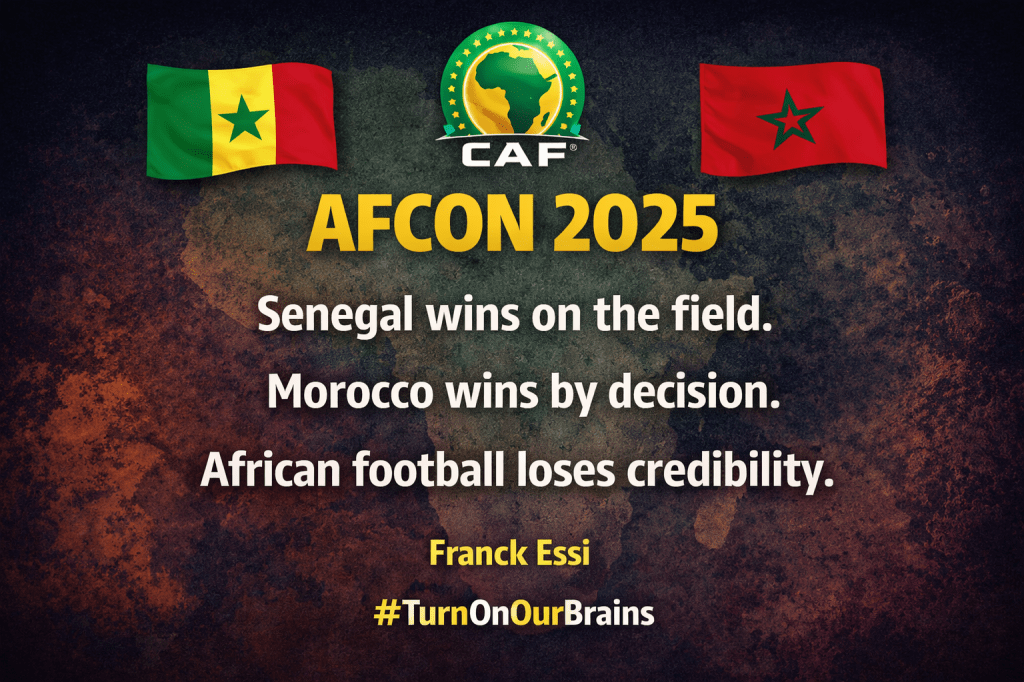
—
I don’t often talk about football.
Not out of indifference — I love this sport deeply, with the quiet loyalty of those who learned it in the street before they learned it in stadiums. But by deliberate choice. Because I am convinced that Africa devotes disproportionate energy to its footballing emotions relative to the issues that truly shape its future: governance, development, economic sovereignty, social justice. Every time an Africa Cup of Nations sets the continent ablaze for an entire month, I wonder how much of that fervour, that capacity for mobilisation, we could redirect toward transforming our institutions, our economies, our democracies.
So if I am writing today, it is because what has just happened goes beyond football.
By annulling Senegal’s victory in the final of the 2025 Africa Cup of Nations and awarding the title to Morocco, the Appeals Jury of the Confederation of African Football did not simply settle a dispute. It reconfigured the implicit rules of African football — and perhaps of continental football as a whole. For the first time at this level, a match that was played, completed and won on the pitch has been rewritten after the fact, in the name of a strict reading of a regulation.
This is an institutional, political and symbolic matter. This text is the opinion of an attentive African citizen — not that of a football expert. An opinion claimed as such.
And behind this decision, a fundamental question: is football still decided on the pitch… or in the offices?
—
The facts: from the chaos on the pitch to the legal reversal
The sequence of events is now etched into the memory of African football.
On 18 January 2026, in the final in Rabat, Senegal won 1-0 after extra time. In added time, a highly contested refereeing decision — the award of a penalty to Morocco, ultimately missed — triggered the Senegalese team’s walk-off the pitch on the instruction of head coach Pape Thiaw, for around twenty minutes. The match resumed, under the referee’s authority. Senegal won. The title seemed secured.
Initially, the disciplinary jury of the Confederation of African Football sanctioned the conduct without altering the sporting result. Then, following Morocco’s Royal Football Federation’s appeal, the reversal was total:
- The Appeals Jury invoked Articles 82 and 84 of the Africa Cup of Nations regulations
- The walk-off was reclassified as match abandonment
- The scoreline was converted to a 3-0 defeat imposed on Senegal
- The title was awarded to Morocco
This reversal — two internal bodies of the Confederation of African Football producing contradictory decisions on the same facts — transforms a sporting controversy into a major legal matter. And it reveals, from the outset, an institutional instability that is deeply troubling.
—
A historic rupture: the end of the pitch’s sovereignty
The fundamental principle of football, as any attentive observer understands it, is simple: the pitch is sovereign.
Yet that principle appears to have been broken here. Because three realities now coexist, in a contradiction that produces an unprecedented symbolic shock:
- The match was played to its conclusion
- The match was won by Senegal on the pitch
- The title was awarded to Morocco by administrative decision
This contradiction introduces a dangerous idea: the result is no longer final at the final whistle. Football enters a grey zone where the game is no longer enough, where administrative decisions can override the truth of the pitch, where victory becomes reversible.
This is a rupture of considerable reach. Not only for this competition — but for all those that follow.
—
Two legitimate readings of the same facts
Before going further, intellectual honesty is required — the kind that the surrounding media noise does not encourage.
The position of the Confederation of African Football and of Morocco is not without foundation.
Articles 82 and 84 of the Africa Cup of Nations regulations are clear: leaving the pitch without the referee’s authorisation constitutes a serious violation; that violation results in a forfeit with a 3-0 defeat. These texts existed. They were known. Morocco’s Royal Football Federation simply requested their application, and the Appeals Jury ruled that they were binding. The Royal Federation moreover clarified that « its approach had never sought to challenge the sporting performance of either team, but solely to request the application of the regulations. » From a strictly legal standpoint, this argument is valid.
But the Senegalese position is equally valid.
Several questions remain without a clear answer. Given that the match resumed after the incident, can we still speak of abandonment? Given that the referee himself authorised the resumption, can his sovereign on-pitch decision be retroactively overturned by an administrative body? The Laws of the Game of the Fédération Internationale de Football Association, which enshrine the primacy of the referee during a match, create a normative contradiction with the Confederation of African Football’s own regulations — a contradiction that only the Court of Arbitration for Sport will be able to resolve definitively.
It is this tension between two legal logics that lies at the heart of the problem.
It must also be said plainly: Senegal bears a share of responsibility for this situation. Walking off the pitch during a match is a serious decision, whatever the provocation. Head coach Pape Thiaw took a major regulatory risk that his team is now paying for. A cooler handling of the incident, even in the face of a refereeing decision perceived as unjust, would likely have preserved a victory that Senegal had earned on the pitch. That responsibility deserves to be stated — even if it does not necessarily justify, in my view, the overturning of the result.
—
Dakar’s response: when the State enters the arena
Faced with this decision, Senegal did not respond solely as a sporting federation. It was the State itself that spoke.
The Senegalese government published an official statement on 18 March 2026 in which it « expresses its deep consternation at the decision handed down by the appeals jury of the Confederation of African Football, aimed at stripping the Senegalese national team of its 2025 African Champion title and awarding it to Morocco. » The text is unambiguous: « Senegal cannot tolerate an administrative decision erasing the commitment, merit and sporting excellence » of its players, and concludes with a firm commitment: « Senegal will remain resolute, vigilant and unyielding in defending the rights of its national team and in restoring the honour of African sport. »
This escalation fundamentally changes the nature of the case. It is no longer simply a dispute between a federation and a sporting body. It is a conflict between two sovereign states, with the credibility of a continental institution as the central stake.
We must nonetheless keep a clear head. A government communiqué is first and foremost a political act. It follows the logic of national communication and popular mobilisation, in a Senegal where sport is a highly sensitive vehicle of identity. The State’s move to the front line, however legitimate its anger may be, carries an identifiable risk: transforming a sporting dispute into a bilateral diplomatic crisis with Morocco, at the expense of regional cooperation that both countries have every interest in preserving.
—
A crisis of confidence in institutions
Beyond Senegal, it is the entire institutional credibility of the Confederation of African Football that appears damaged. Because this affair feeds three particularly corrosive perceptions:
- Opacity in internal decision-making processes
- Instability of decisions — two bodies within the same organisation produced opposing conclusions on the same facts
- Suspicions of political power plays, in a context where Morocco is the host country and a first-rank continental geopolitical actor
Reactions were swift and immediate across the continent. Voices were raised from Dakar to Kinshasa, from Abidjan to Algiers. This indignation does not reflect merely a sporting emotion: it reveals a deep breakdown of trust between African populations and their reference continental football institution.
Yet a sporting institution holds together by one thing alone: trust. And that trust is today gravely damaged.
—
A double weakening: Senegal dispossessed, Morocco contested
This decision produces a rare paradox: both sides emerge from it weakened.
On Senegal’s side:
- a sense of dispossession of a legitimate sporting victory
- the symbolic humiliation of an entire nation
- a frustration that goes beyond the sporting realm and becomes a matter of State
- a title won on the pitch… lost in an office, two months after the fact
On Morocco’s side:
- a title tainted by controversy from day one
- sporting legitimacy permanently questioned
- a victory perceived across the continent as administrative, not earned
- the image of a host nation that won… on green baize
No one wins fully. Senegal loses a title it had earned. Morocco gains one under permanent contestation. And between the two, it is African football as a whole that loses credibility.
—
Is it really over?
At the time of writing, Senegal is in the losing position. The Appeals Jury’s decision has been handed down. Morocco is officially declared 2025 African champion. At the level of internal procedures within the Confederation of African Football, the avenues for appeal appear exhausted.
But it is far from over.
The Senegalese Football Federation has announced an appeal to the Court of Arbitration for Sport in Lausanne, within a ten-day window. The Senegalese government has raised the prospect of an international inquiry into the very functioning of the Confederation of African Football.
The Court of Arbitration for Sport is an independent jurisdiction, external to the Confederation of African Football, whose rulings are binding on all affiliated federations. It has previously annulled or modified decisions taken by continental sporting bodies. Senegal’s referral to it is a serious step — not a purely symbolic procedure.
The normative contradiction between the Confederation of African Football’s texts and the Laws of the Game of the Fédération Internationale de Football Association, the question of the referee’s authority over the resumption of the match, the question of the proportionality of the sanction — all of these questions deserve the in-depth legal examination that only the Court of Arbitration for Sport can today provide with the necessary authority.
The final outcome therefore remains open. And whatever the verdict, it will set a precedent for African football as a whole.
—
A dangerous precedent for the future
This decision establishes something unprecedented: a match can be retried after the fact, a result can be legally transformed, a competition can be redefined away from the pitch. In the long run, this logic opens the door to the legalisation of African football — a multiplication of appeals, chronic instability in competitions, permanent uncertainty over the value of sporting victories.
Nuance is required here. Similar crises of institutional legitimacy have shaken far more powerful organisations. The Fédération Internationale de Football Association was rocked in 2015 by a corruption scandal of global proportions. The Union of European Football Associations has experienced repeated governance crises. The International Olympic Committee had to manage years of state-sponsored doping from Russia. No international sporting institution is immune to this kind of drift.
What is at stake here is therefore not a specifically African weakness. It is the structural fragility of any sporting institution that allows procedure to override the clarity of the game. But in Africa, this fragility carries an additional cost. The cost of image. And the cost of internal trust.
—
The world’s gaze and African pride
The Africa Cup of Nations is one of the most widely followed continental competitions in the world. It attracts growing broadcast rights, an ever-increasing number of international partners, and players trained in the world’s finest academies. It is, in many respects, Africa’s sporting showcase.
Yet this 2025 edition risks being remembered not for the quality of the football, but for an administrative decision handed down two months after the final.
This image damages several essential achievements:
- the credibility of the Africa Cup of Nations as a serious competition in the eyes of international partners
- the attractiveness of African football to investors, broadcasters and sponsors
- the confidence of African populations in their own sporting institutions
- the continental pride that the competition is meant to embody
And behind the Confederation of African Football, it is the image of institutional Africa that is at stake. Because every time an African institution produces a decision that is opaque, contested or perceived as biased, it risks feeding a narrative that Africa has been fighting for decades: that of a continent incapable of governing itself with fairness. That narrative is false. Profoundly false. But decisions like this one make it difficult to refute — especially in the eyes of those who are not seeking to understand, but to confirm their prejudices.
—
African football at a crossroads
17 March 2026 will remain, it seems to me, a pivotal moment. Not because a title changed hands. But because the very meaning of the game faltered.
What happened is not simply a sporting dispute. It is a revealing moment. One that exposes the difficulty our institutions face in producing decisions that are simultaneously legal, legitimate and accepted. One that exposes the persistent gap between written rules and perceived justice. One that exposes the tensions between African states that sport sometimes exacerbates rather than soothes.
And that is why, despite all the passion I feel for this game, I continue to believe that Africa cannot afford to let football occupy all of the public space. Our challenges are too real, too urgent, too complex to be drowned in the emotion of the stands.
But when football becomes the mirror of our institutional fractures, we must be willing to look at it straight. Without complacency. Without excess either.
Senegal won on the pitch. Morocco won on decision. It is not over yet.
And African football is still waiting for an institution equal to its ambitions.
Franck Essi
#AFCON2025
#WhatIBelieve
#LightUpOurBrains
 franckessi.com