By Franck Essi
—
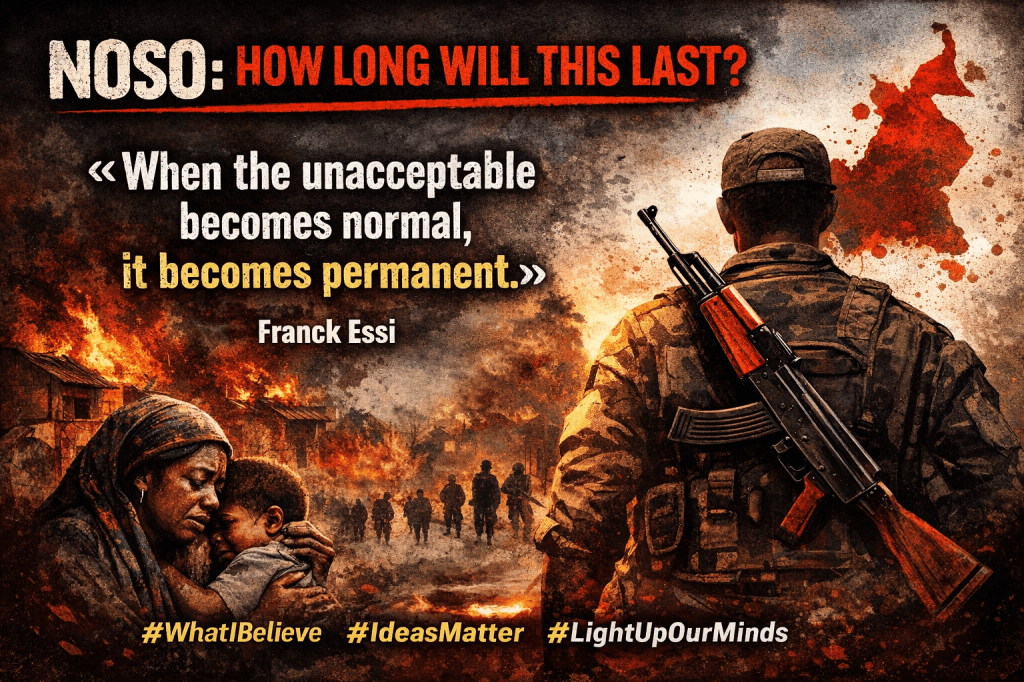
Since 2016, Cameroon has been facing a crisis whose nature, depth, and implications have steadily evolved—from corporatist grievances to a protracted armed conflict. Eight years on, one conclusion imposes itself with unsettling clarity: rather than fading, the crisis in the North-West and South-West regions is becoming entrenched, structured, and normalized.
The 2025 report on the human rights situation in these regions, published in March 2026 by Conscience Africaine and its partners, is not merely a documentation exercise. It is part of an emerging tradition of producing independent, evidence-based memory in a context saturated with competing and often politicized narratives.
This collective work, grounded in rigorous methodology aligned with international fact-finding standards, delivers a diagnosis that can no longer be ignored: the Anglophone crisis remains deeply rooted and continues to generate severe human, social, and institutional consequences.

—
Persistent, structured violence—no longer exceptional
One of the report’s key contributions lies in its empirical grounding. A total of 135 credible incidents were documented in 2025.
This figure, the authors caution, represents only a verified minimum, given access constraints and risks faced by witnesses.
The typology of violations reveals an increasingly structured pattern of violence:
- 65 killings and executions, the dominant form of violence;
- 42 kidnappings for ransom, pointing to a growing coercive economy;
- Cases of arbitrary arrests, torture, sexual violence, and destruction of civilian property.
While 78.5% of incidents are attributed to armed separatist groups and 21.5% to state forces, this distribution should not be reduced to a simplistic accounting of blame.
Rather, it reflects a broader reality: a conflict environment in which civilian protection norms are systematically weakened—and at times openly disregarded—by all actors involved.
—
From political grievance to war economy: the mutation of conflict
The report highlights three major dynamics shaping the evolution of the crisis.
The first is the normalization of lethal violence.
Civilian killings are no longer exceptional. They are embedded in mechanisms of social control, punishment, and intimidation. Killing becomes a political instrument.
The second dynamic is the institutionalization of a ransom economy.
Kidnappings—largely attributed to armed groups—follow increasingly predictable patterns: road interceptions, prolonged captivity, systematic ransom demands, and in some cases, executions even after payment.
This signals a profound transformation: from a political conflict to a hybrid system combining insurgency, organized crime, and survival economies.
The third dynamic concerns territorial coercion through “ghost towns.”
These enforced shutdowns are not mere protest tactics. They are tools of control, disrupting access to essential services—healthcare, education, trade—and gradually dismantling the socio-economic fabric.
—
A massive and systemic human cost
Behind the aggregated data lies a harsher reality: civilians remain the primary victims.
The report estimates at least 278 people directly affected, with a realistic range of 327 to 451 victims.
Yet these figures only scratch the surface.
Each killing, each abduction, each injury triggers cascading effects:
- Family disintegration,
- Worsening economic vulnerability,
- Long-term psychological trauma,
- Forced displacement and community fragmentation.
Women and children are particularly exposed—both as direct targets of violence and as indirect victims of its socio-economic consequences.
The detention of infants at Bamenda Central Prison stands as a stark illustration of the tension between security imperatives and fundamental human rights standards.
—
The limits of a predominantly security-driven response
Over the past eight years, the Cameroonian state has deployed multiple responses:
- Heavy security deployment,
- Episodic political initiatives,
- Institutional reform announcements.
Yet the 2025 trends point to stagnation—and in some respects, deterioration.
The report is unequivocal:
a purely security-based response cannot address the root causes of the crisis.
This statement deserves serious attention.
It exposes a growing mismatch between the tools deployed by the state and the actual nature of the crisis.
—
Toward a necessary refoundation
The coalition’s recommendations go beyond technical fixes. They outline a pathway toward structural transformation:
- A credible and inclusive dialogue,
- Mechanisms of transitional justice,
- Strengthened accountability,
- Deep legal and institutional reforms.
At the core lies a fundamental principle:
no sustainable peace can emerge without truth, responsibility, and reparation.
But beyond policy prescriptions, a deeper question emerges:
is the Cameroonian state capable of reinventing itself in response to a crisis that challenges its very foundations?
—
Resisting the normalization of the unacceptable
The greatest danger today is not only the persistence of violence.
It is its gradual normalization.
As the report rightly warns, prolonged violence risks becoming part of everyday life.
And once a society becomes accustomed to the unacceptable, it stops resisting it.
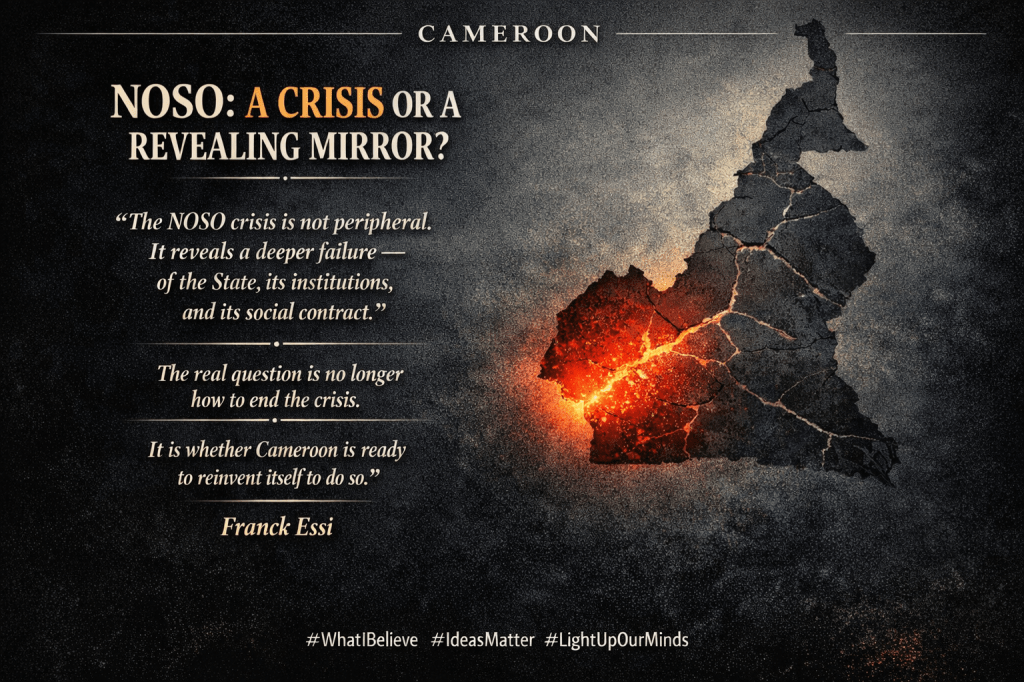
The NOSO crisis is not peripheral.
It is a mirror reflecting deeper structural failures—of the state, its institutions, and its social contract.
In that sense, it confronts us.
It forces us to face reality.
It forces us to move beyond postures.
And above all, it compels us to rethink the very foundations of our political coexistence.
Because ultimately, the question is no longer simply how to resolve the NOSO crisis.
The real question is whether Cameroon is ready to reinvent itself in order to do so.
Franck Essi
#WhatIBelieve
#IdeasMatter
#LightUpOurMinds
The key findings and recommendations here : https://drive.google.com/file/d/1TV3xBn0UsjHOjw-4uiEuaRXpw3G6jy1h/view?usp=sharing
 franckessi.com