By Franck Essi, 10 April 2026
—
This text has been written to mark the 78th anniversary of the founding of the UPC. On 10 April 1948, in a café-bar in Bassa known as Chez Sierra, twelve Cameroonians met discreetly to adopt the statutes of a movement they had joined by different paths. They founded the Union OF Populations of Cameroon. Some of them would die assassinated, poisoned or executed. Today, a Franco-Cameroonian commission has completed its work. Archives are beginning to open. But the truth remains incomplete. And the passing on of knowledge is lacking. This text attempts to gauge the ground covered — and the path that lies ahead.
—
I — 10 April 1948 Chez Sierra: the day it all began.
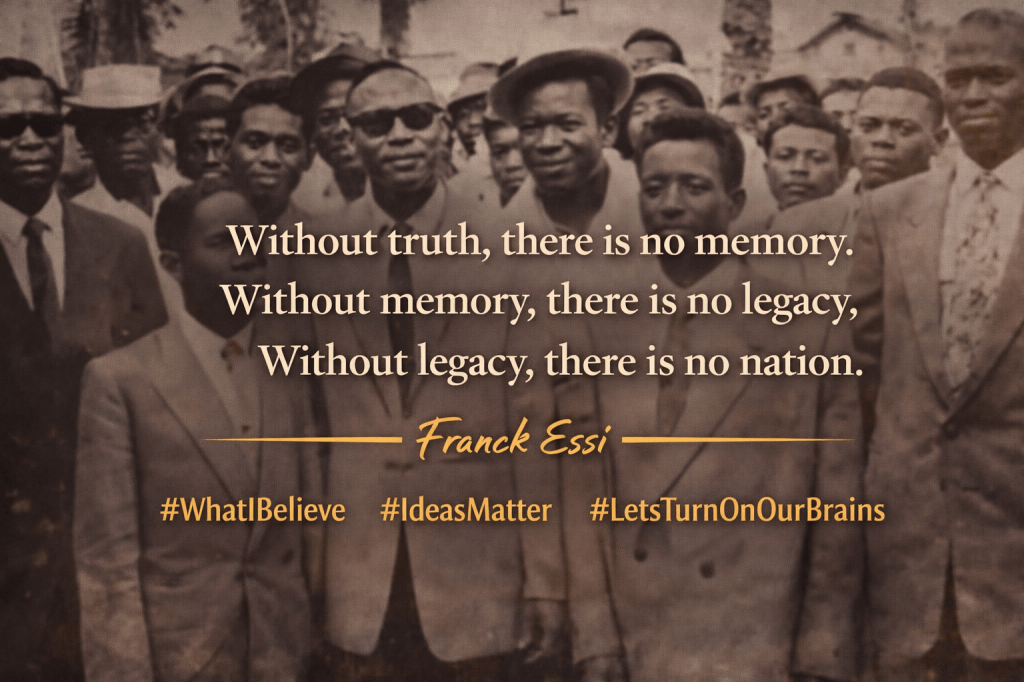
On 10 April 1948, in a café-bar in Bassa, a suburb of Douala, run by a Spanish or Portuguese owner, the regulars simply refer to it as Chez Sierra. That evening, twelve Cameroonians meet there discreetly. There is no official record, no statement, no press conference. For once, the colonial intelligence services were looking the other way: the agent was in Bonabéri, misled by a false alarm.
After a few hours of discussion, the twelve adopted the constitution of a political movement whose concept had been circulating for nearly a year in patriotic circles. The name was decided: Union of the Peoples of Cameroon. This gesture, modest at first glance, was foundational. When one looks at the group’s composition, one feature stands out: the strong presence of trade unionists. This is no coincidence. Since 1944, they have constituted the territory’s most politically educated cadres, forged in social and trade union study circles led by seasoned activists such as Gaston Donnat. Among the most committed founders at Chez Sierra, were leaders of the Union of Confederated Trade Unions of Cameroon (USCC) and cadres close to the CGT.
One detail, which official history often prefers to gloss over, deserves to be clearly recalled: Ruben Um Nyobè was not present at the meeting of 10 April 1948. That evening, the man who would become the face of Cameroonian nationalism was simply not in Douala. This is why a distinction must be made between the ‘founders in the strict sense’ — the twelve at Chez Sierra — and the figures who would subsequently give the movement its soul, its ideological coherence and its political influence.
The UPC’s articles of association were filed at Douala Town Hall on Monday 12 April at 10.50 am. The following day, Tuesday 13 April, a text entitled “Appeal to Cameroonians” publicly announced the movement’s creation. The programme was summed up in a clear statement: the union of all Cameroonians, regardless of their philosophical or religious beliefs, in the struggle against colonialism.
This emergence took place against an international backdrop shaken by the Second World War. Since 1946, Cameroon had no longer been officially a colony: it was placed under United Nations trusteeship, having previously been a League of Nations mandate administered by France and the United Kingdom. Legally, this opened up new possibilities. Politically, however, the French administration continued to exercise centralised colonial power, indifferent to the international commitments of the trusteeship. It was within this stark disconnect between proclaimed law and lived reality that modern Cameroonian nationalism took shape.
The UPC’s project is thus structured around three interlinked and ordered demands: the reunification of Cameroonian territories divided between French and British administrations, national independence, and the establishment of a people’s democracy that will guarantee a continuous rise in the standard of living of the population. The order is no mere detail. Without reunification, independence would be nothing but a truncated independence; without democracy and a rise in living standards, it would be a confiscated independence, devoid of substance.
—
II — The UPC: a movement, a people, a way of life
The UPC is not merely an acronym or a partisan apparatus. From its earliest years, it functioned as a national social movement, supported by a tight network of satellite organisations: trade unions, farmers’ associations, youth organisations, women’s organisations. It is this fabric that gives it its social depth.
Trade unions were the primary conduit for nationalist politicisation. Dockers at the port of Douala, railway workers and agricultural labourers were no longer merely ‘labour forces’: they became active participants in political mobilisation. The UPC distinguished itself from other groups of the time through this convergence of social struggles and national demands.
Women, long relegated to the background in accounts of the period, actually occupy a central place in the mechanics of activism. The Union Démocratique des Femmes Camerounaises (UDEFEC) is not merely a decorative appendage. Testimonies gathered recently, particularly by the artistic section of the joint commission, provide a detailed account of their activities: organising hideouts for the guerrillas, keeping night watch on the roads, setting up supply networks, and circulating information and instructions. They also document the price paid: torture, systematic sexual violence, and atrocities so horrific they defy description. One phrase recurs, like a verdict: “Women played a very significant role during that period, and it is not recorded anywhere. And none of them have been honoured.” ”
On an intellectual and strategic level, a few figures shaped the movement’s architecture. Ruben Um Nyobè, secretary-general and the leading theorist of Cameroonian nationalism, internationalised the cause by speaking on several occasions before the Fourth Committee of the United Nations in the early 1950s. Félix-Roland Moumié, a doctor and party president, embodied the UPC’s diplomacy from exile. Ernest Ouandié organised the internal resistance. Abel Kingué structured the political apparatus. Castor Osende Afana, an economist trained in Europe, developed a radical critique of the economic structures of colonialism and the mechanisms of African underdevelopment, anticipating the debates on monetary dependency that would later sweep through post-colonial Africa.
Finally, the UPC conceived its struggle on a continental scale. It maintained links with other anti-colonial organisations, participated in the networks of nascent Pan-Africanism, and shared with the liberation movements of the same era a vision of decolonisation as a continental process, not merely as a strictly national affair.
—
III — 1955–1971: The Cameroon War, a crime long left unnamed
The dissolution of the UPC by the French colonial administration in May 1955 marked a turning point. Forced underground, many activists joined the guerrilla forces, particularly in Sanaga-Maritime and the Bamileke West. A war began. It was to last more than fifteen years.
Very quickly, the French military authorities recognised that the nature of the situation had changed. Initially, the talk was of ‘restoring order’, then of ‘military operations’.
On the ground, this translated into the military grid control of the territory, the forced regrouping of civilian populations in controlled villages, the destruction of villages deemed ‘accomplices’ of the maquis, systematic search-and-destroy operations, and the creation of local militias under military supervision.
From 1960 onwards, aerial bombardments in Bamileke country became a central element of the counter-insurgency strategy. In several towns in Southern Cameroon — Bafoussam, Dschang, Nkongsamba, Edéa — the severed heads of guerrillas were displayed in markets or at crossroads, as part of a deliberate strategy of terror.
The human toll, to this day, remains impossible to establish with any certainty. The most conservative estimates suggest tens of thousands of deaths, whilst others suggest hundreds of thousands of deaths and missing persons. In any case, this was not merely a matter of ‘repression’, but a highly intense war, long concealed.
This war was also marked by the gradual and systematic elimination of the main UPEC leaders.
On 13 September 1958, Ruben Um Nyobè was assassinated in the Sanaga-Maritime bush, near Libel-li-Ngoy. His body was encased in a concrete block, symbolically torn from the very earth he had defended.
On 3 November 1960, Félix-Roland Moumié was poisoned in Geneva by an agent of the French secret service.
On 15 March 1966, Castor Osende Afana was arrested and beheaded in the Djoum bush, in southern Cameroon.
On 15 January 1971, finally, Ernest Ouandié was publicly executed in Bafoussam, the last of the UPC’s historic leaders, ten years after the country’s formal independence.
This point must be emphasised: the war against the UPC was not merely a French colonial war. After 1960, it also became, in every sense, the war waged by the post-colonial Cameroonian state, under Ahmadou Ahidjo, against its own citizens.
France entrusted independence to local allies who had not only failed to lead the liberation struggle, but had in some cases fought against the very idea of independence just a few years earlier. This arrangement did not quell the conflict: it prolonged it and transformed it into a state-led civil war.
—
IV — The Franco-Cameroonian Commission: an unprecedented structure, predictable limitations
It is against this historical backdrop that the Franco-Cameroonian Multidisciplinary Joint Commission was established on 19 January 2023, by decision of President Emmanuel Macron, in “consultation” with the Cameroonian government. It followed the French Head of State’s visit to Cameroon on 25 and 26 July 2022, during which the issue of decolonization-related violence was publicly addressed.
This commission differs from previous initiatives (Sarr-Savoy on African heritage, Duclert on Rwanda) in two major ways.
Firstly, it is genuinely Franco-Cameroonian: the result of a joint initiative, it brings together researchers from both countries in equal numbers, whereas previous commissions were strictly French.
Secondly, it is structured around two autonomous strands: a Research strand, dedicated to historical work, and an Artistic and Cultural strand, focused on collecting testimonies and preserving memory.
The Research strand, led by historian Karine Ramondy (Sorbonne/Paris 1), brings together fourteen historians in equal numbers from France and Cameroon. Its report, La France au Cameroun (1945–1971), is published in 2025. The team secures the declassification of 2,328 documents totalling 8,859 pages and works in more than fifteen archive centres in France, Cameroon, Switzerland, the United Kingdom, the Netherlands and the United States.
The Arts and Culture section, led by the Cameroonian artist and musician Blick Bassy, co-chair of the commission, is collecting oral testimonies from survivors of the independence struggle. Its report, Survivors of the “maquis”: testimonies of participants, colonial traumas and the transmission of memory regarding the independence struggle in Cameroon, is published in January 2025. Over twenty months in the field, the team collects one hundred testimonies and interviews across four regions of Cameroon (Centre, Littoral, West, South-West) and beyond.
The reports are officially handed over to the President of the French Republic in Paris on 21 January 2025, then to the President of the Republic of Cameroon in Yaoundé on 28 January 2025. These dates are significant: they mark the inclusion of this long-denied war on the official political agenda of both states.
But the limitations of the initiative are real.
As for the archives, the National Archives in Yaoundé remain closed to the commission. This is not a technical detail: it speaks volumes about the Cameroonian state’s persistent reluctance to open its own collections covering a period in which it is a key player.
On the ground, a fifth field survey for the artistic component, scheduled for September–October 2024, has been cancelled due to a lack of funding. Certain areas, such as Moungo, therefore remain under-documented. Time, for its part, is not on our side: witnesses are passing away.
A critique formulated as early as 2022 by Thomas Deltombe, Manuel Domergue and Jacob Tatsitsa raised the central question: to what extent can a commission mandated by the states concerned produce a history that is fully independent of their interests?
The two states are not neutral observers: France bears direct responsibility for the conduct of the war; the Cameroonian state inherited a regime founded on the defeat of the UPC. Under these circumstances, the temptation to tone down the most damning conclusions is built into the very structure of the initiative.
—
V — Historiography and the commission: useful convergences, dangerous divergences
In terms of the facts, the commission largely confirms what critical historiography had already brought to light. Three major points of convergence emerge: the central role of the French colonial administration in the repression of the UPC, the direct involvement of the French army in counter-insurgency operations, and the existence of a deliberate strategy aimed at neutralising, then eliminating, the nationalist movement.
From this perspective, the debate is no longer about whether the Cameroon War took place, nor whether the violence was widespread and organised: these points are now documented and acknowledged.
The focus has shifted to the consequences: political, historical, and institutional. What remains under discussion is no longer the reality of the facts, but how to apportion responsibility and draw concrete conclusions for the present day.
It is here that differences in emphasis emerge. Some studies emphasise the systemic dimension of French colonial violence: this was not a matter of individual excesses, but of state policy, conceived and endorsed at the highest level. The commission’s report, mindful of balance, also emphasises the role of Cameroonian political elites who, after 1960, took over the repression themselves. This reminder of postcolonial responsibility is necessary. But it carries a risk: that of diluting the primary historical responsibility — that of the French colonial state — within a narrative where ‘everyone is somewhat to blame’. Yet, when it comes to mass crimes, this symmetrisation is politically dangerous.
—
VI — The recommendations: what the texts demand of the states
The recommendations in both sections are not mere appendices. They constitute, in reality, a precise set of requirements addressed to both states. They are often more radical than official communications would have us believe.
On the French side, the artistic section first calls for full and complete acknowledgement of responsibility for the tragedy in Cameroon between 1945 and 1971. This is not merely a matter of vaguely acknowledging ‘violence’, but of naming: the war, the crimes, the targeted assassinations of leaders, the massacres of civilian populations (Ékite, Mom-Dibang, Song Simut, to name but a few), and torture, described by witnesses as virtually institutionalised. It then calls for compensation for the victims and their beneficiaries, explicitly modelled on what was done for the victims of the suppression of the Mau Mau uprising in Kenya. It also calls for the return of the UPC archives held at the Defence Historical Service in Vincennes, as part of Cameroon’s national heritage. The text even cites specific items, such as Ruben Um Nyobè’s white briefcase, taken during his assassination and containing his dream journals and personal documents, the solemn return of which is presented as a gesture that is both historic and symbolic. Finally, it calls for a reform of the French school curriculum, so that colonisation and the struggles for independence are taught more honestly.
On the Cameroonian side, the recommendations are just as demanding. The report first calls for a form of national therapy, based on ritual sessions specific to the different communities, allowing the dead to be symbolically buried, to honour them and to acknowledge the suffering endured. It proposes the construction of a Museum of Decolonisation and the Struggle for Independence, housing a National Archives and Documentation Centre, which would collect and make accessible the country’s archives covering this period, including the audiovisual testimonies produced by the commission. It recommends the the organisation of state funerals for those who gave their lives for Cameroon’s emancipation, explicitly mentioning the case of Ruben Um Nyobè, whose body remains trapped in a concrete block, as well as the repatriation of the bodies of Félix-Roland Moumié and Abel Kingué, who died in exile. Finally, it proposes the establishment of 13 September as a national day for the heroes and martyrs of independence, the construction of a national memorial, the naming of public infrastructure after figures from the struggle, and the revision of history curricula to incorporate, from primary school onwards, the history of the UPC and the independence struggles, alongside educational visits to historical sites.
If we take this text seriously, it is not a matter of adding a footnote to a textbook, but of rewriting the national narrative from the ground up, on both sides.
—
VII — The machinery of forgetting: how the state organised the erasure
To understand just how urgent these recommendations are, one must grasp the scale of what the commission calls the ‘fabrication of oblivion’. The war against the UPC did not end with the suppression of the party and the destruction of the maquis. It continued as a war over knowledge and memory.
From the very first years of independence, a repressive legal arsenal was put in place to control what could be known, taught or even named regarding the country’s political history between 1945 and 1960. In 1961, a school textbook on the history of Cameroon was seized from all bookshops and withdrawn from sale, officially because it gave ‘too much prominence’ to the UPC and Um Nyobè. In 1962, an ordinance on the suppression of ‘subversion’ made it perilous simply to refer publicly to the UPC or to mention the name of Ruben Um Nyobè. In 1984, a collection of Um Nyobè’s writings, published abroad, was subject to an administrative ban within the country.
This campaign of erasure was so effective that, decades later, during an interview conducted by the commission’s artistic team, a former member of the single-party regime claimed that it was Um Nyobè himself who had called for forgetting and reconciliation. The reversal of memory is complete: the policy of those who had him assassinated is attributed to their victim.
Étienne Segnou’s work on the teaching of national history confirms that the history of the UPC and the Cameroon War remains marginalised in secondary school curricula. Textbooks favour a narrative centred on administrative and institutional developments, relegating popular mobilisations, political conflicts and UPC figures to the margins. When Um Nyobè, Moumié, Ouandié or Afana are mentioned, it is often in a superficial manner, without putting their political and intellectual roles into perspective. This invisibilisation is no accident. It is the result of a political choice, subsequently perpetuated by inertia.
—
VIII — One year on from the handover: a worrying assessment
The reports were handed over in Paris on 21 January 2025 and in Yaoundé on 28 January 2025. The texts exist, conferences are being held, and interviews are circulating. But one year on, if we look at the facts on the ground, the results are meagre.
As regards the archives, no substantial new opening of French collections has been announced. In Yaoundé, the National Archives’ access policy does not appear to have changed. On the research front, no bilateral programme specifically dedicated to the period 1948–1971 has been officially launched, no university chair has been established, and no significant funding for theses specialising in this period has been made public.
In terms of remembrance, no national monument dedicated to Ruben Um Nyobè or to the victims of the Cameroon War has been unveiled. No official commemoration ceremony has been organised by the state. The commemoration of 13 September remains the initiative of civil society and certain opposition political parties. Ruben Um Nyobè’s body remains sealed within its concrete block. In the field of education, history curricula have not been revised to fully incorporate the history of the UPC. On the artistic front, a few projects exist — often led by civil society and the diaspora — but without a structured public policy. The hundred testimonies collected by the artistic component, which constitute a unique audiovisual archive, have not yet found a defined national broadcasting platform.
This disconnect between the quality of the recommendations and the weakness of their implementation is nothing new: as anyone who studies truth commissions knows, reports only have an impact if they are backed by sustained political, media and social pressure. Without this, they remain symbolic objects that states are happy to boast about, whilst avoiding drawing the necessary conclusions.
—
IX — What the commission did not address (or did not address sufficiently)
Even whilst acknowledging the work accomplished, several questions remain largely unanswered.
The first concerns individual accountability. The commission establishes institutional responsibilities: the French state, the army, the administration. But it does not go so far as to systematically list the officers, administrators and political leaders who ordered specific crimes. Yet a truth that remains at the institutional level, without descending to the level of individuals, remains incomplete. This is not a matter of harbouring illusions of belated criminal justice, but of establishing a historical record.
The second shortcoming concerns the rights of the families. In certain localities, such as Ndjut in the West region, village delegations approached the commission’s investigators believing that their work involved identifying victims with a view to possible compensation. These families are still mourning their loved ones, often without an identified grave. Their right to know the circumstances of their relatives’ deaths, and to locate or mark burial sites, remains largely unaddressed.
The third shortcoming concerns the economic dimension of the war against the UPC. Castor Osende Afana had already highlighted the economic stakes of colonialism, but the commission, in its recommendations, says little about the plundering of militants’ property, the deliberate destruction of certain regional economies to weaken the social foundations of the guerrilla movement, or the continuity of economic interests protected by this war.
Finally, the fourth shortcoming relates to the connection with contemporary political crises, notably the Anglophone crisis. The artistic section does indeed refer to a ‘crisis of legitimacy’ of power since 1960 and a link between the original crime of decolonisation and current tensions in the Anglophone regions, but this link is only sketched out. Yet one cannot grasp the depth of today’s crisis without revisiting the way in which the state was built in opposition to some of those who had pushed the demand for independence the furthest.
—
X — Producing alternative narratives: an African endeavour, not just a Cameroonian one
One thing is now clear: we cannot leave it solely to states—and even less so to those that were complicit in the repression—to produce the historical truth about this period. This work requires the active engagement of critical intellectuals, independent researchers, artists, activists and families who refuse to let their memories fade away.
This project also requires resources. Producing an independent history is not just about writing books: it means funding theses and long-term research, supporting archive centres, digitising collections, producing documentaries, series and podcasts, and creating access platforms. Yet African public institutions have so far invested little in this battle for memory, whilst major international foundations rarely direct their funding towards the history of African anti-colonial struggles.
Hence a specific responsibility for African private actors: entrepreneurs, patrons, and figures from the cultural world. They could decide to fund independent research centres, autonomous university chairs, digitisation programmes, oral archives, and artistic and documentary projects on this history. The history of the UPC does not await a single decision from above: it can also be taken up by society.
Finally, this project must be conceived on a pan-African scale. What happened in Cameroon has clear parallels in Kenya, Algeria, Mozambique, Angola, Zimbabwe and elsewhere. A comparative history of colonial counter-insurgency in Africa, and its continuity in certain forms of postcolonial governance, remains to be written. It would enable us to situate the war in Cameroon within a broader context and to understand what postcolonial states have inherited—and sometimes reproduced—from colonial practices.
—
XI — Three imperatives for the next ten years
On the occasion of this 78th anniversary, it is no longer enough to simply list the facts. We must articulate what this moment concretely compels us to undertake.
First imperative: hold states to their commitments. France and Cameroon have established a commission, approved its terms of reference, and received its reports. They have, in effect, made an implicit commitment to implement measures. It is up to civil society, researchers, parliamentarians and the media to demand a public timetable: opening of the archives, establishment of 13 September as a commemorative day, construction of the Museum of Decolonisation, reform of school curricula, repatriation of the bodies. Without follow-up, a truth commission is merely a public relations gesture.
Second imperative: invest in transmission. The memory of the UPC will not survive the passing of the last witnesses if it is not actively passed on. The hundred testimonies from the artistic section constitute an audiovisual archive of inestimable value, but they only ‘live on’ if they are accessible. Setting up a platform that allows a secondary school student in Yaoundé, Bafoussam or Bamenda to hear directly from a former guerrilla fighter recounting what they saw would, in practice, do more for the national memory than several academic conferences. A documentary film on Um Nyobè screened in secondary schools can become an educational tool as powerful as a chapter in a textbook.
Third imperative: recognising the legitimacy of the UPC’s project. Beyond the truth about the crimes, there is another truth to be acknowledged: the UPC’s political vision — reunification, genuine independence, popular democracy, raising the standard of living for the people — was a legitimate vision for Cameroon. Those who championed it were neither criminals nor manipulated agitators, but patriots who had a vision for this country. Recognising this legitimacy does not mean sanctifying a party; it means accepting that there were other possibilities besides those that prevailed. Concrete actions can give substance to this recognition: naming streets, schools and universities; establishing a national day on 13 September; repatriating and honouring the remains; returning symbolic objects such as Um Nyobè’s white handkerchief, etc.
—
XII — In conclusion: Without a history we embrace, there can be no national vision
Seventy-eight years ago, in a bar in Bassa, Chez Sierra, twelve Cameroonians decided that the future of this country could no longer be left in the hands of those who had colonised it. They adopted a constitution, defined a programme, and took the risk of losing everything. Many paid for this choice with their lives.
Today, a commission has produced substantial work and precise recommendations. The truth is advancing, but slowly, and always against persistent resistance. The work of truth is never merely academic. It is political. It lays bare the foundations of the national pact, the lines of power, the legacies of legitimacy. It disturbs those who have built their authority on the organised forgetting of the alternatives they have eliminated.
This is precisely why it is necessary. It is not a matter of dwelling on grudges or adopting a victim mentality, but of building a national project on truth rather than denial. A Cameroon that does not know where it comes from cannot make clear-headed decisions about where it wants to go. A Cameroon that does not name its foundational wounds cannot heal them.
We must pay tribute to those who have already begun this demanding work: researchers, journalists, activists, artists, teachers, archivists, and families who keep the names, faces and stories alive. Their commitment is a service rendered to the entire nation. For a people who refuse to confront their past often condemn themselves to repeating their wounds.
Franck Essi
#WhatIBelieve
#IdeasMatter
#Let’sTurnOnOurBrains
References
Afana, C. O. (1966). L’économie de l’Ouest africain. Paris : Maspero.
Bassy, B. (coord.) et al. (2025). Survivants du « maquis » : témoignages d’acteurs, traumas coloniaux et transmission mémorielle de la lutte d’indépendance au Cameroun. Note de synthèse du volet artistique et culturel de la Commission mixte franco-camerounaise, janvier 2025.
Deltombe, T., Domergue, M., & Tatsitsa, J. (2016). La guerre du Cameroun : l’invention de la Françafrique, 1948-1971. Paris : La Découverte.
Deltombe, T., Domergue, M., & Tatsitsa, J. (2022). « Guerre du Cameroun. Une commission d’historiens, pour quoi faire ? », Afrique XXI, 16 septembre 2022.
Eyinga, A. (s.d.). L’UPC, une révolution manquée ? Afrique Contemporaine / Chaka Éditions, vol. 13.
Eyinga, A. (1984). Introduction à la politique camerounaise. Paris : L’Harmattan.
Joseph, R. (1977). Radical Nationalism in Cameroun: Social Origins of the U.P.C. Rebellion. Oxford / New York : Clarendon Press.
Mbembe, A. (1996). La naissance du maquis dans le Sud-Cameroun. Paris : Karthala.
Ramondy, K. (dir.) et al. (2025). La France au Cameroun (1945-1971) : Rapport de la Commission « Recherche » sur le rôle et l’engagement de la France dans la lutte contre les mouvements indépendantistes et d’opposition au Cameroun de 1945 à 1971. Paris : Hermann Éditeurs.
Segnou, É. (2015). Le nationalisme camerounais dans les programmes et manuels d’histoire. Paris : L’Harmattan.
Segnou, É. (2020). Le nationalisme camerounais : histoire des luttes de libération nationale au Cameroun (1840-1971). Paris : L’Harmattan.
Présidence de la République française (2025). « Remise du rapport de la Commission mixte franco-camerounaise pluridisciplinaire sur la période 1945–1971 », Communiqué de presse, 28 janvier 2025.elysee
Ministère de l’Europe et des Affaires étrangères (France). « Travaux de la Commission mixte franco-camerounaise pluridisciplinaire sur la période 1945-1971 ».diplomatie
Hermann Éditeurs (2025). Présentation de l’ouvrage La France au Cameroun (1945-1971).histoirecoloniale
Vie publique (France). Dossier documentaire « France – Cameroun : Commission mixte pluridisciplinaire sur la période 1945–1971 ».vie-publique
Read also:
Remember Ruben Um Nyobè: from memory to method
The thought and political project of ruben um nyobe
What I Take Away from the Figure of Ruben Um Nyobè
10 April 1948 – 10 April 2025: 77 years ago, the Union of the Populations of Cameroon (UPC) was born, the Immortal Soul of the Cameroonian people.
Tribute to Castor Osende Afana
https://franckessi.com/2026/03/15/tribute-to-castor-osende-afana/
 franckessi.com