By Franck Essi
With each new election, new faces appear, slogans rain down and promises pile up. In the heat of the contest, it is easy to be seduced by a candidate’s eloquence, the colour of a logo or the nostalgia of a speech. But for voting to be an act of lucidity — and not a reflex or an illusion — we must learn to decode the candidates and judge their political platforms not by their packaging, but by their substance.
This is not a task reserved for experts or ‘intellectuals’. With a minimum of tools and common sense, anyone can ask simple but powerful questions. Because true democracy begins there: in the ability of every citizen to judge in good conscience.
Who is speaking? Where do they come from? What do they represent?
The first question to ask is not ‘what are they saying?’ but ‘who is speaking?’ Where does the candidate come from? What is their background? Do they have real experience in management or collective engagement, or simply a CV polished for the occasion? What do their past actions say? Have they ever been on the side of the people in difficult times? Have they ever taken risks for causes of general interest? Words matter, but actions speak louder.
Are they speaking alone or on behalf of a group?
A credible project cannot be carried out by one person alone. Solitary power has always failed. It is therefore important to look at the teams: who are their allies? What are the women and men around them worth? Are they competent, honest and diverse? A serious candidate must be able to build a coherent, inclusive and visible coalition — not a fan club or a recycled clan. True leadership brings people together, shares and listens.
Is the programme clear, realistic and costed?
A programme is not a poem. It is a contract of responsibility. It must offer concrete, costed and contextualised solutions. It must say how it will be done, with what, and for whom. It is not enough to promise ‘jobs’, ‘peace’ or ‘electricity for all’. The path must be explained, along with the obstacles, budgetary choices and structural reforms envisaged. An informed citizen must ask themselves:
- Does this programme solve my concrete problems (access to healthcare, employment, education, security)?
- Is it applicable in the current context?
- Does the candidate say what they will do about the army, the justice system, and the security services?
- Do they talk about redistribution and social justice, or just vague growth?
What is their relationship with truth and transparency?
Observe what they say. Do they lie shamelessly? Do they avoid uncomfortable questions? Do they rewrite recent history to suit themselves? A candidate who disregards the truth during a campaign will not respect it once in power. Are they capable of acknowledging mistakes and showing nuance, or are they merely arrogant and propagandistic? Humility, rigour and transparency are signs of political maturity.
Do they defend the interests of citizens or private interests?
Behind every candidate, there are supporters. It is crucial to understand who is pulling the strings. Where does the campaign money come from? What networks does the candidate maintain? Are they the product of an elite seeking to reinvent itself, or the voice of legitimate citizen demands? A good benchmark: do the interests they defend in their speeches reflect your own, those of the majority, or those of a well-placed minority?
Do they listen, consult and be accountable?
A good candidate does not speak alone into a microphone. They listen to grievances, respond to criticism and organise dialogue with citizens. They publish their positions. They accept contradiction. They revisit their past commitments. Ask yourself: does this person see me as a political adult, or just as a vote to be won? Do they believe in civic debate, or are they just looking for emotional support?
And after the election, what will they do?
Finally, the real question is what happens after. A serious candidate doesn’t just talk about winning. They talk about what will change in governance, in power relations, in the way the mandate will be exercised. They talk about institutions, control mechanisms, structural transformation. They don’t just tell you to ‘vote for me’. They say, ‘here’s how you will be part of the change’.
The proper use of doubt
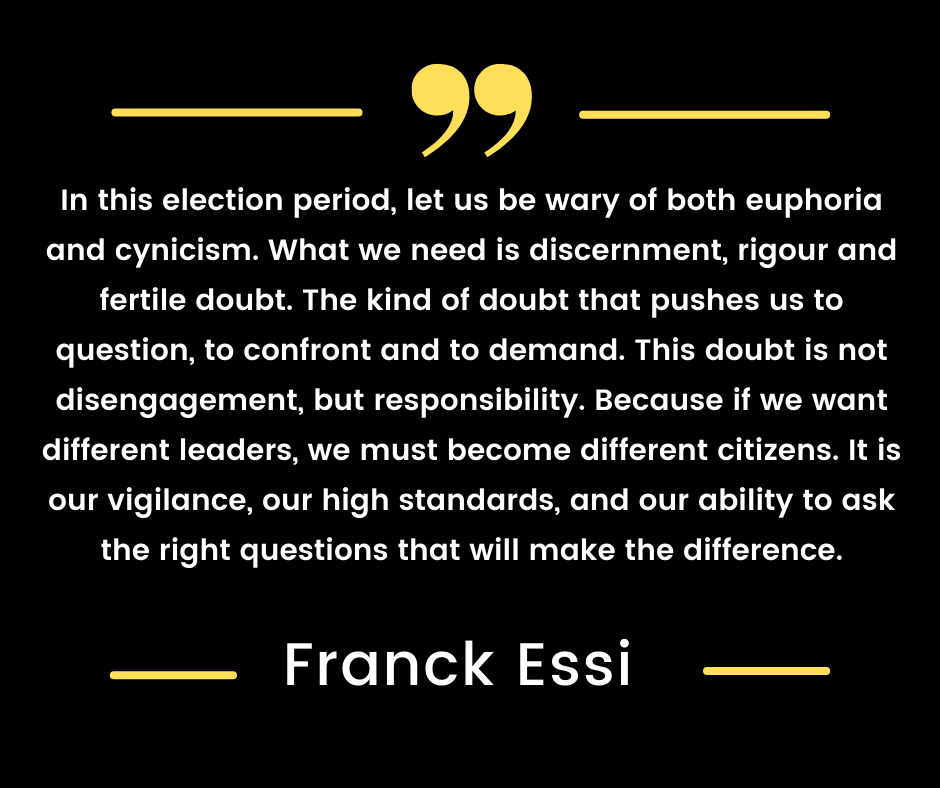
In this election period, let us be wary of both euphoria and cynicism. What we need is discernment, rigour and fertile doubt. The kind of doubt that pushes us to question, to confront and to demand. This doubt is not disengagement, but responsibility.
Because if we want different leaders, we must become different citizens. It is our vigilance, our high standards, and our ability to ask the right questions that will make the difference.
Franck Essi
#WhatIBelieve
#WeHaveTheChoice
#WeHaveThePower
#TurnOnOurBrains
#CitizenEducation
 franckessi.com
[…] Upcoming elections in Cameroon: how to analyse the candidates and their political platforms […]
J’aimeJ’aime