By Franck Essi
—
We are once again in an election year. One of those years when public debate heats up, passions flare, hopes resurface — and unfortunately, so do old demons: tribalism, community hatred, power struggles, and illusions of revenge.
But beyond the slogans and shifting alliances, one essential question demands our attention: Change, yes. But what kind of change?
—
Nothing can stand in the way of change forever
65 years. That’s how long our country has remained under a regime born of decolonization but still trapped in an endocolonial and neocolonial logic. A system that has prevented millions of Cameroonians from fulfilling their dreams, expressing their talents, and pursuing their projects. A system that turned the state into a barrier rather than a catalyst for progress.
And now, shamelessly, we are being offered yet again a 92-year-old man for another seven-year term — a living symbol of the absurdity of a power that refuses to let go, even in the face of reason and reality.
In this context, the need for change is not an opinion: it is a historical necessity.
—
False change: a dangerous illusion
But beware: this noble and powerful word — “change” — has been hollowed out. Not all forms of change are desirable, and some can be dangerously deceptive. There are false transitions that deepen our problems instead of solving them.
Let us name clearly the kinds of change we must reject:
- Change of people without change of rules: Swapping one person at the top without reforming the institutional framework is like putting a new driver in a broken-down vehicle. As long as the Constitution, electoral code, and political party laws remain rigged, even the best leaders will be powerless to bring meaningful change.
- Change of elite circles without change for the masses: When one elite group replaces another without transforming the system itself, ordinary citizens continue to suffer. Power merely shifts hands — the structure of exclusion remains.
- Change of faces without change in governance: Changing who’s in charge without changing how decisions are made is nothing more than a facelift. If authoritarianism, opacity, and clientelism persist, there is no real transformation.
- Revenge of one group of elites against another: When political change is driven by bitterness instead of vision, it creates cycles of retaliation. The state then becomes a battlefield for factions rather than a tool for serving the public good.
- Revenge of one community against another: Instrumentalizing identity-based frustrations for political gain fosters division rather than reconciliation. A change that fractures national unity is not a step forward — it is a threat.
- Cosmetic change to please external partners: Some leaders simulate reform to satisfy international donors, while keeping intact the domestic system of domination. This is window-dressing democracy — full of declarations but empty of transformation.
—
Real change: a deep, multidimensional transformation
True change is not proclaimed — it is prepared, embodied, and built over time. It is not about destroying everything, but about rebuilding on new, just, and durable foundations.
Here are the pillars on which meaningful change must rest:
- Ethical change: Justice, honesty, truth, and the common good must once again anchor public service. Power must be seen not as a privilege but as a responsibility — exercised with humility and accountability.
- Epistemological change: To liberate ourselves, we must reclaim our right to think for ourselves. This means valuing our languages, our intellectual traditions, our philosophies, and cultivating critical thinking rooted in our context.
- Democratic change: Democracy is not just about elections — it is about participation, debate, accountability, and the protection of fundamental rights. We need strong institutions, real freedoms, and a vibrant civil society.
- Governance reform: Governance must move away from arbitrariness and opacity. We need transparent, inclusive, and performance-based management of public affairs — grounded in planning, public service, and citizen proximity.
- Civilizational change: Cameroon must regain its soul, its ambition, its path. It is time to move beyond survival, toward dignity, innovation, cultural pride, and continental leadership.
—
What this demands of political leaders
Such a transformation requires leaders who can embody and carry it credibly and sincerely. That entails not only good intentions, but also specific commitments:
- Vision: To think beyond the short term, rooted in our history and oriented toward the collective future.
- Coherence: To align words with actions — rupture cannot be claimed and contradicted at the same time.
- Credible programs: Proposals must be concrete, costed, feasible, and transparent.
- A spirit of service: Power is not a trophy. It is a mission — and must be lived as such.
—
What this requires from militants and political parties
Transformation does not begin only at the top — it grows within the political and activist ecosystems that nourish it. Parties and their members must embody the change they claim to seek.
That means:
- Overcoming the cult of personality: No change is possible within rigid structures centered on one individual.
- Encouraging respectful debate: Diversity of views should be a strength, not a threat. Unity is built through constructive disagreement, not forced consensus.
- Practicing the alternative today: The way we organize now foretells the society we will build tomorrow. Exemplarity begins on the path, not just at the destination.
—
What this demands from citizens
Ultimately, the Cameroonian people are not spectators in their history. They are — and must be — the central actors of change. But this requires a conscious and active reclaiming of citizenship.
It means:
- Seeking reliable information: Rejecting fake news, cross-checking sources, and thinking critically.
- Resisting divide-and-rule tactics: Tribalism, bribery, and community-based manipulation are tools used to weaken popular power. Awareness is our first line of defense.
- Acting locally: Change begins in our neighborhoods, families, markets, churches, and associations. Every citizen can be a spark that lights the flame.
—
My Deepest Conviction
Cameroon is not suffering from too much alternation — it suffers from its tragic and prolonged absence. For over six decades, the country has been held hostage by the same architecture of power — marked by democratic denial, institutional decay, and disconnect from the people.
My deepest conviction is this:
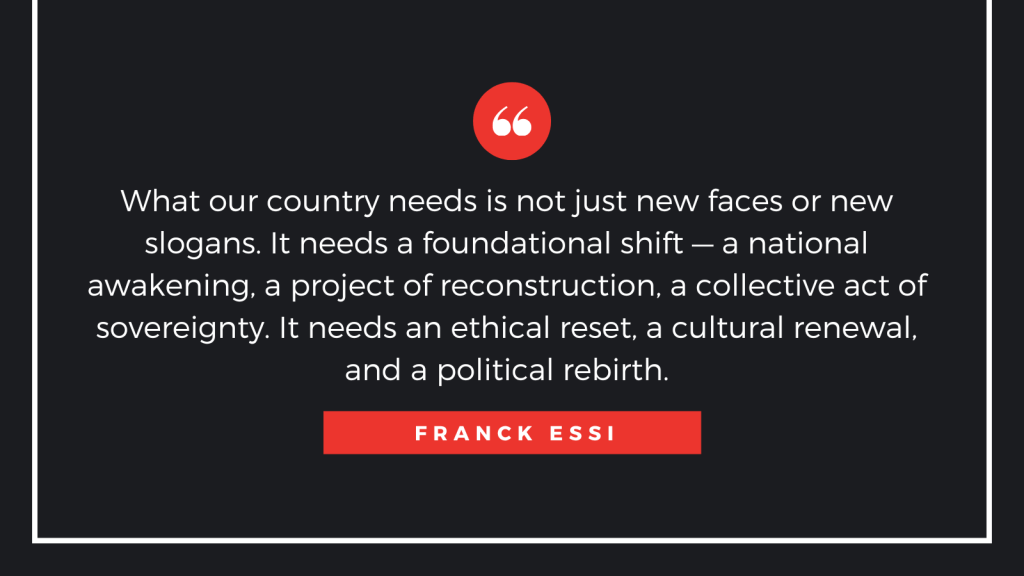
What our country needs is not just new faces or new slogans. It needs a foundational shift — a national awakening, a project of reconstruction, a collective act of sovereignty. It needs an ethical reset, a cultural renewal, and a political rebirth.
Changing the president is not the same as changing direction. Real transformation begins in our minds, our practices, our relationship with power and with each other. It is embodied by those who, here and now, show by example that they can do better, differently, for all.
And this change, I do not dream it alone.
With my comrades in the movement Stand Up For Cameroon, we carry this conviction deep within us:
> the profound change we need is a democratic political transition, achieved through a peaceful popular movement, that can refound the state and bring lasting reconciliation among Cameroonians.
This is the vision we uphold.
This is the struggle we lead.
And this is the hope we invite every citizen to embrace.
Now. Together. Resolutely. Peacefully. But firmly.
Franck Essi
#WhatIBelieve
#WeHaveTheChoice
#WeHaveThePower
#TurnOnOurBrains
#CitizenEducation
#PoliticalTransition
 franckessi.com
[…] CAMEROON 2025: CHANGE, YES. BUT WHAT KIND OF CHANGE? […]
J’aimeJ’aime