By Franck Essi
—
Tribal prejudice: a social construct with destructive consequences
Tribal prejudices don’t fall from the sky. They are neither natural, nor eternal, nor neutral. They are produced, learned, internalized, and reproduced. They are distorted, often caricatured representations of an ethnic group, a linguistic community, a territory, or a way of life. They reduce the Other to a fixed essence: greedy, dominating, lazy, cunning, dangerous, invasive… repeated so often that they eventually seem like truth.
In Cameroon, as in many African countries, these prejudices are sedimented layers of partial narratives, collective traumas, unresolved injustices, and deliberate political manipulations. Tribalism is not primarily hatred of the Other—it is ignorance of their complexity. It is intellectual laziness that reduces individuals to where they come from. It is the forgetting of our shared humanity.
—
A threefold factory: family, media, and political power
From early childhood, tribal prejudices are shaped in spaces of trust. In many families, children learn—often implicitly—to be suspicious of “those people”: “They’re not like us,” “They only care about money,” “They want to take all the power.” These ideas are sometimes said jokingly, but the poison seeps in quietly. The child absorbs them, learns to justify them, and may later pass them on.
The media often reinforce these stereotypes rather than challenge them. From comedy sketches and viral videos to song lyrics and gossip, certain accents, behaviors or customs are ridiculed. Under the guise of folklore, entire communities are essentialized.
But it is in politics that tribal prejudice becomes a strategic weapon. Since independence, Cameroonian elites have mastered the art of using ethnic belonging to consolidate power. Appointments, resource allocations, electoral campaigns, and backroom deals are often cloaked in the language of “regional balance” but rest on deeply divisive logic. In this cynical game, tribalism is not an accident — it is a method of rule.
—
Algorithmic bubbles and the power of cognitive bias
In the age of social media, tribalism has found new, fast-moving vehicles. Algorithms trap us in identity-based echo chambers that confirm what we already believe. A viral video of a fight, a fake news story, a malicious comment — and suddenly an entire ethnic group is stigmatized. Emotion travels faster than reason.
Cognitive biases play a central role here. Confirmation bias makes us seek out and remember only the information that reinforces our existing beliefs. Anchoring bias means that our first impression—however false—outweighs any later correction. In-group bias makes us favor those who resemble us and distrust those who are different.
In short, our brains simplify reality. And in an unequal, fragmented society with no unifying national narrative, those simplifications take the form of ethnic stereotypes.
—
Breaking the cycle: an individual responsibility
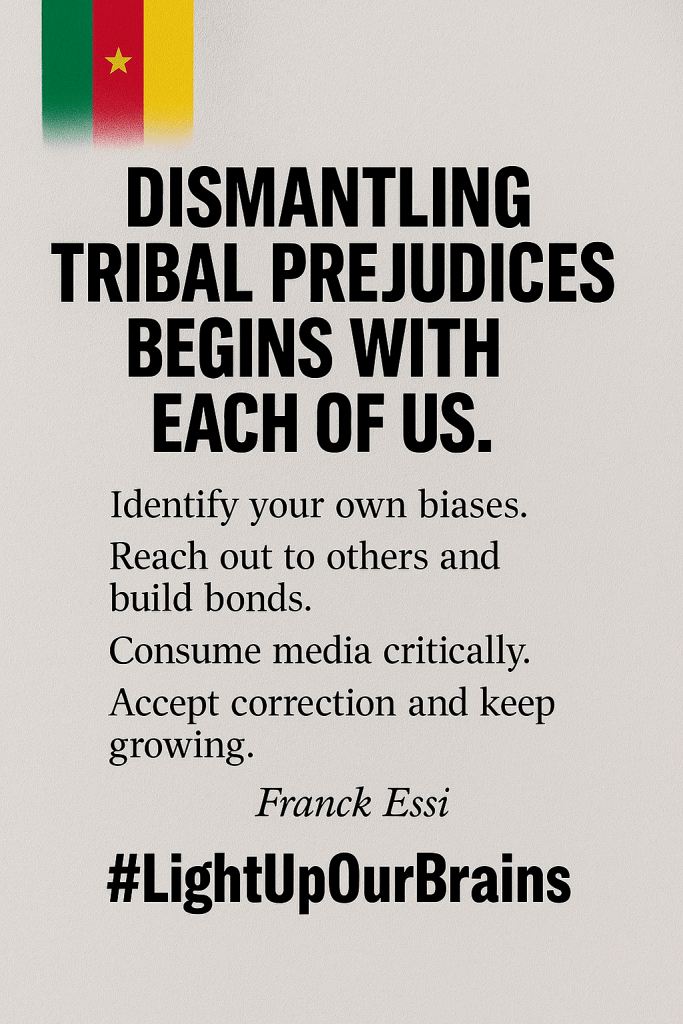
Dismantling tribal prejudice starts with personal work. It requires unlearning what we’ve absorbed. It calls for an ethic of awareness and a discipline of self-questioning.
Here are some practical steps:
- Identify your own biases: What emotions arise when you hear a certain group mentioned? What generalizations do you automatically make? What assumptions do you carry without evidence?
- Seek out difference: Go toward the Other. Build genuine relationships beyond cultural comfort zones. Collaborating, living, debating with people from different backgrounds shatters lazy assumptions.
- Consume content critically: Pay attention to media, comedy, or political discourse that promotes stereotypes. Avoid them. Challenge them. Replace them with stories that celebrate complexity and solidarity.
- Educate differently: As parents, teachers, mentors, or influencers, we must transmit critical thinking. Share new narratives. Tell stories of unity. Show examples of intercommunity solidarity and cooperation.
- Accept correction: No one is above tribalism. Even progressives can slip into bias unconsciously. The key is to remain humble, open to feedback, and willing to change.
—
A collective effort: building an inclusive national narrative
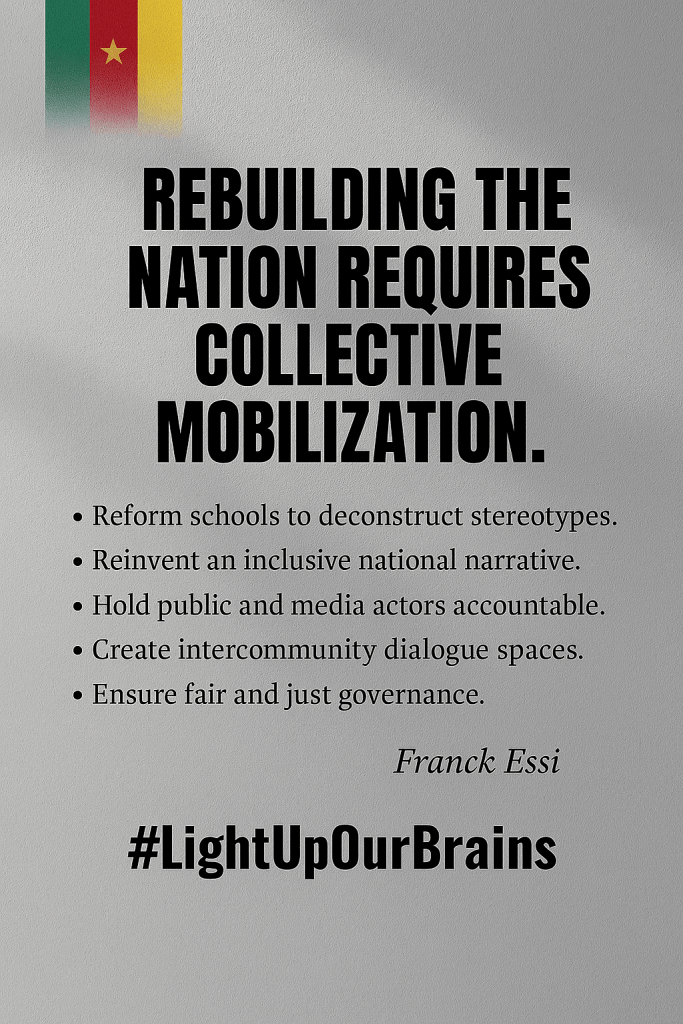
No individual can fight this alone. Overcoming tribal prejudice requires a collective cultural, institutional, and political response.
- Reform the education system: Introduce civic education rooted in pluralism, the history of Cameroon’s peoples, shared struggles, and national figures of unity. Make schools a place of deconstruction, not reproduction.
- Reinvent the national narrative: We lack a unifying myth. We must co-write a story that acknowledges past wounds but celebrates common resistance, shared aspirations, and historical convergence. A collective memory that includes all regions, languages, and cultures.
- Regulate public discourse: Political parties, religious and community leaders, influencers — all must be held accountable. Hate speech and ethnic stereotyping should have no place in a country trying to build democracy.
- Create spaces for intercommunity dialogue: Citizens’ forums, digital platforms, art projects, civic initiatives — all are needed to foster mutual understanding and concrete collaboration.
- Clean up governance: As long as public appointments and resource allocation are perceived as ethnically biased, identities will continue to be instrumentalized. Fair, transparent, and accountable governance is the cornerstone of true unity.
—
Rebuilding the common good: a political imperative
Tribalism is a symptom of a weak, partial, and captured state. Fighting it is not only about tolerance — it is about rebuilding the social contract. It means reconstructing the state so it protects all, serves all, and unites all.
In a crisis-ridden Cameroon, as new electoral cycles approach, there is urgent need to push back against everyday hate. Tribalism is not a cultural destiny — it is a political system. And like all systems, it can be dismantled.
It is up to each of us to light up our conscience, to reject the easy path of resentment, and to take part in a long but vital struggle: to turn our differences into assets — not weapons.
#IdeasMatter
#WeHaveAChoice
#WeHaveThePower
#LightUpOurBrains
#CivicEducation
 franckessi.com