A presidential land grant ignored, a ministerial order defied, fraudulently obtained title deeds — the Founangué woodland affair exposes how far administrative impunity can go in Cameroon.
—
In a country where land disputes rank among the leading sources of social tension, certain cases should immediately command the attention of public authorities. What is unfolding in Maroua, in the Far North region, is one such case — not only because it threatens intercommunal cohesion in an already fragile region, but because it documents something far more serious: the capacity of private interests to circumvent, with the complicity of certain state agents, decisions taken at the highest level of the Republic.
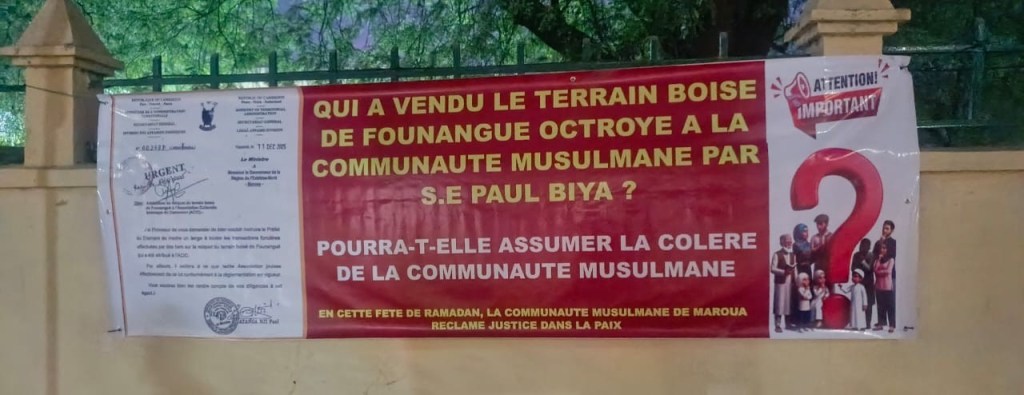
At the heart of this affair is a plot of land located in the wooded zone of Founangué, in the Maroua III subdivision. This land was the subject of a formal presidential grant to the Association Culturelle Islamique du Cameroun (ACIC) in 2018, for the benefit of the Muslim community of Maroua. It has since been partially seized through fraudulently obtained title deeds, while construction work continues despite a formal ministerial order to stop.
To grasp the full scope of the situation, its timeline must be retraced in its entirety.
—
The origins: a community project twenty years in the making
The story begins in the early 2000s.
As early as 2004, the Muslim community of Maroua initiated a project to build a socio-cultural complex intended for youth development, vocational training and educational activities. Funding was mobilised at that time. On 24 November 2008, a formal written request for the allocation of the Founangué wooded zone — then provisionally occupied by motorcycle repairers and second-hand goods traders — was submitted to the Prefect of the Diamaré Department. This letter, a copy of which is included in the case file, was sent by the Islamic Youth of Cameroon, Provincial Committee of the Far North.
—
2011: a first presidential decision
During President Biya’s visit to the region for the 2011 presidential campaign, the Diocese of Maroua-Mokolo also filed a request for the same plot. The Head of State ruled in favour of that request, while indicating that the remaining portion of the land should be reserved for the Muslim community. This was the first presidential arbitration on the matter.
In the years that followed, the Diocese undertook expansion works that encroached on the portion set aside for the Muslim community and erected a dividing wall on space that had explicitly been reserved for them. This was seen as a unilateral disregard of the Head of State’s instructions.
—
2018: a formal grant, once again circumvented
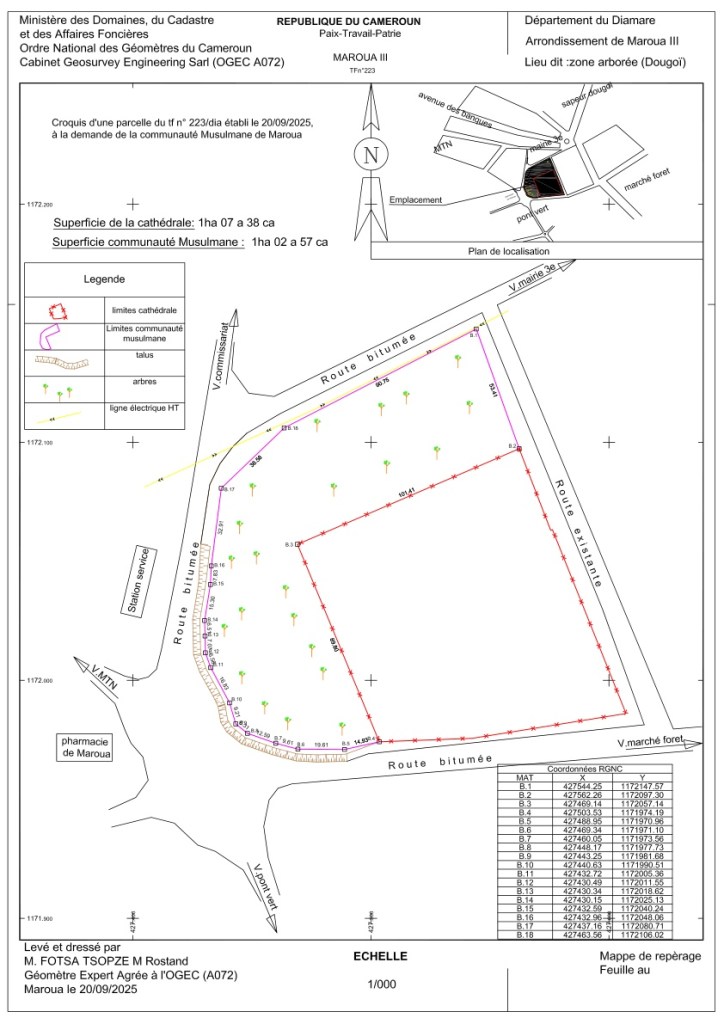
In the face of these persistent manoeuvres, a formal grant was issued in 2018 by the Presidency of the Republic to the Association Culturelle Islamique du Cameroun (ACIC) — an organisation founded in 1963, recognised as a religious association by presidential decree N°88/319 of 7 March 1988, and the legal representative of the Muslim community of Maroua in this matter. The grant covers the remaining portion of the Founangué woodland, with an initial area of 1 hectare, 07 ares and 57 centiares.
Despite this formal decision, the situation on the ground did not normalise. In February 2022, the Association for the Promotion of Social Works of the Muslim Community of Maroua wrote directly to the President of the Republic to alert him that the Diocese was disregarding his instructions and continuing to occupy the space that had been attributed to the Muslim community.
Two presidential decisions — one in 2011, one in 2018 — had thus proved insufficient to resolve the matter on the ground.
—
A new threat: title deeds obtained through fraud
The situation took a more complex turn when several individuals managed to register title deeds over this same already-attributed plot.
According to the preliminary administrative appeal filed by Maître Alioum Oumarou, counsel for ACIC, before the Minister of State Property, Cadastre and Land Affairs on 7 January 2026, six title deeds had been identified at that stage:
— Title Deed N°16740, registered in the name of Djara Oumarou, 1,000 m²;
— Title Deed N°16721, registered in the name of Haieta, 1,000 m²;
— Title Deed N°16720, registered in the name of Ousmanou Diabi, 500 m².
— Title Deed N°16719, registered in the name of Hecheked, 500 m²;
— Title Deed N°16741, registered in the name of Djouleiyatou Mana, 1,000 m²;
— Title Deed N°16742, registered in the name of Souaibou Madi, 1,000 m², the latter reportedly holding at least four additional title deeds over the same plot.
The deeds identified to date cover at least 5,000 m² of the plot granted to ACIC. The legal brief states that these individuals acted « in collusion with local administrative authorities » and that their title deeds are tainted by fraud under Article 9 of Decree N°76-165 of 27 April 1976: the law conditions the registration of a title deed on national domain land upon effective occupation or use of the property — a condition the relevant holders manifestly do not meet. Building permits are also reported to have been issued under the same irregular circumstances.
—
September 2025: construction begins, the community raises the alarm
Despite ongoing challenges, construction work began on the plot during 2025. On-site observations recorded the fencing of the land with corrugated iron sheets, the felling of trees, the erection of a wall, advanced foundations and the stockpiling of building materials.
On 9 September 2025, twenty civil society organisations representing the Muslim community of Maroua wrote to the Prefect of the Diamaré Department, reporting the ongoing works and requesting his intervention to stop the encroachment on the community’s allocated land. The letter, signed by Imam Mohamadou Bachirou Sale as spokesperson, had no immediate effect on the ground.
—
December 2025: a ministerial order defied
This is where the affair takes its most serious turn.
On 7 October 2025, the Coordinating Body of the Muslim Community for the Promotion of Peace and Sustainable Development formally referred the matter to the Minister of Territorial Administration. On 11 December 2025, Minister Atanga Nji Paul sent an URGENT communication — referenced N°002997/MINAT/SG/DAJ — to the Governor of the Far North Region, instructing him to order the Prefect of Diamaré to put an end to all land transactions on the plot and to ensure that ACIC effectively enjoyed possession of it, in accordance with the applicable regulations.
This ministerial instruction should have brought an immediate end to the situation.
It did not.
On 2 January 2026, ACIC wrote to the Minister to thank him for his intervention — and in the very same letter reported that works undertaken by third parties were continuing clandestinely, in open defiance of the Minister’s formal orders.
A presidential grant from 2018 ignored. A formal ministerial instruction from December 2025 defied. This double finding is the clearest demonstration of the failures this article sets out to document.
—
2026: legal proceedings
Having exhausted administrative channels, ACIC initiated legal proceedings at the start of 2026. On 7 January, its counsel filed a preliminary administrative appeal before the Minister of State Property requesting the cancellation of the fraudulent title deeds. On 10 February, a formal notice was served ordering the cessation of works, the removal of structures already built, and an end to the disturbance.
On 19 February 2026, Souaibou Madi, one of the identified title deed holders, formally opposed the notice through a bailiff, represented by his counsel Maître Seidou Florent. He claims ownership of the land on the basis of his Title Deed N°16742 of 18 February 2025 and contests the existence of a presidential grant on the grounds that, in his view, no supporting document has been produced.
The matter is now before the courts.
—
What this affair reveals about the system
Beyond the plot of Founangué, this case exposes structural failures in Cameroon’s land administration system: the registration of title deeds over already-attributed land, the alleged complicity of certain local officials in irregular immatriculation procedures, the absence of coordination between administrative services, and — most troubling of all — the administration’s inability to enforce its own decisions, even when they come from ministerial level.
These failures are not mere procedural errors. They are drivers of conflict in a country where land touches on economic, identity and security stakes. The Far North region, already facing considerable challenges, can ill afford a new source of intercommunal tension.
—
The State’s responsibility
In a state governed by the rule of law, the obligations of the administration are clear: legally secure land attributions, prevent and sanction administrative fraud, and ensure that public decisions are implemented. When these obligations go unmet, it is not only citizens who are left exposed to conflict — it is the credibility of the State itself that is undermined.
The Minister of Territorial Administration’s instruction in December 2025 demonstrates that the State is aware of what is happening at Founangué. The question is therefore not one of information, but of will — and of the means deployed to enforce decisions already taken.
Will the State uphold its own word?
—
A petition to prevent a conflict
Faced with this situation, civil society organisations from the Far North have chosen to alert public opinion and to address the highest authorities, including the President of the Senate. A petition has been launched to demand the cancellation of irregularly obtained title deeds, the immediate halt of construction works, and the definitive legal protection of the land attributed to the Muslim community of Maroua.
👉 Sign the petition: https://www.change.org/p/restituer-le-terrain-bois%C3%A9-de-founangu%C3%A9-%C3%A0-la-communaut%C3%A9-musulmane-5baad028-372b-4b66-996e-625524eb20ff
—
Conclusion
At its core, this affair raises a question that goes far beyond the plot of Founangué.
What is a decision of the State worth, if it can be ignored for years without consequence for those who ignore it? What does a ministerial instruction mean, if it can be defied the day after it is received? And what becomes of citizens’ trust in the Republic, when the law does not apply equally to all?
A plot granted by the Head of State in 2018. A formal ministerial instruction in December 2025. Construction continuing in February 2026. This is not a story of administrative error. It is a story of organised impunity.
The law is not optional. It is the foundation of our life together.
Franck Essi
29 March 2026
#Maroua
#Cameroon
#WhatIBelieve
#LightUpOurMinds
 franckessi.com