By Franck Essi
—
There are days when, faced with the complexity of the world, the weight of its difficulties, the ambient stupidity and the discouraging slowness of positive change, I sincerely wonder whether our efforts amount to anything.
There are days when the pettiness, selfishness and recklessness of some make me wish lightning were more selective in its choices.
There are days when obscurantism seems so deeply rooted, so comfortably settled in, that resignation almost feels reasonable.
In those moments, I always return to the same convictions. They are simple reasons, gathered over time and experience, that I like to revisit in order to find the strength to navigate this sometimes complex and discouraging world. They do not resolve everything. But they get me moving again.
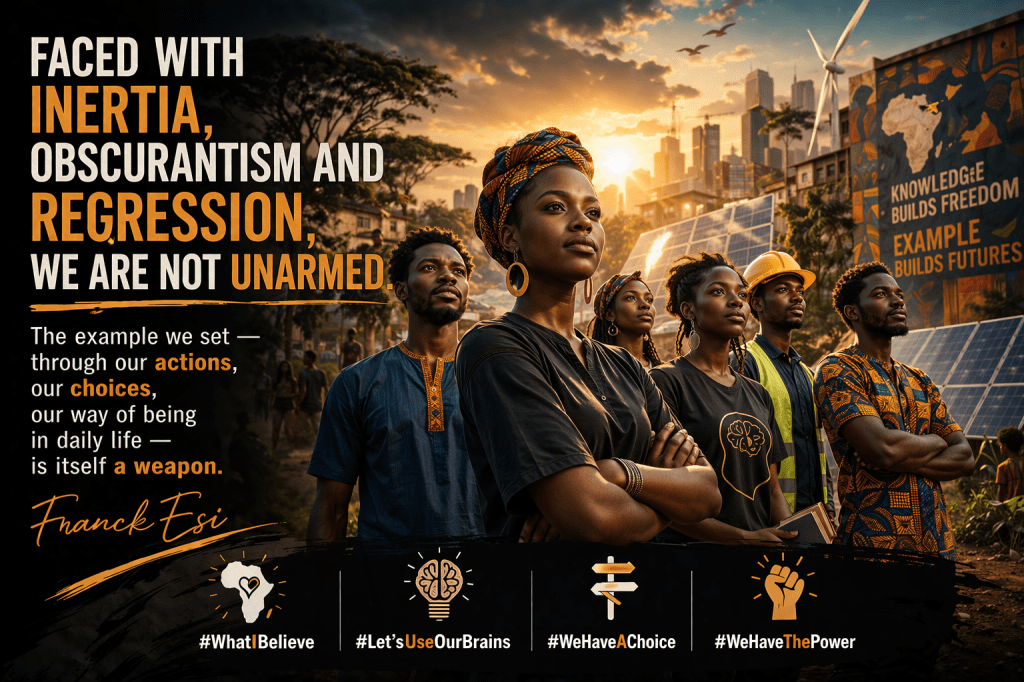
They are also convictions that have taught me this: faced with inertia, obscurantism and regression, we are not unarmed. The example we set — through our actions, our choices, our way of being in daily life — is itself a weapon. Discreet, patient, but devastatingly effective. I share them with you today, in the hope that they may be as useful to you as they are to me.
—
I. Why Act
1. We must not do good for others — nor in order to be rewarded.
We must do good because it is right. For ourselves, first and foremost. Because Good is Good, regardless of the gaze, the judgment or the approval of others — and regardless of gratitude or its absence.
There is immense freedom in no longer making the quality of our actions dependent on the reactions of those around us. As long as we act in order to be seen, recognised or rewarded, we remain hostages. Hostages to the gaze of others, hostages to their moods, their ingratitude or their indifference. I have seen people abandon worthy causes because they did not receive the recognition they had hoped for. I have seen commitments collapse at the first sign of ingratitude. It is human. But it is also a weakness we can choose to overcome.
One who acts because it is right — because their conscience commands it — is a free being. And a free being is a dangerous being to every system that thrives on dependence and fear. At the end of our time on this earth, it is our conscience — not the applause nor the criticism — that will be our one and final witness.
2. No progress arises by chance: it is the quiet acts of ordinary people that build the world.
Every advance in our families, our neighbourhoods, our countries is the patient fruit of women and men who have chosen to think beyond themselves. Ordinary people, in ordinary circumstances, who decided to do a little more than the minimum — a teacher who prepares their lessons with care, a doctor who treats with conscience, a civil servant who refuses the bribe, a parent who raises their children with rigour and dignity.
They are often unknown names, frequently forgotten faces. No one has erected statues in their honour. Yet it is their cumulative example, their repeated gestures, their quiet sacrifices that have altered the course of things. There is no such thing as a small task done well. There are only people who choose to give of themselves or to hold back. And it is the sum of these daily, invisible, repeated choices that determines the face of a society.
We have waited too long for salvation to come from above. True development does not descend from above — it rises from below. And it is the weapon of those who have decided not to wait.
Let us grant ourselves the privilege of belonging to this lineage of builders rather than to the cohort of demolishers!
—
II. History Vindicates Us
3. Nothing great is achieved without passion or sacrifice.
Everything of value in this life bears the marks of commitment, struggle and perseverance. Nothing lasting has ever been built in comfort, ease or half-measures.
Ruben Um Nyobe knew this. Secretary-General of the Union of the Populations of Cameroon, he devoted his entire life to the cause of his people’s independence and reunification, defying French colonial repression, refusing exile and compromise, until he was cut down by bullets in the forest of Sanaga-Maritime in September 1958. He had not waited to be in the majority. He had not waited for conditions to be favourable. He had acted with what he had, where he was.
Thomas Sankara knew this too — he who chose to transform Burkina Faso through rigour, vision and an uncompromising refusal of complacency, knowing full well that such intransigence might cost him his life. It did.
Our determination must be stronger, more enduring, than that of those who destroy or who labour to maintain the status quo. For the forces of inertia and regression never rest.
4. It is always pioneering minorities that make history.
First, they are mocked. Then, they are fought. Finally, they are celebrated.
This pattern has repeated itself since the dawn of time, in every country, in every culture, in every field. Pioneers are unsettling because they reveal, by contrast, the passivity and mediocrity of those who do not dare. Their very existence is a silent reproach — and that is precisely why there are always those who seek to silence them.
The question, therefore, is not whether the minority will ultimately be proven right — it always is. The question is simpler and more urgent: will we be among them? Will we have chosen, at the moment it mattered, to stand on the side of those who dare, who build, who refuse to settle for the ordinary?
—
III. What This Demands of Us
5. Those who act always face three categories of opponents.
There are first those who attempt to do the same thing and who, through rivalry or jealousy, become obstacles rather than allies. There are then those who actively do the opposite, whose resistance at least has the merit of being open. And there are finally — the most numerous, the most silent, and yet the most burdensome — those who do absolutely nothing.
It is often this last category that discourages the most. Not through declared hostility, but through quiet indifference. Their capacity to watch the world deteriorate without moving an inch, to witness injustice without flinching, to greet the efforts of others with a shrug. Mass indifference is the oxygen on which the status quo thrives — and it feeds precisely on the discouragement of those who act.
Let us not grant them that power. Facts, time and history will render to each what they are due.
6. By keeping our own light burning, we give others the courage to light theirs.
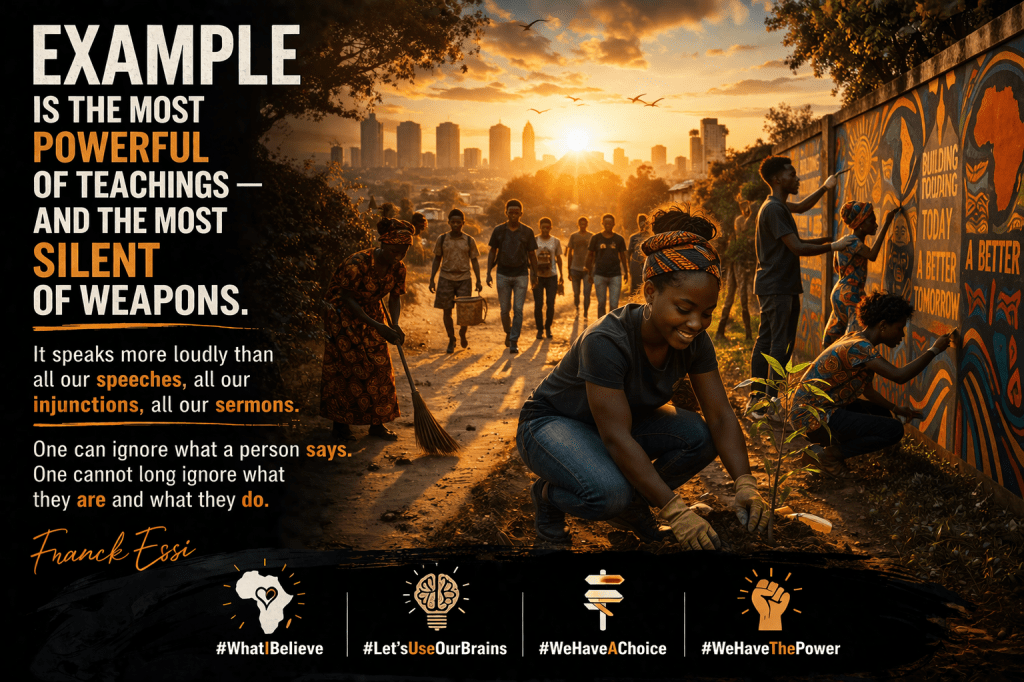
Example is the most powerful of teachings — and the most silent of weapons. It speaks more loudly than all our speeches, all our injunctions, all our sermons. One can ignore what a person says. One cannot long ignore what they are and what they do.
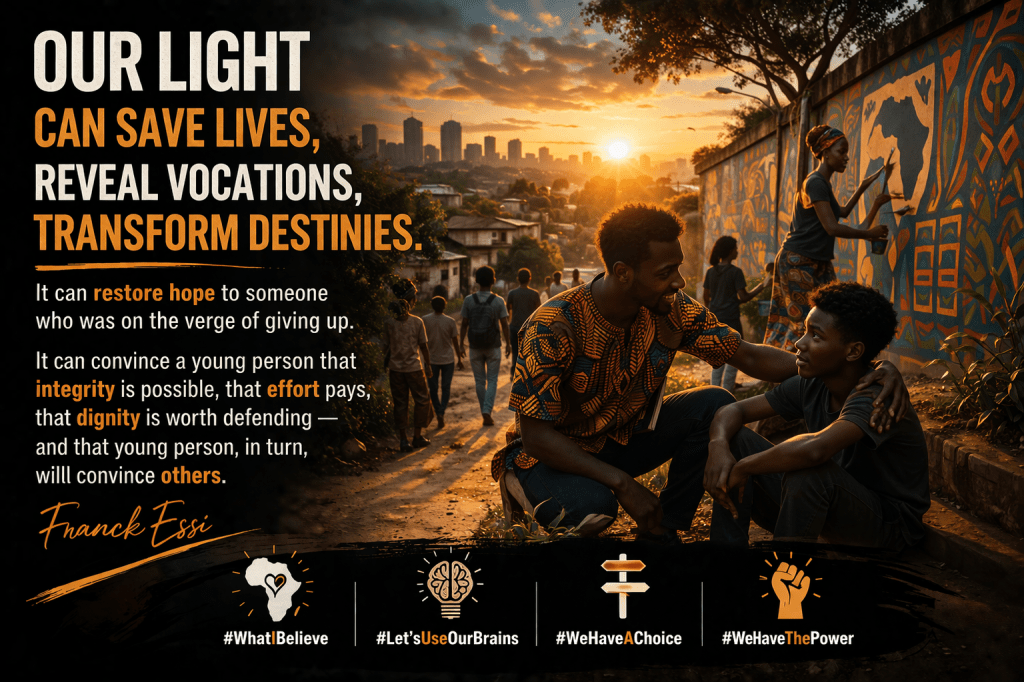
Our light can save lives, reveal vocations, transform destinies. It can restore hope to someone who was on the verge of giving up. It can convince a young person that integrity is possible, that effort pays, that dignity is worth defending — and that young person, in turn, will convince others.
And this light illuminates first and foremost our children, who watch us live. They will remember not what we told them to do, but what they saw us do — or fail to do. It is there, in that space between our words and our actions, that the next generation is either forged or broken.
7. No Nation is born great. And no generation inherits a country it has not helped to build.
Every great Nation is the fruit of the patient, daily effort of its citizens, stone by stone, generation after generation. Greatness is not an automatic inheritance. It is earned, built, maintained — and it can be lost, through collective negligence and abdication, just as surely as it was once built.
Our children and grandchildren will inherit what we have — or have not — built. They will inherit our institutions, our infrastructure, but above all our values, our habits, our relationship to work, to one another, to the common good.
It is perhaps the heaviest of responsibilities. But it is also the most beautiful of motivations. Let us be among those who pursue it resolutely — not out of obligation, but out of conviction and love.
—
Let us strive to be part of the solution, not a cause of the problem — in everything we do, wherever we are.
Cameroon and Africa will go no further than where the mindset and actions of their sons and daughters lead them. For our societies to change, we must continually evolve our attitudes, our behaviours and our choices, in keeping with the ideals we carry.
It is not a comfortable task. It is not an easy task. But it is the only one equal to what we hope for our countries. And it is, at bottom, the one weapon we have never lacked — if only we consent to seize it.
You cannot build a golden society with leaden thoughts, words and deeds!
Strength and courage to all those who do their part!
Franck Essi
#WhatIBelieve
#Let’sUseOurBrains
#WeHaveAChoice
#WeHaveThePower
#CivicEducation
 franckessi.com