For truly sovereign, people-led, democratic transitions — which restore lasting security, build functional states and guarantee social justice
By Franck Essi, 7 April 2026
—
1. Why I am taking a stance on the Sahel
As an African from Cameroon, committed for years to the democratic renewal of my country and to the triumph of a model of governance based on human rights, social justice and popular sovereignty, I am following with keen attention and a critical eye the political dynamics unfolding across the countries of the Alliance of Sahel States — Mali, Burkina Faso and Niger. These three countries, currently led by transitional military regimes, invoke sovereignty to justify their break with certain foreign powers and their profound reconfiguration of the internal political order.
What is happening in the Sahel is not a distant event that does not concern Cameroonians or other Africans. It is a testing ground for responses, failures and hopes that is redefining the contours of what is possible on our continent. And it is precisely because I believe that Africa deserves better than repeated cycles of authoritarianism and dependency — whatever ideological guise they may take — that I deem it necessary, for all intents and purposes, to take a public stand.
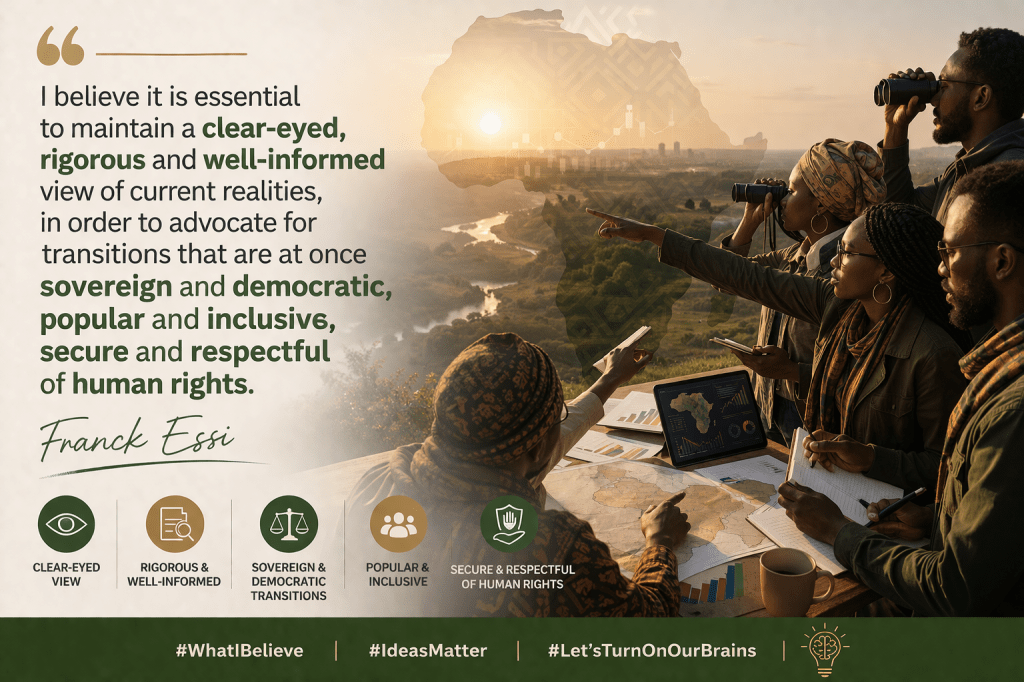
Whilst the claims to sovereignty put forward by these regimes may find support among large sections of the population, they cannot in themselves justify a lasting suspension of fundamental rights, a democratic backsliding, or an authoritarian concentration of power. I believe it is essential to maintain a clear-eyed, rigorous and well-informed view of current realities, in order to advocate for transitions that are at once sovereign and democratic, popular and inclusive, secure and respectful of human rights.
I recognise that the security contexts in the Sahel are marked by a persistent terrorist threat, complex armed conflicts, mass population displacements, profound institutional breakdowns and persistent external threats. These realities make transitions more arduous. But they in no way diminish the need for principles or the obligation to pursue governance objectives that are both pragmatic and just.
At a time when these regimes are turning their backs on some of their promises, becoming entrenched and abandoning democratic principles, we must be clear about the goals to be pursued and the paths to take to achieve them.
—
2. The principles underpinning my thinking, which I consider essential, even indispensable
Before any analysis of the current situation, I believe it is useful to recall the principles which, in my view, underpin any genuine transition:
- Popular sovereignty as the exclusive foundation of political power. All legitimate authority derives from the people and acts in their interest — not solely in the interest of transitional military authorities, nor in that of foreign powers, however new they may be. The seizure of power through mechanisms other than popular choice may prove necessary, given the circumstances, but cannot, in my view, become the new norm.
- Full respect for human rights and fundamental freedoms: freedom of expression, of the press, of assembly, of association, the right to life, to physical integrity, and to a fair trial. These rights are not luxuries of rich countries — they are the bedrock of all human dignity. And ancestral African philosophies and traditions had already affirmed and enshrined them. For example, Ubuntu and the Mandé Charter did not wait for the Universal Declaration of Human Rights to come into being and to govern life in African societies.
- The non-instrumentalisation of the fight against terrorism for the purposes of suppressing dissent, the abusive militarisation of power, or the prolonged suspension of democratic processes. The security threat is real; it must not become a permanent pretext. Security has many dimensions. It is not limited to the neutralisation of non-state armed groups that sow terror. Lasting peace also depends on strengthening the other pillars of harmonious life in society.
- Social justice, inclusion and gender equality as the guiding principles of all public policy, particularly with regard to marginalised communities, women and the direct victims of conflict. For true and sustainable development lies in deepening harmony between the diverse components of our pluralistic societies.
- Transparency, accountability and citizen participation as imperatives of governance — not as tolerated accessories, but as conditions of legitimacy. The proclamation of grand ideals or major development objectives does not exempt us from the need to manage collective resources properly and to be accountable to the sovereign, the People.

—
3. What I observe on the ground: a rigorous, documented and contextual analysis
I urge all forces of African transformation to avoid two symmetrical pitfalls: the hasty idealisation of transitional military authorities presented as new liberators, and their automatic condemnation as if there were nothing to be understood in the dynamics that led to their emergence. What we must collectively cultivate is:
- An objective assessment of the actions taken: Which rights have been guaranteed? Which populations have been effectively protected? Which countervailing powers have been suppressed or established since the regime changes?
- Constant attention to the plight of vulnerable communities — women, displaced persons, ethnic and religious minorities, those detained without trial or victims of extrajudicial executions documented by independent organisations.
- A critical analysis of the real impact of security policies: have military operations — including those carried out with the assistance of foreign private military companies such as Africa Corps — strengthened peace or exacerbated the suffering of civilian populations, as suggested by several international investigations into incidents in Mali and Burkina Faso?
- Sustained vigilance against the exploitation of patriotism to justify internet shutdowns, the arrest of opponents, the closure of independent media and the silencing of civil society organisations. Supporting a people’s sovereignty means precisely defending that people’s right to question those who speak on their behalf.
- A careful reading of the formalisation of the AES as a confederation in July 2024, with the signing of a founding treaty in Niamey: whilst the ambition for enhanced cooperation between African states is entirely legitimate, the confederal structure as it is taking shape currently rests on three transitional military regimes whose popular mandates to commit their peoples to a political union of this scale warrant clarification and documentation.
- Finally, the formal withdrawal from ECOWAS, effective in January 2025, constitutes a major geopolitical turning point, the economic, security and diplomatic consequences of which for the population warrant an in-depth public debate — a debate which, unfortunately, current circumstances make difficult to hold freely.
—
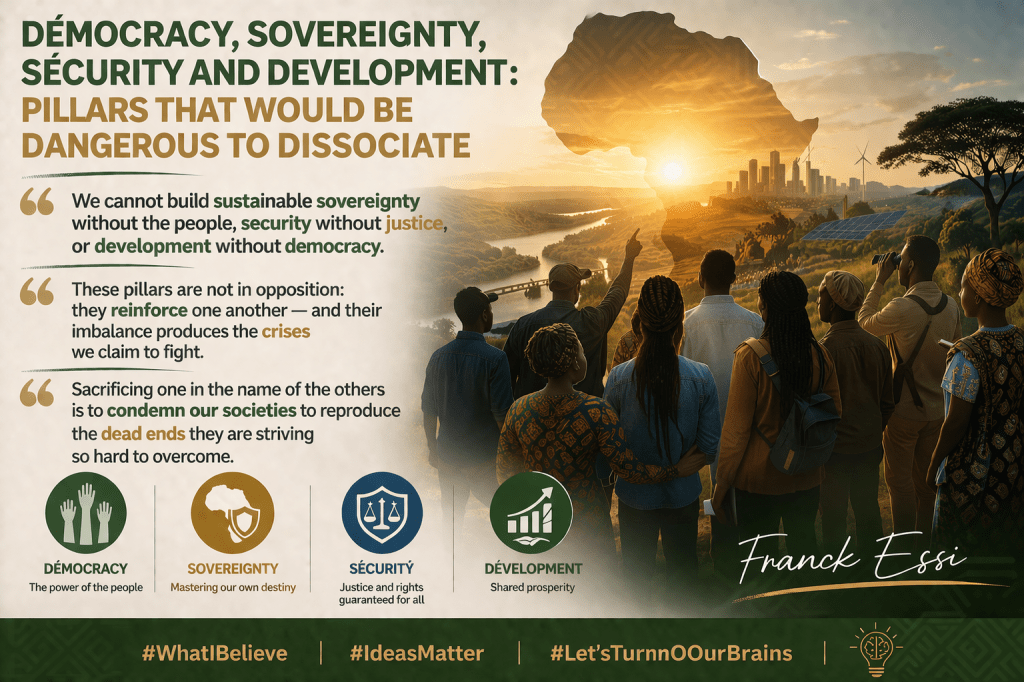
4. Democracy, sovereignty, security and development: pillars that would be dangerous to separate
Democracy and sovereignty must not be pitted against one another. Security and human rights must not be pitted against one another. Economic urgency and participatory governance must not be pitted against one another. These pillars are deeply interdependent, and any rhetoric claiming the contrary deserves to be seriously questioned:
- There can be no lasting sovereignty without popular participation. State sovereignty exercised without citizen oversight is not the sovereignty of the people — it is simply the replacement of foreign tutelage with domestic tutelage, even if the latter wears a uniform.
- There can be no just development without democratic inclusion. African and global historical data consistently confirm this: prolonged states of emergency do not produce development. They produce captured rents and insular elites.
- There can be no lasting security without justice and without guaranteed rights for all. Terrorism in the Sahel did not arise out of nowhere. It developed over decades of exclusion, injustice, corruption and state absence in the peripheries. An exclusively military response to a structurally political and social problem will not suffice — as twenty years of international intervention in the region have shown.
Any strategy that sacrifices one of these pillars in the name of the others risks reproducing the patterns that our peoples are precisely seeking to overcome.
—
5. What I hope to see: politically legitimate, inclusive and genuinely transformative transitions
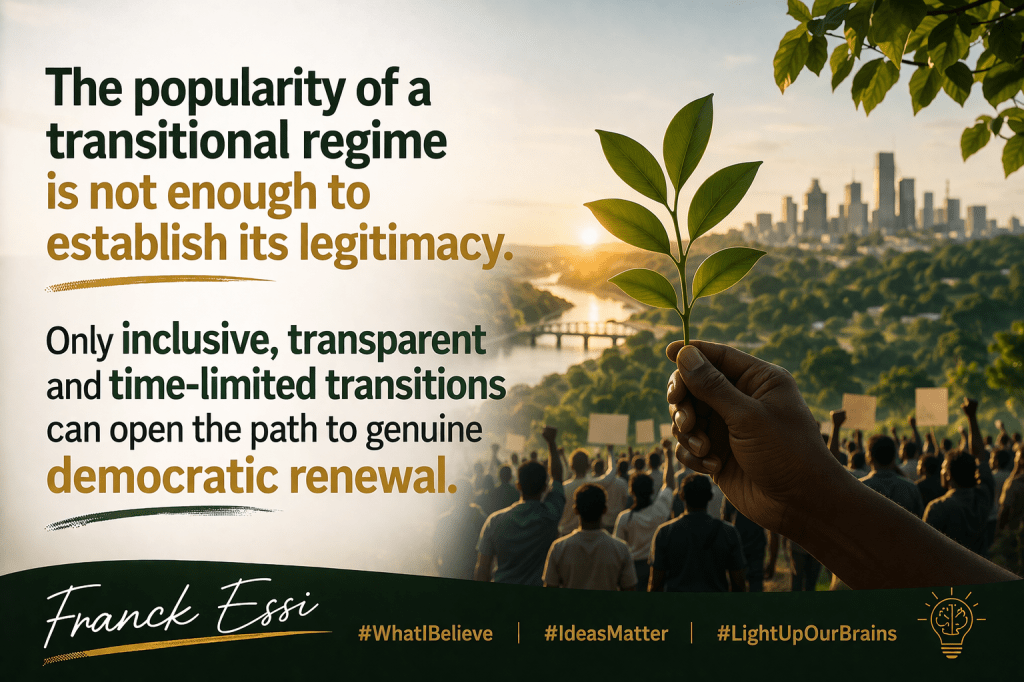
The initial popularity of transitional military regimes — real and understandable given the failures of the governments they replaced — is not enough to legitimise them in the long term. The use of ‘national dialogues’ or ‘conferences on renewal’ does not in itself guarantee genuine popular support or the production of transformative solutions, especially when they are organised and controlled by the transitional military authorities themselves, or when they tend to exclude critical voices, opposition forces, trade unions, citizens’ movements, women and young people.
In Mali, the 2021–2022 National Conference on Rebuilding was largely boycotted by political parties and a significant section of civil society. In Burkina Faso, the High Council for National Reconciliation is struggling to embody credible popular representation. In Niger, the attempt at inclusive dialogue proposed by ECOWAS was rejected. These precedents call for caution and high standards.
It therefore seems important to me that transitions are based on genuinely inclusive, participatory and credible processes, notably through:
- The organisation of a sovereign national conference or an inclusive national assembly, endowed with real powers, open to all sections of the nation without arbitrary exclusion, and led by figures recognised for their integrity, independently of the transitional military authorities.
- The guarantee of fair conditions for participation: freedom of expression for all speakers, the safety of participants, full and unrestricted access for the media and independent observers.
- The incorporation of the commitments arising from the dialogue into a binding roadmap, accompanied by a precise implementation timetable and an independent monitoring mechanism.
- A strict limit on the duration of the transition, with a firm and public commitment from the transitional military authorities not to stand as candidates in future elections. In this regard, the recent statements by General Assimi Goïta in Mali, who has not ruled out standing as a candidate in a future presidential election, are a signal that I take very seriously and which deserves a clear response from the forces of African transformation.
- The establishment of a pluralist citizen monitoring body, capable of objectively assessing the progress made and warning of any potential abuses.
These processes must ultimately be rooted in a lucid African historical and comparative memory: learning from the rare successes of transition, but also from the many cases where empty dialogue has allowed military regimes to prolong their grip on power to the detriment of the people. Mamadi Doumbouya’s Guinea, which promised an exemplary transition before its leader organised his indefinite hold on power, is the most recent lesson we must not forget.
—
6. On international alliances: true sovereignty is not built by shifting dependencies
The liberation of African peoples necessarily involves breaking with old and persistent forms of foreign domination, whether economic, military, diplomatic or cultural. Such interference has long prevented African states from fully exercising their sovereignty and meeting the basic needs of their populations. I acknowledge this without hesitation.
I sincerely commend the efforts made by certain ESA states to reduce the influence of foreign powers: the denunciation of unbalanced treaties, the closure of military bases perceived as instruments of interference, and the determination to reform cooperation systems that perpetuated dependency. These decisions deserve careful and respectful consideration.
However, breaking with historical dependencies must not lead to the creation of new ones. The quest for sovereignty cannot be reduced to a mere shift from one form of tutelage to another. The deployment of foreign private military forces in Mali and Burkina Faso, mining and security contracts concluded under conditions of opacity, and accelerated rapprochements with certain partners without transparency regarding the terms of the agreements: all of this calls for a serious and well-documented analysis that the prevailing ‘patriotic’ atmosphere must not render impossible.
I therefore believe it is important to promote:
- A clear-sighted and public analysis of new alliances — whether they involve Russia, China, Turkey or other actors: do they truly serve the interests of the people, or do they establish new forms of strategic dependence and the capture of resources?
- Controlled diversification of international partnerships, built on the basis of verifiable mutual interest, contractual transparency and respect for the fundamental rights of people.
- The affirmation of a sovereign, autonomous and united African path, which rejects the logic of blocs, subjugation and geopolitical manipulation — whatever their origin.
- The establishment of citizen oversight mechanisms for international agreements concluded during periods of transition, to ensure they do not compromise the future of peoples in the name of short-term strategic calculations.
Sovereignty cannot be decreed in a fiery speech. It is built on informed choices, robust institutions and genuine accountability to the people.
—
7. On security: neither capitulation in the face of violence, nor impunity in the response
I fully recognise the need to combat terrorism and armed violence, which are ravaging entire communities in the Sahel. This reality is tragic and calls for a firm and determined response. But an effective and sustainable security response cannot be based on violations of fundamental rights — not only because this is morally unacceptable, but because it is strategically counterproductive.
In practical terms, this entails:
- Strict adherence to international humanitarian law in all circumstances, including during military operations conducted with foreign partner forces, some of whose actions have been documented as involving serious abuses against civilian populations.
- The effective protection of civilian populations and of assets essential to their survival, which must remain the primary measure of the effectiveness of any security operation.
- The prevention and firm repression of enforced disappearances, torture and extrajudicial executions, which in turn fuel the cycle of violence and permanently alienate populations from state institutions.
- Investment in social, educational and economic reconstruction to dry up the root causes fuelling armed recruitment — poverty, exclusion, territorial marginalisation, and the long-term absence of the state in peripheral areas.
- Psychosocial support for former combatants, particularly young people who were forcibly recruited, to enable their dignified reintegration without triggering a new wave of violence in the future.
—
8. On the role of women: their central role in any genuine rebuilding
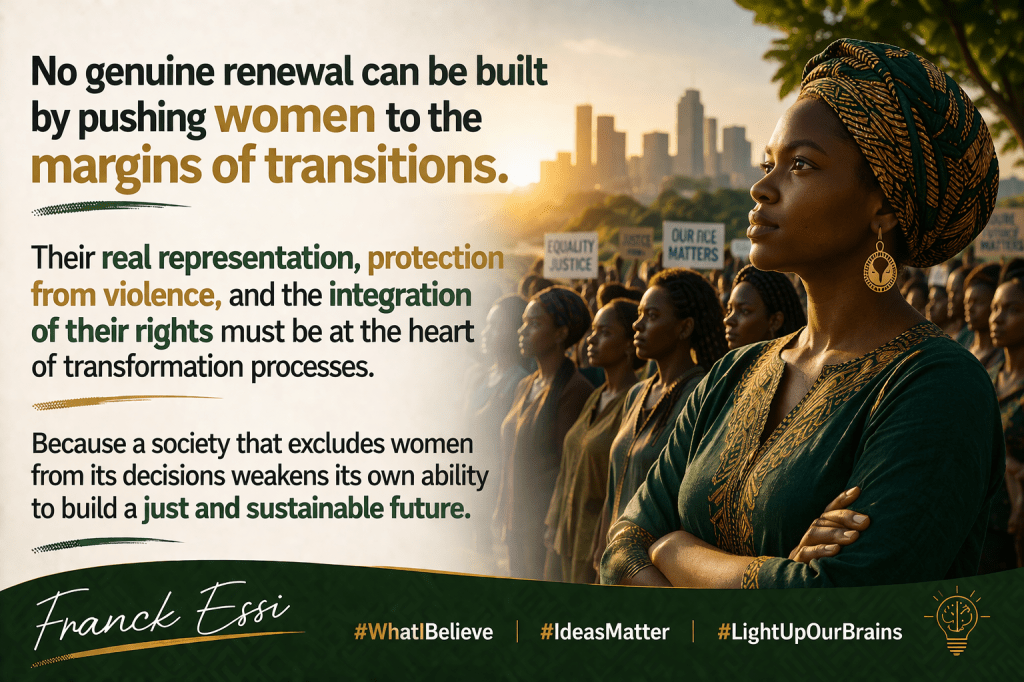
Women cannot be relegated to the margins of transition processes. They are often the first to suffer the consequences of conflict — displacement, violence, economic fragility of the household — and the last to be involved in decisions about their own future. This contradiction is intolerable and must be addressed.
I believe it is essential to advocate for:
- Their effective, rather than merely symbolic, representation in transitional governance bodies, with real responsibilities and concrete influence over decisions affecting their communities.
- Systematic protection against gender-based violence, the prevalence of which in armed conflict remains criminally under-punished in almost all Sahelian contexts.
- The explicit integration of women’s demands — access to justice, land, education and political representation — into the social, economic and political agendas that transitions claim to champion.
—
9. My call for civic vigilance, clear-eyed engagement and solidarity that does not compromise its principles
I make a sincere appeal to the citizens of the Sahel: exercising constant critical vigilance over their authorities is not a betrayal — it is the highest expression of civic conscience. Supporting a transition also means reminding it of the commitments it has made. Not relinquishing this active role in shaping one’s country’s political future, even in moments of collective support, is precisely what distinguishes a popular transition from a mere change of power.
I call on African actors — intellectuals, activists, civil society organisations, independent media — to express clear-sighted and committed solidarity, which supports popular liberation movements whilst remaining faithful to the principles of democratic sovereignty. Supporting a transition without questioning its excesses is not solidarity — it is complacency.
Finally, I urge international partners to make any support conditional on verifiable and measurable progress in governance, access to essential basic services, human rights, citizen participation and the inclusive nature of the transition — not on declarations of intent, nor on roadmaps lacking independent monitoring mechanisms.
—
10. On the issue of detainees: a moral imperative and a condition of credibility
A truly democratic transition process cannot tolerate the illegal or arbitrary detention of citizens, often prosecuted for crimes of opinion, activism or peaceful opposition. Journalists, activists, opponents, members of civil society: their situations are documented by credible independent organisations, and their fate is a true indicator of the real nature of a transition process.
It is deeply desirable that the transitional military authorities commit to:
- Release without delay all persons detained in violation of fundamental rights, in particular journalists, activists, opposition figures and members of civil society whose cases indicate deprivation of liberty without any serious legal basis.
- Put an end to the practice of prolonged pre-trial detention without trial, which violates the right to a fair trial and constitutes in itself a form of punishment imposed outside any legal framework.
- Establish an independent commission to investigate cases of political detention, with a public mandate to recommend urgent releases and prevent further arbitrary arrests.
- Guarantee, in all circumstances, the physical integrity, dignity and procedural rights of any person deprived of liberty, in accordance with regional and international instruments.
This approach is not only a moral and legal obligation. It is also, in practical terms, a prerequisite for peace and credibility in any process of crisis resolution and national renewal. One cannot build a state governed by the rule of law whilst keeping political prisoners in its jails.
—
11. What I firmly believe: sovereignty without the people is merely another form of servitude
In an era of political reinvention in Africa, the temptation is great—and humanly understandable—to confuse authoritarianism with sovereignty, to mistake the break with the old order for a complete liberation, to see in the sovereign discourse of the transitional military authorities the programme that the people have been waiting for for decades.
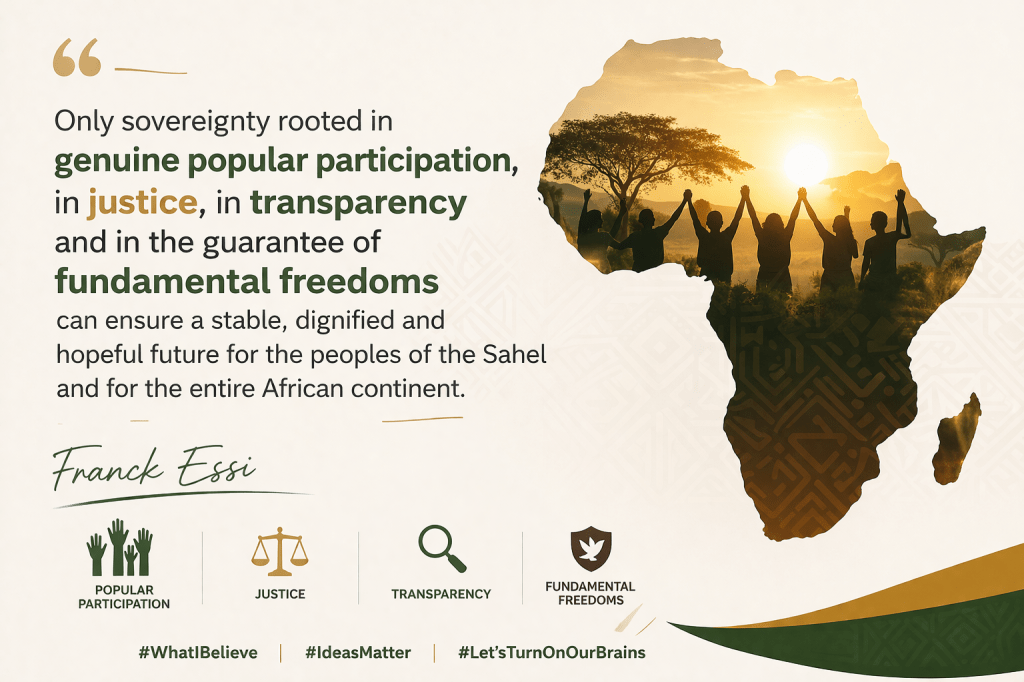
I reject this confusion — not out of dogmatism, but out of fidelity to what African history teaches us. Only sovereignty rooted in genuine popular participation, in justice, in transparency and in the guarantee of fundamental freedoms can ensure a stable, dignified and hopeful future for the peoples of the Sahel and for the entire African continent.
The future of African transitions is not decided in foreign embassies or in press releases from foreign ministries. It is decided by the people’s ability to stand together in defence of their rights, their genuine sovereignty and their collective dignity. And no circumstance, no power, no rhetoric can permanently strip them of that ability — provided that we, as Africans, refuse to relinquish it ourselves.
This is what I believe in. This is why I continue to put pen to paper. And this is what should drive our efforts at transformation.
Franck Essi
An African from Cameroon
#WhatIBelieve
#IdeasMatter
#Let’sTurnOnOurBrains
Read also:
Withdrawal of AES Countries from ECOWAS: What Lessons for the Regional Organization in Crisis Management?
 franckessi.com