By Franck Essi

—
The adoption of the constitutional amendment introducing the position of Vice President is not a technical adjustment. It is a political signal that must be read with clarity. In a locked political system, every reform reveals as much as it conceals — and forces of change to clarify their own strategy in relation to three paths that, for more than thirty years, have structured Cameroon’s political debate, often without us fully acknowledging it.
—
More than sixty years after independence, more than forty years of Paul Biya in power, and over thirty years after the return to multiparty politics, Cameroon still faces a fundamental political question: how can a deeply entrenched political system be transformed?
Over these decades, three broad strategies have gradually emerged in response to the existing system:
preserving the system, fighting within the system, and fighting beyond the system.
The recent adoption of the constitutional amendment introducing the position of Vice President of the Republic — approved by a Parliament dominated by the ruling majority — is therefore not a minor institutional episode. It is part of a constitutional modification aimed at establishing a structured mechanism for presidential succession at the top of the state.
What has just happened highlights, with unusual clarity, what each of these three paths reveals about its strengths, its limits, and its risks (About the three approaches:https://franckessi.com/2026/04/04/changing-cameroon-fighting-the-system-fighting-within-the-system-or-fighting-outside-the-system/).
Authoritarian political systems rarely transform themselves by accident. They evolve through calculation.
—
- The system anticipates and secures the aftermath.
Contrary to what some narratives suggest, the system in power does not operate through permanent improvisation. It observes, adjusts, and prepares.
The introduction of a Vice President primarily serves as a mechanism for managing presidential succession and stabilizing power in case of vacancy or institutional uncertainty.
Within the proposed constitutional framework, the Vice President is expected to ensure continuity of the executive branch in the event of incapacity or vacancy of the presidency, thereby avoiding an uncertain institutional transition.
In other words, the system is preparing to move through the post-Biya era without fundamentally transforming itself.
This type of reform corresponds to a classic mechanism of controlled transition. It does not aim to open the political space but to guarantee continuity of power under a modified institutional arrangement.
The first lesson is therefore clear: the regime’s strategy is coherent.
Adjust certain institutional mechanisms, redistribute internal balances, prepare for the future — while preserving the core architecture of power.
—
- The system can reform itself in order to preserve itself
Political regimes that endure for decades rarely survive solely through repression or electoral manipulation. They also survive through their ability to reorganize institutionally in order to maintain themselves.
This amendment illustrates precisely that dynamic.
What some may interpret as an opening can also be understood as a strategic reconfiguration of power.
But the experience of the last three decades reveals an even more subtle phenomenon: entrenched political systems do not simply resist — they absorb.
They gradually integrate forces that initially sought to challenge them. They sometimes transform their opponents into participants, and eventually into implicit partners within the existing political framework.
This is the central risk of the second path: the strategy pursued by a significant part of the political opposition, which believes that change will come primarily through strict adherence to the rules of the system.
Participating in elections organized by the system, denouncing its abuses, and hoping that persistence within institutional mechanisms will eventually lead to democratic alternation.
This strategy is not without logic. Even an imperfect institutional space remains a space for political struggle.
However, within a tightly controlled system, it carries a well-known risk: playing on a field defined and controlled by the adversary, while at the same time granting it a legitimacy it might not otherwise have obtained.
—
- The political struggle does not take place only within institutions
Political history consistently reminds us of a simple truth: institutions are almost always shaped by those who already hold power.
Cameroon itself has experienced this.
The “ghost towns” protests of the early 1990s demonstrated that popular pressure could force a system to open its political space — even if only partially.
The February 2008 protests, often referred to as the “food riots,” revealed a deep social frustration capable of temporarily shaking the confidence of an entrenched regime.
These episodes are not mere historical curiosities. They show that the third path — building political pressure beyond the institutional spaces tolerated by the system — is not a theoretical abstraction.
Across the African continent and elsewhere, profound political transformations have often occurred when citizen, social, and political pressure became strong enough to make the status quo unsustainable.
When forces of change limit themselves solely to the institutional terrain defined by the system, they risk remaining trapped in a structurally unbalanced competition — indefinitely.
—
- The need to rebuild a popular civic dynamic
One of the deepest weaknesses of pro-change forces in Cameroon remains the absence of sustained and structured popular mobilization.
Fighting beyond the system does not mean acting in a vacuum. It requires building concrete social dynamics:
- Citizen movements capable of organizing and raising political awareness
- Civil society organizations that connect political debates to lived realities
- Independent media able to arm public opinion against disinformation
- Civic education initiatives that restore citizens’ awareness of their own power
- Youth mobilization capable of transforming a generation into political actors rather than passive observers.
Such spaces have existed and still exist in Cameroon. But it must be acknowledged honestly that they have not been sufficiently structured nor connected to a broader strategic project.
Without an organized civic dynamic, institutional reforms risk remaining internal adjustments within the system itself.
Successful democratic transitions around the world have almost always been preceded by a reactivation of society as a political actor, rather than by a simple reshuffling of elites.
—
- The urgency of a collective strategy
This moment also reminds us that political, social, and civic forces seeking systemic change must overcome several persistent obstacles:
- fragmentation of initiatives that dissipates political energy
- sterile competition among leaders that substitutes egos for strategy
- the absence of a collective roadmap capable of transforming scattered frustrations into coherent political force.
Without strategic convergence, the system will continue to move forward while its challengers remain divided.
This fragmentation helps explain several phenomena visible today:
- the gradual depoliticization of the population
- weak civic mobilization
- the growing disconnect between political discourse and lived realities
- the inability of opposition forces to generate sustained momentum.
—
My conviction
The introduction of the Vice President position is therefore not merely an institutional innovation.
It is a revelation.
A revelation of the system’s ability to anticipate and reconfigure itself in order to endure.
A revelation of the limits of an opposition that seeks change solely within the rules of a game it did not design.
And a revelation of the urgency of seriously exploring a third path — one that seeks to transform the system by building a popular, political, and civic balance of power capable of forcing real change.
One conviction remains.
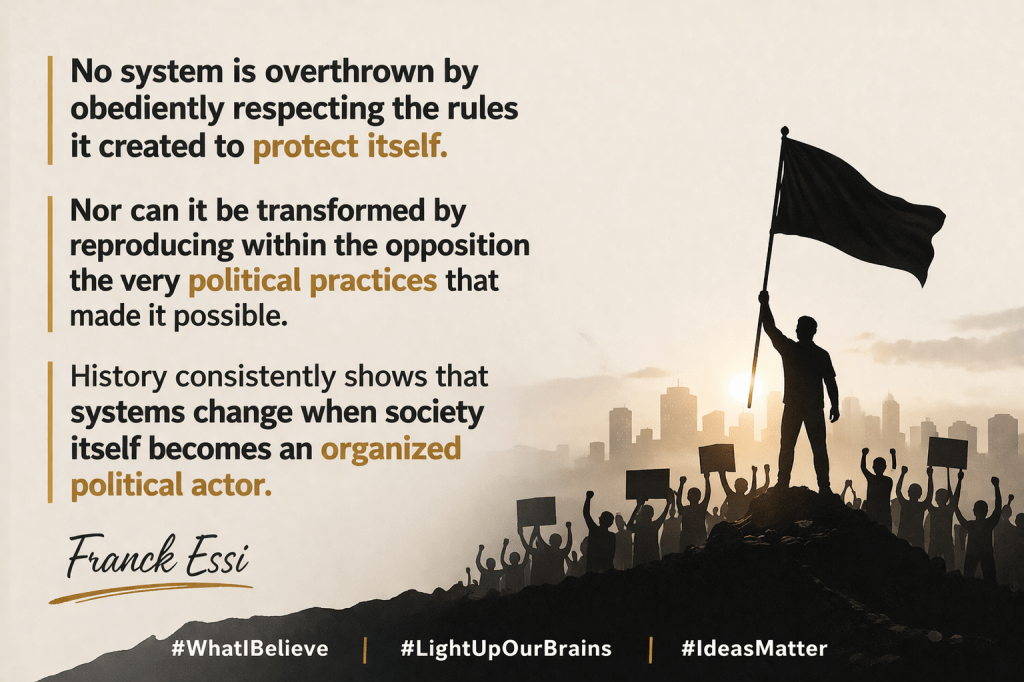
No system is overthrown by obediently respecting the rules it created to protect itself.
Nor can it be transformed by reproducing within the opposition the very political practices that made it possible.
History consistently shows that systems change when society itself becomes an organized political actor.
Strategic patience.
Political clarity.
Citizen mobilization.
These are the three ingredients that will make the difference.
Franck Essi
#WhatIBelieve
#LightUpOurBrains
#IdeasMatter