—-
Steve Biko belongs to that rare category of historical figures whose lives were short, yet whose influence remains immense. Born on December 18, 1946, in South Africa, he grew up in a country deeply scarred by racial segregation and later by apartheid. He died on September 12, 1977, in Pretoria after suffering severe injuries while in police detention. (britannica.com)
Very early in life, Biko understood that oppression was not limited to unjust laws, police brutality, or economic exclusion. It also operated within the mind. Apartheid sought not only to dominate Black bodies, but also to produce submissive consciousness.
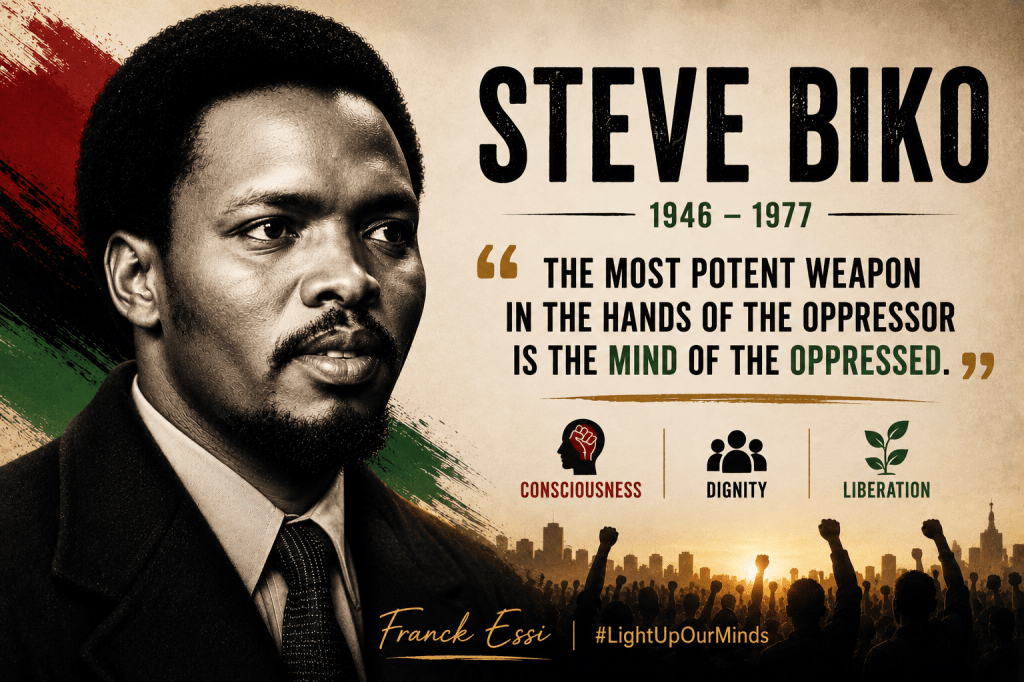
He summarized this reality in one of his most famous statements:
“The most potent weapon in the hands of the oppressor is the mind of the oppressed.”
—-
1. A Militant Born in a Country Organized Against Black Dignity
As a medical student at the University of Natal, Steve Biko quickly became involved in political activism. In the late 1960s, while many anti-apartheid organizations had been banned, he helped establish the South African Students’ Organisation (SASO) in 1968. This organization became one of the major intellectual spaces for the development of the philosophy of Black Consciousness.
—-
2. Black Consciousness: An Inner and Political Revolution
Steve Biko’s greatest intellectual contribution was his understanding that the liberation of a people begins with the recovery of their self-worth.
He famously wrote:
“Black Consciousness is an attitude of the mind and a way of life.”
Black Consciousness was therefore not merely an identity claim. It was a way of thinking, living, standing upright, and rejecting imposed inferiority.
It rested on several essential principles:
- Rejecting internalized inferiority;
- Reclaiming the power to define oneself;
- Building collective autonomy;
- Transforming fear into organized power.
Biko did not preach hatred. He preached dignity. He did not ask Black people to isolate themselves from the world. He asked them first to stop seeing themselves through the eyes of their oppressors.
—-
3. A Thinker of Organization, Not Only of Denunciation
Steve Biko was not merely an intellectual. He was also a builder of organizations. Around the Black Consciousness Movement emerged community initiatives such as health programs, educational projects, social activities, and spaces for political awareness and training.
He understood a fundamental truth: a people are not liberated by speeches alone. They are also liberated through structures, schools, networks, solidarities, and everyday practices.
Consciousness that is not organized becomes temporary emotion. Revolt without method can be crushed. Outrage without strategy eventually fades away.
—-
4. The Fear of the Regime Before a Man Standing Upright
The apartheid regime quickly realized that Steve Biko was dangerous — not because he possessed weapons, but because he awakened minds. And a people regaining confidence become difficult to govern through fear.
In 1973, Biko was placed under a banning order. He could no longer speak publicly, travel freely, be quoted in the press, or participate normally in political activities.
In August 1977, he was arrested by South African police. He died on September 12, 1977, at the age of 30.
Nearly fifty years after his death, South Africa reopened the judicial inquest into the circumstances surrounding his death in order to examine possible criminal responsibility.
—-
5. What Steve Biko Teaches Us
Steve Biko’s legacy goes far beyond South Africa. It speaks to all peoples who have been dominated, humiliated, divided, or made incapable of believing in their own power.
First, he teaches us that the first prison is often mental. Before being defeated by force, a people can be defeated by doubt, fear, inferiority complexes, and habits of obedience.
Second, he teaches us that dignity is a political force. A people who respect themselves become harder to buy, manipulate, intimidate, or divide.
He also teaches us that consciousness must become organization. It is not enough to understand injustice. People must educate, structure, plan, act, and endure over time.
Finally, Biko reminds us that a true leader is not merely someone who speaks on behalf of the people. A true leader helps the people rediscover their own voice.
—-
My Deep Conviction
Steve Biko did not only fight apartheid as a political system. He fought the internalization of apartheid within the minds of the oppressed.
That is why his message remains profoundly relevant today: no people can sustainably transform their condition if they do not first transform the way they see themselves, their dignity, and their collective power.
— Franck Essi
#WhatIBelieve
#IdeasMatter
#LightUpOurMinds
#CitizenLeadership
#SteveBiko
#BlackConsciousness
—-
Online References
- Encyclopaedia Britannica — Steve Biko biography. (britannica.com)
- South African History Online — Steve Biko quotes. (sahistory.org.za)
- Google Arts & Culture / Steve Biko Foundation — Steve Biko and the Black Consciousness Movement. (artsandculture.google.com)
- Reuters — Reopening of the investigation into Steve Biko’s death in 2025.

