By Franck Essi
—
There is a strange habit, very widespread in the way we talk about politics: we know how to comment on the maneuvers of political machines, decipher power struggles between factions, interpret the signals sent by foreign chancelleries, and dissect budgets with the grave air of insiders. But we almost always forget the decisive question: what does this concretely change for the majority of the population?
And yet, this is the very question that should govern all the others.
This is not only a moral requirement. It is a requirement of method, lucidity, and relevance. A political analysis that does not begin with the real effects of decisions on the social majority is an incomplete analysis. It may appear learned, sophisticated, technically impeccable. Yet it remains partially blind. It misunderstands crises, and often even more so the conditions for overcoming them.
I defend here a simple principle: People First! Not as an agitational slogan. Not as a sentimental formula. But as a rigorous interpretive framework, as an analytical compass, as a standard for judging public policies, economic reforms, and even certain major international decisions.
For a policy that impresses experts but worsens the lives of the majority is not a good policy. And an analysis that forgets those who bear the real weight of political decisions deserves only half the name of analysis.
—
Who are we talking about when we say “the people”?
We must first clear up an ambiguity. The people are neither a mystical entity, nor a homogeneous mass, nor a naturally virtuous crowd. The word has too often been used to flatter, simplify, or manipulate. It therefore deserves to be defined seriously.
By the people, I mean here a precise sociological and political reality: the social majority made up of those who live mainly from their labor, have little influence over the centers of economic and political decision-making, and possess neither the resources nor the networks that would allow them to shield themselves easily from the rules imposed upon them. Broadly speaking, these are the groups located in the lower and middle segments of the social structure—in other words, the vast majority of those who endure decisions more than they shape them.
In other words, the people are not an essence. They are a position within the social structure. They are defined at once by an economic place, a limited ability to influence the rules of the game, and greater vulnerability to public choices.
This precision matters. It helps us avoid two traps. The first is essentialism, which turns the people into a sacred category. The second is lazy relativism, which concludes that since not everyone has the same interests, the notion of the people means nothing. That is false. The interests of a civil servant, a small informal trader, a farmer, a market vendor, a contract teacher, or a motorcycle taxi rider are not always identical. But they do share one decisive common point: none has the structural power to set the general rules or easily escape their consequences.
Therefore, saying People First! does not mean indiscriminately satisfying every particular demand. It means something else, something far more serious: designing analyses and policies on the basis of their effects on this social majority, while ensuring that benefits spread broadly and that costs do not, once again, fall on the same people.
—
Why do so many analyses miss the essential?
The great failure of conventional political analysis is not that it is always wrong. It is that it is often built on the wrong priorities.
It looks first at the top: macroeconomic stability, diplomatic balances, coalition calculations, donor preferences, signals sent to investors, arrangements among elites. All of that matters, of course. But none of it is enough.
Let us take a simple example. When a finance law is presented, most public commentary generally focuses on the big aggregates: budget size, deficit, projected growth, compliance with external commitments, fiscal credibility. We comment on the trajectory of the numbers as though the numbers spoke for themselves. But how many analyses then ask: what does this budget mean for a housewife, for a teacher, for a patient without health coverage, for a farmer transporting produce over degraded roads, for a young graduate without a job, for a family forced to choose between treating a child and paying school fees?
That is where the blind spot reveals itself.
Dominant analysis is not always consciously hostile to the people. More subtly, it is trapped within the categories of thought of ruling groups. It spontaneously adopts the indicators, priorities, temporalities, and language of those who govern, finance, advise, or comment from positions of power. It therefore most often speaks the language of elites, even when it claims to speak on behalf of everyone.
The result is this: a reform may be praised as rational even as it weakens the daily lives of millions. A policy may be presented as courageous even as it transfers most of its cost onto those with the least room to absorb it. A situation may appear stable on dashboards even as it deteriorates inside households.
That is why so many analyses sound brilliant and yet ring hollow.
People First! is precisely the opposite of that habit. It means reversing the gaze. It means no longer beginning by asking: what do the powerful want? It means beginning by asking: what are ordinary people actually living through?
And very often, that simple inversion changes everything.
—
A simple method for putting the majority back at the center
A principle without a tool remains a formula. To prevent People First! from becoming just another posture, it must be translated into concrete questions.
Here is a simple but remarkably useful framework that any journalist, researcher, activist, public official, or citizen can use when facing a reform, a conflict, a budgetary decision, an international negotiation, or a major political event.
The “People First!” framework
1. What is the impact on essential prices?
What will be the effect on the price of rice, bread, fuel, transport, rent, medicines, and basic goods? An increase in the cost of living often weighs more heavily on the majority than an abstract improvement in major macroeconomic indicators.
2. What is the impact on access to essential public services?
Does the decision improve or worsen real access to health care, education, water, electricity, transport, justice, and security? A policy that beautifies official reports while distancing citizens from essential services is a socially defective policy.
3. How are benefits and costs distributed?
Who really gains? Who really loses? We must disaggregate as much as possible by income level, region, gender, generation, urban or rural status, and sector of activity. A measure that mainly benefits an already protected minority while shifting costs onto the greatest number cannot be called a success.
4. Are there credible protection or compensation mechanisms?
Do the most exposed groups benefit from support measures? Are these measures funded, targeted, accessible, effectively implemented, and assessable? The announcement of imaginary compensation is not compensation.
5. Was there genuine consultation?
Was there public debate, intelligible information, participation by the affected populations, access to data, the possibility of contestation, and space for adversarial deliberation? A policy imposed without listening is almost always an incomplete policy.
6. Is the effect durable or merely immediate?
Does the measure durably improve the condition of the majority, or does it provide temporary relief that prepares a heavier burden tomorrow? This question helps distinguish popular policy from clientelist policy, and useful reform from cosmetic reform.
—
What this framework changes in concrete terms
Let us take a classic case: the removal or reduction of fuel subsidies, a reform often presented as necessary in the name of fiscal sustainability.
Conventional analysis first looks at public finances: how much the state saves, what signal is sent to donors, what effect there is on the deficit, what credibility is gained with financial institutions.
The People First! approach immediately changes the order of questions. It asks first:
- What will be the effect on the cost of urban and intercity transport?
- What impact will there be on food prices?
- What effect will this have on small transport operators, artisans, modest households, and informal activities?
- Do public hospitals, schools, rural areas, and sensitive sectors have specific protections?
- Do compensation measures actually exist, or have they merely been announced?
- Have citizens been honestly informed about the trade-offs and the consequences?
What then becomes visible is what conventional analysis tends to hide: a budgetarily coherent decision can be socially destructive if its cost is transferred, without precaution, onto the vulnerable majority.
This method can be applied to almost anything: a trade agreement, a tax reform, an agricultural policy, a devaluation, a reconstruction plan, land reform, an international aid program, a privatization, a university reform, or a security policy. The question remains the same: what are the concrete effects on the social majority?
—
A demanding compass
A major misunderstanding must be dispelled here. People First! does not mean spending recklessly, indulging frustrations, buying short-term social peace, or labeling any badly designed expense as “social.”
Governments have invoked the people to justify clientelism, improvisation, fiscal irresponsibility, or the authoritarian confiscation of power. This drift exists. It would be absurd to deny it.
But precisely because it exists, we must be precise: a policy genuinely oriented toward the majority is defined not by its discourse but by its measurable results, its transparency, its targeting, its capacity for correction, and its countervailing powers.
We must therefore distinguish three things:
- Anti-popular policy, which protects first and foremost the interests of a minority;
- Populist policy, which speaks in the name of the people without durably improving their condition;
- Popular policy in the strong sense, which truly and durably improves the living conditions of the majority under public scrutiny.
This distinction is fundamental. An opaque subsidy, badly targeted, politically instrumentalized, and lacking any evaluation mechanism is not People First! It is an electoral loyalty-building technique. By contrast, a demanding policy, sometimes costly, but designed to improve education, health, access to services, popular productivity, social mobility, and the material security of the majority fully belongs to this logic.
In other words, People First! is not a politics of ease. It is a politics of priority. It is not the enemy of rigor. It is the enemy of a rigor whose cost is borne almost exclusively by those who have the least.
—
Why this approach is also pragmatic
Policies oriented toward the majority are often presented as morally attractive but economically suspect. That is a mistake.
The most durable political trajectories show a simple constant: no state builds solid stability on the prolonged abandonment of its social base. Sooner or later, the political, economic, or security cost of that abandonment returns in one form or another: crisis of legitimacy, civic disengagement, violence, brain drain, the widespread spread of survival economics, collapse of trust, chronic weakness of domestic demand, territorial tensions, institutional instability.
Conversely, when the population’s basic needs are genuinely taken seriously, several virtuous effects follow: public trust is strengthened, political legitimacy improves, households are better able to plan ahead, private investment finds a more stable social environment, productive capacities grow, and society becomes less combustible.
In other words, People First! is not only a principle of justice. It is also a principle of stability, effectiveness, and foresight. A people durably impoverished, humiliated, or relegated can never form a solid base for a serene state.
—
At the international level too
The principle also applies to international relations, though in a specific form.
At the national level, People First! is a principle of direct action. A government has the obligation to place the fundamental interests of its population at the heart of its choices. At the international level, it is first and foremost a principle of vigilance, negotiation, and protection. We cannot expect an external actor to spontaneously place our people at the center of its priorities. But we must evaluate every external relationship in terms of its effects on our society.
This applies to debt, imposed conditionalities, trade agreements, foreign investment, extractive policies, geopolitical arrangements, international aid, sanctions, and major commodity-price fluctuations.
Conventional analysis often looks at these issues through the lens of honoring commitments, financial ratings, the business climate, and external credibility. The People First! approach adds another, decisive question: what will be the concrete social cost of this agreement or this constraint?
Take the case of debt renegotiation. Technical analysis will talk about rates, maturities, sustainability, and sovereign risk. A People First! analysis will also ask: how many schools, health centers, water access programs, social safety nets, or strategic investments will be sacrificed? Will the required conditionalities worsen precarity? Can the country defend a counterproposal that combines fiscal discipline with social protection?
Likewise, international aid is still too often judged by the amount pledged or disbursed, and too rarely by its concrete effects on people’s living conditions. A serious approach would require more public audits, well-being indicators, local transparency, and beneficiary participation in defining priorities.
—
Avoiding demagogic appropriation
One of the greatest dangers of any politically powerful formula is its appropriation.
Authoritarian regimes, populist leaders, and opportunistic political entrepreneurs have often claimed to speak in the name of the people while governing against them. We therefore need a simple test to distinguish a genuine People First! approach from an instrumentalization.
I propose three criteria:
- Transparency and counter-powers. Does power accept criticism, freedom of the press, independent evaluations, access to data, citizen audits, and oversight institutions?
- Accountability. Must leaders account for the real results of their policies? Are failures acknowledged, corrected, and sanctioned?
- Sobriety of those who govern. Can a regime seriously claim to serve the people while its leaders accumulate privileges, rents, ostentatious luxury, and exorbitant protections as essential services deteriorate?
This test is decisive. It reminds us of a simple truth: People First! is not a proclamation. It is an institutional discipline.
—
The Cameroonian case
In Cameroon, this approach would allow us to reread many crises and many false debates differently.
Let us take the so-called “Anglophone” crisis, which is in reality a broader national political crisis. For years, public analysis focused on confrontations among visible actors: the central government, separatist groups, external mediations, military options, diplomatic agendas. These dimensions were real. But they did not exhaust the problem. A People First! reading would have required us to ask much earlier far more fundamental questions:
- How were the affected populations actually living?
- What was their real access to justice, education, public services, economic opportunities, and political representation?
- What everyday resentments, what administrative frustrations, what institutional humiliations, what territorial imbalances predated the open eruption of the crisis?
In other words, too often we analyzed the armed actors and not enough the populations caught in the middle. We looked at the summit of the conflict, but far too little at its social underpinnings.
And even today, a People First! approach would require us to judge reconstruction efforts not only by budgets committed, projects announced, or kilometers of roads rehabilitated, but also by more concrete criteria: effective return of displaced persons, real reopening of schools and markets, restored access to justice, local economic recovery, everyday security, and the return of a minimum level of trust.
The same principle applies to other issues: the high cost of living, youth unemployment, disorderly urbanization, regional inequalities, access to health care, local taxation, agricultural policies, the quality of public services, indebtedness, land management, and security. In each of these fields, the question should be the same: does this policy truly improve the condition of the majority, or does it merely produce an official narrative of progress?
—
And when the people are divided?
This is the most serious objection, and it must be taken seriously. The people are not a bloc. Their components may have divergent, even opposing, interests. Between farmers and herders, between urban and rural populations, between protected employees and precarious workers, between regions, between generations, between consumers and producers, the necessary arbitrations are real and not always straightforward.
That is why People First! must not be understood as a catalog of automatic answers. It is first and foremost a procedural principle. It does not mechanically say what must be decided in every case. It says how to judge and how to arbitrate: by making the differentiated effects of decisions visible, by organizing adversarial debate, by publicly exposing costs and benefits, by protecting the most vulnerable as a priority, by preferring—where benefits are otherwise comparable—the solutions that minimize social suffering, and by correcting policies on the basis of observed results rather than proclaimed intentions.
In other words, when arbitration is unavoidable, the central question becomes: which group is most exposed, least protected, least capable of absorbing the shock? That is the group that should benefit from priority protection.
This rule does not abolish social conflict. It does not eliminate complexity. But it offers a criterion for arbitration that is fairer, more defensible, and often more stable than the law of the strongest, the best connected, or the loudest.
—
Three immediate uses
The strength of an idea is also measured by its capacity to be used. People First! has value only if it becomes an analytical reflex.
Starting now, three simple practices can anchor it in public debate:
- Subject all political analysis to the test of concrete effects. Before sharing an article, a video, a commentary, or an analytical note, ask the essential questions. If nobody says who pays, who benefits, what changes for prices, essential services, territories, vulnerable groups, and the duration of effects, then the analysis is incomplete.
- Demand social indicators in political and economic commentary. Media outlets, research institutes, public commentators, and think tanks should systematically integrate a few simple indicators: evolution of the basic basket, access to health care, transport costs, school attendance, access to energy, real purchasing power, food security, and access to water.
- Test the framework collectively in activist, professional, and civic circles. The best way to protect this idea against appropriation is to make it practical, discussable, amendable, and verifiable. Take a recent event. Apply the framework. Compare perceptions. Look for blind spots. Revise.
—
Changing our compass: an urgent necessity
I am not asking anyone to idealize the people. I am asking that we begin from a simple fact: a policy that changes nothing for the majority is not a success; at best it is an administrative performance, at worst a statistical fiction.
In the same way, a political analysis that does not begin with the concrete effects of decisions on the social majority illuminates only part of reality. It accompanies the powerful in their own mirror, but it poorly understands what is actually stirring within a society.
People First! is neither a charitable posture, nor a rally slogan, nor moral packaging. It is a demand for lucidity. It is a way of judging more fairly. It is a way of governing more solidly. It is a way of analyzing more usefully.
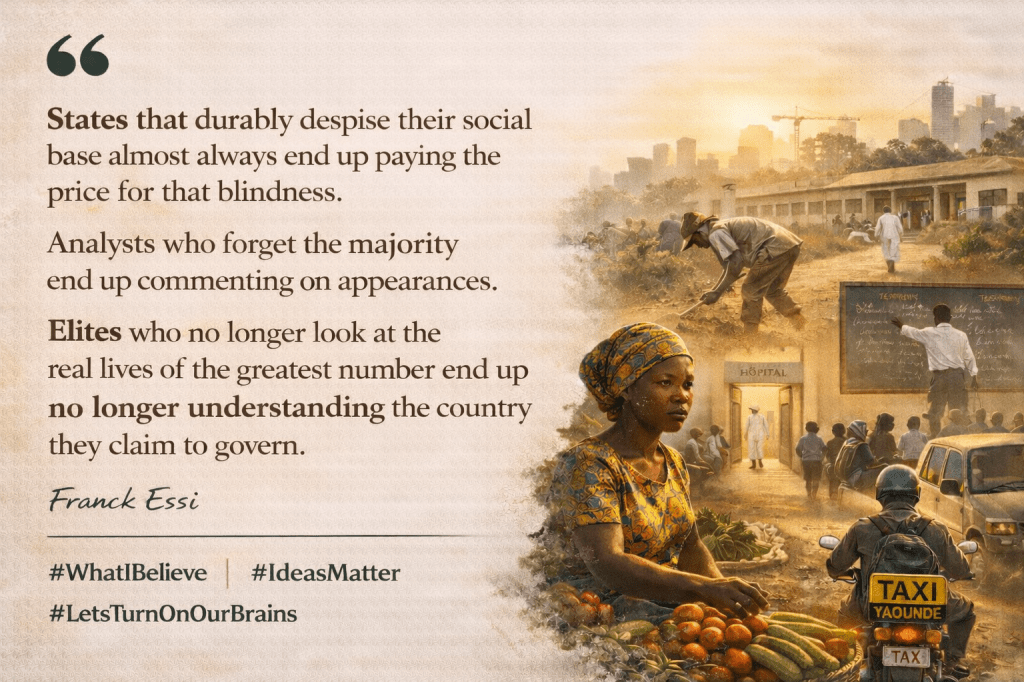
States that durably despise their social base almost always end up paying the price for that blindness. Analysts who forget the majority end up commenting on appearances. Elites who no longer look at the real lives of the greatest number end up no longer understanding the country they claim to govern.
That is why I have chosen this compass.
Not out of kindness.
Not out of political romanticism.
But out of realism.
Because in the end, there is no serious politics against the majority.
And there is no truly useful analysis that begins anywhere other than with it.
People First!
At last.
Franck Essi
#WhatIBelieve
#IdeasMatter
#LetsTurnOnOurBrains