In our quest for transformation, we often make a serious mistake: we assume that a corrupt, inefficient, or opaque system is simply a “sick” system waiting to be healed.
That is an illusion.
A worn-out system is not passive.
It is a living organism with a survival instinct. It develops its own antibodies to neutralize change.
Understanding this resistance is not an invitation to fatalism.
It is a strategic necessity for anyone who wants to endure.
1. Apparent disorder is often an organized order
For many young citizens, dysfunction seems irrational:
Why is the administration so slow?
Why is merit not the rule?
Why does favoritism persist even while destroying the country?
The answer is brutal:
this disorder benefits certain people.
🔹 Where rules are unclear, power becomes a commodity.
🔹 Where procedures are opaque, some people can monetize access, speed, or decisions.
🔹 Where merit threatens established positions, the system often prefers the loyalty of the incompetent to the unpredictability of the talented.
When you demand transparency, rigor, or accountability, you are not simply proposing a technical improvement.
You are threatening an economy of disorder.
That is why resistance is often aggressive, subtle, and systemic.
2. Sometimes, even the victims defend the system
The most disturbing reality is that resistance does not only come from above.
It also comes from people who suffer under the system.
Why?
🔹 Because even a bad system can feel predictable.
🔹 Because change creates uncertainty.
🔹 Because many people have learned how to survive within disorder.
🔹 Because the phrase “This is how we’ve always done things” slowly puts critical thinking to sleep.
The system achieves its greatest victory when it convinces young people that:
“Everyone is the same.”
“Nothing will ever change.”
“It is safer to adapt than to resist.”
But cynicism is not wisdom.
It is the psychological victory of the status quo.
3. Old systems have methods to discourage you
Every committed young person must learn to recognize these methods:
🔸 Mockery
You will be called naïve, unrealistic, or a “lesson giver.”
The goal is to make you doubt yourself.
🔸 Isolation
They will try to make you feel alone, strange, or excessive.
The goal is to disconnect you from others.
🔸 Co-optation
If you become influential, the system may offer you a position, an advantage, or a compromise.
The goal is to turn collective commitment into personal comfort.
🔸 Exhaustion through inertia
The system smiles at you, listens to you, promises change… and then does nothing.
The goal is to wear down your energy through endless waiting.
This is the strategy of the cotton wall:
the system does not always fight you directly; sometimes it slowly absorbs you.
4. The real response: building strategic endurance
Change does not only require courage.
It requires intelligence, method, and consistency.
Consistency is not blind stubbornness.
It is not smashing your head against a wall until you break.
It is continuing to seek a way through the wall while looking for cracks, leverage, alliances, and alternative paths.
To endure over time, we must:
✅ Create islands of alternative practice
This means building, even on a small scale, spaces where the rules we want for tomorrow are already applied today.
For example: within an association, people can choose transparency in finances, punctual meetings, and merit-based responsibilities instead of favoritism.
A small but disciplined group can become living proof that another model is possible.
✅ Apply tomorrow’s values inside our own organizations
We cannot condemn disorder in society while reproducing the same disorder in our groups, parties, associations, or businesses.
Change begins with coherence.
For example: respecting commitments, reporting honestly on finances, listening to dissenting opinions, preparing meetings seriously, and respecting deadlines.
If we want a fairer, more effective, and more responsible country, we must already practice fairness, seriousness, and responsibility wherever we hold influence.
✅ Prove through results that another model works
Speeches alone are not enough.
People believe what they can see working.
If a young team shows that it can organize activities properly, manage projects seriously, mobilize citizens honestly, or solve local problems with limited resources, it becomes an example.
Results are stronger arguments than slogans.
✅ Accept small victories
Many people give up because they want immediate transformation.
But in blocked systems, every step forward matters.
Introducing one good practice in an organization, convincing ten people to think differently, achieving greater transparency in one small process, or training a few young people in critical thinking: these are already victories.
A small victory is not a small thing.
It is a seed.
✅ Understand that even one millimeter matters in a long struggle
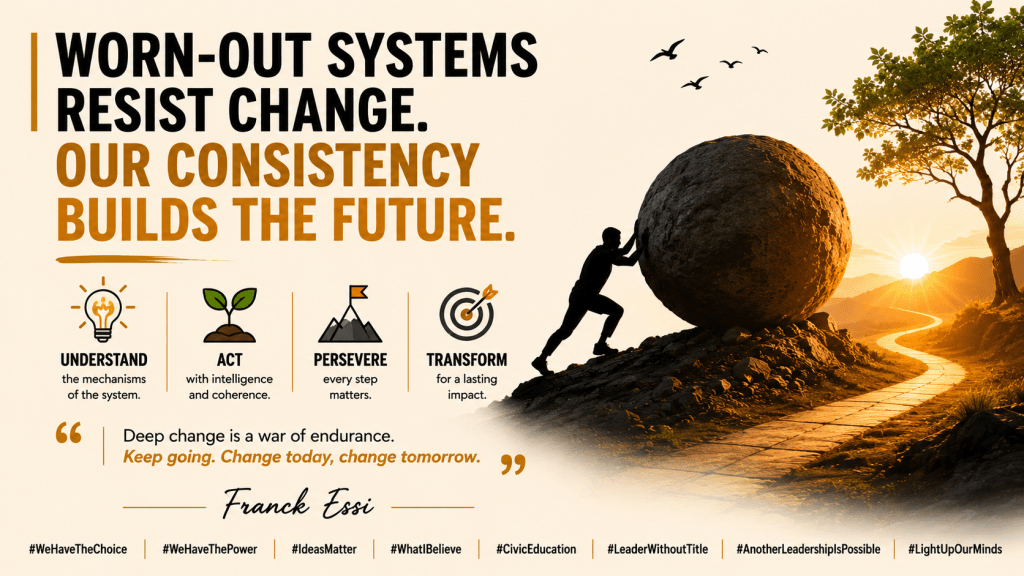
Deep change is often slow.
It can feel like striking a rock again and again without seeing any crack. Then one day, it finally breaks.
It was not only the final strike that broke the stone. It was all the previous strikes as well.
In the same way, every meeting, every article, every training session, every civic action, and every meaningful conversation prepares the ground.
Nothing is wasted when it builds consciousness, organization, and confidence.
Do not give up because change is slow.
Do not give up because the obstacles are huge.
Do not give up because the old system resists.
Worn-out systems always collapse under the weight of their own contradictions.
Our role is not to beg them to change.
Our role is to be ready, equipped, consistent, and organized to build what comes next.
Franck Essi
#WeHaveTheChoice
#WeHaveThePower
#IdeasMatter
#WhatIBelieve
#CivicEducation
#LeaderWithoutTitle
#AnotherLeadershipIsPossible
#LightUpOurMinds

