By Franck Essi
—-
May 1st should not be, in Cameroon, a simple ritual of supervised parades, official slogans, and commemorative fabrics. This date should first recall a fundamental historical and political truth: workers’ rights have never been given — they have always been wrested, defended, and then often challenged. In Cameroon too, social gains were born from power struggles, sacrifices, strikes, mobilizations, repressions, and long-term political commitments.
But commemorating is not enough. We must return to the long history of workers’ resistance, to the articulation between social struggle and national struggle, to the gains obtained, the accumulated failures, the current dead ends of trade union organizations, and the conditions for a genuine revival of popular mobilization. For the question of labor does not reduce to wages: it refers to citizenship, justice, dignity, sovereignty, and ultimately, to the very nature of the Cameroonian State.
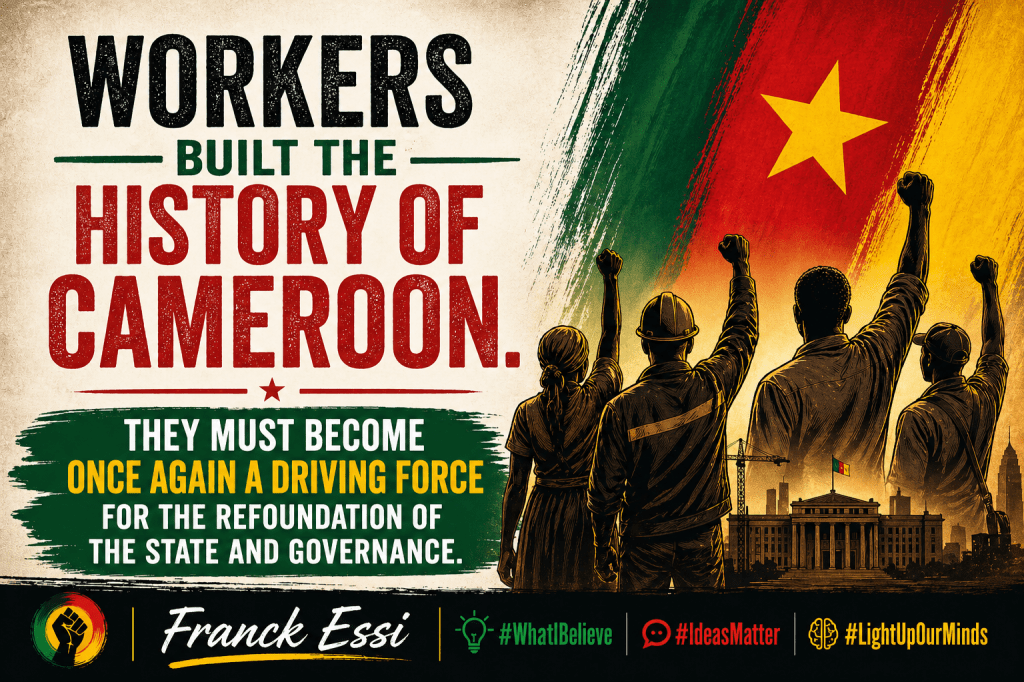
The main lesson is clear: without workers’ reinvestment in social, economic, and political struggle, and without the refoundation of the State and governance, no lasting progress will be possible.
—-
At the Origins: Workers’ Resistance Under Colonization
The history of Cameroonian workers’ struggles did not begin in 1940, nor even in 1945. It is inscribed in a longer timeframe — that of proto-unionism and social resistance that emerged as early as the 1920s and 1930s, in a context where the colonial administration fought against any autonomous self-organization of African workers. Even before the legal recognition of trade union rights, forms of mutual aid, professional groupings, mutualist associations, and semi-clandestine organizations served as a matrix for the emergence of a workers’ and advocacy consciousness.
Structures such as the ASFAC (Association des Fonctionnaires et Agents du Cameroun — Association of Civil Servants and Agents of Cameroon), identified in the 1930s, testify that Cameroon’s labor world was already seeking to organize itself despite colonial obstacles.[6] The true legal turning point came in 1944, when colonial authorities finally opened the possibility for Cameroonians to form professional trade unions, in the wake of the Brazzaville announcements. On December 18, 1944, the creation of the USCC (Union des Syndicats Confédérés du Cameroun — Union of Confederated Trade Unions of Cameroon) in Douala marked a decisive step in the visible structuring of the Cameroonian labor movement.
The year 1945 revealed the subversive potential of this movement in broad daylight. In September, in Douala, a strike by railway workers and day laborers that spread to working-class neighborhoods was crushed in blood by armed settlers with the complicity of the colonial order; several accounts mention dozens of deaths and a manhunt against trade unionists, including Léopold Moumé Etia. This episode established, from the very beginning, a truth that Cameroonian history would confirm time and again: the workers’ struggle has always been inseparable from the political and racial repression inherent to the colonial system.
—-
Social Struggle and National Struggle: The Role of Trade Unionists in the Fight for Reunification and Independence
One of Cameroon’s major specificities is that the labor question very early merged with the national question. Trade unionism did not only carry wage or corporate demands; it contributed to the emergence of a political consciousness oriented toward emancipation, reunification, and independence.
The founding of the UPC (Union des Populations du Cameroun — Union of the Peoples of Cameroon) in 1948 in Douala illustrates this articulation. Among the founders were several personalities linked to the labor world, including Léopold Moumé Etia, confirming the deep bridges between the labor movement and the nationalist movement. After the repression of September 1945, responsibility within trade union organizations became more Cameroonian: Ruben Um Nyobè became secretary general of the USCC (Union des Syndicats Confédérés du Cameroun) in 1947, before playing a central role in the UPC.
The UPC explicitly asserted that economic demands are inseparable from political demands: there can be no social emancipation without national sovereignty and without transformation of the structures of domination shaping the colonial economy. This reading explains why trade unionists, teachers, urban workers, young militants, and committed laborers participated, directly or indirectly, in the fight for reunification and for a real independence — not one simply handed down from above.
This memory must be rehabilitated. It reminds us that a powerful labor movement does not settle for negotiating sectoral advantages: it weighs on the very definition of the national destiny.
—-
Real Gains, Won Through Struggle
The social history of Cameroon is not only a history of repression. Workers have obtained real victories, even if they remain partial, fragile, and often poorly enforced.
Legal and Trade Union Gains
- 1944: creation of the USCC (Union des Syndicats Confédérés du Cameroun — Union of Confederated Trade Unions of Cameroon) in Douala, the first structured framework of the Cameroonian labor movement.
- 1967: enactment of Cameroon’s first Labor Code, which laid the foundations for more modern protection of workers.
- 1977: trade union unification around the UNTC (Union Nationale des Travailleurs du Cameroun — National Union of Cameroonian Workers), providing a national framework, even though it remained heavily politically controlled.
- 1992: adoption of Law No. 092/007 of August 14, 1992 on the Labor Code — a central text enshrining trade union freedom, regulating the right to strike, and structuring labor relations.
- 1990s: rise of trade union pluralism with the affirmation of organizations such as the CSTC (Confédération des Syndicats des Travailleurs du Cameroun — Confederation of Trade Unions of Cameroonian Workers) in a context of political opening.
Rights Recognized in Legislation
Cameroonian labor law today recognizes several important guarantees: a legal working week of 40 hours, overtime pay increases, protection against unfair dismissal, paid leave, and the formalization of some employer obligations. These provisions are the product of historical power struggles, not spontaneous concessions from employers or the State.
Sectoral Struggles and Negotiated Victories
Even recent advances confirm that struggle is the key. In manufacturing industries, the wage scale tied to the SMIG (Salaire Minimum Interprofessionnel Garanti — Guaranteed Minimum Interprofessional Wage) of 60,000 FCFA (Franc CFA) in March 2024 was obtained through social negotiation and trade union pressure within SYNDUSTRICAM (Syndicat des Industries, du Commerce et des Services du Cameroun — Trade Union of Industries, Commerce and Services of Cameroon). In the oil sector, the collective agreement signed in November 2024 did not fall from the sky: preceded by a formal trade union initiative, a joint mixed commission established as early as March 2023, and months of discussions, it resulted in the revision of 26 articles with improvements on allowances, housing, health, and career guarantees.
Whether it takes the form of a strike, public mobilization, collective bargaining, or political challenge, every lasting gain proceeds from struggle.
—-
The Major Contemporary Sectoral Struggles
Teachers: From the « Dead Chalk » to the Crisis of the Educating State
The education sector has become one of the main centers of social conflict in Cameroon. In 2022, the OTS (On a Trop Supporté — We Have Endured Too Much) movement popularized the « dead chalk » operation to denounce career delays, insufficient remuneration, administrative slowdowns, and the deterioration of the public education service. In 2025, organizations such as the COREC (Collectif des Organisations Revendicatives des Enseignants du Cameroun — Collective of Advocacy Organizations of Cameroonian Teachers) relaunched pressure with strike calls, « dead school » operations, and threats to boycott examinations, around issues of teacher status, regular payment, sectoral dialogue, and a collective agreement for the private sector.
This struggle goes far beyond the wage question. It reveals the crisis of a State incapable of managing careers, ensuring regular payments, planning recruitments, and seriously protecting public schools. When teachers fight, it is the entire question of public governance that is at stake.
The Oil Sector: Gains Wrested Through an Organized Power Struggle
The oil sector corrects a false idea: advances there were not obtained without struggle. If a new collective agreement was signed in 2024, it is because there was a trade union demand, structured negotiation, collective pressure, and perseverance in the power struggle. Even when struggle does not take the form of a spectacular strike, it exists as initiative, coordination, and organized resistance. This reality needs to be stated clearly, at a time when some would like to promote the idea that consultation alone suffices without a power struggle.
The Informal Sector: The Social Majority Still Unarmed
The main labor front in Cameroon remains the informal sector. According to data from the EESI3 (Enquête sur l’Emploi et le Secteur Informel, troisième édition — Survey on Employment and the Informal Sector, third edition), 90.4% of the active population operates within it, and approximately 3.7 million actors were counted there in 2024. In this world, only 6 workers in 100 are salaried employees, 78.3% work for themselves, barely 2.1% have a written contract, and 47.2% work more than 40 hours per week without any protection whatsoever.
An immense majority of Cameroonian workers thus remains outside the effective protection of mainstream labor law. Any revival of the labor movement that neglects the informal sector, small trades, urban informal economy, women traders, and precarious forms of activity will remain socially marginal — and therefore politically insufficient.
—-
Trade Unions Today: Between Social Utility, Representativeness Crisis, and Internal Drift
It would be politically insufficient to blame only the State or employers. The current crisis in workers’ mobilization also stems from internal weaknesses within the Cameroonian trade union landscape. Several analyses highlight organizational fragmentation, the politicization of apparatuses, the personalization of leadership, weak implantation in the informal sector, and insufficient militant renewal.
Contemporary Cameroonian trade unionism remains marked by the legacy of accompanying unionism — shaped over decades of political control and authoritarian unification. This history has left reflexes of dependence on power, a culture of weak accountability, and in some cases, clientelist practices that drive workers away from their own organizations.
These weaknesses deserve to be named directly:
- Weak internal democracy, with leaderships that are rarely renewed and insufficiently accountable to the rank and file.
- Proximity to power networks, which undermines advocacy autonomy.
- Partisan politicization, turning some trade unions into vehicles for political disputes rather than instruments for defending labor.
- Inability to sustain mobilization among young people, precarious workers, and those in the informal sector.
- Often sterile social dialogue, lacking binding mechanisms and sufficiently structured power relations.
Saying this does not weaken the trade union cause — on the contrary, it takes it seriously. There will be no renaissance of the labor movement without the democratization, moralization, and social re-rooting of the unions themselves.
—-
The Structural Blockages That Limit Hard-Won Gains
The gains wrested through struggle are constrained by deep structural blockages that limit their real impact.
The persistent absence of a specific law on trade unions — awaited since the 1990 law on freedom of association — weakens the consolidation of a modern, protected, and fully recognized trade unionism. On the wage front, the SMIG (Salaire Minimum Interprofessionnel Garanti — Guaranteed Minimum Interprofessional Wage) was set in 2024 at 60,000 FCFA (Franc CFA) in the non-agricultural private sector, at 45,000 FCFA in the agricultural sector, while the SMIG for State agents under the Labor Code was raised to 43,969 FCFA after a 5% increase. These amounts remain insufficient in the face of inflation estimated at 6.3% and the continuous erosion of purchasing power.
On the poverty front, the results of the ECAM5 (Enquête Camerounaise Auprès des Ménages, cinquième édition — Cameroonian Household Survey, fifth edition) are unequivocal: the poverty incidence rose from 37.5% to 38.6% between 2014 and 2021, while the richest 20% consume approximately 10 times more than the poorest 20%. The World Bank emphasizes that lasting poverty reduction requires better job creation and more effective social investments — something that Cameroonian public policies have yet to produce.
As for the official unemployment rate hovering around 3.6%, it masks the reality of massive underemployment, dominant informality, and formal salaried employment growth limited to 2.5% in 2024, compared to 5.1% in 2023. The problem of labor in Cameroon is less the total absence of activity than the proliferation of precarious, poorly paid, and unprotected jobs.
—-
Why the Labor Question Leads to the Refoundation of the State
Cameroon’s labor crisis cannot be isolated from the broader crisis of the State and governance. When a country fails to effectively protect trade union freedom, enforce collective agreements, properly pay its teachers, extend social protection, and offer prospects to its laboring youth, the problem is no longer sectoral: it is institutional and political.
The refoundation of the State requires at minimum:
- the restoration of the rule of law against administrative arbitrariness;
- genuine, regular, and transparent social dialogue;
- an economic policy oriented toward decent employment rather than mere statistical growth;
- more specialized and more accessible social justice;
- governance accountable to citizens, particularly in the most neglected territories.
The White Paper of the Trade Union Movement published in 2025 is, in this regard, an important document. It proposes raising the SMIG (Salaire Minimum Interprofessionnel Garanti — Guaranteed Minimum Interprofessional Wage) to 150,000 FCFA (Franc CFA), the enactment of the law on trade unions, the repeal of the anti-terrorism law used against social movements, strong measures for youth employment, and broader reflection on the transformation of public governance. This confirms a truth too often sidestepped: the labor question is also a question of institutional regime.
—-
What Conditions Are Needed for Future Success?
Past decades show that no social progress flows from the mere goodwill of those in power. Rebuilding a labor movement equal to contemporary challenges requires political, organizational, and moral conditions that trade union actors must fully own.
Among the essential conditions:
- rebuilding a consciousness of solidarity among workers in the public, private, and informal sectors, breaking with the sectoral corporatism that fragments forces;
- documenting demands rigorously — data on cost of living, wages, productivity, inequalities — so that negotiations are grounded in facts;
- organizing beyond traditional salaried employment, reaching out to precarious workers, the self-employed, platform workers, and those in small trades who today constitute the reality of Cameroonian labor;
- training a new generation of trade union militants, capable of negotiating, mobilizing, and proposing concrete institutional reforms;
- democratizing and moralizing trade unions, to restore the trust of a base that has progressively distanced itself from them;
- building alliances between trade unions, civil society, youth, and political forces committed to social justice;
- making May 1st a moment for assessment, program, and mobilization — not a simple ceremonial routine that consumes militant energy without ever converting it into a power struggle.
In sum, no lasting progress will be possible without a massive reinvestment of workers in social, economic, and political struggle. Sectoral retreat, passivity, and clientelist compromises structurally weaken the labor camp. Conversely, when workers once again become an organized, democratic, lucid, and assertive force, they can once again weigh on the economic, social, and institutional choices of the country.
—-
Conclusion
The history of Cameroonian workers is a long history of struggles, far older than the commemorations of May 1st alone. It sinks its roots into the workers’ resistance of the colonial period, extends through the blood of Douala in 1945, meets the struggle for reunification and independence through the bridges between trade unionism and the UPC (Union des Populations du Cameroun — Union of the Peoples of Cameroon), and continues today in the battles of teachers, oil workers, formal sector employees, and the immense majority relegated to the informal economy.
This history teaches one simple thing: struggle is the key. Rights do not advance by themselves; they advance when workers organize, resist, negotiate, unite, and take responsibility for intervening in national life. But this truth imposes an additional demand: the trade union movement itself must refound itself, democratize, and break with clientelist drift to recover a genuine popular footing.
Cameroon will build neither lasting social justice, nor shared prosperity, nor a protective State without workers returning to the center of the democratic struggle. Reinvesting in social, economic, and political struggle is therefore not one option among others: it is a historical necessity. For the refoundation of the State and governance will also pass — and perhaps above all — through the rebirth of a workers’ movement conscious of its strength, its history, and its responsibility in the national destiny.
Franck Essi
#WhatIBelieve
#IdeasMatter
#LightUpOurMinds
 franckessi.com