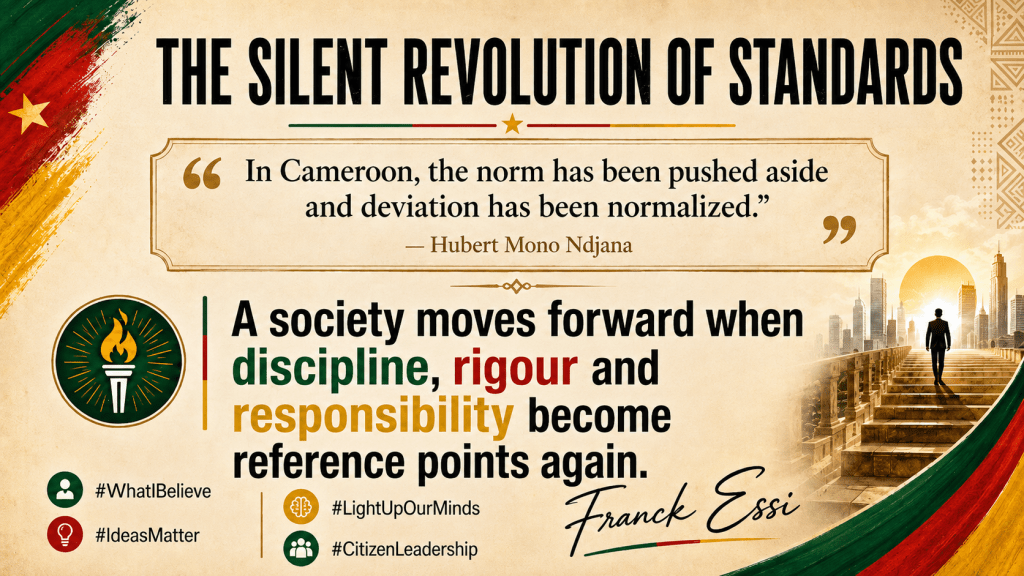
The philosopher Hubert Mono Ndjana once offered a powerful formula to describe one of our great collective tragedies:
“In Cameroon, we have pushed aside the norm and normalized the deviation.”
This sentence says almost everything.
It describes what happens to a society when:
• the abnormal becomes ordinary;
• disorder becomes tolerable;
• lateness becomes banal;
• incompetence becomes accepted;
• mediocrity no longer shocks anyone.
Some revolutions begin in the streets.
Others begin in institutions.
But there is also a quieter, slower, deeper revolution:
the silent revolution of standards.
It begins the day we decide that approximation must no longer be our normal way of doing things.
It begins when we refuse to consider as normal:
• poorly prepared meetings;
• unkept commitments;
• sloppy documents;
• responsibilities without accountability;
• promises without follow-up;
• great ambitions carried by small disciplines.
Because the problem is not only that things are going badly.
The real problem is that we have sometimes become used to what is going badly.
We have pushed aside the norm:
• the norm of work well done;
• the norm of punctuality;
• the norm of rigour;
• the norm of keeping one’s word;
• the norm of respecting procedures;
• the norm of evaluating results.
And, at the same time, we have normalized the deviation:
• lateness;
• improvisation;
• permanent patchwork solutions;
• favouritism;
• disorder;
• lack of follow-up;
• endless excuses.
Yet no society can rise sustainably with low standards.
Changing a country also begins with changing what we accept as normal.
When an activist arrives on time, prepares their files, keeps their word, learns, contributes and reports back, they are not simply performing an individual act.
They are already taking part in a cultural revolution.
When an organization decides that:
• every meeting must be useful;
• every decision must be followed up;
• every responsibility must be assumed;
• every document must be carefully prepared;
• every commitment must be respected;
it raises its level of discipline.
And when the level of discipline rises, the results eventually change.
The revolution of standards does not always make noise.
It is not immediately visible.
It does not always bring applause.
But it slowly transforms:
• mindsets;
• habits;
• organizations;
• institutions;
• and, ultimately, society itself.
It is not about humiliating those who do less well.
It is about showing, through example, that it is possible to do better.
A people begins to rise again the day it stops seeing as normal what diminishes it.
Our struggle is therefore not only political.
It is also:
• moral;
• cultural;
• organizational;
• disciplinary;
• civic.
It is about placing the norm back at the centre:
• the norm of work well done;
• the norm of discipline;
• the norm of coherence;
• the norm of responsibility;
• the norm of accountability;
• the norm of keeping one’s word.
This is the silent revolution of standards.
It does not shout.
It does not parade.
It does not always seek the spotlight.
But it prepares the great victories.
Because great nations are not born only from great speeches. They are also born from small standards upheld every single day.
Franck Essi
#WhatIBelieve
#IdeasMatter
#CitizenLeadership
#LightUpOurMinds