—-
During a recent training session on leadership and personal management applied to militant action, we discussed a simple, almost obvious principle whose implementation can deeply transform an organization, a movement, a community, and even a country:
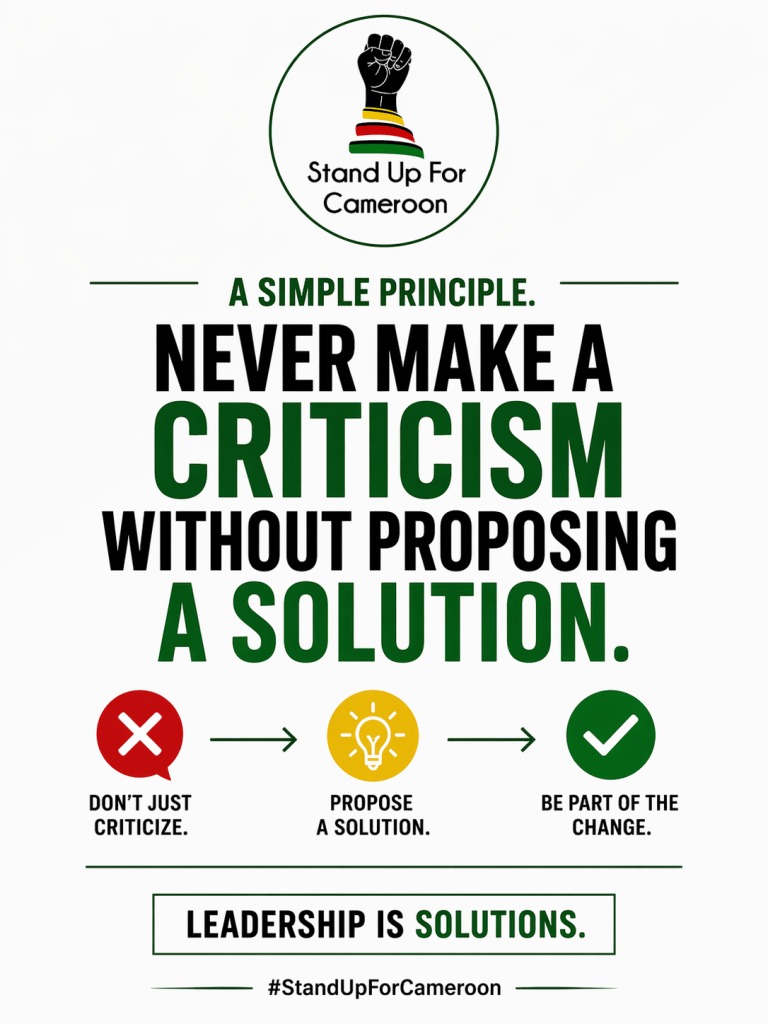
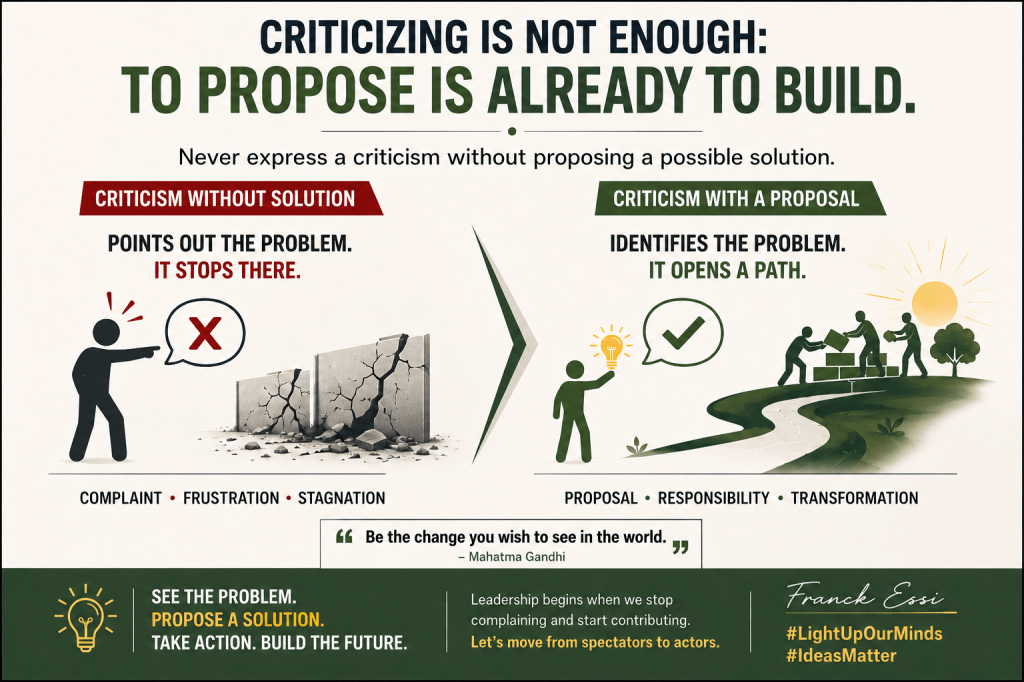
Never express a criticism without proposing a possible solution.
This principle may seem ordinary. Yet it touches on one of the major weaknesses of our collective commitments: we often know very well how to say what is wrong, but we struggle much more to say what could be done differently, better, more effectively, or more justly.
In militant action, as in public life, criticism only becomes transformative when it opens a path forward.
—-
Criticism Is Necessary, But It Is Not Enough
This is not about rejecting criticism. An organization without criticism quickly becomes a blind organization. A movement without contradiction soon becomes a space of conformity. A society where no one dares to denounce abuses eventually normalizes the unacceptable.
In an association, for example, if no one dares to say that a meeting was poorly prepared, that responsibilities were badly distributed, or that decisions are never followed up, the same mistakes will keep repeating themselves. In a political party, if no one points out the contradictions between public discourse and internal practices, the organization may gradually lose its credibility. In a country, if citizens stop criticizing injustice, abuse, and dysfunction, arbitrariness eventually becomes a habit.
Criticism can therefore be useful. Sometimes, it is even a duty.
But not all criticism has the same value.
There is first criticism that enlightens. It helps us see what was not clearly perceived. It names a problem, identifies a weakness, and draws attention to a blind spot. For example, saying after a militant activity: “We mobilized many people, but we did not sufficiently prepare the reception of new participants,” is not destroying the work done. It is helping the organization do better next time.
Then there is criticism that corrects. It does not merely say that something is wrong; it proposes a concrete improvement. For example: “Communication around the event came too late. Next time, we should prepare a publication calendar two weeks in advance, with visuals, short messages, and clear responsibilities.” Here, criticism becomes immediately useful because it opens a path for progress.
There is also criticism that warns. It appears when one sees a serious risk for the organization, the movement, or the cause. For example, when a militant says: “Be careful: if we continue to operate without minutes, without follow-up on decisions, and without clarified responsibilities, we will create confusion and frustration.” Such criticism may disturb, but it can save a collective dynamic.
But there is also criticism that humiliates. It does not seek to improve things, but to belittle people. It does not say: “This task was poorly executed.” It says instead: “You are incompetent,” “You never understand anything,” or “With people like you, nothing can move forward.” This type of criticism wounds, closes ears, and destroys trust.
There is also criticism that destroys. It generalizes, darkens everything, refuses to acknowledge what has been done, and offers no way out. For example: “This organization is useless,” “Everything is bad,” “There is nothing worth saving.” Even when it comes from a real discomfort, this kind of criticism produces discouragement rather than correction.
Finally, there is criticism that merely releases personal frustration. It often comes out as anger, sarcasm, or repeated complaint. It may be right on certain points, but it helps no one move forward. For example: “We told you this would fail,” “Anyway, nobody ever listens here,” or “I will not say anything anymore.” This criticism expresses fatigue or hurt, but it does not transform the situation.
This is where the difference begins between a spirit of complaint and a spirit of responsibility.
—-
Leadership Begins When Criticism Becomes Contribution
Anyone can say:
“This does not work.”
“This was not well done.”
“The leaders have failed.”
“The organization is poorly structured.”
“Things should have been done differently.”
But leadership begins at another level.
It begins when we add:
What do we propose?
What improvement do we suggest?
What alternative are we putting on the table?
What part are we willing to take in the solution?
Take a simple example. In an organization, a member may say: “Meetings always start late.” That is criticism. It may be true. But it becomes contribution when the person adds: “I propose that the agenda be sent the day before, that the meeting start at the scheduled time, and that latecomers join without interrupting the work.”
Another example: a militant may say: “We are not present enough on the ground.” Again, this is criticism. But it becomes useful when the person adds: “We can organize a monthly field visit in the neighborhoods, with one small team in charge of citizen listening, another in charge of documentation, and another in charge of follow-up.”
In the same spirit, saying “our communication is weak” may be true, but it remains insufficient. Saying instead: “Our communication is weak; I propose that we set up an editorial calendar, shorter messages, more coherent visuals, and a small team dedicated to monitoring our platforms,” is already entering into construction.
A militant, a leader, a citizen, or a mature public actor does not merely observe dysfunctions. He or she seeks to understand their causes, identify areas for improvement, and propose ways to correct them.
Because seeing a problem is one thing; helping to solve it is another.
—-
From the Posture of Spectator to the Posture of Actor
In our organizations, movements, and civic spaces, we must gradually move away from a culture in which many people observe, comment, and criticize, while few feel responsible for contributing.
We all know these scenes: after a meeting, some people say in the corridors what they did not dare to say in the room. After an activity, some explain to their friends everything that did not work, without ever proposing an improvement to the team concerned. In a WhatsApp group, some people only react when there is an error to denounce, but remain silent when it is time to prepare, organize, mobilize, or contribute.
This posture weakens collective dynamics. It creates two implicit categories: those who carry the burden of action, with their limits and mistakes, and those who reserve for themselves the comfort of permanent commentary.
The real question is therefore not only:
What is wrong?
The real question is also:
What can I do, at my level, to make things better?
This change in posture is decisive.
It moves us:
- from complaint to proposal: instead of simply saying “nothing is organized,” say “let us put in place a clear task calendar”;
- from frustration to initiative: instead of repeating “I am never involved,” propose “I can take responsibility for this specific area”;
- from denunciation to construction: instead of simply saying “this method is bad,” explain “here is a more effective method we can test”;
- from indignation to responsibility: instead of stopping at “this is unacceptable,” ask “what concrete action can we take?”;
- from commentary to action: instead of remaining in permanent analysis, accept to carry a task, a file, an initiative.
The person who only criticizes may be right in the diagnosis. But the person who proposes already enters the dynamic of change.
The person who denounces may raise an alert. But the person who brings a solution begins to build.
The person who sees a weakness and suggests an improvement is already helping to raise the collective standard.
—-
Proposing Does Not Mean Having All the Answers
However, we must avoid a misunderstanding. Proposing a solution does not mean claiming to possess absolute truth. It does not mean having a perfect, complete, or final answer.
Sometimes, it is enough to formulate a path.
A hypothesis.
A possible improvement.
A different method.
A useful question.
An alternative to be discussed.
For example, in a team struggling to mobilize, someone may simply say: “I am not sure this is the best solution, but we could try, for one month, to call ten people directly every week instead of relying only on messages in groups.” This is not a perfect solution, but it is a testable path.
In a movement where tasks are poorly followed up, someone may suggest: “What if, after each meeting, we had a small table with three columns: decision taken, person responsible, deadline?” Again, the point is not to pretend to solve everything. It is to introduce a little more method.
In an organization facing internal tensions, someone may say: “Before accusing one another, let us hold a session to clarify the facts, listen to perceptions, and identify what needs to be corrected.” This proposal does not solve everything, but it prevents conflict from becoming a collective poison.
The essential thing is not to let criticism fall like a dead stone.
Useful criticism should always become working material. It should help us think better, organize better, decide better, and act better.
This is how organizations grow. This is how movements become stronger. This is how societies learn to transform themselves.
—-
Embodying the Change We Call For
The best response to the weaknesses we denounce may be this deeper requirement: to become, ourselves, part of the solution.
In the spirit of the famous invitation often attributed to Gandhi, it is not enough to want the world to change. We must also accept to embody, at our own level, part of the change we call for.
If we want more rigorous organizations, let us be more rigorous. This can begin with simple things: arriving on time, reading documents before meetings, honoring commitments, and reporting on what we have done.
If we want more responsible movements, let us be more responsible. This means not disappearing when a task becomes difficult, not promising what we will not do, and not publicly criticizing what we refuse to help improve internally.
If we want more fraternal spaces, let us be less destructive in our words and behaviors. This means criticizing actions without crushing people, correcting without humiliating, expressing disagreement without discrediting the other person’s commitment.
If we want a better-governed country, let us begin by cultivating, within our own commitments, a sense of discipline, method, and contribution. For we cannot demand virtuous governance at the top of the State while normalizing, in our own spaces, disorder, irresponsibility, improvisation, and the absence of accountability.
Collective transformation often begins with personal discipline.
—-
The Challenge of Our Collective Commitments
In a country like Cameroon, where frustrations are numerous, injustices are deep, and dysfunctions are visible, criticism is inevitable. It is even necessary.
But if we truly want to build something different, we must go further.
We must learn to turn every criticism into an opportunity for improvement.
Every disagreement into an opportunity for clarification.
Every identified weakness into a project for strengthening.
Every observed mistake into a lesson for doing better.
This applies to political parties, civic movements, associations, businesses, administrations, families, and religious communities. Wherever human beings work together, there will be limits, errors, tensions, and clumsiness. The question is therefore not whether there will be problems. There will always be problems. The real question is whether we will know how to transform those problems into opportunities for learning.
An organization becomes stronger when its members do not merely denounce what is missing, but help create what is missing.
A movement becomes more credible when its militants are not only lucid commentators, but demanding builders.
A society moves forward when its citizens understand that criticism is necessary, but contribution is indispensable.
—-
My Deep Conviction
We need a new culture of engagement.
A culture in which criticism is not forbidden, but elevated.
A culture in which disagreement is not silenced, but directed toward the search for solutions.
A culture in which everyone understands that denouncing is not enough if one does not also contribute to building.
Criticizing can be a beginning.
Proposing is already a commitment.
Contributing is entering the history of change.
That is why I deeply believe that militant leadership begins when we stop asking only what is wrong, and begin asking also:
What part of the solution can I bring?
It is at this level that criticism becomes useful.
It is at this level that commitment becomes serious.
It is at this level that leadership becomes transformational.
Criticizing without proposing may release anger.
Criticizing while proposing may open a path.
But criticizing, proposing, and contributing is already beginning to change reality.
Franck Essi
#PoliticalTransition
#LightUpOurMinds
#Leadership
#IdeasMatter
 franckessi.com