By Franck Essi
This text was written on November , 3 2020, the day after the massacre at Mother Francisca International School in Kumba, South West Cameroon, which claimed the lives of 9 children. It is republished today in the wake of the historic visit of Pope Leo XIV to Bamenda — the first papal visit to the heart of the Anglophone region — which has placed the question of peace and reconciliation in the North West and South West of Cameroon back at the centre of international attention. Six years on, the questions raised here remain entirely unresolved.

….
In the aftermath of the Kumba massacre of October 24, 2020, we observed various types of reactions across the Cameroonian public sphere, particularly on social media.
Among the reactions universally shared, we noted the expression of grief, the shock to our collective human conscience and, consequently, the firm condemnation of the abject murder of these children. Even the most vehement proponents of secession condemned, at least this once, an act that defies description.
This demonstrates that even those who champion an armed struggle to « liberate their people » or « restore their independence » hold to certain principles, and publicly acknowledge that killing children is to commit the unforgivable, the irreparable.
On the Government’s side, before any investigation had concluded, officials hastened to accuse the « secessionist terrorists, » claiming to have already « neutralised » one of the perpetrators.
Faced with this unspeakable horror, the indifference and detachment that had characterised a large part of the population were seriously shaken, prompting people who, not long before, had felt no obligation to mobilise, to say: « Enough is enough. »
That « Enough is enough » gave rise to two diametrically opposed calls: #EndAnglophoneCrisis versus #EndAmbazoniaTerrorism, each unilaterally pointing the finger at a designated set of responsible parties.
But what is precisely at stake? Which rallying cry is the more appropriate one?
—
I — END AMBAZONIA TERRORISM
For those who rally around this slogan, the principal problem in this crisis and war is the terrorism of Ambazonia’s armed factions. This terrorism struck, most recently, against the children of Mother Francisca International School on October 24, 2020.
Before that, it struck down Florence Ayafor, Comfort Tumasang and countless others. It will, regrettably, strike again in the near future; we have a duty to stop it — swiftly, firmly and definitively, even if that means employing the most forceful means at the State’s disposal.
This terrorism manifests through every form of barbarity and savagery against civilians, as much as against the defence and security forces. It entrenches insecurity and paralyses all activity. It is thanks to this terrorism that « lockdown » and « ghost town » operations persist.
This is the primary lever and driving logic of Ambazonian operations — the weapon of cowards, of those incapable of confronting the regular army head-on.
Through the moral, psychological and physical violence it inflicts on civilian populations, Ambazonian terrorism sustains, on the one hand, the illusion of popular support for the secessionist project, and on the other, the impression that the crisis endures.
Yet, according to proponents of « End Ambazonia Terrorism, » the « secessionist terrorists » are in disarray, in total rout. To survive and delay their downfall, they are forced to reveal their true face to the world: bestiality, inhumanity, horror.
In doing so, they demonstrate that they no longer belong to the community of civilised persons, with whom dialogue is possible. They become enemies of life itself and must, purely and simply, be deprived of that same life of which they are no longer worthy.
Proponents of « End Ambazonia Terrorism » therefore prescribe focusing on the neutralisation and/or elimination of these individuals. But in doing so, do they genuinely create the conditions for a rational and republican resolution of a crisis whose underlying causes are well known and uncontested?
For them, ultimately, neutralising these « secessionist terrorists » is equivalent to automatically creating the conditions for a full resolution of the problems faced by the populations of the South West and North West.
But what do the proponents of « End Anglophone Crisis » think?
—
II — END ANGLOPHONE CRISIS
For the partisans of « End Anglophone Crisis, » the many missed historical appointments are at the root of the Kumba disaster.
Invoking the long view — the 1961 Reunification — and the shorter arc — the beginning of the crisis in 2016 — they attribute the current situation to the mismanagement of legitimate grievances, State violence, the imprisonment of the original and peaceful leaders, the mockery of a national dialogue (grand in title, derisory in outcomes) and a ruthless, one-dimensional military strategy.
The rise of the secessionists in public opinion — first among Anglophones —, the taking up of arms and the atrocities we now witness are the consequence of a regime logic in Yaoundé, designed to respond to the demands of the Consortium’s member organisations with nothing but the instrument of fury.
These partisans condemn violence wherever it originates, but reiterate that this crisis cannot be resolved through the sole prism of military force. The security dimension is a consequence, not the core issue.
The core issue is the need for autonomy and the rejection of assimilation by the people of the former Southern Cameroon, expressed through at least four demands:
▶️ Greater decision-making power at the local level.
▶️ Greater resources to implement meaningful development projects.
▶️ Greater security and protection for communities.
▶️ The recognition and preservation of their identity through the judicial and educational sub-systems, as a minimum.
These key questions are today obscured by the war. To move forward, it is necessary to:
⏺️ Restore security, as a first step.
⏺️ Resume dialogue and negotiations, as a second step.
⏺️ Formally enshrine the new socio-political consensus, as a third step.
The partisans of « End Anglophone Crisis » therefore insist on the need for a comprehensive and multidimensional response to the crisis — one that addresses its roots, not merely its consequences.
In this context, around which rallying cry should we seek to unite our efforts toward peace?
—
III — THE RIGHT VEHICLE FOR A MOBILISATION FOR PEACE
To reach common ground, a few essential clarifications are in order.
« Ambazonian terrorism » cannot be attributed to all proponents of secession. In this asymmetric conflict, some support secession without supporting the armed struggle. Some actively oppose the atrocities committed against civilian populations and recognise this tactic as self-defeating.
Whether one accepts it or not, THIS IS A FACT.
The sincere and intellectually rigorous commentator must condemn with the utmost energy the perpetrators of massacres such as that of Kumba, but they cannot and must not reduce the entire secessionist camp to the authors of that massacre — that distinction is essential. The reason is simple: the secessionist movement is a leaderless melting pot, with no uncontested central command.
By the same token, the summary killings, extrajudicial executions, acts of torture and massacres perpetrated by certain elements of the army are equally not attributable to the army as a whole, nor to the broader population that supports the current institutions.
Crimes have been committed. Some constitute war crimes and crimes against humanity — imprescriptible under national law and international treaties. They must be tried and punished accordingly.
But beyond crimes and horrors, we must end this war and resolve this crisis.
Let us not forget that the violence currently inflicted upon civilian populations represents the consequences and critical deterioration of a crisis that is, at its core, sociopolitical.
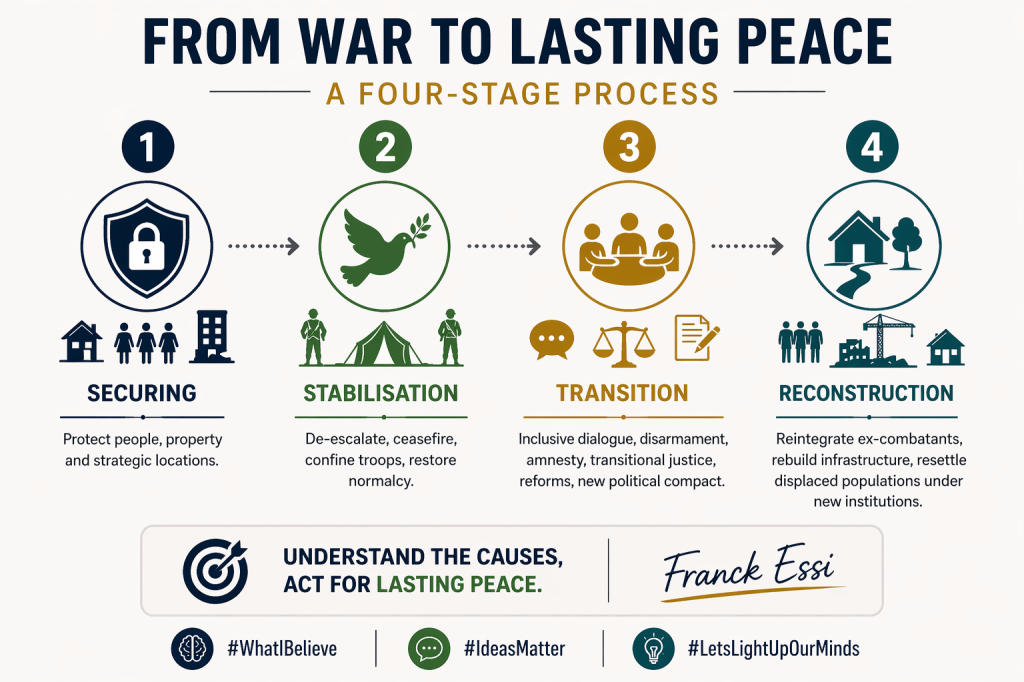
In a context of war, security must be ensured. Doing so requires a four-stage process:
✅ Securing persons, property and strategic locations — the natural imperative when violent confrontations are intense and no peace talks are underway.
✅ Stabilisation: the full range of processes and mechanisms leading to de-escalation and a return to normality — negotiating a ceasefire, confining troops to designated areas, and restoring a degree of normalcy to the lives of affected populations.
✅ Transition: an inclusive national dialogue, demobilisation of armed combatants, amnesty measures, a transitional justice mechanism, key reforms arising from a balanced dialogue, and the adoption of a new political compact.
✅ Reconstruction: the reintegration of ex-combatants, the rebuilding of destroyed infrastructure, the resettlement of displaced and refugee populations under the authority of new political institutions.
In light of all the above, it is essential to identify the most relevant and comprehensive approach.
To insist that the priority is « End Ambazonia Terrorism » is to reduce a deep-rooted crisis to its consequences, to a subset of its actors, and above all to its security dimension alone. It is to stare exclusively at the hole into which we have fallen. It is also to forget that for the populations caught in this war, the abuses of both sides must be examined and purged.
« End Anglophone Crisis » strikes us as the more complete framework, both as an objective and as an approach. It encompasses the security question, but also every other dimension raised by the crisis and throughout the war. It requires addressing root causes.
One thing remains clear to us at STAND UP FOR CAMEROON: each time we choose to miss the historical appointments that would allow us to resolve certain problems, those problems return years later in forms that are sharper, more insidious and more radical.
The issue is now squarely on the table. Let us go to the heart of the matter and confront head-on the only solution worth pursuing: the refounding of the Cameroonian State, in its nature and its form, for the good of every Cameroonian.
Franck Essi, November 3, 2020.
#WhatIBelieve | #IdeasMatter | #LightUpOurMinds | #StandUpForCameroon