—-
Frantz Fanon lived only thirty-six years, yet he left behind an immense intellectual legacy. Born on July 20, 1925, in Fort-de-France, Martinique, then a French colony, he would become a psychiatrist, political philosopher, revolutionary writer, and one of the most influential thinkers of decolonization in the twentieth century.
—-
1. A Child of Colonialism Who Became a Thinker of Liberation
Fanon grew up in a colonial society shaped by assimilation. People were taught to admire France, speak its language, and internalize its standards. Very early, however, he encountered the ideas of Aimé Césaire, his teacher, who introduced him to the critique of colonialism and the affirmation of Black dignity.
During World War II, Fanon left Martinique to join the Free French Forces. He fought for a France that nevertheless refused to fully recognize the humanity of its colonial subjects. This contradiction became central to his thinking: how can colonized people be asked to die for freedoms denied to them?
—-
2. Black Skin, White Masks: Understanding the Colonial Wound
In 1952, Fanon published Black Skin, White Masks. In this groundbreaking work, he analyzed the psychological effects of racism and colonial domination. His central idea was both simple and profound: colonization does not only occupy territories; it also wounds consciousness.
The colonized person may eventually see himself through the eyes of the colonizer. He may begin to despise his own language, skin, history, and cultural references. Fanon famously wrote:
“O my body, make of me always a man who questions!”
This sentence captures his refusal of passivity. For Fanon, freedom was not merely about changing masters. It was about learning to think independently.
—–
3. The Psychiatrist Who Saw Society Inside Individual Suffering
Fanon became a psychiatrist and worked at the Blida-Joinville psychiatric hospital in Algeria beginning in 1953. There, he realized that many psychological disorders could not be separated from systems of oppression, humiliation, and violence.
This became one of his major contributions: Fanon showed that political oppression produces deep psychological wounds. Healing therefore requires more than medicine; it also requires transforming the social conditions that destroy human dignity.
—-
4. Algeria: From Analysis to Commitment
When the Algerian War of Independence began in 1954, Fanon gradually moved from analysis to active political engagement. He joined the Algerian National Liberation Front (FLN) and, after being expelled from Algeria in 1957, continued his activism from Tunis. He became one of the leading intellectual voices of anti-colonial struggle.
In his resignation letter from the psychiatric hospital, he wrote a morally powerful statement:
“There comes a time when silence becomes dishonesty.”
This sentence still speaks to activists, intellectuals, citizens, and leaders today: there are moments when silence itself becomes complicity.
—-
5. The Wretched of the Earth: Thinking Decolonization to the End
In 1961, shortly before his death, Fanon published The Wretched of the Earth. The book became one of the foundational texts for liberation movements in Africa, Asia, Latin America, and Black diasporas worldwide.
In it, he wrote:
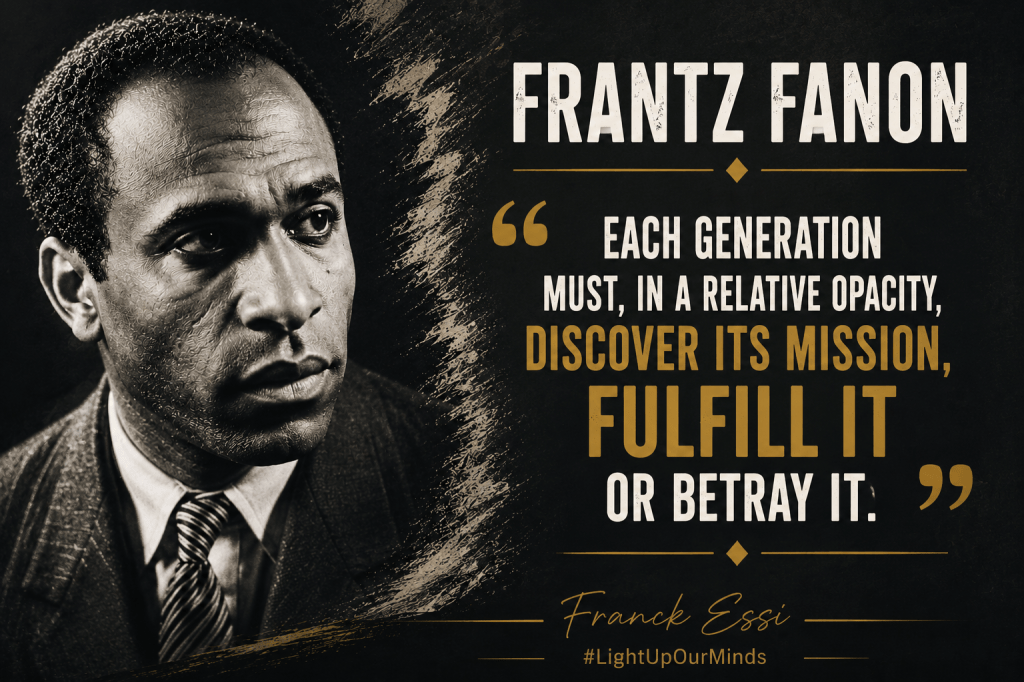
“Each generation must discover its mission, fulfill it or betray it, in relative opacity.”
This is perhaps Fanon’s most famous and enduring idea. History does not provide clear instructions. Every generation must interpret its moment, identify its responsibility, and decide whether it will rise to the occasion.
Fanon also criticized incomplete independence movements: those that merely replaced foreign rulers with local elites while leaving systems of exploitation intact.
—-
6. What Fanon Still Teaches Us Today
First lesson: domination often begins in the mind
A people may gain a flag, an anthem, and a seat at the United Nations while remaining mentally dependent. Fanon challenges us to decolonize our imagination, our standards of success, and our political thinking.
Second lesson: it is not enough to denounce; we must build
Fanon was not merely a man of anger. He was a man of clarity. He wanted oppressed peoples to become capable of creating a new world, not simply reversing positions of power.
Third lesson: intellectuals must choose their side
For Fanon, thinking was never an escape from reality. To think meant illuminating struggles, naming injustices, exposing oppressive systems, and helping people reclaim their dignity.
Fourth lesson: political independence without social transformation is an illusion
Fanon warned against false liberation: changing faces without changing structures; replacing foreign domination with domestic oppression; celebrating sovereignty while abandoning the people.
Fifth lesson: every generation has a mission
For our generation, the Fanonian question remains alive: will we fulfill our mission or betray it? Will we merely comment on disorder, or will we work to rebuild our societies?
—-
7. My Deep Conviction
Frantz Fanon reminds us that a people are not truly liberated simply by expelling a visible oppressor. They become free when they reclaim their thinking, their dignity, their courage, their capacity to organize, and their ability to imagine a future that is not a servile copy of the old world.
Fanon is not merely a thinker of the past. He is a summons. A challenge addressed to peoples still humiliated, to youth still dispossessed, to elites still alienated, and to militants still hesitating.
In essence, he tells us: do not merely ask for a place in the world as it is. Work to create a more human world.
Franck Essi
#WhatIBelieve
#IdeasMatter
#LightUpOurMinds
#CitizenLeadership
—-
Online References
Stanford Encyclopedia of Philosophy, “Frantz Fanon”: (plato.stanford.edu)
Internet Encyclopedia of Philosophy, “Frantz Fanon”: (iep.utm.edu)
Encyclopaedia Britannica, “Frantz Fanon”: (britannica.com)
The Wretched of the Earth, online text: (abahlali.org)
 franckessi.com