—-
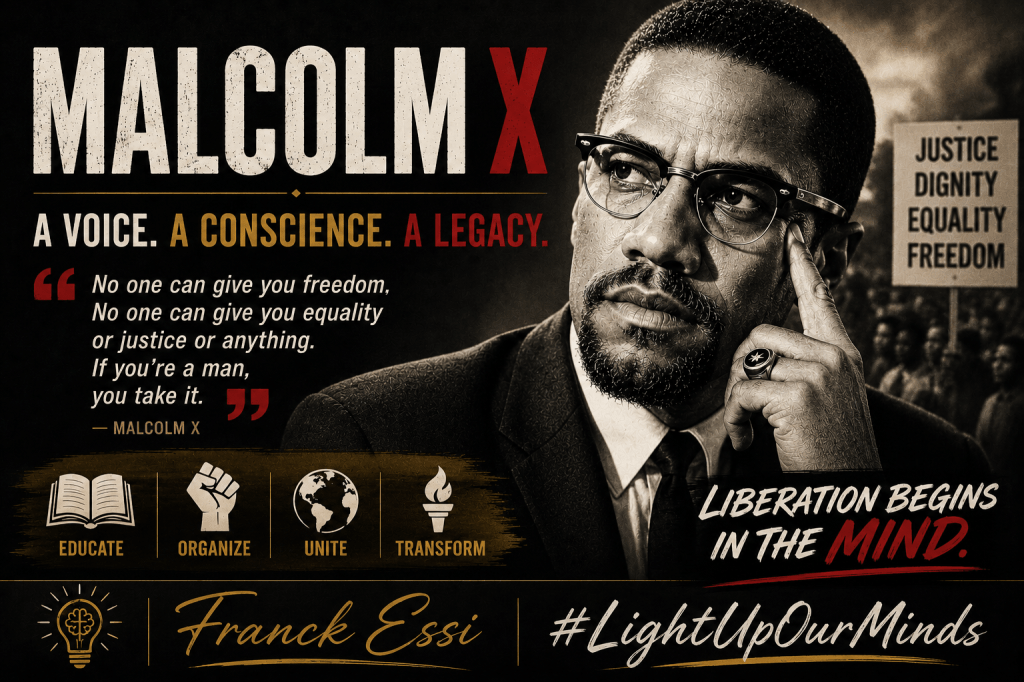
Malcolm X, born Malcolm Little on May 19, 1925, in Omaha, Nebraska, and assassinated on February 21, 1965, in New York, was one of the great political consciences of twentieth-century America. He was at once a Black activist, a thinker of dignity, a fierce critic of racism, a powerful orator, a committed Muslim, and one of the major figures of the African American freedom struggle.
—-
1. A Childhood Marked by Racial Violence and Dispossession
Malcolm grew up in an America shaped by segregation, institutional racism, and violence against Black people. His father, Earl Little, was influenced by the ideas of Marcus Garvey, who promoted Black pride and Pan-Africanism. Very early in life, Malcolm discovered that oppression was not only economic; it was also psychological, cultural, and political.
His childhood was shattered by the death of his father and the institutionalization of his mother. He experienced foster care, street life, crime, and eventually prison. Yet it was precisely in prison that his intellectual rebirth began.
—-
2. Prison as a Space of Reconstruction
In prison, Malcolm read, studied, wrote, and debated relentlessly. He transformed confinement into a political school. One of the most authentic reflections of this transformation comes from his autobiography:
“My alma mater was books, a good library.”
This stage is crucial. Malcolm X teaches us that a human being can rebuild himself through intellectual discipline. He did not become an activist merely because he suffered; he became one because he understood the mechanisms behind that suffering.
—-
3. The Nation of Islam: Dignity, Discipline, and Rupture
After joining the Nation of Islam, Malcolm Little became Malcolm X. The “X” symbolized the African name lost through slavery. He quickly emerged as one of the organization’s most influential spokespersons.
His message was clear:
- Black people had to stop internalizing inferiority;
- they had to rebuild their dignity;
- they had to organize themselves;
- they had to defend themselves politically, morally, and collectively.
Malcolm X strongly criticized naïve integration into a society that still refused to fully recognize Black humanity. While Martin Luther King Jr. emphasized reconciliation and moral transformation, Malcolm insisted on dignity, power, self-defense, and political consciousness.
—-
4. “The Ballot or the Bullet”: The Political Turning Point
In 1964, Malcolm X delivered one of his most famous speeches: The Ballot or the Bullet. During the speech, he declared:
“It’s either the ballot or the bullet.”
This phrase should not be read as a glorification of violence. Rather, it was a warning that when peaceful paths to justice are systematically blocked, society itself creates the conditions for unrest. Malcolm’s deeper argument was simple: voting must become a genuine instrument of liberation, otherwise it becomes an empty ritual.
He also famously stated:
“Time has run out.”
This was a philosophy of political urgency. Oppressed peoples cannot be asked to wait forever for justice.
—-
5. Breaking with the Nation of Islam and Opening to the World
In 1964, Malcolm X broke with the Nation of Islam. His pilgrimage to Mecca profoundly transformed his worldview. There, he encountered Muslims of all races and nationalities and embraced a more universal understanding of Islam.
He did not abandon the Black struggle; he broadened it.
Malcolm came to understand that the African American struggle had to be connected to anti-colonial and anti-imperialist struggles across Africa, Asia, and Latin America. He later founded the Organization of Afro-American Unity, inspired by the Organization of African Unity.
His political thought became increasingly international. He no longer spoke only of “civil rights” within the United States; he spoke of human rights on a global scale. This was a major strategic shift. Civil rights confined the issue within American institutions, while human rights internationalized the struggle.
—-
6. An Intellectual of Clarity and Lucidity
Malcolm X was not merely a charismatic speaker. He was also a profound thinker of domination and power. He understood that oppression operates through several interconnected mechanisms:
- material violence;
- historical distortion;
- internalized shame;
- economic dependency;
- media manipulation;
- division among oppressed people.
At the Oxford Union debate in 1964, Malcolm defended the principle that when people are denied freedom, they inevitably seek ways to reclaim it. Beneath the radical tone was a simple idea: injustice should never be mistaken for peace.
—-
7. His Assassination and Legacy
Malcolm X was assassinated on February 21, 1965, at the Audubon Ballroom in Harlem. Although members of the Nation of Islam were convicted, the case has remained controversial for decades, and new legal developments continued into the 2020s.
His legacy extends far beyond his death. Malcolm X remains a symbol for all those who believe that liberation requires more than slogans: it requires consciousness, discipline, organization, and strategy.
—-
Key Lessons from Malcolm X
1. Consciousness Is the First Battlefield
Before transforming society, people must liberate their minds. Malcolm X teaches that the oppressed must stop seeing themselves through the eyes of their oppressors.
2. Reading Can Save a Life
His life demonstrates that books, study, and intellectual discipline can pull a person out of confusion and despair. Reading is not a luxury; it is a weapon of self-reconstruction.
3. Dignity Comes Before Negotiation
Malcolm X reminds us that no people negotiate effectively when they are ashamed of themselves. Self-respect is the foundation of political power.
4. Voting Only Matters If It Produces Real Power
His reflections on “the ballot” remind us that voting should not be a ceremonial act. It must become a tool for organization, accountability, and transformation.
5. Great Leaders Evolve
Malcolm X changed over time. He revised some of his earlier positions and expanded his worldview. Part of his greatness lies precisely in his capacity for intellectual evolution.
6. Local Struggles Must Connect to Global Ones
By linking the Black American struggle to African and anti-colonial struggles worldwide, Malcolm X showed that oppressed peoples must internationalize their causes, build alliances, and think globally.
—-
My Deep Conviction
Malcolm X teaches us that a person can be born into fracture, fall into error, rise again through knowledge, become a voice for his people, and leave behind a lasting political light.
His life teaches one essential truth:
Liberation begins the day we refuse to confuse survival with dignity, silence with peace, and waiting with strategy.
— Franck Essi
#WhatIBelieve
#IdeasMatter
#LightUpOurMinds
#CitizenLeadership
 franckessi.com