—-
There is a kind of fatigue people rarely talk about.
A fatigue that does not only come from the body, but from deep inner weariness.
The fatigue of those who carry causes, responsibilities, commitments, collective dreams, or long-term struggles.
The fighter’s fatigue.
It affects:
- activists;
- leaders;
- organizers;
- entrepreneurs;
- parents;
- social workers;
- engaged citizens;
- and even all those simply trying to remain upright in a world that often feels harsh, incoherent, or unjust.
This fatigue is not always visible.
One can keep speaking, working, posting, organizing, smiling…
…while being internally exhausted.
—-
When commitment becomes a long journey
At the beginning of a struggle, there is often:
- enthusiasm;
- anger;
- hope;
- the energy of a fresh start;
- the feeling that change is near.
Then reality arrives.
And reality is often slower, more complex, and more resistant than expected.
One then discovers:
- the resistance of systems;
- betrayals;
- misunderstandings;
- internal divisions;
- attacks;
- silent sacrifices;
- delays;
- collective setbacks;
- deeply rooted habits.
Many then discover a difficult truth:
Deep transformation often takes much longer than our initial enthusiasm expected.
And this is where the fighter’s fatigue sometimes begins.
—-
The silent signs of this fatigue
The fighter’s fatigue does not always appear through a dramatic collapse.
Sometimes, it emerges quietly:
- loss of motivation;
- growing cynicism;
- constant irritability;
- feelings of uselessness;
- loss of joy;
- difficulty hoping;
- isolation;
- exhaustion from facing the same problems repeatedly;
- the feeling of carrying everything alone;
- the desire to give up completely.
Some people become harsh.
Others become emotionally cold.
Others continue mechanically, without real inner energy.
And sometimes, the activist eventually starts resembling what they once fought against.
—-
The trap of permanent sacrifice
In many activist or professional cultures, exhaustion is sometimes glorified.
As if:
- sleeping were weakness;
- slowing down were betrayal;
- taking care of oneself were selfishness.
Yet an exhausted human being often ends up:
- making poor decisions;
- listening poorly;
- loving poorly;
- transmitting poorly;
- managing emotions badly;
- losing clarity.
Even the greatest causes can be weakened by people who are internally consumed.
History shows that many movements have been damaged:
- by ego conflicts;
- by accumulated frustrations;
- by psychological exhaustion;
- by the inability to manage the human dimension of long-term struggle.
—-
Understanding that we are not machines
We live in an era obsessed with constant performance.
We are expected to:
- produce;
- react;
- publish;
- respond;
- comment;
- mobilize;
- stay visible;
- remain constantly active.
But no human being can sustainably function like a machine.
Even the land needs fallow periods.
Even seasons alternate.
Even trees lose their leaves before blooming again.
Why should human beings escape the law of renewal?
—-
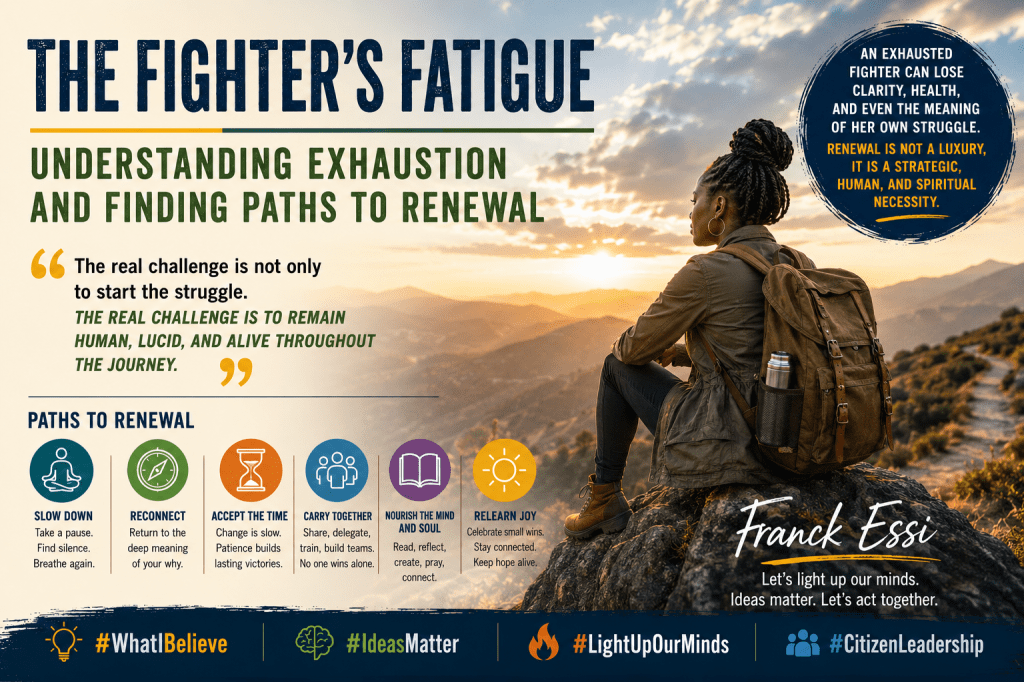
Paths toward renewal
Renewal does not mean abandoning the struggle.
It means recovering:
- breath;
- meaning;
- clarity;
- balance;
- inner strength.
And this can happen through several paths.
—-
1. Learning to slow down again
Sometimes, we must accept:
- taking a pause;
- reducing noise;
- stepping temporarily away from permanent agitation.
Not to escape the struggle.
But to avoid losing ourselves inside it.
Some of the best decisions are born in silence, not in exhaustion.
—-
2. Reconnecting with the deeper meaning of our commitment
When fatigue comes, it becomes important to reconnect with the fundamental question:
Why did I begin in the first place?
Was it:
- for recognition?
- for social media?
- for power?
- or for a deeper conviction?
The struggles that endure are often rooted in something deeper than momentary emotion.
—-
3. Accepting that change is slow
One of the greatest sources of frustration is the illusion of immediate results.
Yet:
- mentalities evolve slowly;
- institutions change gradually;
- societies carry deep historical inertia.
The history of major human transformations is a history of strategic patience.
Nelson Mandela spent 27 years in prison.
The American civil rights movement went through decades of struggle.
African independences were the result of long historical accumulations.
Sustainable transformation often looks more like a long construction process than an instant miracle.
—-
4. Learning to carry the burden together
Many people burn out because they try to carry everything alone.
But no collective struggle can sustainably rest on one person alone.
We must:
- transmit knowledge;
- delegate;
- train others;
- share responsibilities;
- build strong teams;
- create collective intelligence.
Durable movements are those capable of creating successors and relay structures.
—-
5. Nourishing the mind and soul
A mind constantly exposed to:
- conflicts;
- controversies;
- bad news;
- permanent tension,
eventually becomes deeply exhausted.
We must also nourish our intelligence and inner life:
- through reading;
- reflection;
- art;
- spirituality;
- sincere conversations;
- moments of beauty and calm.
Inner renewal is also a discipline.
—-
6. Learning joy again
The longest struggles cannot survive without joy.
Not naïve joy.
Not the joy of ignorance.
But lucid joy:
- the joy of continuing despite difficulties;
- the joy of seeing small victories;
- the joy of human connection;
- the joy of transmitting;
- the joy of remaining faithful to one’s values.
The peoples who survive great hardships are often those who preserve their ability to sing, laugh, create, and hope.
—-
My deep conviction
The fighter’s fatigue is not a sign of weakness.
It is often the sign that someone has carried something heavy for a long time.
But we must be careful:
an exhausted fighter can eventually lose clarity, health, humanity, or even the meaning of their own struggle.
That is why renewal is not a luxury.
It is a strategic, human, and spiritual necessity.
Because great transformations do not only require courage.
They also require women and men capable of enduring without destroying themselves.
The real challenge is not only to start the struggle.
The real challenge is to remain human, lucid, and alive throughout the journey.
— Franck Essi
#WhatIBelieve
#IdeasMatter
#LightUpOurMinds
#CitizenLeadership

