
We live in societies where criticism is abundant, but contribution is often much rarer.
Many people know how to say what is wrong. Few take the time to help understand, correct, and build better. Many know how to denounce shortcomings. Few accept to transform their dissatisfaction into a useful proposal, a concrete commitment, or a shared responsibility.
Yet, in a family, an organization, a company, an association, or a civic movement, criticism can be a powerful tool for progress. It can also become a weapon of mass destruction against trust.
Everything depends on the mindset from which it is expressed.
Criticizing is easy.
Building requires character.
Whenever people live together, work together, decide together, or commit themselves together, there will inevitably be disagreements, delays, mistakes, frustrations, and shortcomings.
The problem, therefore, is not the existence of criticism.
The problem is the quality of criticism.
Because criticism can be a stone thrown at someone.
It can also be a stone laid to build something better.
Everything depends on three things: the intention, the manner, and the sense of responsibility.
The intention is the deeper reason why I criticize: is it to help improve, or to put someone down?
The manner is the form I give to my criticism: do I speak with precision, respect, and clarity?
The sense of responsibility is my ability not only to point out a problem, but also, whenever possible, to contribute to solving it.
Constructive criticism therefore begins before words. It begins inside the person who criticizes.
Before correcting others, we must first examine our own state of mind: am I acting from a spirit of service or domination? Am I trying to help, or do I simply need to be right? Am I looking for a solution, or merely for someone to blame?
Constructive criticism is first a matter of character. It requires self-mastery, empathy, courage, and integrity. It requires us not merely to react in the heat of the moment, but to choose a useful response.
It is an act of personal leadership.
This is where the first requirement begins: understand before judging.
Before saying:
“This activity was badly organized,”
it is useful to ask:
- Was the preparation timeline realistic?
- Were the available resources sufficient?
- Were the roles clearly defined?
- Were the people in charge properly supported?
- Did information circulate on time?
- Were the difficulties encountered openly shared?
Many quick judgments are born from incomplete understanding.
A failed meeting is not always the sign of an incompetent team. It may reveal poor preparation, late communication, lack of coordination, or insufficient follow-up.
A less active activist is not always disengaged. They may be tired, poorly integrated, insufficiently supported, or simply waiting for a clear mission.
A young leader who makes a mistake is not necessarily incapable. They may lack experience, method, or mentoring.
Constructive criticism does not begin with accusation.
It begins with listening.
But understanding is not enough. Once the context has been clarified, criticism must still be expressed in a useful way. This is where the true art of constructive criticism begins: transforming vague dissatisfaction into precise observation, emotional reaction into responsible contribution, and quick judgment into a proposal for progress.
1. Criticize with precision
Useful criticism clearly names the problem.
Saying:
“You never do anything right”
helps no one.
It is vague, excessive, and discouraging.
Instead, saying:
“The communication around this meeting came too late, which reduced participation”
helps identify the real point to improve.
Precision prevents injustice. It avoids turning a specific mistake into a general condemnation. It helps separate facts from emotions, the problem from the person, and the incident from identity.
In an organization, saying:
“The communication team does not work”
can create frustration and defensiveness.
Instead, saying:
“The announcement was published only the day before. To improve mobilization, we should communicate at least one week in advance”
opens a path for progress.
Vague criticism wounds.
Precise criticism enlightens.
But precision alone is not enough. Criticism must also be grounded, explained, and understandable. Otherwise, it remains just another opinion.
2. Criticize with arguments
Constructive criticism does not simply express an impression. It explains. It gives reasons. It allows the person receiving it to understand what needs to be improved.
Saying:
“This text is not good”
offers no key for improvement.
Instead, saying:
“The text contains strong ideas, but the introduction is too long and the central message comes too late”
helps clarify what needs to be corrected.
Without arguments, criticism sounds like a mood.
With arguments, it becomes a contribution.
Saying to someone:
“Your intervention was bad”
may discourage them.
Instead, saying:
“Your intervention had good ideas, but it would have been stronger with a clearer structure: the problem, the example, then the proposal”
gives them a method for improvement.
Well-argued criticism does not close the door.
It shows a path.
But showing what is wrong, even with good arguments, is still not enough. Constructive criticism must help move from diagnosis to action.
3. Criticize while seeking solutions
Constructive criticism never stops at observation. It seeks improvement.
Saying:
“This team does not work well”
is not enough.
Instead, saying:
“We can clarify roles, set clear deadlines, and hold a brief weekly check-in”
moves things forward.
The right question is not only:
“Who failed?”
The right question is also:
“What can we learn and improve?”
In a family, it is not enough to say:
“We spend too much.”
It is more useful to say:
“We spend too much without a plan. What if we prepared a small budget together at the beginning of each month?”
In an association, it is not enough to say:
“Our meetings last too long.”
It is more useful to say:
“What if we set a clear agenda, a time limit for each item, and a fixed closing time?”
In a civic movement, it is not enough to say:
“We are too present online and not present enough on the ground.”
It is more useful to say:
“What if each local cell committed to one concrete action per week: a neighborhood visit, a local discussion, or an act of solidarity?”
Constructive criticism turns frustration into learning.
It turns error into an opportunity for progress.
It turns tension into clarification.
It turns weakness into a field for improvement.
It does not seek a culprit to expose.
It seeks a solution to build.
But a solution proposed to others is not always enough. Maturity begins when the person who criticizes also accepts to take their share of responsibility.
4. Criticize with responsibility
Constructive criticism does not only say:
“Others must solve the problem.”
It also dares to say:
- “I can help proofread the document.”
- “I can call two people to help revive mobilization.”
- “I can propose a follow-up table.”
- “I can take part in the next preparation meeting.”
There is a great difference between someone who criticizes from the stands and someone who criticizes while stepping onto the field.
Seeing a problem is useful.
Helping to solve it is even more useful.
One can say:
“The minutes are not well written.”
But it is more responsible to add:
“I can propose a simpler template for future minutes.”
One can say:
“Young people are not involved enough.”
But it is more constructive to propose:
“I can organize a meeting with them to understand their expectations and identify those who want to take responsibility.”
Responsible criticism does not merely seek to be right.
It seeks to be useful.
However, even criticism that is precise, well-argued, solution-oriented, and responsible can fail if it lacks respect. Because in every human relationship, substance is not enough. Manner matters too.
5. Criticize with respect
Constructive criticism always distinguishes the person from the problem.
Saying:
“You are incapable”
attacks the person.
Instead, saying:
“This part can be improved”
addresses the problem.
The difference is immense.
When we attack a person, they shut down, defend themselves, or become resistant. When we address the problem, we open the possibility of dialogue.
Respect does not weaken criticism.
It makes it easier to hear.
In a team, one can say:
“I think this decision was not sufficiently explained. It created misunderstanding. Next time, we should better present the reasons behind the choice.”
That is very different from saying:
“You always make decisions anyhow.”
The first formulation builds trust.
The second destroys the relational climate.
Every word either adds to or withdraws from collective trust. Respectful criticism can strengthen a relationship. Humiliating criticism can leave a lasting wound.
But respect is not only about words. It is also about the moment, the place, and the setting in which criticism is expressed.
6. Criticize at the right time and in the right setting
Even a just truth can produce bad effects when expressed at the wrong time, in front of the wrong people, or in an inappropriate tone.
Humiliating someone publicly, even with a valid argument, is not an act of courage. It is often a failure of leadership.
In some cases, it is better to correct privately.
In others, a collective discussion is necessary, especially when the problem concerns the whole organization.
Substance matters.
Form matters too.
Timing also matters.
Constructive criticism seeks effectiveness, not spectacle.
It does not seek to prove that the person criticizing is smarter, more lucid, or more demanding than others. It seeks to help people grow, improve methods, and strengthen the collective.
This is precisely what distinguishes it from destructive criticism.
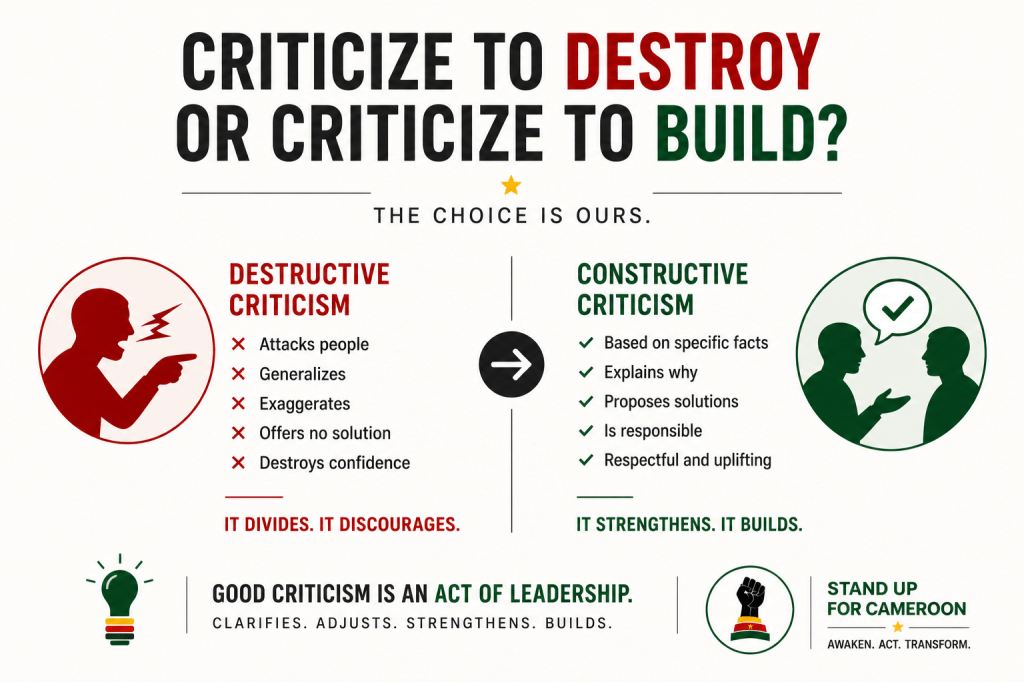
Destructive criticism follows another logic
Destructive criticism attacks people.
It generalizes.
It humiliates.
It exaggerates.
It proposes nothing.
It is sometimes fueled by frustration, ego, rivalry, or jealousy.
It says:
“You are useless.”
Where constructive criticism says:
“Here is what we can improve.”
It says:
“Nothing works.”
Where constructive criticism says:
“Here is what is blocking us, and here is how we can move forward.”
It says:
“It is always the same people who fail.”
Where constructive criticism says:
“What can we learn from this difficulty?”
An immature group criticizes to vent.
A mature group criticizes to improve.
This distinction is fundamental. Because the quality of criticism often reveals the quality of an organization.
In fragile groups, criticism becomes a weapon.
In solid groups, it becomes a learning tool.
In fragile groups, people criticize to weaken.
In solid groups, people criticize to strengthen.
In fragile groups, the person criticized is treated as an enemy.
In solid groups, criticism becomes an opportunity to do better together.
But there is one final requirement, often even more difficult: whoever wants to criticize usefully must also accept to be criticized.
Accepting criticism too
We cannot claim the right to correct others while refusing all feedback ourselves.
Maturity begins when we understand that no one grows without an outside perspective, without contradiction, without correction, without honest feedback.
Accepting criticism does not mean accepting everything.
It means listening before defending oneself.
It means looking for the part of truth before rejecting the form.
It means distinguishing what is unfair from what may be useful.
Sometimes, awkward criticism contains a precious truth.
Sometimes, exaggerated criticism reveals a real discomfort.
Sometimes, difficult criticism exposes a blind spot we did not want to see.
The mature leader does not only ask:
“Why am I being criticized?”
They also ask:
“What can I learn from this feedback?”
Of course, not all criticism is fair. Not all of it is well-intentioned. Not all of it deserves the same level of attention. But no serious responsibility can grow through the systematic refusal of feedback.
Those who want to lead others must learn to listen to what disturbs them.
Those who want to build must learn to correct what blocks progress.
Those who want to grow must accept to see what they cannot see alone.
Before criticizing, let us ask ourselves five questions
Before expressing criticism, it can be useful to pause for a moment and ask:
- Have I understood the context before judging?
- Have I identified a precise problem?
- Do I have arguments, or only an impression?
- Do I have a possible solution to propose?
- Am I willing, whenever possible, to contribute to improvement?
These simple questions can change the quality of our words.
They force us to move beyond immediate reaction and enter into a more conscious approach. They remind us that criticism is not only a right to speak. It is also a relational, moral, and collective responsibility.
In the end, the real question is therefore not:
“Do I criticize?”
The real question is:
“Does my criticism truly help move things forward?”
Does it help people understand?
Does it help correct?
Does it help improve?
Does it strengthen trust?
Does it help build a more serious, effective, and responsible organization?
Because good criticism is an act of leadership.
It enlightens.
It adjusts.
It makes people responsible.
It strengthens trust.
It raises the level of expectations.
It builds.
Criticizing to destroy requires little greatness.
Criticizing to build requires character.
And in any organization called to grow, criticism should never be a weapon against people, but a tool in the service of progress.
Franck Essi
#IdeasMatter
#WeHaveAChoice
#WeHaveThePower
#SelfManagement
#LeaderWithoutTitle
#LightUpOurMinds
 franckessi.com