—-
We all know this experience.
We attend a training session, a workshop, a conference, or a seminar. We listen to powerful ideas. We discover new methods. We feel stimulated, encouraged, sometimes deeply moved.
In the moment, everything seems clear.
We tell ourselves:
“This time, things are going to change.”
Then a few days pass.
Urgencies return. Old habits take over. Notes remain in a notebook, a phone, or a computer. And gradually, the energy of the seminar fades away.
So the question is simple:
Why are we often inspired without being truly transformed?
The answer lies in one essential distinction:
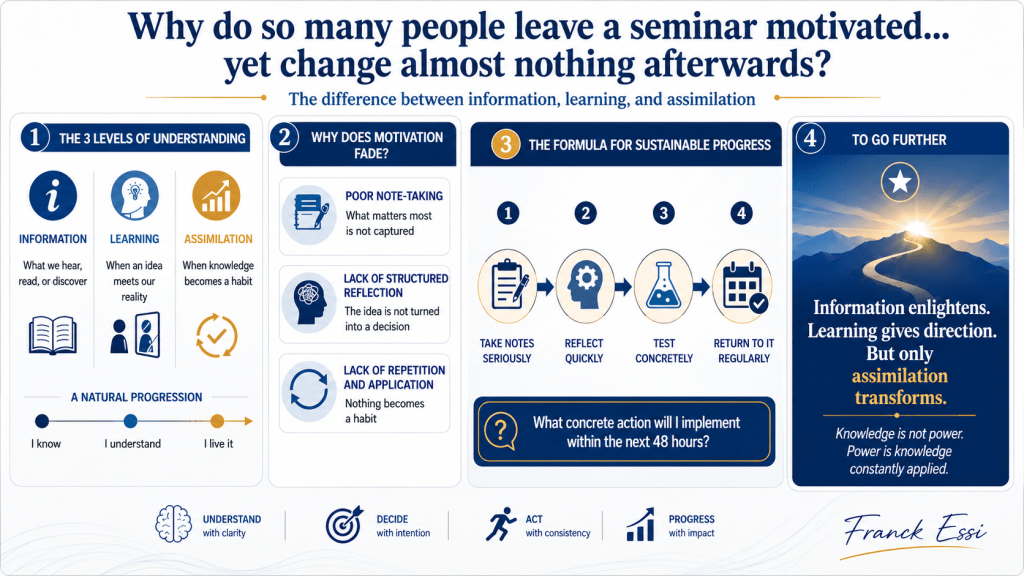
There is a major difference between receiving information, learning something, and deeply assimilating it.
—-
1. Information: What We Receive
Information is what we hear, read, or discover.
It may take several forms:
- a concept;
- a method;
- a tool;
- a quote;
- a powerful idea;
- practical advice;
- a shared experience.
But information alone does not transform a person.
It can enlighten the mind. It can open a new perspective. It can trigger awareness. But it does not yet change behavior.
You can listen to an excellent conference on discipline and remain undisciplined.
You can attend a leadership training and still mismanage your relationships.
You can receive planning tools and continue living in constant improvisation.
Why?
Because knowing an idea is not the same as living by that idea.
—-
2. Learning: When Information Meets Our Reality
Learning is not merely hearing.
It is beginning to understand.
It is connecting the information received to our own life, responsibilities, challenges, relationships, habits, and daily choices.
A person truly learns when they begin to ask the right questions:
- What does this mean for me?
- Where do I recognize myself in what was said?
- What concrete problem can this idea help me solve?
- What practice must I change?
- What attitude must I correct?
- What decision must I make?
At this stage, information stops being general.
It becomes personal.
It becomes a mirror.
But even learning is not enough. Understanding a truth is not the same as embodying it.
—-
3. Assimilation: When Knowledge Becomes a Habit
Assimilation is the decisive step.
It happens when what we have understood truly enters our reflexes, choices, priorities, and daily practices.
Assimilation can be recognized by one simple sign:
We no longer merely refer to an idea; we begin to function according to it.
For example:
- we have not only learned the importance of listening: we listen better;
- we have not only understood the need to manage our time better: we actually plan our priorities;
- we have not only heard about personal responsibility: we gradually stop blaming circumstances and start acting on what depends on us;
- we have not only discovered an organizational tool: we use it until it becomes natural.
This is where transformation begins.
Many people receive information.
Some truly learn.
But very few assimilate deeply enough to change sustainably.
—-
Why Does the Break Happen?
When so many people leave a seminar motivated without changing deeply afterwards, it is not always because they lack willpower.
It is often because the passage from inspiration to transformation has not been organized.
Three common mistakes appear again and again.
—-
Mistake 1: Poor Note-Taking
Many people take notes as if they were collecting memories.
They write down a few sentences, a few quotes, a few scattered ideas. But they do not capture what truly matters.
Good note-taking should help identify:
- key ideas;
- important principles;
- practical steps;
- useful examples;
- questions to explore further;
- decisions to make;
- actions to test quickly.
A good note should not only answer the question:
“What was said?”
It should above all answer another question:
“What must I do differently from now on?”
—-
Mistake 2: Lack of Structured Reflection After the Training
A seminar does not end with the last slide.
It truly ends when we have taken the time to transform what we received into concrete decisions.
In the hours or days that follow, it is essential to revisit our notes and ask ourselves a few simple questions:
- What have I truly understood?
- What challenged me the most?
- Which principle must I apply?
- Which habit must I correct?
- Which practice must I abandon?
- What action must I take immediately?
- Who can help me remain accountable to this commitment?
Without this time of reflection, inspiration remains superficial.
It touches emotion, but it does not descend into the will.
It produces enthusiasm, but not yet transformation.
—-
Mistake 3: Lack of Repetition and Application
We often want to change without practicing.
We want to progress without repetition.
We want to become better without building new habits.
But every lasting transformation rests on one simple law:
What we do not practice regularly never becomes part of who we are.
An idea heard once can inspire.
An idea practiced several times can transform.
An idea repeated with discipline can become second nature.
That is why application is decisive.
It is not enough to say:
“I understood.”
We must be able to say:
“I tried it. I repeated it. I adjusted it. I am beginning to live it.”
—-
The Exact Formula for Not Changing
The formula for not changing is simple:
- receive information;
- fail to deepen it;
- fail to connect it to your own situation;
- fail to choose a concrete action;
- fail to practice;
- fail to repeat;
- fail to evaluate your progress.
This is how we accumulate:
- notebooks full of notes;
- folders full of materials;
- certificates of participation;
- memories of good seminars;
- but very little real change.
We end up confusing exposure with transformation.
We believe we are moving forward because we attend many activities.
But in reality, we do not change, because we do not convert what we receive into personal discipline.
—-
The Formula for Sustainable Progress
By contrast, the formula for progress is clear:
- take serious notes;
- reflect quickly;
- choose one priority;
- test concretely;
- repeat regularly;
- evaluate honestly;
- adjust progressively.
After every seminar, we should not try to apply everything.
Trying to apply everything is often the best way to apply nothing at all.
We must choose one simple, concrete, immediate action.
One question can change everything:
What concrete action will I implement within the next 48 hours?
Not in six months.
Not when conditions are perfect.
Not when others have changed.
Within the next 48 hours.
Because change rarely begins with grand declarations.
It begins with one coherent act.
—-
The True Power of Knowledge
We must therefore correct a very common statement:
Knowledge is not power.
Knowledge can become power. But it is not automatically power.
True power is:
- knowledge understood;
- knowledge chosen;
- knowledge applied;
- knowledge repeated;
- knowledge embodied.
It is knowledge becoming discipline.
It is principle becoming habit.
It is idea becoming behavior.
It is motivation becoming lasting commitment.
—-
The True Measure of a Seminar
In the end, seminars do not change our lives by themselves.
Conferences do not transform our organizations by themselves.
Trainings do not alter our trajectories by themselves.
What truly transforms us is what we do with what we have received.
Information enlightens.
Learning gives direction.
But only assimilation transforms.
Anyone who wants to grow must learn to move from the emotion of the moment to the discipline of habit.
Because the true measure of a seminar is not what we felt when we left the room.
It is what we changed in the way we live, work, decide, and serve.
Franck Essi
#WhatIBelieve
#IdeasMatter
#LightUpOurMinds