Why critical thinking, learning, and the ability to correct ourselves are political strengths
By Franck Essi
There is a mistake we sometimes make in movements for change: believing that protecting our cause means protecting our camp from all criticism.
We think we are defending the organisation by downplaying its weaknesses. We think we are preserving unity by avoiding certain debates. We think we are being loyal by refusing to acknowledge certain mistakes. Sometimes, we even think that admitting a weakness would simply give ammunition to the adversary.
I understand this temptation.
Our struggles often unfold in deeply unequal environments. In Cameroon, as in many other African countries, forces for change may find themselves facing powers with vastly greater financial, institutional, administrative and media resources. The rules of the game may be unfair. Spaces for freedom may be restricted. The balance of power may be extremely unfavourable.
All of this is real.
But precisely because the environment is difficult, we cannot afford to be careless about what depends on us.
We do not always control:
- the decisions of the adversary;
- the institutions;
- the rules of the game;
- the resources available to those we are fighting.
But we can work on:
- our organisation;
- our strategy;
- our ability to mobilise;
- the quality of our alliances;
- our communication;
- our presence on the ground;
- our discipline;
- the way we make decisions;
- and, above all, our ability to learn.
This is why I believe that lucidity is not an intellectual luxury for our struggles. It is a strategic necessity.
Our adversaries explain part of our defeats. Not all of them.
When we experience failure, it is natural to try to understand what happened.
And when we are confronting a deeply unequal system, part of the explanation may indeed lie with the adversary:
- repression;
- fraud;
- intimidation;
- disproportionate resources;
- biased rules;
- unequal access to the media;
- administrative restrictions;
- manipulation.
All these factors may be real and, at times, decisive.
But even when they are, another set of questions still needs to be asked:
- Did we prepare our action well enough?
- Did we assess the balance of power correctly?
- Did we build the right alliances?
- Did we reach the right people?
- Did we really understand what citizens expected from us?
- Did we listen to warnings that challenged our assumptions?
- Did we correct mistakes we had already made before?
These questions are sometimes difficult to ask because they may be interpreted as an attempt to minimise the responsibility of those we are fighting.
Yet both things can be true at the same time.
The playing field can be deeply unfair and our strategy can still be inadequate.
The adversary can cheat and we can still make mistakes.
The system can be responsible for many things without being responsible for everything.
Acknowledging our own part does not mean absolving the adversary.
It means identifying what we can still improve.
And that is precisely where our power lies.
The cycle of defeat
An organisation that refuses to look at its own weaknesses risks entering a dangerous cycle:
- we fail;
- we explain the failure entirely through the actions of the adversary;
- we avoid self-criticism because it might divide or discourage us;
- we reproduce many of the same methods;
- we experience another failure;
- and then we start again.
Over time, justification replaces learning.
And complacency begins to disguise itself as loyalty.
Yet I believe we need to say this clearly:
Complacency that prevents an organisation from learning can unintentionally prepare its next defeat.
This is not an invitation to blame ourselves.
It is an invitation to become better.
Because a strong organisation is not one that never makes mistakes.
It is one that discovers its mistakes early enough and corrects them quickly enough.
Criticising does not mean being right
But there is an opposite trap.
Saying that an organisation should accept criticism does not mean that every criticism is valid.
Some criticisms are:
- not relevant;
- partial;
- poorly informed;
- unrealistic;
- self-interested;
- unfair;
- or simply wrong.
The fact that someone challenges the movement’s line does not automatically make that person right.
This distinction matters.
Welcoming criticism does not mean accepting it. It means giving it the right to be examined.
A mature organisation should be able to hear an objection without immediately treating its author as a traitor.
But the criticism must then be subjected to debate:
- What facts support it?
- What problem does it identify?
- What consequences would the proposed solutions have?
- Are there counterarguments?
- What other options can we consider?
At the end of this process, several outcomes are possible.
- accepted, because it was right;
- rejected, because its arguments do not stand up to scrutiny;
- surpassed, because it helps us arrive at a third solution, different from both the initial position and the critic’s proposal.
This is why disagreement is not necessarily a problem.
It can become a resource.
Provided that the debate is reasoned, transparent and fair.
The right to criticise is not a right of veto
We must also understand that a political organisation has to be able to make decisions.
Internal democracy does not mean that everyone has a permanent right to block decisions they disagree with.
At some point, debate has to lead to a decision.
Then the organisation has to act.
Otherwise, we fall into another form of powerlessness: structures where everything is discussed, all the time, without ever moving forward.
I believe a healthy culture could rest on four simple principles:
- Freedom before the decision.
- Rigour in the debate.
- Discipline in action.
- Evaluation after action.
Before the decision, everyone should be able to speak.
During the debate, arguments should be examined seriously.
Once a decision has been made according to legitimate rules, the organisation should be able to act.
But after the action, it must be capable of revisiting what it decided and asking:
Were we right?
This is the step we often neglect.
We sometimes assess our actions according to our intentions rather than according to their results.
Yet a decision can be made in good faith and still produce poor results.
In that case, correcting it is not losing face.
It is learning.
Contradiction is neither betrayal nor a virtue in itself
Our movements can easily fall into two extremes.
In the first, contradiction becomes suspicious. Anyone who asks certain questions is seen as weakening the group.
In the second, contradiction becomes almost a virtue in itself. The person who criticises automatically sees themselves as more lucid than those who have to make decisions.
I believe in neither extreme.
A good activist is not someone who applauds everything.
But neither is it someone who criticises everything.
It is someone who knows why they support, why they question and why, sometimes, they change their mind.
Useful criticism should, among other things:
- seek to clarify rather than humiliate;
- argue rather than constantly question people’s motives;
- distinguish people from problems;
- propose alternatives whenever possible;
- accept that it too can be debated and refuted.
The person who criticises must therefore accept one basic rule:
their criticism can also be questioned.
The freedom to disagree works both ways.
When our camp changes the way we judge
There is another difficulty, and it is much more personal.
We do not always judge the same behaviour in the same way depending on whether it comes from our camp or from the one we oppose.
We see this constantly in political life and on social media.
- When the adversary changes position, we call it inconsistency. When our leader does the same, we call it strategy.
- When the adversary enters into an unexpected alliance, we call it opportunism. When our side does the same, we call it pragmatism.
- When an accusation concerns the adversary, we may be tempted to share it quickly. When it concerns our own camp, we immediately demand evidence, context and sources.
This does not mean that all situations are identical.
But we must learn to recognise our double standards.
One question can help us:
If exactly the same facts concerned my adversary, would I judge them in the same way?
This question is uncomfortable.
That is precisely why it is useful.
The problem with a strong leader is not that they are strong
Our societies remain deeply marked by the personalisation of power.
And this phenomenon does not concern only those we oppose.
Movements for change can also become excessively dependent on one person.
A strong leader can, however, be an asset. A struggle sometimes needs someone capable of:
- embodying a vision;
- inspiring confidence;
- bringing people together;
- mobilising;
- making difficult decisions.
The problem, therefore, is not the strength of the leader.
The problem begins when the strength of the leader produces the weakness of the organisation.
When:
- no one dares to contradict them;
- internal institutions stop functioning without them;
- any criticism of them becomes criticism of the cause;
- their succession seems impossible;
- their word gradually becomes indistinguishable from the movement’s line.
At that point, it becomes urgent to distinguish three things:
- the cause;
- the organisation;
- the person leading it.
A cause can be just while an organisation makes mistakes.
An organisation can remain necessary while a leader is wrong.
And a leader can be remarkable without becoming the owner of a collective cause.
We cannot fight the personalisation of power in the state while rebuilding it inside our own movements.
Social media makes lucidity even more difficult
Our phones are now genuine political spaces.
We use them to:
- learn;
- debate;
- mobilise;
- organise campaigns;
- build communities;
- circulate calls to action;
- sometimes even prepare mobilisations.
This is a tremendous opportunity for movements for change.
But it also creates a trap.
Digital politics often pushes us to react very quickly.
A video appears.
A screenshot circulates.
An accusation is made.
Before we have even checked anything, we already feel something: outrage, excitement, anger, fear.
And when the content serves our camp, we may feel like sharing it immediately.
We need to learn a new discipline:
not everything that suits us is necessarily true.
Before sharing, a few simple habits should become natural:
- check the source;
- look for the context;
- distinguish a fact from an opinion;
- wait when the information is not sufficiently established;
- ask ourselves whether we would show the same caution if the information concerned our own camp.
An activist for change should not become a distributor of doubtful information simply because it harms the adversary.
We cannot demand a better-informed society while contributing to confusion ourselves.
Here again, our consistency is part of our credibility.
Those who want to change society must be more demanding of themselves
This is probably the essential point.
We cannot demand from others what we refuse to practise ourselves.
If we want greater accountability, we must be accountable.
If we want strong institutions, we must build organisations that can survive their leaders.
If we want those in power to accept contradiction, we must learn to tolerate it within our own ranks.
If we want free citizens, we cannot train activists who are only expected to obey.
If we denounce propaganda, we must be particularly rigorous with the information coming from our own side.
And if we want a new political culture, we must start practising it before we come to power.
Because our movements are not preparing only:
- elections;
- mobilisations;
- campaigns;
- political alternations;
- or changes of regime.
They are also preparing ways of governing.
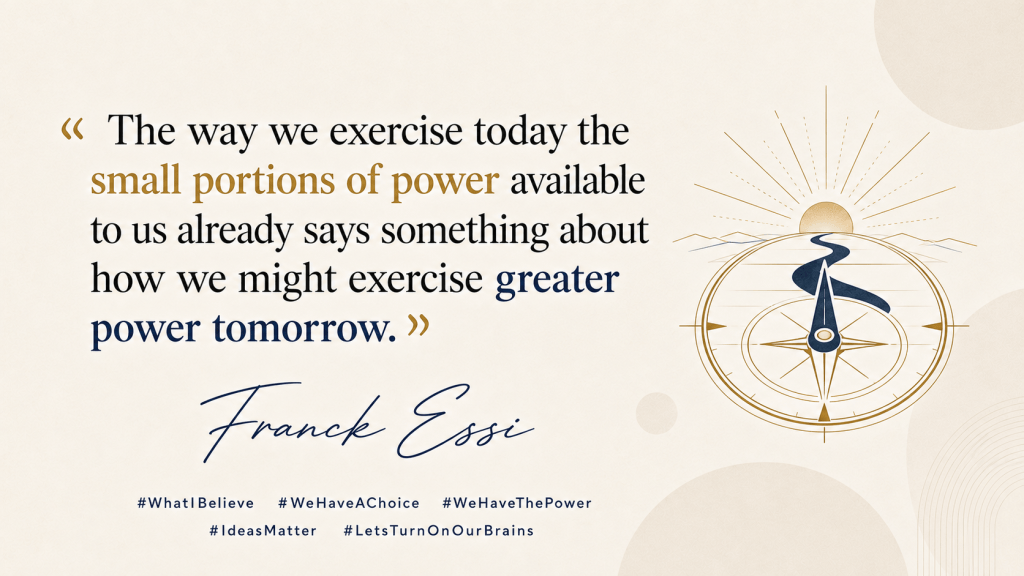
The way we exercise today the small portions of power available to us already says something about how we might exercise greater power tomorrow.
Building movements that can correct themselves
In the end, what our struggles need most may not simply be more criticism.
They need a capacity for correction.
We should regularly ask ourselves:
- Can we admit that an assumption was wrong?
- Can we abandon a strategy that no longer works?
- Can we listen to citizens who do not share our convictions?
- Can we honestly evaluate an action after carrying it out?
- Can we acknowledge that an adversary may sometimes have understood something we did not?
- Can we prepare the succession of our leaders without treating it as a threat?
- Can we say, “We were wrong,” without believing that it makes us weaker?
These are, in my view, some of the real measures of organisational maturity.
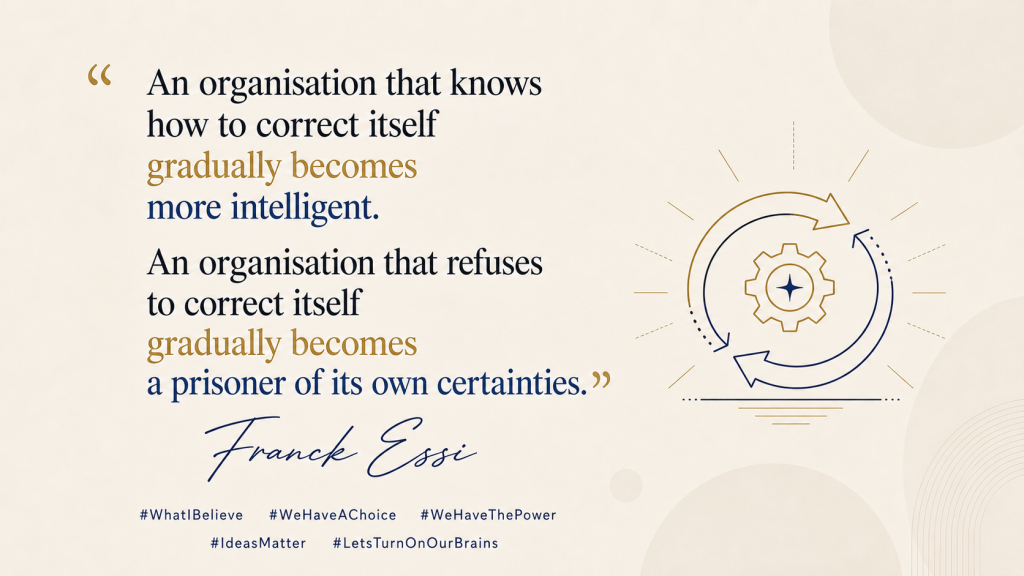
An organisation that knows how to correct itself gradually becomes more intelligent.
An organisation that refuses to correct itself gradually becomes a prisoner of its own certainties.
MY DEEPEST CONVICTION: RIGOUR IS ALSO A FORM OF LOYALTY
I believe in loyalty.
I know that great struggles require women and men who can stand firm when things become difficult, who can trust, respect collective decisions and sometimes make significant sacrifices.
But not all forms of loyalty are equal.
There is a loyalty that protects people.
And there is a loyalty that protects the cause.
They are not always the same.
Systematically shielding a leader from criticism may help them today and weaken the organisation tomorrow.
Avoiding a debate in the name of unity can sometimes turn a small difficulty into a major crisis.
Refusing to admit a mistake can temporarily protect our image and condemn us to repeat that mistake.
Lucid loyalty therefore demands more.
It asks us:
- to care enough about our cause to want to know the truth about it;
- to accept that those we struggle alongside may sometimes see something we do not;
- to debate without tearing ourselves apart;
- to decide without humiliating those who disagreed;
- to revisit a decision when reality shows that we were wrong;
- to distinguish what the adversary imposes on us from what we can still improve ourselves.
We will never control everything.
But we can always try to be more lucid, better organised, more consistent and more capable of learning.
And in struggles where we sometimes have far fewer resources than those we are fighting, that capacity can become a considerable strength.
Being rigorous with ourselves does not weaken our struggles. It prepares them to endure, to learn and, perhaps, to win.
The loyalty our causes need is therefore not the kind that protects all our certainties.
It is the kind that helps us become better.
Franck Essi
#WhatIBelieve
#WeHaveAChoice
#WeHaveThePower
#IdeasMatter
#LetsTurnOnOurBrains
 franckessi.com