What African Experiences Should Teach the Forces of Change in Cameroon
By Franck Essi
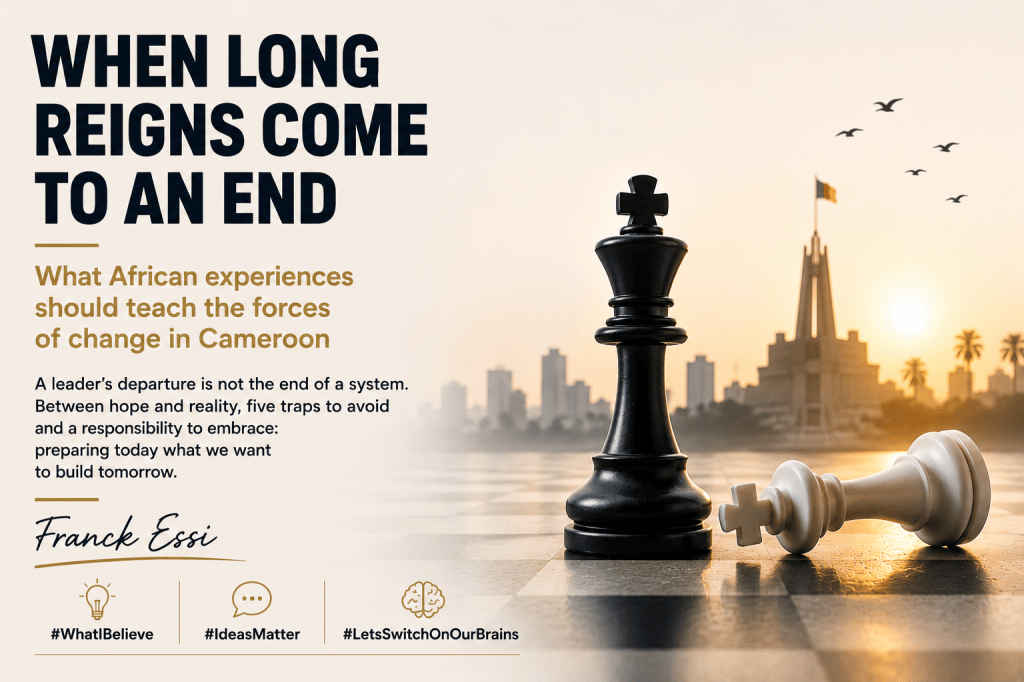
For years, talking about the post-Biya era in Cameroon could seem like an exercise in speculation. Paul Biya was there. The regime held. Institutions continued to function. Elections came and went. And each time some announced that the end of the regime was imminent, the system once again demonstrated its capacity to endure.
The situation is different today. Paul Biya is still President of the Republic. He was declared the winner of the October 2025 presidential election and began a new seven-year term. The regime retains most of the institutional, administrative and security instruments of power. There is therefore no serious basis for claiming that its fall is imminent. Yet the question of what comes next has become difficult to avoid.
The contested 2025 presidential election, the rejection of the candidacies of several major opposition figures, the violence that followed the proclamation of the results, the April 2026 constitutional amendment reintroducing the office of Vice-President and, above all, Paul Biya’s long absence between 7 June and 20 August 2026 have brought back to the centre of public debate a question that the system had long managed to keep unclear: that of succession. His return to Yaoundé ended speculation about his absence, but it did not remove the political question that the episode had revealed: what happens to a State when too many decisions, arbitrations and powers still depend on one man?
I do not know when or how the current regime will come to an end. I am wary of overly confident predictions, especially in Cameroon, where we have for years heard so many announcements of the imminent fall of the regime. But caution should not become an excuse not to think. The real question may no longer simply be who will come after Paul Biya. It may be what will come after the system that his long rule has helped shape.
These are two profoundly different questions. And this is where the experiences of other African countries can be useful to us. Not because Algeria, Zimbabwe, Burkina Faso, Sudan or Gabon provide a ready-made formula for Cameroon. Every country has its own history, institutions, balance of power and wounds. But these experiences allow us to see more clearly some of the traps that we might otherwise discover too late.
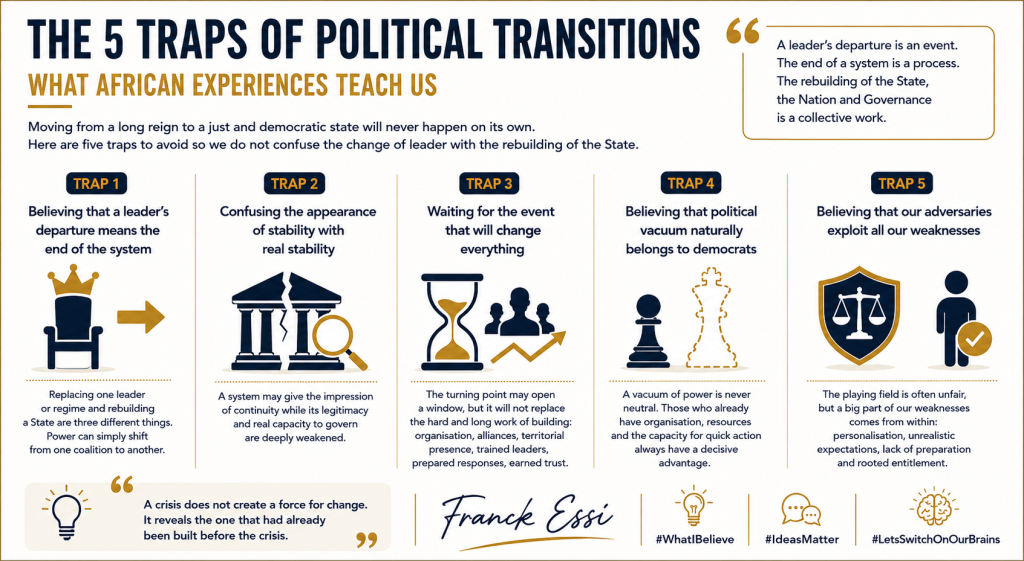
The first trap: believing that the departure of the leader means the end of the system
We easily imagine political change as the replacement of one camp by another. On one side would be those who govern and, on the other, those who want change. Then would come the day when the latter replace the former.
The history of political transitions is far less simple. The comparative work of Barbara Geddes, Joseph Wright and Erica Frantz (Autocratic Breakdown and Regime Transitions: A New Data Set; How Dictatorships Work: Power, Personalization, and Collapse) shows that the disappearance of an autocracy opens several possible paths. It may lead to democracy, but it may also allow another authoritarian coalition to take power or the old system to reorganise itself around a new leader.
Removing a leader, changing a regime and refounding a State are therefore three different things.
Zimbabwe offers a particularly clear illustration. Robert Mugabe had ruled for thirty-seven years and survived economic crises, sanctions, contested elections and a resilient opposition. Yet his fall did not come primarily from that opposition. It came from a fracture at the heart of his own camp, when the succession struggle pitted supporters of Emmerson Mnangagwa against those of Grace Mugabe. The army intervened, the ruling party abandoned Mugabe and he eventually resigned. But ZANU-PF remained in power.
This experience should make us cautious when we observe possible fractures at the top of power in Cameroon. An internal division can create an opening, but those who break with a regime do not necessarily do so for the same reasons. Some may genuinely want to transform the system. Others may simply want to take control of it themselves. A succession crisis can weaken a regime without producing democratic change.
The second trap: confusing the appearance of strength with real strength
Long-standing regimes have a particular characteristic: because they have survived several crises, we sometimes end up believing that they will survive them all. Abdelaziz Bouteflika’s Algeria should make us more cautious.
After his stroke in 2013, Bouteflika appeared less and less in public. Yet the State officially continued to function. Ministers governed, the administration operated and institutions gave the appearance of continuity. But gradually, another question began to emerge: who was really governing? When his candidacy for a fifth term was announced in 2019, a massive popular mobilisation developed. The Hirak movement, combined with the gradual withdrawal of military support, eventually led to the President’s departure.
But once again, protesters discovered something important: removing Bouteflika was easier than transforming the political system that had sustained him.
I am obviously not suggesting that Paul Biya is Abdelaziz Bouteflika or that Cameroon will follow Algeria’s path. But the President’s long absence in 2026 made visible a question that we should address independently of the person or health of the President: why does the continuity of our State still depend so heavily on the presence and capacity for arbitration of a single man?
This is an institutional question before it is a personal one. It goes to the heart of what refoundation should mean: building institutions capable of functioning normally regardless of who leads them.
The third trap: waiting for the event that will change everything
There is another temptation that I believe I recognise within the forces of change to which I belong: waiting for the decisive event. When the balance of power appears deeply unequal, we naturally hope that an external event will come and alter it.
We sometimes wait for:
- an election that would finally open up the political game;
- a massive popular mobilisation;
- a vacancy of power;
- a split at the top;
- one scandal too many;
- or a decision that would cause a decisive part of society to shift.
It can happen. But Burkina Faso reminds us that the spark can never replace the fuel.
Blaise Compaoré’s attempt to amend the Constitution in order to extend his twenty-seven-year rule triggered the 2014 uprising. Within a few days, his power collapsed. But those few days had been prepared by several years of social mobilisation, political opposition, citizen organising, youth movements, the activities of Le Balai Citoyen and fractures within the ruling establishment itself.
Seen from afar, a regime had fallen in a few days. Seen more closely, a society had spent years accumulating the conditions that made those few days possible.
This distinction seems fundamental to me for Cameroon. A crisis can open a window. But it will not build in our place:
- the organisations we have failed to consolidate;
- the alliances we have failed to build;
- the territorial presence we have neglected;
- the leaders and cadres we have failed to train;
- the answers we have failed to prepare;
- the trust we have failed to create.
A crisis does not suddenly manufacture a force for change. It reveals what that force had built before the crisis.
The question then becomes different. Instead of asking only what might bring down the regime, perhaps we should ask ourselves: what would we really be capable of doing if a major political opening occurred tomorrow?
The fourth trap: believing that political vacuum naturally belongs to democrats
Sudan and Gabon teach us another reality, perhaps even more uncomfortable: a political vacuum never remains empty for long. When the old balance breaks down, those who already possess organisation, a chain of command, resources, information and the capacity to make rapid decisions enjoy a considerable advantage.
In Sudan, major popular mobilisations in 2019 contributed to the fall of Omar al-Bashir after nearly thirty years in power. But the army, which had agreed to sacrifice the President, had not thereby renounced its own political role. The difficult civilian-military transition was interrupted by the 2021 coup, and rivalries between armed institutions then led, in 2023, to a devastating war.
In Gabon, in August 2023, a significant part of the population welcomed with relief the end of Ali Bongo’s rule and, with it, more than half a century of family domination. But those who immediately took control of the transition came from the very heart of the security apparatus.
These two situations are different. Yet they remind us of the same thing: those who have suffered most under a system are not automatically those who will be best placed to organise what comes after it.
This is why I believe we should avoid two simplifications regarding Cameroon’s defence and security forces:
- it would be a mistake to treat them as an enemy bloc: police officers, gendarmes and soldiers are also citizens, have families and experience the country’s difficulties;
- it would be another mistake to expect them to become the political saviours of the nation.
For my part, I do not wish to see a civilian personalist regime replaced by a military personalist regime. We must preserve the State and its security forces without making weapons the foundation of political legitimacy.
Cameroon also has its own vulnerabilities
Comparison can help us think. But comparison must never make us forget what is specific to us.
Cameroon is a deeply diverse, bilingual country marked by two colonial legacies. For almost a decade, it has experienced armed conflict in the North-West and South-West regions. The Far North continues to face significant security challenges. Territorial inequalities remain substantial. And our political life is regularly traversed by discourses that mobilise ethnicity, region, autochthony and belonging.
The work of Francis Nyamnjoh (Africa’s Media, Democracy and the Politics of Belonging; with Michael Rowlands, “Elite Associations and the Politics of Belonging in Cameroon”) reminds us how deeply these issues can weaken citizenship. During a transition, they could become even more dangerous.
Competition for power could quickly turn into a series of explosive questions: Which region should govern? Which community should “take its turn”? Who should pay for the injustices of the past? Who can legitimately speak on behalf of whom? The refoundation of Cameroon cannot therefore be the victory of one part of the country over another. It cannot be the revenge of one community, one region or one camp. It must create the conditions for everyone to recognise themselves in a new political order.
The Anglophone crisis should also serve as a warning. Piet Konings and Francis Nyamnjoh (“The Anglophone Problem in Cameroon”; Negotiating an Anglophone Identity) had documented, long before 2016, frustrations related to centralisation, representation and feelings of marginalisation. We now know the cost of allowing a political problem to remain without a political response for too long.
Finally, we must take seriously the remarkable adaptability of the Cameroonian system. Fabien Eboussi Boulaga (La démocratie de transit au Cameroun), Luc Sindjoun (Comment peut-on être opposant au Cameroun ?), Joseph Takougang and Milton Krieger (African State and Society in the 1990s: Cameroon’s Political Crossroads) have each, in their own way, shown how the regime survived the extraordinary democratic surge of the early 1990s.
Multiparty politics was restored, freedoms were won, the opposition captured cities and seats, and a tremendous democratic hope swept across the country. Yet the system survived. It conceded on some issues, absorbed certain demands, recomposed its alliances and preserved the essentials of its control.
We must therefore avoid two mistakes: believing that the regime is eternal and believing that its weakening will be enough to produce democracy.
Our opponents explain part of our weaknesses. Not all of them.
We cannot understand the current weakness of the forces of change without looking at the terrain on which they operate. Institutional rules are deeply asymmetrical. Public and administrative resources overwhelmingly favour those in power. The rejection of the candidacies of some candidates in the 2025 presidential election once again demonstrated the importance of institutions in shaping political competition. The violence and arrests that followed the election also reminded us of the cost that contestation can carry.
All this is real. But another thing can be true at the same time. Because we are part of the forces that want to change this system, we must also look at what depends on us.
At times, we have:
- over-personalised our struggles, giving individuals an importance that should belong to organisations and institutions;
- placed too much expectation on elections, as though they alone could create the necessary balance of power;
- confused visibility with rootedness, especially when activity on social media gives us an exaggerated perception of our real presence in society;
- prepared the contestation better than the aftermath, often knowing more precisely what we reject than what we would do during the first weeks of a transition.
Recognising these weaknesses does not mean minimising the responsibilities of those in power. The playing field can be unfair and our strategy can still be improved. Those in power can possess disproportionate resources and we can still make better use of what we have. Repression can explain part of our difficulties and we can nevertheless strengthen our organisation.
This distinction is important because it brings us back to the space in which we still have power.
We may not yet have the balance of power. But we can build it.
Today, the forces seeking genuine refoundation control neither the State, nor the main institutions, nor public resources, nor the means of coercion. This must be acknowledged.
But the balance of power is not only military or institutional. It can also be:
- social, when growing numbers of citizens share the same demand;
- organisational, when dispersed structures learn to act together;
- territorial, when the project genuinely exists beyond Yaoundé, Douala and social media;
- political, when the forces of change become credible enough that no lasting solution can bypass them;
- technical, when they demonstrate that they know not only how to denounce, but also how to propose and govern.
The balance of power does not always come before the work. It can be the result of the work.
That is probably where an essential part of our responsibility lies today.
Preparing what comes next without pretending to know how it will happen
We do not know how a possible transition will begin. It may come through constitutional succession, a vacancy, an internal fracture, popular mobilisation, another electoral crisis, negotiation or even military intervention. It may also arise from a combination of several of these factors.
We do not fully control the scenario. But we can prepare our answers.
We can, in particular, clarify:
- what the refoundation of the State, the Nation and governance concretely means;
- the architecture, duration and limits of a possible transition;
- the continuity of the administration and public services;
- the place of the territories in the new institutional order;
- an updated political response to the Anglophone crisis;
- the guarantees offered to civil servants and the defence and security forces;
- mechanisms for truth, justice, reparation and reconciliation;
- safeguards against the capture of the transition;
- the conditions for a return to a democratic and sustainable constitutional order.
Preparing these answers today does not mean announcing that the transition begins tomorrow. It means refusing to improvise when it does begin.
Change must also reassure
This is a dimension that we sometimes underestimate. Many Cameroonians may want change and fear it at the same time. There is no contradiction in that.
A civil servant can be unhappy with the system and fear a purge. A soldier can want better governance and still wonder about his future. An entrepreneur can want stronger rule of law and fear several months of instability. A community can want political alternation and fear that another community might use the transition to take revenge. A citizen can deeply desire change and still prefer bad stability to a future perceived as completely unpredictable.
These fears exist. We may consider them excessive, but we cannot pretend they do not exist. A credible force for change must therefore not only mobilise those who already want change. It must also reassure those who fear it.
This means stating clearly that refoundation cannot mean a general purge, communal revenge, a hunt against former officials or military capture. But reassuring people does not mean organising impunity. Serious human rights violations, crimes and major acts of embezzlement must be established and dealt with under fair rules.
Neither collective revenge nor general impunity. Finding this balance will be difficult. That is precisely why we must think about it before the crisis.
What I believe
I do not know when the current regime will come to an end. Nor do I know how. And I believe we should be wary of all those who turn every absence, every rumour, every difficulty or every internal conflict within the regime into an announcement of its imminent fall.
But caution must not become passivity. We may not know when the window will open and can still work seriously on what we will do if it does.
For my part, I believe Cameroon needs a civilian, inclusive, non-violent and genuinely refoundational transition. A transition that preserves the State while profoundly transforming the way it functions; that recognises our wounds and differences without allowing them to be instrumentalised; that reassures without organising impunity; that involves the territories and citizens; and that gradually makes institutions stronger than the people who lead them.
We may not yet have the balance of power required to impose this refoundation. But we can work to build it. We can clarify our ideas, consolidate our organisations, deepen our roots in the territories, learn to work with forces different from our own, train those who may tomorrow exercise responsibilities and, above all, show Cameroonians that the alternative to the current system is not necessarily chaos.
Because Cameroon will probably not be transformed by those who best predicted the end of the regime. It will be transformed more by those who best prepared what comes after it.
The real question may therefore no longer simply be who will come after Paul Biya. It is what Cameroon we want to build after the system that his long rule has helped shape.
The departure of a leader is an event. The end of a system is a process. The refoundation of the State, the Nation and governance is a collective undertaking. And that undertaking can begin before the rupture.
Franck Essi
#WhatIBelieve
#IdeasMatter
#LetsSwitchOnOurBrains
Read also:
CAMEROON: ARE WE WITNESSING THE SAME SYMPTOMS AS IN ALGERIA?
THE NEED TO EXPLORE SOCIAL MOVEMENTS AS A NON-PARTISAN APPROACH TO ACHIEVING DEMOCRATIC POLITICAL TRANSITION
AFTER THE BREAK: LESSONS FROM THE GREAT WAVES OF TRANSITION
Further reading
Fabien Eboussi Boulaga, La démocratie de transit au Cameroun, L’Harmattan, 1997. [Access]
Luc Sindjoun (ed.), Comment peut-on être opposant au Cameroun ? Politique parlementaire et politique autoritaire, CODESRIA, 2004. [Access]
Joseph Takougang and Milton Krieger, African State and Society in the 1990s: Cameroon’s Political Crossroads, Westview Press, 1998. [Access]
Piet Konings and Francis B. Nyamnjoh, “The Anglophone Problem in Cameroon”, The Journal of Modern African Studies, vol. 35, no. 2, 1997. [Access]
Francis B. Nyamnjoh and Michael Rowlands, “Elite Associations and the Politics of Belonging in Cameroon”, Africa. [Access]
Claude Ake, The Feasibility of Democracy in Africa, CODESRIA, 2000. [Access]
Michael Bratton and Nicolas van de Walle, Democratic Experiments in Africa: Regime Transitions in Comparative Perspective, Cambridge University Press, 1997. [Access]
Barbara Geddes, Joseph Wright and Erica Frantz, “Autocratic Breakdown and Regime Transitions: A New Data Set”, Perspectives on Politics, 2014; How Dictatorships Work: Power, Personalization, and Collapse, Cambridge University Press, 2018. [Access]
Milan W. Svolik, The Politics of Authoritarian Rule, Cambridge University Press, 2012. [Access]
Erica Chenoweth and Maria J. Stephan, Why Civil Resistance Works: The Strategic Logic of Nonviolent Conflict, Columbia University Press, 2011. [Access]

