What they imply for Cameroon and Africa
By Franck Essi, 05th October 2026
Cameroon, like many African countries, has considerably expanded access to education over the past few decades. Schools have been built, teachers recruited, curricula revised and textbooks distributed. Digital technology and, more recently, artificial intelligence are opening up new possibilities.
These developments are necessary. But they do not fully answer the question that, in my view, should remain at the centre of every education policy: what are children actually able to do after spending several years in school?
Recent major international reports help shed light on this question. Education at a Glance 2026 by the Organisation for Economic Co-operation and Development (OECD), the 2022 results of the Programme for International Student Assessment (PISA), the 2019 findings of the Programme for the Analysis of Education Systems of CONFEMEN (PASEC), and the African Spotlight 2025 report by the United Nations Educational, Scientific and Cultural Organization (UNESCO) and the African Union provide complementary perspectives on what makes an education system work — or fail to work.
PASEC is a programme of the Conference of Ministers of Education of French-speaking Countries (CONFEMEN).
These studies do not measure exactly the same populations or the same dimensions. PISA assesses, among other things, the skills of 15-year-olds. PASEC focuses mainly on primary education outcomes in several African countries. Spotlight draws on different datasets to examine foundational learning and school leadership.
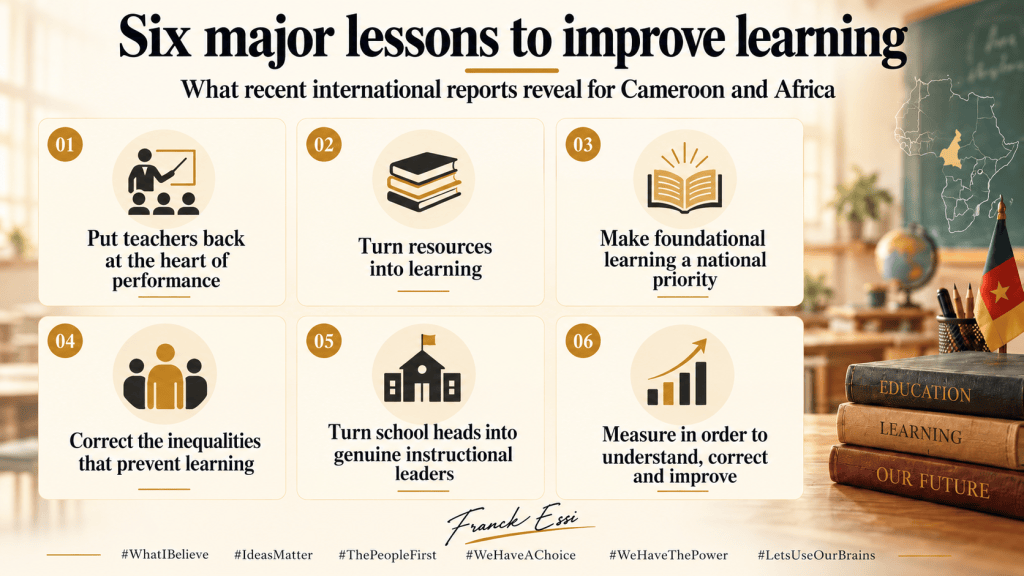
The point is therefore not to artificially combine them into a single ranking. Their combined reading instead brings out six recurring requirements.
None of them is a magic formula. Taken together, however, they point to one essential idea: an education system performs when it is able to turn its resources, time, teachers and organisation into real learning.
1. Put teachers back at the heart of performance
Teacher quality remains one of the most decisive factors.
The 2026 edition of Education at a Glance devotes particular attention to teacher shortages. In countries for which the OECD has data, 9.1% of primary and secondary teachers were not fully qualified in 2024-2025. This refers to compliance with national regulatory requirements and is not a direct measure of teaching quality.
The African challenge is often more complex. Many systems must simultaneously recruit more teachers, distribute them more effectively, improve their training and strengthen their professional support.
PASEC 2019 highlights a distinction we sometimes overlook: mastering knowledge oneself and knowing how to make a child understand it are two different skills. Teaching requires subject knowledge, but also the ability to identify learning difficulties, analyse mistakes and adjust instruction.
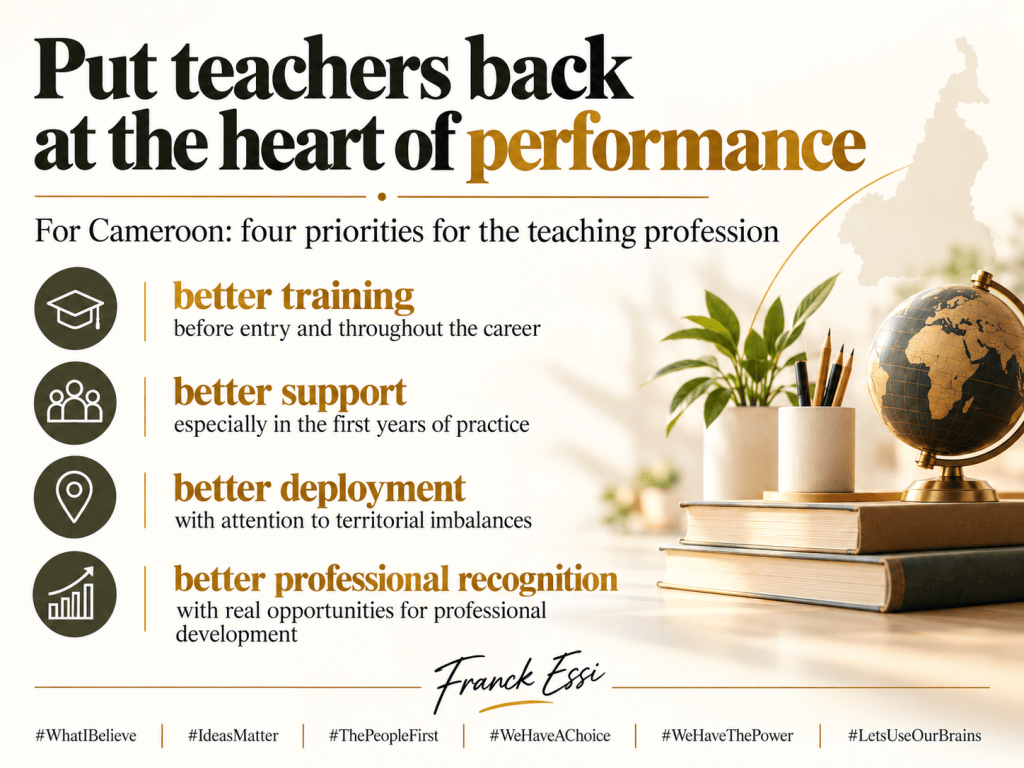
For Cameroon, this means that teacher policy should not be limited to recruitment, integration into the civil service or salaries, however important these issues may be. It should also focus on:
- better training, both before entry into the profession and throughout a teacher’s career;
- better support, particularly during the first years of practice;
- better deployment, with greater attention to territorial imbalances;
- better professional recognition, through real opportunities for career and skills development.
We will not sustainably rebuild the school system without also rebuilding the status and profession of teaching.
2. Turn resources into learning
Resources obviously matter. A school without teachers, textbooks, water, toilets or decent classrooms cannot provide good learning conditions.
But international experience reminds us of an essential distinction: spending more and producing more learning are not automatically the same thing.
Cameroon offers an interesting example. According to the World Bank, in public primary schools the country moved from around one textbook for every twelve pupils in 2016 to three essential textbooks for every two pupils in 2023.
That is a significant improvement.
The next question, however, is what this improvement actually changes inside the classroom. Do textbooks reach all schools? Can pupils use them? Do teachers use them effectively? Are they aligned with the curriculum and the competencies children are expected to acquire?
The same reasoning should apply to education policy more broadly. We need gradually to move from a culture focused mainly on resources committed to one that also pays attention to outcomes achieved.
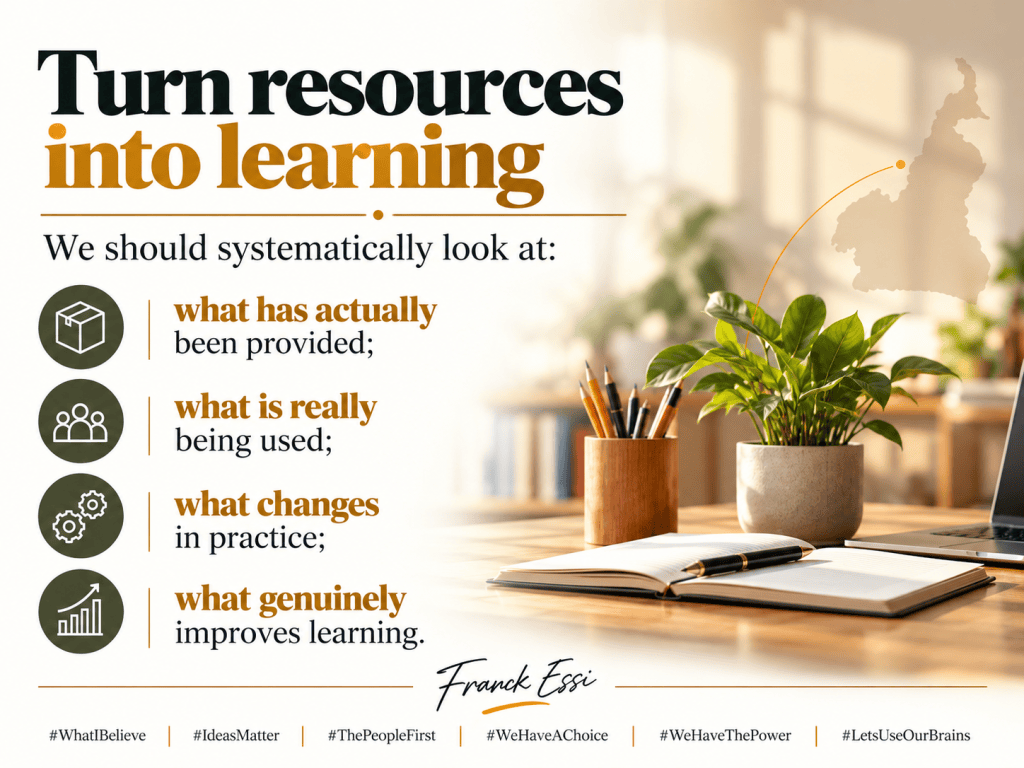
In practical terms, we should systematically look at:
- what has actually been provided;
- what is really being used;
- what changes in practice;
- what genuinely improves learning.
The number of schools built matters. But what children actually learn inside them matters even more.
3. Make foundational learning a national priority
This is probably where the African challenge is most visible.
According to the harmonised estimate presented in Spotlight 2025, only 10.8% of African children reach the minimum proficiency level in both reading and mathematics by the end of primary school.
Behind the real progress in school enrolment therefore lies a difficult question: how many children are in school without acquiring enough of the tools they need to continue learning successfully?
Continental averages, however, should not hide major differences between countries.
PASEC 2019 found that, at the end of primary school, 93.4% of assessed pupils in Gabon, 74.7% in Senegal and 53.7% in Cameroon reached the sufficient proficiency threshold in reading. In Cameroon, around 33% of assessed pupils reached the sufficient threshold in mathematics.
These figures date from 2019. They are therefore not a snapshot of Cameroon in 2026. But they do show that education outcomes across Africa are neither uniform nor predetermined.
These differences deserve closer examination. They should push us to look at teacher training, effective learning time, learning materials, languages of instruction, school management and student support.
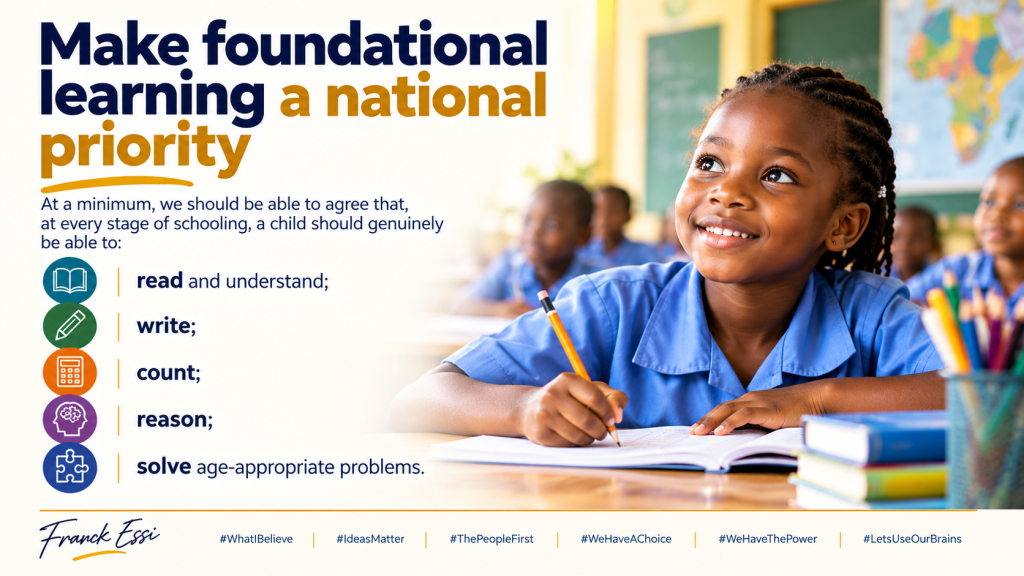
At a minimum, we should be able to agree that, at every stage of schooling, a child should genuinely be able to:
- read and understand;
- write;
- count;
- reason;
- solve age-appropriate problems.
This does not, of course, sum up the whole purpose of education. Schools must also develop culture, judgement, creativity, citizenship and the capacity to act. But without strong foundations, everything else becomes more fragile.
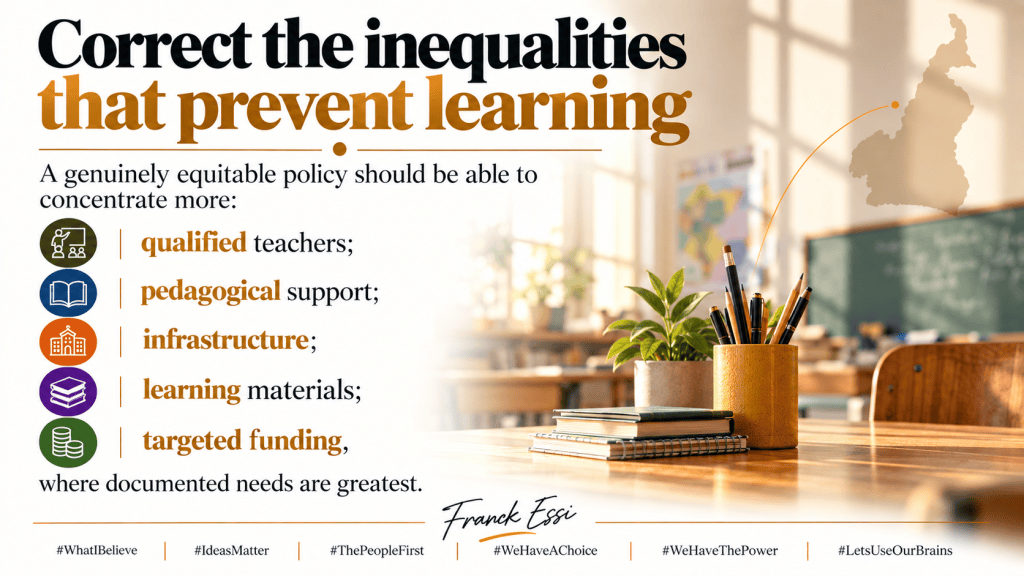
4. Correct the inequalities that prevent learning
PISA also shows that socio-economic background remains strongly associated with educational performance.
This issue is particularly important in many African countries, where disadvantages can accumulate: poverty, rural location, distance, disability, language of instruction, weak infrastructure or insecurity.
A child attending an under-resourced rural school or living in an area affected by insecurity clearly does not enjoy the same learning conditions as a child with stable teachers, available textbooks and a supportive family environment.
We should draw a simple conclusion from this: equality does not necessarily mean distributing exactly the same resources everywhere.
A genuinely equitable policy should be able to concentrate more:
- qualified teachers;
- pedagogical support;
- infrastructure;
- learning materials;
- targeted funding,
where documented needs are greatest.
Equity sometimes requires giving more to those who start with less.
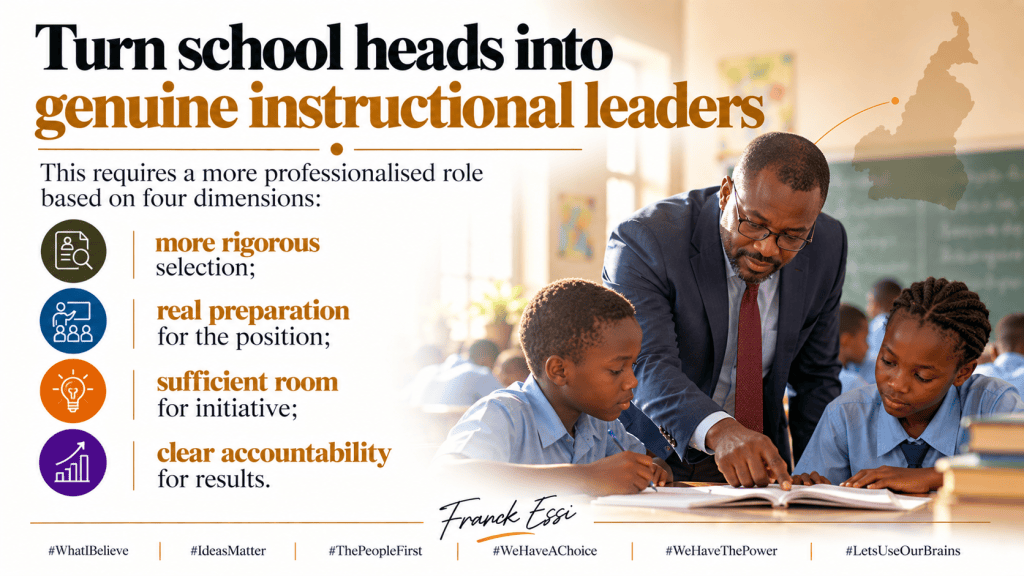
5. Turn school heads into genuine instructional leaders
We speak a great deal about ministries and teachers. Much less about school leaders.
Yet Spotlight 2025 draws, among other sources, on work conducted in nearly 300 schools in Cameroon, Côte d’Ivoire, Kenya, Morocco and Zimbabwe, and highlights the importance of school leadership in improving learning.
This issue deserves greater attention in Cameroon.
A school head should not simply be an administrator responsible for passing on instructions, monitoring attendance or producing statistics. He or she should also be able to identify pedagogical difficulties, support teachers, organise remedial action and mobilise families around learning.
This requires a more professionalised role based on four dimensions:
- more rigorous selection;
- real preparation for the position;
- sufficient room for initiative;
- clear accountability for results.
The challenge is to strike a balance between centralisation that stifles initiative and autonomy without accountability.
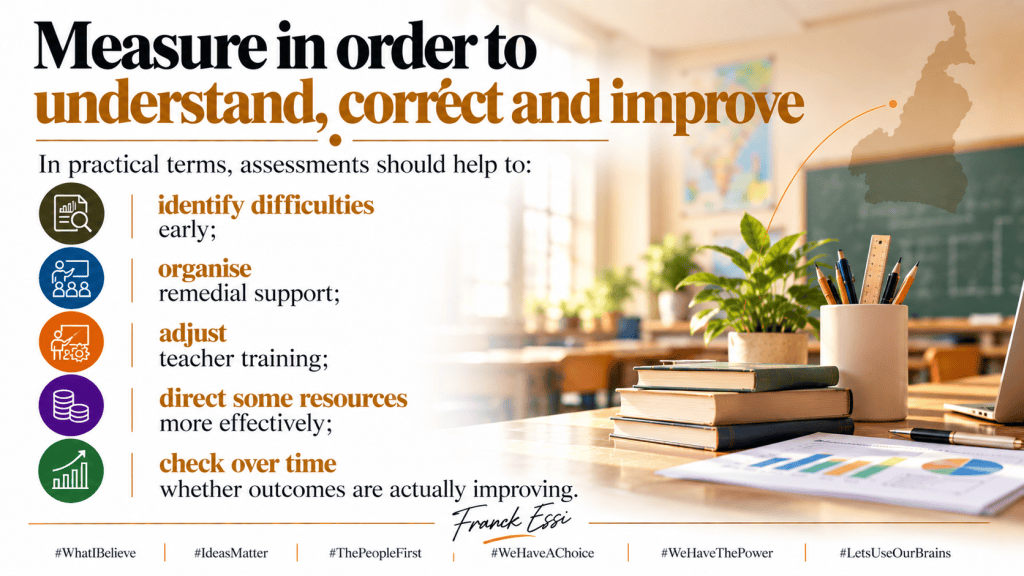
6. Measure in order to understand, correct and improve
Finally, we probably need to rethink some of the indicators we use to define success.
We know how to count schools built, teachers recruited, children enrolled and candidates who pass examinations.
These indicators are necessary. But they do not fully tell us what children can actually do.
After several years in school, can a pupil understand a text? Argue a point? Solve a new problem? Search for and verify information? Apply what has been learned in a different context?
Cameroon already has mechanisms for assessing learning outcomes. PASEC is also supporting several African countries in strengthening their national learning assessment systems (DNE, from the French Dispositifs nationaux d’évaluation) over the 2026-2030 period.
The challenge is therefore not necessarily to create more structures. It is above all to make better use of the information we already have in order to make decisions.
In practical terms, assessments should help to:
- identify difficulties early;
- organise remedial support;
- adjust teacher training;
- direct some resources more effectively;
- check over time whether outcomes are actually improving.
Assessment should not primarily be used to distribute blame.
It should help us understand what is not working and then correct it.
The deeper requirement: build a coherent system
International comparisons do not offer us a model to copy mechanically.
They point instead to several requirements that must be adapted to our own realities.
Cameroon is unlikely to improve its education system sustainably by reforming curricula, teacher training, textbooks, school governance or assessment separately.
These different dimensions must function as parts of the same system.
This means ensuring coherence between:
- what we want children to learn;
- what curricula prescribe;
- what textbooks and learning tools make possible;
- what teachers are prepared to teach;
- what assessments actually measure;
- and the decisions made on the basis of those results.
This is where the education question meets a broader governance question:
Who decides, who implements, who finances, who evaluates and who is accountable for the results?
Rebuilding education is therefore not about accumulating reforms. It is about gradually creating a system capable of learning from its own results, correcting its weaknesses and directing its resources towards what genuinely helps children learn.
Because, in the end, the true measure of our education policy will not be the number of reforms announced or the number of curricula revised.
It will be what our children have actually learned and what they have become capable of doing with what they have learned.
Franck Essi
#WhatIBelieve
#IdeasMatter
#ThePeopleFirst
#WeHaveAChoice
#WeHaveThePower
#LetsUseOurBrains
Sources and references
Organisation for Economic Co-operation and Development (OECD), Education at a Glance 2026: OECD Indicators
Link: https://www.oecd.org/en/publications/education-at-a-glance-2026_b4968bbc-en.html
OECD, Teacher shortages and the attractiveness of the teaching profession, Education at a Glance 2026
Link: https://www.oecd.org/en/publications/2026/09/education-at-a-glance-2026_3bce4131/full-report/teacher-shortages-and-the-attractiveness-of-the-teaching-profession_074961e4.html
OECD, PISA 2022 Results, Volume I: The State of Learning and Equity in Education
Link: https://www.oecd.org/en/publications/pisa-2022-results-volume-i_53f23881-en.html
OECD, PISA 2022 Results, Volume II: Learning During – and From – Disruption
Link: https://www.oecd.org/en/publications/pisa-2022-results-volume-ii_a97db61c-en.html
Conference of Ministers of Education of French-speaking Countries (CONFEMEN) / Programme for the Analysis of Education Systems of CONFEMEN (PASEC), PASEC2019: Quality of Education Systems in Francophone Sub-Saharan Africa
Link: https://pasec.confemen.org/fr/nos-actions/evaluation-des-apprentissages
CONFEMEN/PASEC, PASEC2019: Cameroon National Report
Link: https://pasec.confemen.org/wp-content/uploads/sites/2/2023/03/Rapport-PASEC2019_Cameroun_Anglais.pdf
United Nations Educational, Scientific and Cultural Organization (UNESCO) / Global Education Monitoring Report / African Union, Spotlight on Basic Education Completion and Foundational Learning in Africa: Lead for Foundational Learning, 2025
Link: https://www.unesco.org/gem-report/en/publication/2025spotlight
UNESCO / Global Education Monitoring Report, Spotlight on Basic Education Completion and Foundational Learning: Cameroon, 2025
Link: https://www.unesco.org/gem-report/en/publication/2025spotlight-cameroon
World Bank, Turning Pages, Transforming Lives: Cameroon’s Textbook Revolution, 2024
Link: https://www.worldbank.org/en/results/2024/02/01/turning-pages-transforming-lives-cameroon-textbook-revolution
CONFEMEN/PASEC, National Learning Assessment Systems
Link: https://pasec.confemen.org/fr/nos-actions/dne
CONFEMEN/PASEC, Strategy for Strengthening and Establishing National Learning Assessment Systems, 2026-2030
Link: https://api-services.pasec.confemen.org/media/public/dne_and_pasec2028/DNE/Documents/1.%20SRM-DNE-2026-2030_CONFEMEN_PASEC_num.pdf

