By Franck Essi
—
The urgent need to break with the fascination with saviours
With every new election, the scene is the same: unrealistic promises, candidates portrayed as heroes, speeches inflated with ego. We hear the same thing over and over again: ‘I will change the country.’
But after the euphoria comes disappointment. Almost always, the system remains unchanged, injustices are reinforced, and popular hope fades. This cycle repeats itself because we continue to believe in the myth of the saviour — the one who, alone, will come and repair all the fractures in a country. This myth, inherited from the colonial past and fuelled by authoritarian political practices, prevents collective action from emerging.
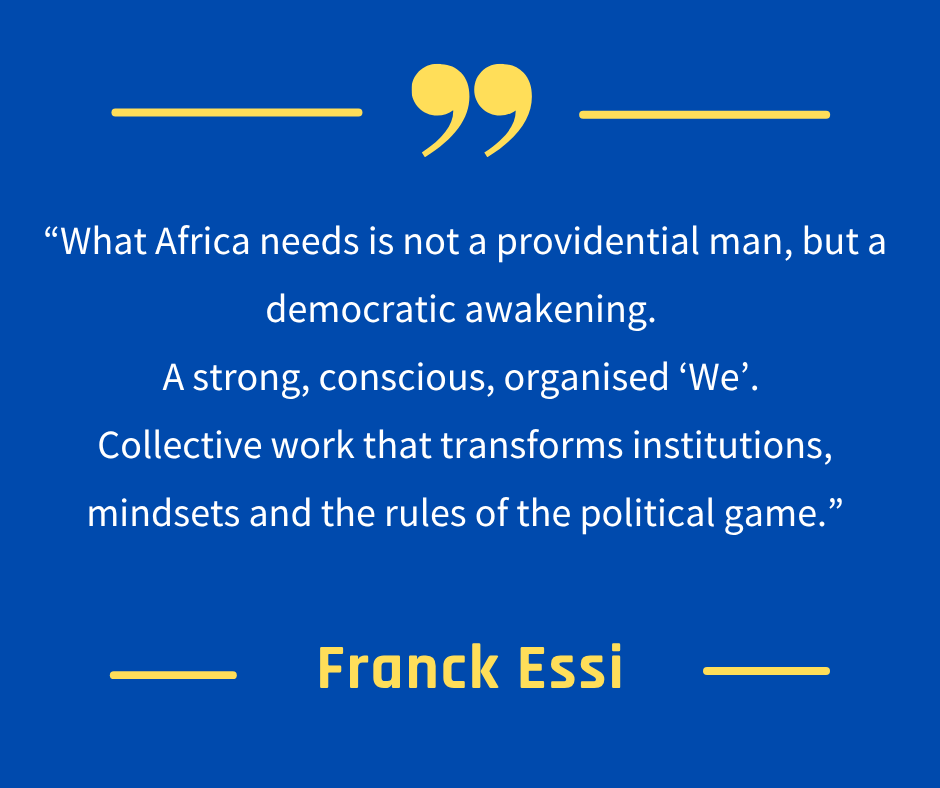
We are convinced that it is time to abandon this illusion. What Africa needs is not a providential man, but a democratic awakening. A strong, conscious, organised ‘We’. Collective work that transforms institutions, mindsets and the rules of the political game.
—
The dangerous illusions of political ‘Me, Myself and I’
The discourse of the lone leader is based on three major illusions that undermine African societies and prevent any structural progress.
1. The omnipotence of the leader
Believing that one individual alone can change a country is to misunderstand the complexity of power systems. Even a courageous and sincere leader cannot single-handedly defeat networks of influence, institutional routines and obstacles rooted in social practices. When isolated and without collective support, such leaders often end up failing or compromising their principles.
Genuine transformation requires collective organisation, a structured activist base and a solid institutional apparatus.
2. Change without real reform
Promising change without reforming the rules of the game is a deception. As long as constitutions can be manipulated, institutions captured and justice dependent, no change of government can guarantee progress.
Changing faces without changing the way power is exercised is tantamount to perpetuating the status quo in a new guise.
3. Election spectacle
Too often, democracy boils down to an electoral show. Citizens are reduced to extras, called upon to vote without understanding the deeper issues at stake. Debates focus on personalities, never on systems. There is no talk of resource management, power sharing or control over leaders.
A vibrant democracy is not limited to the ballot box. It requires active citizens who are involved in everyday life and capable of demanding accountability.
—
Why this fascination with saviours?
This belief in strongmen has deep roots. It comes from our history and our institutions, but also from the influence of external actors.
1. A history of internalised domination
After independence, many countries replaced colonial administrations with strong presidential regimes. Heads of state became father figures, almost sacred, concentrating all power and deciding everything.
This authoritarian model marginalised collective initiatives and emptied institutions of their substance.
2. The state as private property
In many contexts, the state is not seen as a common good, but as a source of privilege. Power is exercised through personal relationships, loyalty networks, and the distribution of positions and contracts. Political parties are often reduced to electoral instruments with no ideological agenda or debate.
This system blocks the emergence of countervailing powers and discourages citizen participation.
3. Self-serving support from foreign powers
In the name of stability, some external partners prefer to deal with authoritarian regimes rather than support the construction of open societies.
This international complacency reinforces the myth of the indispensable leader and compromises popular sovereignty.
—
For a collective alternative: the concrete foundations of an insurrection of the ‘We’
Breaking free from the cult of the saviour is not simply a matter of changing vocabulary. It is a strategic shift: collective power must be organised. This requires building a new democratic architecture based on four essential pillars — not as a luxury, but as the minimum necessary for real change to be possible.
1. Building political parties rooted in local realities
The majority of African parties are electoral shells that only become active when elections are approaching. We must put an end to this opportunistic logic.
What needs to be done:
- Create sustainable ‘village or neighbourhood cells’.
- Organise popular universities of politics.
- Establish community financing mechanisms.
- Enforce gender parity and generational renewal in leadership bodies.
2. Build grassroots, autonomous citizen movements
African civil society often remains either underfunded or co-opted. To be a real force for change, it must combine grassroots mobilisation, financial autonomy and the ability to propose solutions.
What needs to be done:
- Create local democratic watchdog networks.
- Establish citizens’ houses in every municipality.
- Develop local governance pacts.
- Organise concerted action campaigns at the regional level.
3. Rebuild institutions from the bottom up
Reforming the state cannot remain a slogan. The relationship between the rulers and the ruled must be legally and institutionally rebuilt.
What needs to be done:
- Demand accountability laws.
- Promote local justice.
- Launch community constituent processes.
- Establish local ‘citizens’ parliaments’.
4. Trigger an educational and cultural revolution in politics
The battle is also being fought in people’s minds. We must break the expectation of a saviour by forming a critical and committed civic consciousness.
What needs to be done:
- Establish active civic education for all.
- Create a digital library accessible to all citizens.
- Involve artists and cultural leaders in political education.
- Develop citizenship clubs in schools, places of worship and neighbourhoods.
—
My conviction: Stop believing, start building. Stop following, start acting.
Real change will not come about through the election of a ‘new’ man, but through the emergence of an organised, informed and structured citizenry. This is the insurrection of ‘We’.
Every neighbourhood, every village, every school can become a laboratory for this new democracy.
And this democracy will not come from the top. It will emerge from the bottom. It will not be entrusted to one person, but built by many.
We do not need a guide, but a collective direction.
We do not need a hero, but a network of coordinated actions.
It is not charisma that builds a republic, but popular organisation.