By Franck Essi
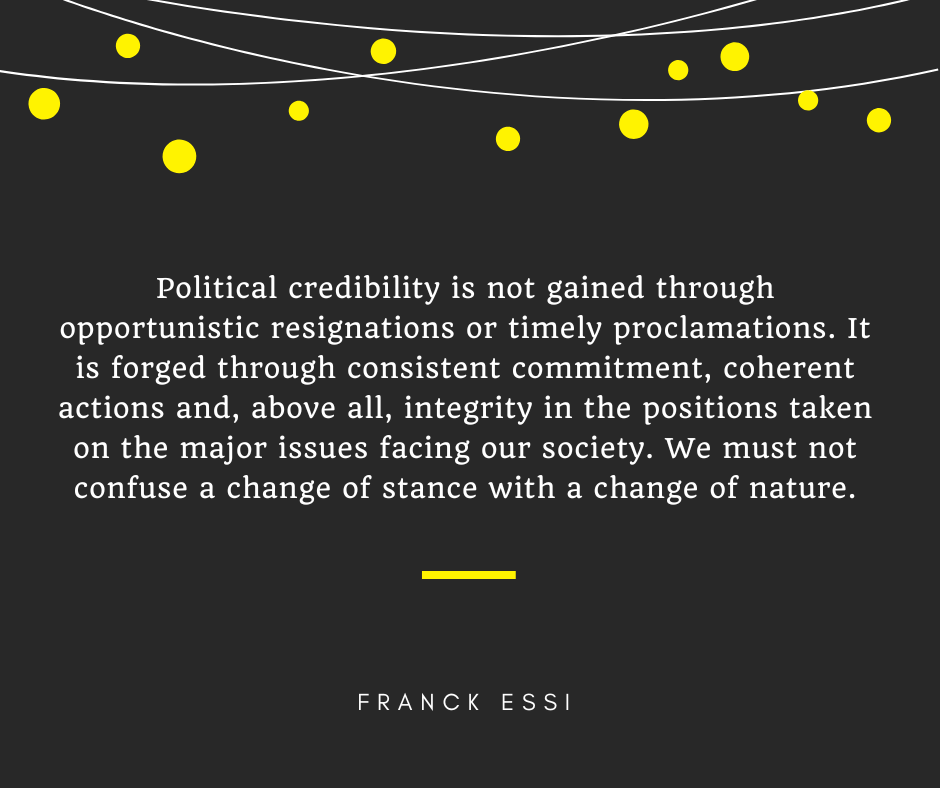
The recent announcement of Issa Tchiroma’s resignation from the Cameroonian government has provoked, as always when a figure from the regime leaves office, a wave of enthusiastic, even euphoric, comments and interpretations. However, amid the excitement of these spontaneous reactions, we must exercise caution so as not to confuse a change of stance with a genuine change of nature.
Issa Tchiroma perfectly embodies the type of politician whose successive about-turns illustrate an opportunistic strategy rather than a genuine desire for reform. As Minister of Communication for many years, he was one of the most vocal and relentless defenders of the current regime, even going so far as to justify the unjustifiable. He is particularly remembered for his statements following accusations of human rights violations in the far north of the country, where he firmly denied any government responsibility despite overwhelming evidence provided by international and local organisations.
Issa Tchiroma was also the face of multiple contradictions, switching from virulent opposition to the regime to an equally passionate defence of it once he began to enjoy government privileges. This zigzag career path is a cruel reminder that political opportunism, far from being marginal, is a worrying norm in our national political landscape.
Tchiroma’s resignation is indicative of a broader trend: that of influential figures within the regime seeking to reposition themselves in the run-up to elections or during periods of socio-political unrest. This tactical stance allows them, with little effort, to wear the mantle of the opposition while capitalising on popular fatigue, disappointment and even despair.
But it is important to remember that political credibility is not gained through opportunistic resignations or timely proclamations. It is forged through consistent commitment, coherent actions and, above all, integrity in the positions taken on the major issues facing our society.
Therefore, in the face of these sudden conversions and media repentances, citizens, political activists, civil society and the media must be particularly vigilant. A few essential questions deserve to be asked each time a defection is presented as an act of political courage:
- What are the real reasons for this reversal?
- What guarantees of integrity can be expected from individuals who have supported a regime for years and suddenly denounce its abuses?
- How much credibility should be given to those who, only yesterday, defended practices that are now denounced as contrary to the interests of the people?
The answers to these questions will help us avoid falling into the trap set by those whose primary objective is to ensure their own political survival. To avoid past mistakes, several recommendations are in order:
- Journalists have a crucial role to play in exercising their critical faculties and not merely parroting statements. They must question, dig deeper, confront discourse with historical facts and demand accountability for past actions.
- Civil society organisations must act as vigilant guardians of political memory. Documenting the past, reminding people of responsibilities and ensuring ongoing vigilance are their best contribution to democracy.
- Political activists for change must prioritise alliances based on clear values and a coherent vision rather than on short-term calculations. Cameroon’s future will not be built on dubious compromises but on solid and shared convictions.
- Finally, ordinary citizens who aspire to real change must remain clear-headed and demanding in the face of easy promises and sudden reversals. Popular vigilance is the first line of defence against political manipulation and destructive opportunism.
Issa Tchiroma’s resignation, far from being insignificant, is a signal. But this signal is not one of revolution or spontaneous renewal. It is the predictable echo of a well-known practice whereby the old adorns itself with the trappings of the new without fundamentally changing its essence.
Ultimately, the real transformation of Cameroon will not come from skilled opportunists or last-minute repentants. It will be driven by a strong civil society, a conscious and active youth, and by political actors whose integrity and commitment have been tested by time and trials. Let us never confuse a simple change of posture with a genuine change of nature, for it is on this distinction that our democratic future truly depends.
Franck Essi
#WhatIBelieve
#WeHaveTheChoice
#WeHaveThePower
#TurnOnOurBrains
#CitizenEducation
#PoliticalTransition
 franckessi.com
[…] Don’t confuse a change in posture with a change in nature […]
J’aimeJ’aime