Preliminary lessons from an ongoing African political experiment
By Franck Essi
—-
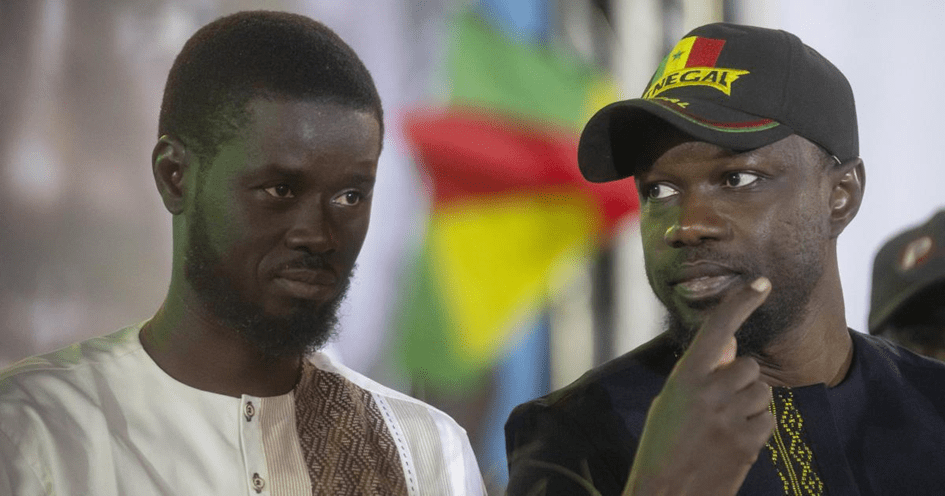
Senegal is going through one of those political moments which, beyond national borders, hold up a mirror to an entire continent. What is playing out between Bassirou Diomaye Faye and Ousmane Sonko is not merely a crisis between two men. It is not merely a dispute over precedence between a president and his former prime minister. It is not merely an internal tension within PASTEF. It is an ongoing African political experiment, with its grandeur, its promises, its contradictions, its fragilities and its risks.
At the outset, there was a duo. A duo that became a symbol. A duo which, in 2024, embodied a rare hope: that of a radical change of government, driven by a mobilised youth, a fervent activist base, a sovereignist discourse, and a promise of public moralisation, justice, national dignity and the transformation of the state. Ousmane Sonko, barred from standing in the 2024 presidential election, had put forward Bassirou Diomaye Faye as a substitute candidate. Diomaye Faye had won. Sonko had been appointed Prime Minister. PASTEF had then consolidated its political hold through a very large parliamentary majority. For a while, therefore, everything seemed in place to turn an electoral victory into a project of national renewal.
But political history teaches a lesson that people often rediscover the hard way: winning power is not the same as knowing how to exercise it. On 22 May 2026, Bassirou Diomaye Faye dismissed Ousmane Sonko from his post as Prime Minister and dissolved the government. On 25 May, he appointed the economist Ahmadou Al Aminou Lo as the new Prime Minister. On 26 May, there was a new twist: Ousmane Sonko was elected President of the National Assembly, with the support of 132 out of 165 MPs, thus becoming a powerful parliamentary figure in opposition to the executive.
The crisis is therefore no longer merely governmental. It has become institutional. It now pits two forms of legitimacy from the same camp against one another: the presidential legitimacy of Diomaye Faye and the activist, partisan and parliamentary legitimacy of Ousmane Sonko. Diomaye holds the reins of the state. Sonko still commands much of the political energy that brought about the change of government. One embodies the office. The other still embodies, for many, the cause. One speaks in the name of institutional stability. The other can present himself as the guardian of the original promise.
It is precisely this separation of legitimacies that makes the situation dangerous.
—-
A crisis that did not come out of the blue
It would be too easy to view this crisis as a mere interpersonal accident. It has deeper roots. It was inherent, from the outset, in the political architecture of the 2024 change of government.
The Diomaye–Sonko partnership was fraught with ambiguity from the outset. Diomaye was the elected president, but Sonko was the movement’s long-standing leader. Diomaye held institutional legitimacy, but Sonko retained strong symbolic authority. Diomaye governed from the Palace, but Sonko still spoke to a militant grassroots base that saw him as the soul of PASTEF. As long as the objective was to defeat the old regime, this duality could work. Once in power, it demanded clarification.
Who really makes the decisions? Who sets the economic agenda? Who mediates differences between the party and the state? Who speaks on behalf of the project? Who controls the pace of the break with the past? Who is willing to lose an internal battle without turning the disagreement into a national crisis?
The crux of the problem: Diomaye seems to have wanted to make the transition presidential, whilst Sonko seems to have wanted to keep the break under militant and partisan control. This tension is not unusual. It is even typical in movements for change. What is problematic is that it was not sufficiently institutionalised, discussed, resolved and contained before it exploded publicly.
For political friendship is no substitute for institutional architecture. Activist solidarity is no substitute for decision-making rules. Personal trust is no substitute for arbitration mechanisms. An election campaign may thrive on symbols of unity. A state, however, needs clear chains of accountability.
—-
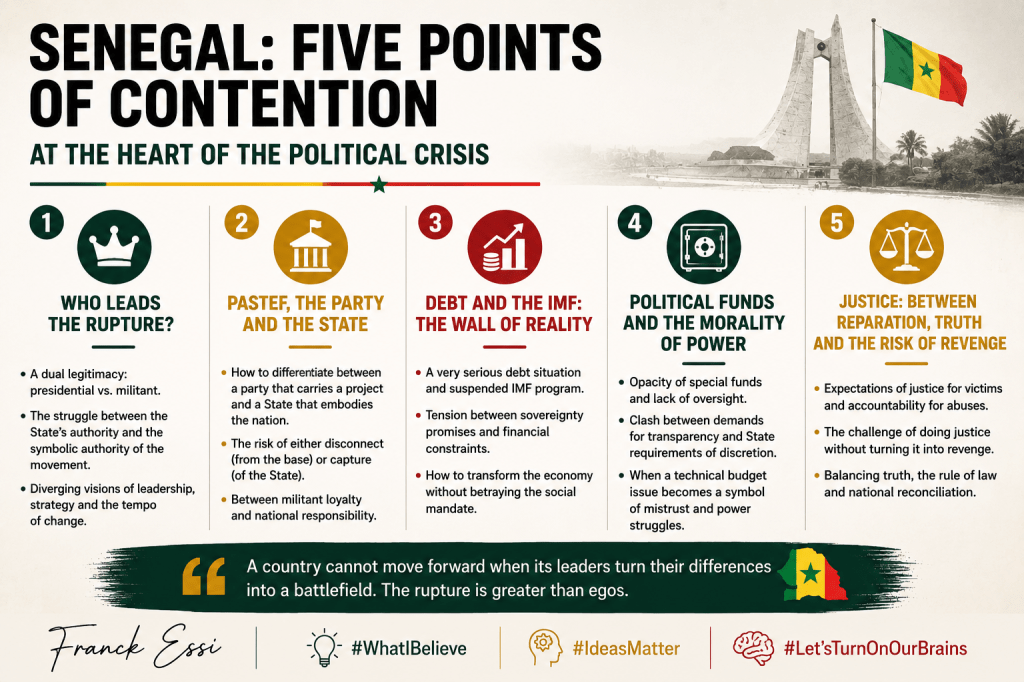
First issue: who is leading the breakaway?
The first dividing line is that of actual leadership.
The implicit slogan for 2024 could be summarised as follows: Diomaye and Sonko are two faces of the same promise. Politically, this merger had a mobilising power. But institutionally, it carried a risk. For once the election is won, the state always poses the same questions: who signs? who appoints? who dismisses? who negotiates? who answers to the nation? who bears the consequences?
Diomaye Faye could hardly continue to be seen as merely Sonko’s institutional extension. Sonko could hardly accept becoming an ordinary Prime Minister, subject to a presidential logic that part of his support base might interpret as normalisation or betrayal. Each was therefore bound by a different form of legitimacy. Diomaye had to prove that he was truly the president. Sonko had to prove that he remained the guardian of the project.
This is where the partnership began to fray. Not because there were differences of opinion. Any serious political endeavour involves differences of opinion. But because these differences no longer seemed to have a space within the organisation to be addressed. When a strategic disagreement becomes a public spectacle, it ceases to be merely a debate. It becomes a power struggle.
—-
Second issue: PASTEF, the party and the state
The second fault line concerns the relationship between PASTEF and the state.
PASTEF is no ordinary party. It is a political apparatus, but also a memory of struggle, an emotional community, a militant identity and a vision of rupture. But when a party comes to power, it must learn a crucial distinction: a party champions a project; the state champions a nation.
A party is accountable to its activists. The state is also accountable to those who did not vote for it. A party can thrive on fervour. The state must thrive on the rule of law, procedures, administrative continuity, budgets, oversight, impartial justice and results.
The Senegalese crisis therefore raises a major question: should PASTEF have controlled the state in the name of loyalty to its project? Or should it have accepted that the state, once conquered, would in turn impose its constraints, its slowness, its caution and its responsibilities?
The danger is twofold. If the state ignores the party that brought it to power, it loses its popular and activist base. But if the party captures the state, it reduces the nation to its own camp. It transforms political alternation into appropriation. It confuses national loyalty with party discipline. It ends up reproducing, in a different guise, the very practices it denounced yesterday.
—-
Third issue: debt and the IMF, or the wall of reality
The economic issue is probably the most pressing. The debt crisis has transformed political contradictions into a crisis of governability.
Senegal faces a very serious financial situation. The IMF programme, worth about $1.8 billion, was suspended after the discovery of misreported debt, while the country’s debt is projected to reach around 132% of GDP by the end of 2024. In this context, several media outlets reported that Sonko was notably opposed to debt restructuring and an increase in fuel prices, while discussions with the IMF were expected to resume in June.
This case highlights the difficulty of the transition from opposition sovereignty to government sovereignty. In opposition, it is possible to say: we will refuse humiliation, renegotiate, defend national dignity, and break with external dictates. But in power, one must pay wages, fund public services, maintain subsidies or explain their reduction, preserve creditors’ confidence, avoid budgetary suffocation, and protect the most vulnerable.
Sonko seems to have wanted to prevent the debt from becoming a political capitulation. Diomaye seems to have wanted to prevent it from becoming an uncontrollable financial crisis. Both concerns are understandable. But without a common strategy, they become at odds with one another.
The real question, then, is not simply a matter of who was right. It runs deeper: how can a government elected on a platform of sovereignty, social justice and radical change manage a massive debt without betraying its popular mandate, without losing its financial credibility, and without making the people pay the price for the previous regime’s cover-ups?
Sovereignty is not merely proclaimed. It is built. Through domestic production. Through fair taxation. Through budgetary discipline. Through transparency in debt management. Through productive transformation. Through the quality of institutions. Through the ability to negotiate without kowtowing and to resist without isolating the country.
—-
Fourth issue: political funds and the ethics of power
Political funds, sometimes referred to as special funds or secret funds, are appropriations included in the state budget, generally for the benefit of senior authorities, notably the Presidency or the Prime Minister’s Office.
In Senegalese administrative history, these funds are described as appropriations voted by the National Assembly, but the details of their use remain largely undisclosed to the public. They are regarded as a financial manifestation of the raison d’état, that is to say, resources made available to the Head of State without any obligation to disclose precisely how they are used or who the beneficiaries are.
The issue of political funds appears to be technical. In reality, it is highly symbolic. It brings together four conflicts: a moral conflict, an institutional conflict, a strategic conflict and a leadership conflict.
Moral, because it raises the question of the use of public money. Institutional, because it questions which authority is competent to carry out the reform: the Presidency, the Prime Minister’s Office or the National Assembly. Strategic, because it pits the need for swift action against the state’s duty of prudence. Political, finally, because it raises the question of who is the true guardian of the 2024 promise. One fact stands out clearly: political funds are a minor budget item in appearance, but a major political dividing line in reality.
Sonko seems to view this issue through the lens of an anti-establishment activist: no public money should escape scrutiny. Diomaye seems to view it through the lens of a president facing the constraints of the state: certain sensitive expenditures require discretion, security, intelligence, diplomacy and crisis management. The two positions are not necessarily incompatible. It is possible to maintain sensitive funds whilst subjecting them to confidential, judicial or limited parliamentary scrutiny.
But when political trust is damaged, rational compromises become almost impossible. One side’s caution becomes suspect. The other’s moral urgency becomes destabilising. And a budgetary issue becomes a political crisis.
—-
Fifth issue: justice, between reparation, truth and the risk of revenge
The Diomaye–Sonko administration was also expected to deliver on the issue of justice. Justice for the victims of political violence. Justice against opacity. Justice against the abuses of the former regime. Justice against privilege.
But delivering justice from within the state is more difficult than demanding justice from the opposition. If justice moves too slowly, victims feel betrayed. If it moves too quickly and appears targeted, the opposition denounces a witch-hunt. If the state compensates without judging, it may appease without redressing. If it prosecutes without safeguards, it may turn justice into an instrument of revenge.
The question is therefore a daunting one: how can justice be done without vengeance? How can reparations be made without buying silence? How can prosecutions be carried out without humiliation? How can accountability be established without opening a new cycle of settling scores?
On this issue, as on others, Diomaye and Sonko are making two demands that should be complementary: the demand for truth and the demand for the rule of law. But they can become contradictory if they are exploited in a battle for leadership.
—–
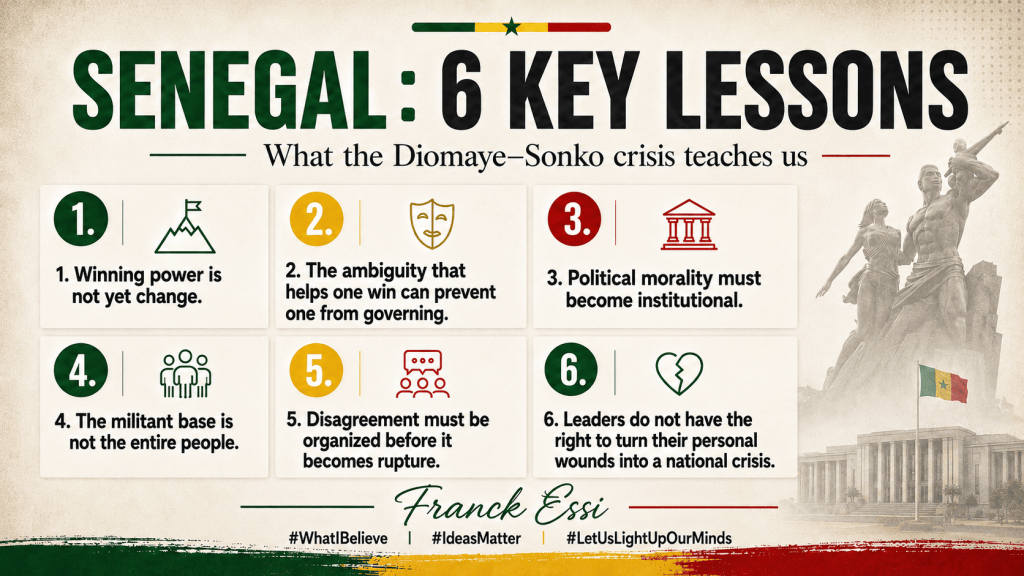
The key lessons from the Senegalese experience
The first lesson is simple: winning power does not yet mean change. Winning an election allows one to enter the state apparatus. Transforming the state requires a method, institutions, education, teams, trade-offs and the capacity to deliver.
The second lesson is that the ambiguity that helps you win can prevent you from governing. The symbolic merger between Diomaye and Sonko was electorally useful. But after the victory, roles, responsibilities, areas for compromise and mechanisms for resolving disagreements needed to be clarified.
The third lesson is that political ethics must become institutionalised. Simply claiming to be different is not enough. Mechanisms must be created to prevent even one’s own camp from misgoverning: oversight of public funds, budgetary transparency, an independent judiciary, parliamentary accountability, limits on privileges, and sanctions for abuses.
The fourth lesson is that the activist base is not the entire population. It serves as a reminder of the promise, but it cannot become the state’s sole guiding principle. To disregard the base is to lose one’s soul. To govern solely for it is to lose the state.
The fifth lesson is that disagreement must be managed before it turns into a rupture. No movement for change can govern sustainably if its leaders settle their disagreements in public without a solid internal mechanism.
The sixth lesson is that leaders have no right to turn their personal grievances into a national crisis. When one carries a collective hope, one’s conflicts are no longer private matters. They involve the country, its institutions, its citizens and even the credibility of forces for change elsewhere in Africa.
—-
The questions Senegal poses to Africa
This crisis raises questions that go beyond Senegal.
Can a break with the past be governed using the methods of conquest?
How can one distinguish loyalty to a leader from loyalty to a project?
How can we prevent a victorious party from taking over the state?
How can justice be served without revenge?
How can one negotiate with the IMF without losing sovereignty?
How can one tell the truth to the people without crushing them under the weight of constraints?
How can Parliament be made a useful counterweight rather than a base for revenge?
How can we prevent yesterday’s heroes from becoming the rivals who destroy collective hope?
These questions should be of interest to all African citizens’ movements, all opposition parties, and all coalitions for change. For it would be a mistake to believe that this crisis concerns only Dakar. In reality, it speaks to something fundamental about the difficulty of moving from protest to governance.
—–
Possible scenarios
The first scenario is one of strategic appeasement. Diomaye and Sonko realise that their rivalry could destroy what they have built together. The president asserts his authority, but publicly acknowledges Sonko’s historic role. Sonko fulfils his parliamentary role, but refrains from turning the National Assembly into a tool for obstruction. PASTEF organises an internal dialogue. A minimal roadmap is negotiated on debt, political funds, justice, institutional reforms and social emergencies. This is the most beneficial scenario for Senegal. It does, however, require a quality rarely found in politics: putting the cause before one’s ego.
The second scenario is one of conflictual but contained cohabitation. Diomaye governs with his new Prime Minister. Sonko exercises political control over part of Parliament and PASTEF. Tensions remain high, but they play out within the institutions. The Assembly criticises, scrutinises and sometimes slows things down, but does not seek to bring down the executive. This scenario may be uncomfortable, but it can be democratically fruitful if everyone respects the boundaries.
The third scenario is that of a lasting split within PASTEF. Sonko regains control of the party. Diomaye builds an autonomous presidential coalition. MPs are divided. The majority becomes unstable. The country enters a period of political realignment before 2029. Former allies become rivals. The promise of a break with the past fragments into two rival narratives: that of presidential stability and that of militant loyalty. This risk of a split and deadlock is one of the serious scenarios to watch out for.
The fourth scenario is that of a destructive showdown. Diomaye uses the state apparatus to marginalise Sonko. Sonko uses the party, Parliament or the streets to encircle Diomaye. Economic reforms grind to a halt. Negotiations with partners become more difficult. Social tensions rise. Activists become more radical. The promise of change turns into a battlefield. Sonko’s election as Speaker of the Assembly could create a strong counterbalance to power, but also pose a risk of political deadlock in a difficult economic climate.
—-
So that yesterday’s duo does not become a duel against the people
There are still ways to avoid the worst.
The first is to depersonalise the crisis. The breakaway movement belongs neither to Diomaye alone nor to Sonko alone. It belongs to the Senegalese people who championed it, hoped for it and made it possible.
The second is to create a political arbitration mechanism between the Presidency, the government, the National Assembly, PASTEF and the coalition partners. Disagreements must be addressed before they become public spectacles.
The third is to negotiate a minimal non-aggression pact: do not block vital reforms, do not mobilise the streets against the institutions, do not use the justice system as a weapon, do not humiliate former allies, do not confuse parliamentary oversight with revenge.
The fourth is to clarify sensitive issues for the public: debt, the IMF, political funds, the justice system, the cost of living, employment, and the state’s spending. The people can accept sacrifices when they understand why, for how long, and for whose benefit, and when leaders themselves set an example.
The fifth is to make the National Assembly a true forum for accountability. Sonko can gain stature there if he shows that he exercises control without destroying, questions without sabotaging, and champions change without sacrificing the state.
The sixth is to preserve the African promise of this change of government. Senegal is being watched far beyond its borders. If yesterday’s duo becomes a destructive duel, the cynics will say: there you go, the forces of change are no better than the others. They promise morality, then divide over power. They denounce the old systems, then reproduce their quarrels, their pride, their deadlocks.
That is why this crisis goes beyond Diomaye and Sonko. It poses a huge question to all the forces of change: do we merely want to replace those in power, or are we prepared to govern differently?
The true test of a movement for change does not begin the day it comes to power. It begins the day power offers it the chance to betray itself, to split, to lose sight of the bigger picture — or to rise above itself.
Franck Essi
#WhatIBelieve
#IdeasMatter
#Let’sTurnOnOurBrains