Note: Educational text on active citizenship and critical thinking.
Par Franck Essi
There are moments in the life of a country when thinking becomes a civic act.
Not only speaking. Not only becoming indignant. Not only sharing a post. Not only applauding those who think like us. Not only condemning those who think differently.
Thinking.
That is, taking the time to look at the facts, compare versions, question speeches, verify information, identify the interests at stake, recognize our own emotions and, sometimes, accept saying: I may have been wrong.
In a country saturated with rumors, promises, anger, manipulation, frustrations and partisan discourse, learning to think clearly becomes a civic emergency.
As each electoral cycle approaches in Cameroon, as we saw again during the October 2025 cycle, calls for citizen participation multiply. Citizens are called upon to register on electoral rolls, vote, monitor their vote and, more broadly, take part in defining the future of the country.
All this is important.
But all this is not enough.
Active citizenship cannot be reduced to the electoral moment alone. It does not begin in the voting booth and it does not end with the proclamation of results. It is built before, during and after elections, in neighborhoods, villages, markets, schools, universities, workplaces, associations, councils, media spaces, families, places of worship and even WhatsApp groups.
After an election, many citizens return to their frustrations, their private conversations, their silent anger or their habits as spectators. Yet it is often after the election that the real civic work begins: following up, questioning, monitoring, documenting, proposing and organizing.
Citizenship is built above all through our collective ability to think, question, verify, understand and act. This is where critical thinking becomes indispensable.
In a context marked by political promises, rumors, manipulation, partisan discourse, electoral disputes, debates over the transparency of the electoral process, the rapid circulation of false information and the mistrust of some citizens toward institutions, critical thinking is not a luxury.
It is a civic necessity.
It is even, to some extent, a form of protection: protection against manipulation, against easy speeches, against false certainties, against misdirected anger, but also against our own tendency to believe too quickly what suits us.
Because we must admit it: we are not only exposed to the lies of others. We are also exposed to our own biases, our own preferences, our own affiliations and our own emotions.
The challenge is therefore simple: how do we become citizens capable not of merely enduring events, but of understanding them in order to act better?
Critical thinking does not mean criticizing everything
We must first clear up a confusion.
Having a critical mind does not mean being against everything. It does not mean systematically rejecting what authorities, political parties, journalists, intellectuals, religious leaders, traditional rulers or association leaders say. It does not mean insulting those who think differently, nor behaving as if we knew everything better than everyone else.
Critical thinking is the ability to examine a piece of information, an idea, a promise or a situation before forming an opinion.
It is the ability to take a step back before believing, sharing, condemning or supporting.
In practical terms, this means asking a few simple questions:
- Who is speaking?
- Why is this person speaking now?
- What evidence is being provided?
- Who can benefit from this discourse?
- What am I not being told?
- Is this a fact, an opinion, a rumor or a manipulation?
- What other explanations are possible?
Here is the essential point: critical thinking does not mean believing nothing. It means not believing just anything.
In a country like Cameroon, and more broadly in many African societies, this distinction matters. Citizens are often caught between two extremes: believing everything that comes from their own camp or rejecting everything that comes from the opposite camp.
Thinking this way is not critical thinking. It is merely replacing one dependency with another.
A critical citizen is not a citizen who doubts everything. A critical citizen is one who refuses to be governed by rumor, fear, anger or blind followership.
Citizenship is not limited to voting
It must be repeated: voting is important. Registering on electoral rolls is important. Monitoring the vote is important. Citizen mobilization around the electoral process is important.
But citizenship is not limited to that.
If citizens vote without understanding the issues, without examining programs, without questioning track records, without verifying promises and without following public action after elections, their participation remains incomplete.
This does not mean that people should not vote.
Quite the contrary.
Voting is a necessary tool. But it is not enough.
Active citizenship also means demanding accountability. It means following what is being done in one’s council area. It means taking an interest in public budgets. It means understanding why a road is not being built, why a borehole no longer works, why a school lacks desks and benches, why a health center lacks medicine, why a neighborhood goes several days without water or electricity, why a market remains unsanitary, or why certain projects announced during electoral campaigns disappear afterward.
In our countries, many citizens rightly complain about poor governance. But complaint alone is not enough.
It may be legitimate.
But it becomes more useful when it turns into a question, then into organization, then into civic action.
One could summarize it this way:
- Complaint must become question.
- Question must become organization.
- Organization must become civic action.
This is how we move from powerless anger to useful engagement.
Rumors have become a political force
We must take this seriously.
Today, a rumor can travel across a country in a few minutes. False information can leave a phone in Douala, circulate in Yaounde, Bafoussam, Garoua, Bertoua or Maroua, then reach other African countries before it has even been verified.
An anonymous audio recording can become “proof”. An old video can be presented as recent. An image taken in another country can be attributed to Cameroon. A false quotation can be placed in the mouth of a politician, journalist, activist, minister or opponent. A fake press release can circulate as if it came from an official institution. A rumor about a nomination can be presented as a decision already made. A partial result can be turned into a definitive truth.
In WhatsApp groups, we often read formulas such as:
- “Urgent, share everywhere.”
- “Confirmed information.”
- “Do not say I told you.”
- “This came from a reliable source.”
- “I do not know if it is true, but I am sharing.”
Very often, the reliable source does not exist.
Or it has never been verified.
This is where critical thinking becomes a digital responsibility. Before forwarding information, let us ask ourselves whether the source is identifiable, whether the date is known, whether other credible sources mention it and whether the message truly seeks to inform or simply to provoke fear, anger, hatred or confusion.
Because false information is not merely a mistake.
It can create panic, damage a reputation, divide communities, manipulate opinion or push citizens to make bad decisions.
Sharing without verifying sometimes means participating in the manipulation we claim to be fighting.
Political promises must be examined methodically
During electoral campaigns, promises multiply. Roads, jobs, water, electricity, better schools, modern hospitals, better support for young people, women, farmers, traders, teachers, workers and entrepreneurs are all promised.
Promises should not be rejected simply because they are promises.
But they should not be accepted simply because they are pleasant to hear.
A political promise must be questioned.
If a candidate says: “I will create jobs for young people”, we must ask:
- What jobs?
- In which sectors?
- With what funding?
- Within what timeframe?
- With what training?
- With what support for young entrepreneurs?
- With what measurable results?
If another says: “I will build roads everywhere”, we must ask:
- Which roads?
- In which localities?
- With what budget?
- Who will monitor the work?
- How will abandoned projects be avoided?
- How will citizens be informed of the progress of construction sites?
If an official says: “We have done a lot”, we must ask:
- What exactly has been done?
- Where has it been done?
- With what resources?
- With what results?
- For whose benefit?
- Why were some promises not kept?
- Who must give account?
This is not insolence.
It is not disorder.
It is not hostility.
It is citizenship.
The promises of politicians must not bind only those who believe in them. They must also bind those who make them. But this is possible only if citizens remain vigilant.
Understanding institutions is also practicing citizenship
A critical citizen does not simply say: “they decided.” Such a citizen also seeks to understand who decided, according to which procedure, with what mandate, under what control and with what consequences.
In our political discussions, we often talk about the president, the government, Parliament, councils, prefects, ELECAM, the Constitutional Council, courts, the media, political parties or civil society. But we do not always take the time to understand precisely the role of each.
Without this understanding, we can easily target the wrong person, misunderstand responsibility or choose the wrong strategy.
When a law is passed, we must ask who proposed it, who debated it, who adopted it, who could oppose it, who will have to implement it and how citizens can follow its effects. When a council budget is announced, we must ask who prepared it, who voted it, which projects are planned, which neighborhoods are concerned, how spending will be monitored and how citizens can obtain information. When an administrative decision is taken, we must ask which authority made it, on what legal basis, with what possible remedies and with what consequences for citizens.
Critical thinking is therefore not only about commenting on current events. It is also about understanding the mechanisms of power.
Because a citizen who understands institutions better is harder to deceive.
Such a citizen knows better where to ask questions.
Such a citizen knows better whom to hold accountable.
Such a citizen knows better how to transform indignation into useful action.
Everyday problems must be analyzed, not merely endured
Critical thinking is not useful only during elections.
It is useful every day, in the most ordinary situations of life.
At the market, when prices rise, it is easy to accuse only traders. But a critical citizen also asks whether transport costs have increased, whether fuel prices have risen, whether taxes have changed, whether the product has become scarce, whether there is speculation or whether the distribution chain is poorly organized.
In a neighborhood, when water does not flow for several days, it is not enough to complain. We must also ask which service is responsible, what collective steps are possible, which local elected officials can be challenged and why the problem keeps recurring.
In a council area, when a borehole breaks down after a few months, we must go beyond simple anger. We must ask who financed the project, which company implemented it, whether there was a maintenance budget, who was responsible for monitoring it and whether the population was involved.
In a school, when pupils lack desks and benches, we must find out whether the school reported the problem, whether the council is concerned, whether parents were informed, whether a budget had been planned and who must answer.
In a health center, when medicine is lacking, we must ask whether the problem comes from supply, budget, management, distance, control or possible misappropriation.
In transport, when accidents multiply, we must question the state of the roads, vehicle inspections, driver training, enforcement of rules and the responsibility of competent authorities.
In a family, when conflict breaks out, we must sometimes ask whether the problem comes only from individuals or also from things left unsaid, accumulated injustices, old wounds, poorly clarified interests or poorly shared responsibilities.
In an organization, when a project fails, we must ask whether the failure comes only from the unwillingness of some people, or also from unclear objectives, poor planning, weak coordination or insufficient follow-up.
Critical thinking does not solve everything immediately.
But it helps avoid lazy explanations.
It helps identify responsibilities better.
It also helps organize collective action better.
Understanding causes is already beginning to search for solutions.
It is difficult to be critical when one is prisoner of one’s camp
One of the major obstacles to critical thinking is blind attachment to one’s camp: one’s party, region, ethnic group, leader, community, religious group, circle of friends or initial opinion.
When we already like a person or a cause, we tend to believe easily whatever values that person or cause. When we already dislike a person or a cause, we tend to believe easily whatever accuses that person or cause.
This is human.
But it is dangerous.
Because at that point, we are no longer seeking the truth. We are only seeking what confirms what we already believed.
It is relatively easy to criticize the opposing camp. It is much more difficult to question one’s own camp, one’s own leader, one’s own community, one’s own anger or one’s own analysis.
Yet that is often where true critical thinking begins.
Critical thinking therefore requires a form of humility.
We must accept that our camp can be wrong. We must accept that an opponent may sometimes tell the truth. We must accept that pleasing information can be false. We must accept that disturbing information can be true. We must accept that our emotions can blind us.
This is not easy.
But it is necessary.
We can therefore remember this:
- We can be engaged without being blind.
- We can be faithful without being servile.
- We can be loyal without giving up thinking.
- We can be non-aligned without being indifferent.
- We can be non-partisan while being deeply political.
For politics is not limited to parties. It concerns the way we organize life together.
Critical thinking is not cynicism
We must also avoid another confusion.
Some people believe they are critical because they no longer believe in anything. Because they say everything is lost. Because they claim all leaders are the same. Because they think nothing will ever change. Because they turn their disappointment into general contempt.
But that is not necessarily critical thinking.
Sometimes it is cynicism.
Cynicism looks at everything with contempt and ends up doing nothing. Critical thinking looks at things with lucidity in order to act better.
- Cynicism says: “Nothing is useful.” Critical thinking asks: “What can still be useful?”
- Cynicism says: “Everyone lies.” Critical thinking asks: “What evidence do we have?”
- Cynicism says: “All leaders are the same.” Critical thinking asks: “What track records, practices, differences and responsibilities?”
Cynicism sometimes gives the impression of intelligence. But it can become a form of laziness. It excuses us from acting, organizing, proposing and looking for paths.
Cameroon does not only need citizens who mock everything.
It needs citizens capable of discerning, proposing, organizing, controlling, correcting and building.
True critical thinking does not kill action. It makes action more lucid.
The quality of democracy also depends on the quality of citizens
We often talk about the quality of leaders.
That is normal.
But we must also talk about the quality of citizens.
Passive citizens rarely produce strong institutions. Divided citizens are easier to manipulate. Poorly informed citizens are easier to deceive. Citizens who never demand accountability encourage, even despite themselves, poor governance.
This does not mean that citizens are responsible for everything.
Leaders have their responsibilities. Institutions have their responsibilities. Political parties have their responsibilities. The media have their responsibilities. Civil society has its responsibilities. Elites have their responsibilities. But citizens also have theirs.
Democracy is not only a matter of constitutions, laws and elections. It is also a matter of vigilance, political culture, organization, courage and public debate.
Citizens who verify, question and debate with method become harder to divide and manipulate.
That is why critical thinking must be cultivated everywhere:
- in families;
- in schools;
- in universities;
- in associations;
- in unions;
- in the media;
- in neighborhoods and villages;
- in places of worship;
- in digital spaces;
- in political parties;
- in citizen movements.
The aim is not to turn everyone into an expert.
The aim is to enable everyone to become a more lucid citizen.
What can we do concretely?
It is not enough to say that we must develop critical thinking.
We must also start somewhere.
And we can start simply, with very concrete gestures.
Before sharing information, let us verify the source. Before believing a promise, let us ask how it will be achieved. Before condemning a person, let us look for facts. Before defending our camp, let us examine arguments. Before repeating a rumor, let us ask who benefits from it. Before becoming indignant, let us ask whether we have understood. Before following, let us ask whether we are still able to question.
We can remember a simple method: S-D-P-I.
Before sharing information, let us verify:
- S — Source: who is speaking? Is the source identifiable?
- D — Date: is it recent or old? Is the context the right one?
- P — Proof: is there a document, a complete video, a reliable testimony or a credible source?
- I — Interest: who benefits if I believe this?
This method does not solve everything.
But it can already help us avoid many mistakes.
We can also learn to question certain phrases we often hear:
- “Nothing can change.”
- “All leaders are the same.”
- “Young people are not interested in politics.”
- “Elections are useless.”
- “Politics is only for politicians.”
- “There is nothing we can do.”
- “That is how things are here.”
These phrases may contain a real share of frustration.
But they must not become mental prisons.
We must examine them, discuss them, look for counterexamples and ask ourselves what we can do, each at our own level, despite the difficulties.
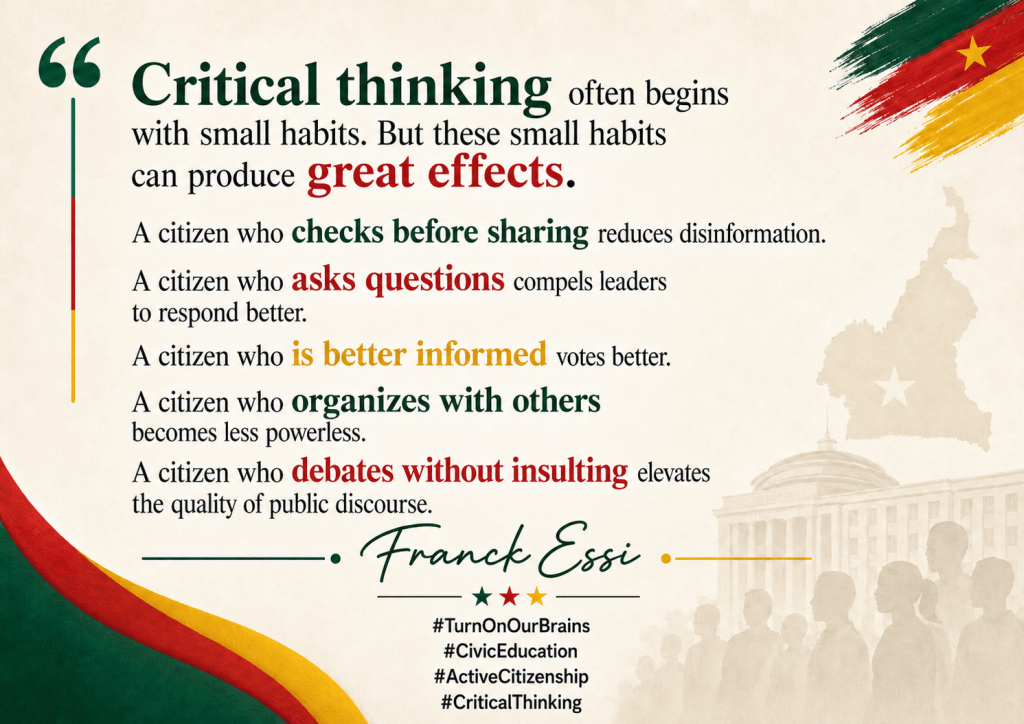
Critical thinking often begins with small habits. But these small habits can produce great effects.
A citizen who checks before sharing reduces disinformation. A citizen who asks questions compels leaders to respond better. A citizen who is better informed votes better. A citizen who organizes with others becomes less powerless. A citizen who debates without insulting elevates the quality of public discourse.
Before sharing, verify. Before following, question. Before condemning, understand. Before acting, think.
The citizen challenge of the week
This week, before sharing political information, let us verify four things:
- The source: who published this information?
- The date: is it recent or old?
- The proof: is there a document, a complete video, a reliable testimony or a credible source?
- The interest: who can benefit from this information?
Let us also choose one statement we often hear and examine it calmly.
For example:
- “Elections are useless.”
- “All leaders are the same.”
- “Young people cannot change anything.”
- “Politics is only for politicians.”
- “Nothing will ever change.”
Let us then ask ourselves:
- Is this completely true?
- Are there counterexamples?
- What evidence exists?
- What responsibilities are involved?
- What can we do, each at our own level, despite the difficulties?
Because in the end, that is the issue.
It is not only about criticizing the country.
It is about becoming capable of understanding it in order to transform it better.
My deep conviction
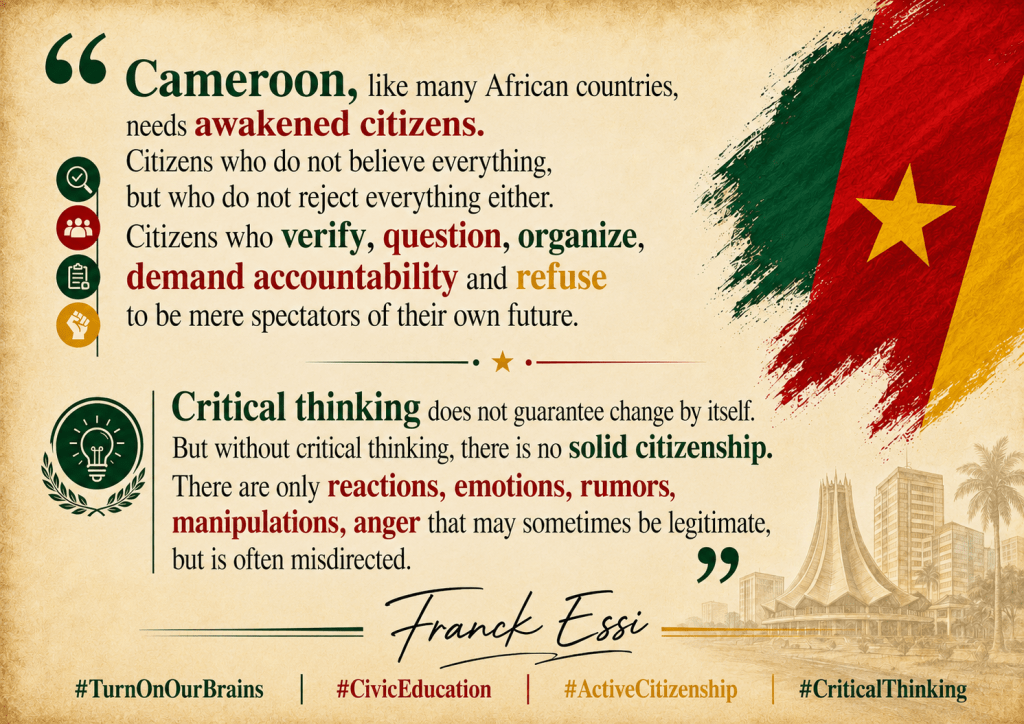
Cameroon, like many African countries, needs awakened citizens.
Citizens who do not believe everything, but who do not reject everything either. Citizens who verify, question, organize, demand accountability and refuse to be mere spectators of their own future.
Critical thinking does not guarantee change by itself.
But without critical thinking, there is no solid citizenship. There are only reactions, emotions, rumors, manipulations, anger that may sometimes be legitimate, but is often misdirected.
While waiting for the changes that many are calling for, it is not useless for each of us to begin with a simple task: learning to turn on our brain before turning on our phone to share information.
That may seem small.
But it is already a lot.
Because a country is not transformed only with slogans.
It is also transformed with citizens capable of thinking, verifying, debating, organizing and acting.
A country where citizens no longer think becomes a territory available for every manipulation.
Turning on our brains is not a slogan. It may be one of the first gestures of our civic liberation.
Franck Essi
#TurnOnOurBrains
#CivicEducation
#ActiveCitizenship
#CriticalThinking