Franck Essi
I believe we need hope.
In a country like Cameroon, marked by so many accumulated frustrations, so many missed appointments with history, so many betrayed promises, and so many normalized injustices, hope is not a luxury. Sometimes, it is what keeps us standing.
It allows us to keep believing that another future is possible. It nourishes commitment. It gives courage to those who refuse resignation.
But I also believe that we must learn to distinguish hope from illusion.
There is a fundamental difference between hoping and telling ourselves stories. There is a difference between believing that a better future is possible and believing that it will happen automatically simply because we strongly desire it.
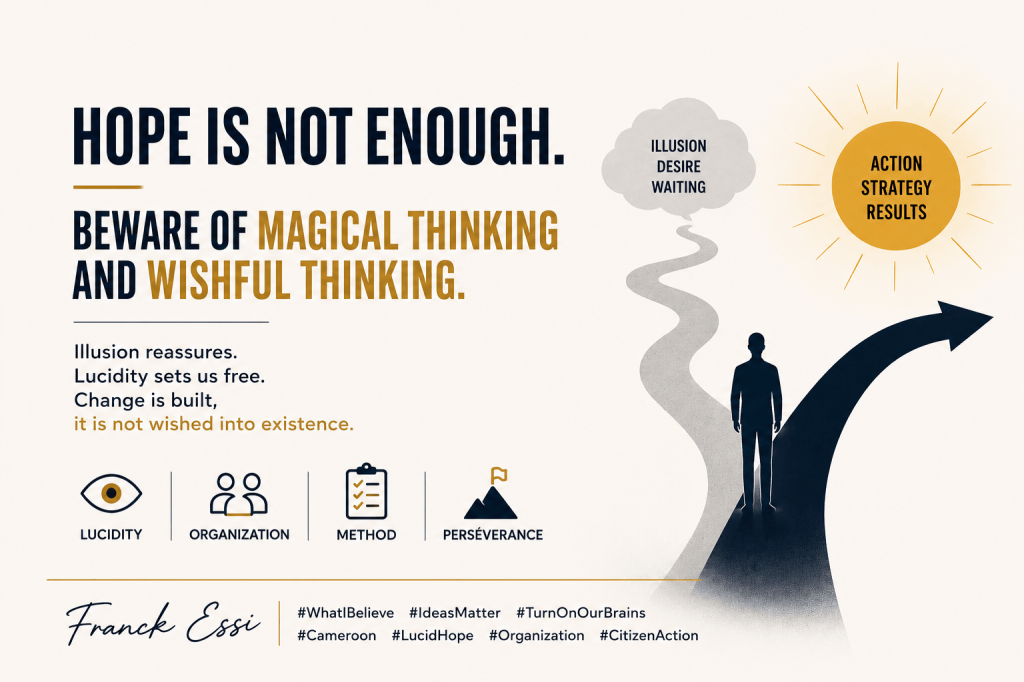
This is where we must beware of two frequent traps: wishful thinking and magical thinking.
The trap of wishful thinking
Wishful thinking means believing that something is true, or that it will happen, mainly because we want it to be true.
“This time, things will change because we really want them to change.”
It is believing that a regime will fall simply because it is old. It is believing that a system will collapse simply because it is unjust. It is believing that an election will automatically produce alternation simply because a large part of the people is suffering. It is believing that a leader, because he or she speaks well or embodies a real anger, can alone overturn deeply rooted power relations.
The problem is not wanting change.
The problem begins when our desire for change replaces the analysis of the real conditions for change.
In our families, associations, companies, political parties, and citizen movements, we sometimes tend to take our wishes for evidence. We confuse what we want to see happen with what is actually being built.
Reality, however, does not always bend to our desires.
The trap of magical thinking
Magical thinking is close to wishful thinking, but slightly different.
It consists in believing that a wish, a slogan, a declaration, a prayer, a symbol, an indignation, or a strong emotion is enough to produce a result.
It is thinking that because we have spoken a lot, things will change. Because we have denounced, the system will retreat. Because we have shouted our anger, the balance of power already exists. Because we have massively shared a post, society is now mobilized. Because a slogan is beautiful, it will necessarily be followed. Because an event is symbolically powerful, it will mechanically produce political effects.
I say this with great humility: we are all exposed to this temptation.
It is human. It reassures us. It sometimes gives us the impression of acting. It saves us from looking too directly at the harshness of reality.
But it can become dangerous when it replaces the patient, thankless, difficult, and demanding work that makes it possible to turn an aspiration into real strength.
A slogan can awaken. But it does not replace organization.
Indignation can open eyes. But it is not enough to change institutions.
A collective emotion can create a moment. But it does not necessarily build a movement.
How these traps appear in our context
In Cameroon, we know these forms of illusion well.
We have sometimes believed that a worn-out system would fall simply because it is worn out. But history shows that a system can be tired, discredited, contested, and yet continue to maintain itself if it still controls the instruments of power, networks of control, material resources, institutional levers, and the ability to divide its opponents.
We have sometimes believed that a candidacy was enough to create an alternative. But a candidacy is not yet a political force. A candidacy can embody an expectation, but it does not replace grassroots presence, the training of activists, presence in polling stations, the capacity to protect the vote, citizen mobilization, communication strategy, and a minimum unity among the forces of change.
We have sometimes confused visibility with power. Being visible on social media is not the same as being organized in neighborhoods, villages, administrations, unions, associations, markets, universities, churches, traditional communities, diasporas, and decision-making spaces.
We have sometimes waited for the savior. The one who would come, through charisma, courage, or popularity, to do on our behalf the collective work that we sometimes refuse to take on ourselves.
But no people can durably free itself by totally delegating its historical responsibility.
Leaders matter. Symbols matter. Speeches matter. Electoral moments matter.
But none of this is enough without an organized, conscious, trained, determined people capable of acting over time.
What these illusions produce
Wishful thinking and magical thinking are not only intellectual mistakes. They have very concrete consequences.
- They make us misread reality.
- They push us to underestimate the opponent.
- They lead us to overestimate our own forces.
- They make us neglect organization.
- They create excessive expectations.
- They produce brutal disappointments.
- They can even demobilize citizens.
When people are implicitly promised that things will change quickly, almost naturally, without explaining the difficulties, stages, risks, and efforts required, great frustration is often being prepared.
And after frustration sometimes comes cynicism.
“Nothing will ever change.”
“All struggles are useless.”
“All leaders are the same.”
“The people understand nothing.”
“It is better to take care of oneself.”
But this cynicism is sometimes the natural child of poorly managed illusions.
When magical thinking is fed for too long, it later produces disenchantment.
We must not kill hope
We must, however, be careful.
Criticizing magical thinking does not mean despising hope.
I deeply believe that hope is necessary. A people without hope becomes trapped in immediate survival. A society that no longer believes in anything eventually accepts the unacceptable. A youth from whom all perspective has been taken away will either leave, fall silent, or explode.
So we need hope.
But we need adult hope. Lucid hope. Organized hope. Disciplined hope. Hope that does not close its eyes to obstacles.
Lucid hope gives strength. Illusion, on the other hand, often ends up exhausting us.
To hope is not to deny power relations. It is to decide to transform them.
To hope is not to refuse to see blockages. It is to work to overcome them.
To hope is not to believe that reality will change because we desire it. It is to understand that reality changes when women and men patiently build the conditions for its transformation.
The right questions to ask
To avoid wishful thinking and magical thinking, we must learn to ask ourselves simple but demanding questions.
Before saying, “Things will change,” let us ask ourselves:
- What evidence do we have?
- What power relations really exist?
- Who is organized?
- Who controls the institutions?
- Who can block change?
- What means do we have?
- What alliances are possible?
- What concrete steps have we planned?
- What do we do if the scenario we hope for does not happen?
- What have we built that can survive a defeat, a crisis, or a disappointment?
These questions are not meant to discourage us.
They are meant to make us more serious.
Because seriousness is not the enemy of commitment. Lucidity is not the enemy of audacity. Method is not the enemy of passion.
On the contrary.
Anger without method can burn out. Hope without organization can dissolve. Will without strategy can lose its way.
What we must cultivate instead
Instead of wishful thinking and magical thinking, I believe we must cultivate four things.
Lucidity
To look at reality as it is, even when it is uncomfortable. Not to confuse our emotions with analyses. Not to confuse our activist circles with the entire country. Not to confuse the intensity of our convictions with their real level of support in society.
Method
To define clear objectives. To identify the stages. To distribute responsibilities. To measure progress. To correct mistakes. To draw lessons. To avoid starting from zero every time.
Organization
No serious transformation is built only with good intentions. We need structures. We need teams. We need relays. We need trained people. We need resources. We need mechanisms of coordination. We need a capacity for lasting presence on the ground.
Perseverance
Deep transformations take time. They require consistency. They demand the ability to withstand delays, contradictions, misunderstandings, setbacks, and sometimes temporary defeats.
But persevering does not mean endlessly repeating the same mistakes. To persevere is to continue while learning.
My deep conviction
I believe Cameroon needs hope.
But not a hope that puts us to sleep. Not a hope that exempts us from thinking. Not a hope that replaces work with slogans. Not a hope that turns our desires into certainties.
We need hope that opens our eyes. Hope that organizes. Hope that trains. Hope that connects. Hope that turns anger into action, indignation into method, and dreams into collective work.
The real question, therefore, is not only: Do we want change?
Of course many people do.
The real question is rather: Are we building the conditions that can make it possible?
That is where seriousness begins. That is where responsibility begins. That is where, perhaps, the political and civic maturity that our country so badly needs begins.
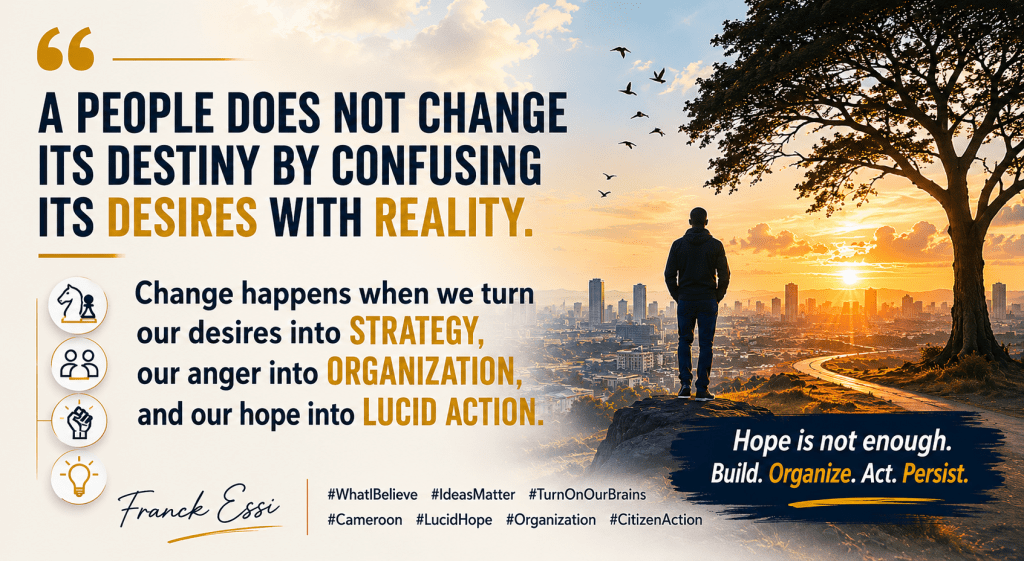
A people does not change its destiny by confusing its desires with reality. It changes it when it turns its desires into strategy, its anger into organization, and its hope into lucid action.
Franck Essi
#WhatIBelieve
#IdeasMatter
#TurnOnOurBrains