By Franck Essi
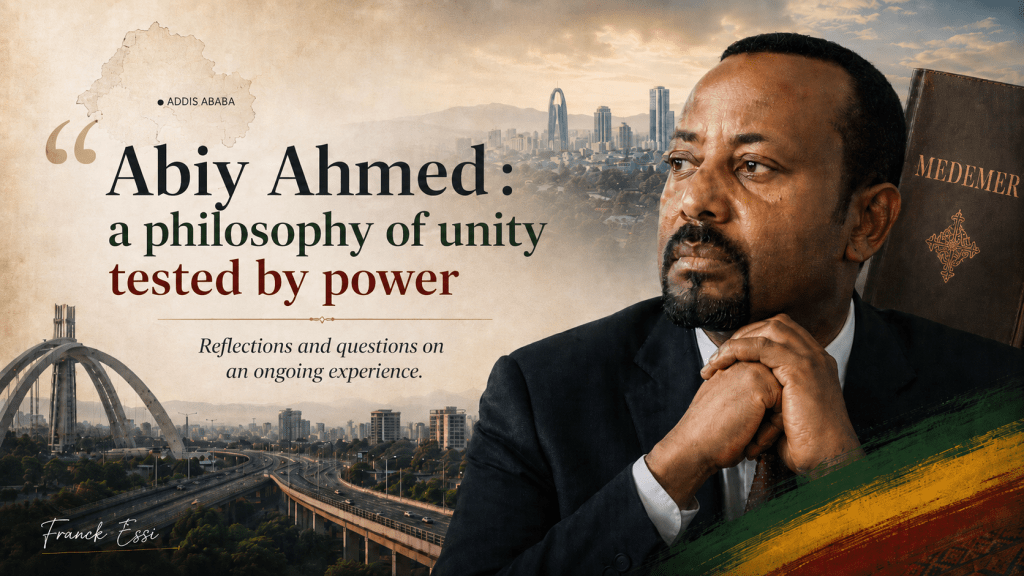
During a recent stay in Ethiopia, in Addis Ababa, I was struck by an impression that is difficult to ignore: something is moving.
I was arriving in a country that many Africans first know through a few powerful symbols: the Battle of Adwa, the prestige of Addis Ababa, the headquarters of the African Union, the figure of Haile Selassie, the depth of Ethiopian Christianity, and, in the contemporary world, Ethiopian Airlines.
This airline is not a detail. It has become one of Ethiopia’s major instruments of influence. In 2023/24, Ethiopian Airlines served 135 passenger destinations and 69 cargo destinations; it carried more than 17 million passengers, transported more than 754,000 tons of freight, and generated more than 7 billion US dollars in revenue. It embodies, in its own way, what Ethiopia seeks to project: organizational capacity, strategic discipline, continental presence and global ambition. The project for the new Bishoftu International Airport, designed to handle up to 110 million passengers a year, confirms this ambition to make Addis Ababa one of the major air crossroads of the continent and the world.
It was therefore in this country, both ancient and in motion, that I stayed.
Addis Ababa is not an ordinary capital. In many respects, it is the political capital of Africa. It hosts the headquarters of the African Union, welcomes a large diplomatic community, and concentrates a significant part of the continental debates on peace, security, integration, development and Africa’s place in the world.
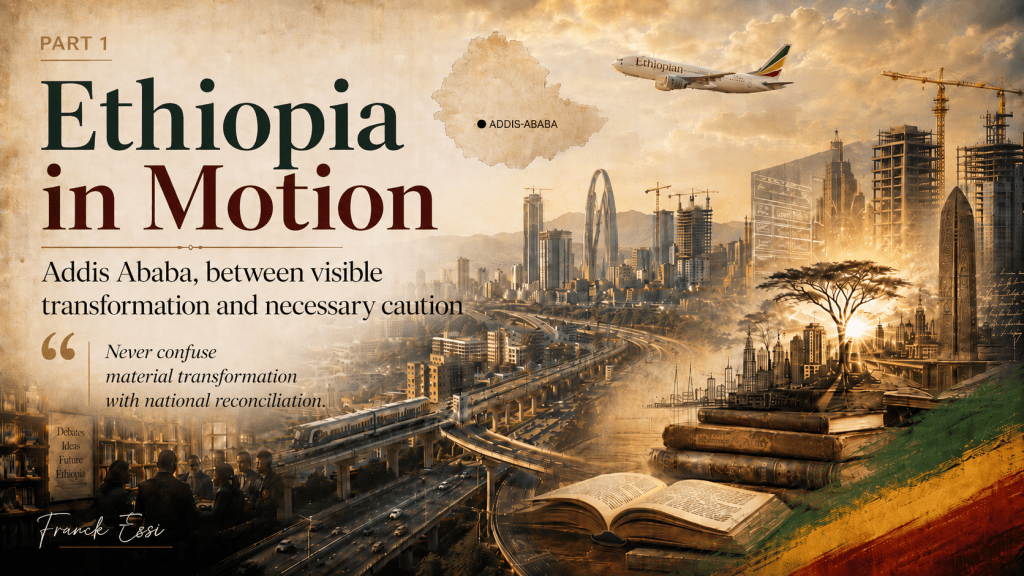
In this elevated, dense and restless city, at once old and new, infrastructure transformation is visible. Widened roads, urban corridors, buildings under construction, redesigned public spaces, modernization projects and open construction sites all give Addis Ababa the appearance of a capital determined to move to another scale.
Of course, a city under construction does not prove that a country is doing well. A transforming capital does not automatically mean a reconciled nation. New infrastructure does not automatically repair political fractures, conflicts of memory, identity tensions or social wounds.
But it would be equally unfair not to see what is visible.
In the view of all the people with whom I spoke — Ethiopians from local elites, senior African professionals working in Addis Ababa, and observers familiar with the country — a dynamic is clearly underway. It can be questioned. It can be criticized. It can be debated in terms of its priorities, costs, methods and social consequences. But it cannot be denied.
This infrastructure dynamic is not merely decorative. It points to a broader political ambition: to make Ethiopia a country that projects itself, accelerates, modernizes its cities, transforms its productive base and seeks to assume a leading continental and regional role.
But a personal anecdote reminded me that one must be careful not to read Ethiopia too quickly.
While visiting the large public library in Addis Ababa, I wanted to buy Abiy Ahmed’s books. In two different bookshops, two people, clearly critical of the Prime Minister, looked at me with surprise, almost with irony, before asking me whether I really had nothing better to do with my money than buy his books. In their eyes, these books were nothing more than “trash”.
The wording surprised me.
It even startled me, because it contrasted so sharply with the image of a capital in full transformation. But it also taught me something. It said something essential: Ethiopia cannot be reduced to its infrastructure. It is not made only of roads, corridors, construction sites, dams, parks and new buildings. It is also made of debates, anger, deep disagreements, political wounds, competing narratives, sometimes virulent criticism and memories that do not simply add up because a government asks them to.
For me, that scene was an intellectual warning.
Look at Addis Ababa, yes.
Admire what is changing, yes.
But never confuse material transformation with national reconciliation.
It is from this double impression — admiration for the visible dynamic and caution before the invisible fractures — that I wanted to reread Abiy Ahmed’s vision.
Because Abiy Ahmed is not only a leader who builds roads, parks, corridors, dams or airports. He is also a head of government who has tried to give his action a political philosophy. He has sought to produce a doctrine. He has written several books around one central concept: Medemer.
And that is where the subject becomes deeply interesting.
What is a philosophy of unity worth when it is confronted with the test of power? What becomes of a thought of synergy when it meets conflicts, resistance, historical fractures, ambitions of power, social expectations and the demands of democracy? Can a doctrine of addition truly repair a country crossed by memories, identities and interests that are sometimes contradictory?
Ethiopia: a few reference points for understanding a political civilization
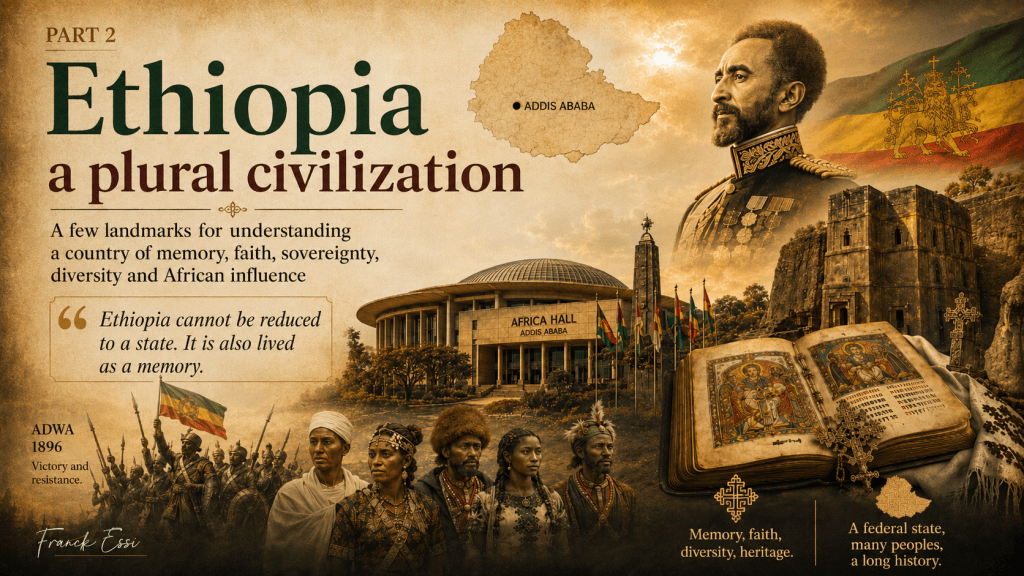
I have neither the pretension nor the expertise to present Ethiopia in all its diversity, complexity and depth. A country of such antiquity, historical density, cultural plurality and geopolitical importance cannot be summarized in a few paragraphs. I would simply like to recall a few reference points that seem useful to keep in mind in order to better understand Abiy Ahmed’s vision, but also the debates, tensions and contradictions that run through his country today.
Ethiopia is not merely a contemporary state. It is an old political, religious and cultural civilization. It carries a historical depth that is rare on the African continent. It thinks of itself as continuity. It experiences itself as memory. It often narrates itself as an exception.
This exception first comes from its singular relationship to sovereignty. Ethiopia is one of the few African countries to have escaped durable European colonization, even though it experienced Italian occupation between 1936 and 1941. In the African and Ethiopian imagination, what remains central is the victory of Adwa in 1896, when the Ethiopian army of Emperor Menelik II inflicted a historic defeat on Italy.
Adwa is not simply a battle. It is a founding act. It is a symbolic reserve of dignity. It is the idea that an African people can resist a European power, defend its sovereignty and command respect.
Ethiopia also occupies a major place in the history of African Christianity. The Ethiopian Orthodox Tewahedo Church is among the oldest Christian traditions in the world. The Christianization of the Kingdom of Aksum dates back to the fourth century, particularly through the influence of Saint Frumentius. In this history, Christianity does not appear as a colonial inheritance imported late, but as a deep component of the national civilization.
This singularity is also visible in the Ethiopian Bible. The biblical canon of the Ethiopian Orthodox Church differs from that of many other Christian traditions. It traditionally includes 81 books: 46 in the Old Testament and 35 in the New Testament. This makes it one of the broadest biblical canons in Christianity. It bears witness to an ancient, learned, liturgical and scriptural religious tradition, strongly linked to the Ge’ez language, manuscripts, monasteries, liturgical practices and a deeply rooted vision of the sacred.
Ethiopia is also the country of Emperor Haile Selassie, one of the major African figures of the twentieth century. Emperor from 1930 to 1974, he sought to modernize his country, insert it into international institutions and make Addis Ababa a center of institutional Pan-Africanism. His image largely exceeded Ethiopia’s borders. For many Africans and people of African descent, he embodied a form of Black dignity, resistance to colonial humiliation and hope for emancipation. In the Rastafari movement, born in Jamaica in the 1930s, Haile Selassie is even considered by many as a messianic figure, sometimes as a prophet of Black liberation.
This symbolic centrality also helps explain Addis Ababa’s place in the institutional history of Pan-Africanism. In May 1963, 32 heads of independent African states met in Addis Ababa to create the Organization of African Unity, known by the acronym OAU. The choice of the Ethiopian capital was not accidental. Addis Ababa then represented several things at once: the capital of an African country that had remained largely sovereign in the face of colonization; the diplomatic prestige of Emperor Haile Selassie; the memory of Adwa; the existence of Africa Hall — the historic building inaugurated in 1961 by Haile Selassie, home to the United Nations Economic Commission for Africa and an emblematic site where the Charter of the Organization of African Unity was adopted — and the desire to make Africa itself the place where Africans deliberate on their future. The Organization of African Unity, created in 1963, would later give way to the African Union, known by the acronym AU, officially launched in 2002 after the Sirte decision of 1999 and the adoption of the Constitutive Act in Lomé in 2000.
Contemporary Ethiopia, however, is much more than an imperial, religious or Pan-African legacy. It is a profoundly diverse society. It has more than 80 ethnolinguistic groups. The Oromo constitute the largest group, around 35.8% of the population; they are followed by the Amhara, around 24.1%, then the Somali, Tigrayans, Sidama, Gurage, Welaita, Afar and many other groups. This diversity is not merely cultural. It structures political life, territorial organization, identity claims, conflicts of memory and balances of power.
This is why Ethiopia is organized as a federal democratic republic with a parliamentary system. The Constitution that entered into force in 1995 explicitly recognizes the “nations, nationalities and peoples” of Ethiopia, their right to self-determination, language, culture, history, self-government and even, under strict conditions, secession. This institutional architecture, often described as ethnic or multinational federalism, seeks to answer a central question in Ethiopian history: how can a very old political civilization be held together with a real plurality of peoples, languages, territories, memories and aspirations?
With about 135.9 million inhabitants in 2025, Ethiopia is the second most populous country in Africa after Nigeria. It is among the most dynamic economies in the region, with growth estimated at 9.2% for the 2024/25 fiscal year, while remaining one of the poorest countries in terms of income per inhabitant, at around 979 US dollars.
This, then, is the Ethiopian paradox: an ancient, proud and sovereign country, Christian for centuries, carrying a memory of resistance, marked by the legacy of Adwa, the figure of Haile Selassie, institutional Pan-Africanism, an airline that has become an African symbol of success, a continental diplomatic capital and a visible infrastructure ambition. But it is also a country crossed by deep fractures: ethnolinguistic diversity, tensions between center and peripheries, debates over federalism, armed conflicts, persistent poverty, demands for justice, wounds of memory and questions about the future of the national pact.
It is in this country, and not in an imaginary or simplified Ethiopia, that Abiy Ahmed comes to power. It is also in this country that his Medemer philosophy must be understood, questioned and tested.
Abiy Ahmed: the reformer, the strategist and the man of doctrine
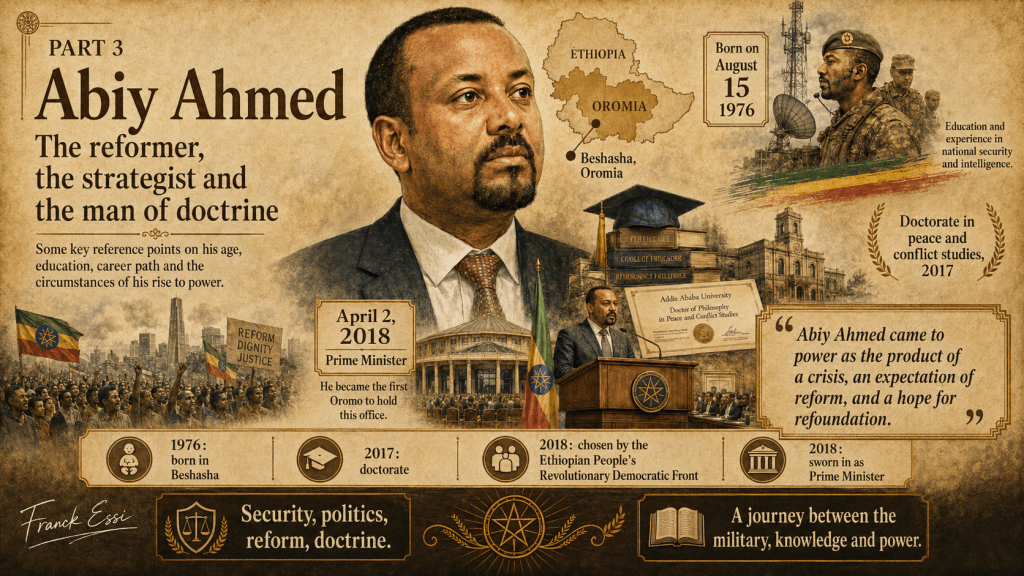
Abiy Ahmed Ali became Prime Minister of Ethiopia on April 2, 2018, at a moment of strong political tension. Born on August 15, 1976, in Beshasha, in the current Oromia region, he was 41 years old when he came to power, and is 49 in 2026. This detail is not insignificant: his arrival at the head of the Ethiopian state then gave the impression of generational renewal in a political system long dominated by the Ethiopian People’s Revolutionary Democratic Front, known by the acronym EPRDF.
His trajectory is singular. As a young man, he participated in the armed struggle against the Marxist regime of Mengistu Haile Mariam before serving in the Ethiopian army. This military path brought him very early into contact with questions of security, statehood, intelligence, war and national reconstruction. He therefore did not come to power as a pure technocrat or as an intellectual external to the state apparatus. His journey brings together armed engagement, the military institution, security networks, partisan politics and academic training.
His academic training also contributes to this singularity. Abiy Ahmed studied computer science, leadership and economics before obtaining, in 2017, a doctorate in peace and conflict studies from Addis Ababa University. This profile partly explains how he presents himself: as a man of security, a man of reform, a man of method, a political leader and a thinker of a new national trajectory.
Politically, Abiy Ahmed was elected to the Ethiopian Parliament in 2010. He then rose within the Ethiopian political apparatus, particularly in the Oromo political space. His rise occurred at a time when the Oromo question had become central. The Oromo are the largest demographic group in the country, but a significant part of the Oromo population had long felt insufficiently represented in the real structure of Ethiopian power. The fact that Abiy Ahmed came from the Oromo Democratic Party, one of the components of the ruling coalition at the time, therefore gave his accession particular political significance.
His arrival in power was not the result of a classic electoral alternation. It was the product of an internal crisis of the system. From 2015 onward, Ethiopia was shaken by large-scale protests, particularly in Oromia and Amhara. These mobilizations expressed deep frustrations: demands for political freedoms, rejection of repression, opposition to land dispossession, denunciation of the marginalization of certain communities, and criticism of domination by a political apparatus perceived as closed.
It was in this context that Prime Minister Hailemariam Desalegn resigned on February 15, 2018. His resignation, rare in Ethiopian political history, was presented as a way to facilitate reforms and calm a crisis that threatened both the stability of the country and the political survival of the ruling coalition.
A few weeks later, the ruling coalition chose Abiy Ahmed to succeed him. On March 27, 2018, the Ethiopian People’s Revolutionary Democratic Front designated him as the new head of the coalition, paving the way for his appointment as Prime Minister. On April 2, 2018, he was sworn in by the Ethiopian Parliament. He then became the first Oromo to occupy the office of Prime Minister in the country’s contemporary history.
His arrival generated immense hope. It seemed to announce a way out of crisis through political opening, recognition of popular frustrations, state reform and national reconciliation. His early gestures pointed in that direction: the release of political prisoners, the return from exile of some opponents, a loosening of media control, a stated willingness to reform the security apparatus, and above all a spectacular rapprochement with Eritrea after two decades of conflict and tension.
In 2019, he was awarded the Nobel Peace Prize for his efforts in favor of peace and international cooperation, particularly for his initiative to resolve the border conflict with Eritrea.
But the history of power is rarely linear.
Very quickly, the initial hope encountered the harshness of reality: political tensions, the war in Tigray, regional violence, debates over federalism, identity crispations, political restrictions, human rights criticism, questions about civic space, internal polarization, economic difficulties and security challenges.
This is why Abiy Ahmed cannot be read simplistically.
He is neither only the miraculous reformer some believed they saw in 2018, nor only the controversial leader to whom his critics sometimes reduce him today. He is more complex. He is at once a man of vision, a man of power, a man of doctrine and a leader caught in the contradictions of a vast, ancient, fragmented and ambitious state.
His books are therefore essential, not because they deliver a definitive truth about Ethiopia, but because they help us understand how Abiy Ahmed wants to think about his country, his power, his mission and his time.
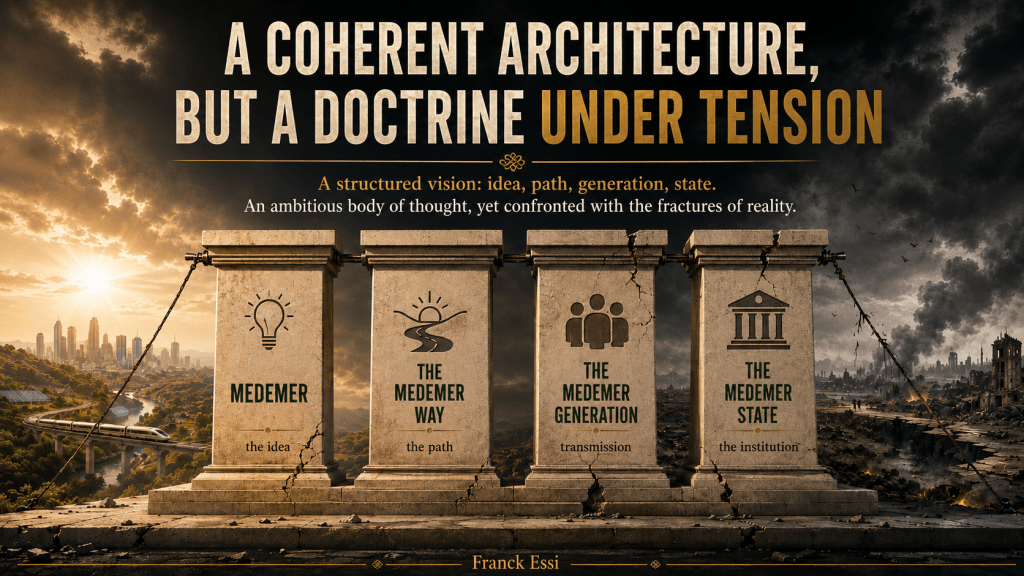
Through Medemer, published in 2019, The Way of Medemer, published in 2021, Generation Medemer, launched in 2023, and The Medemer State, unveiled in 2025, he builds an intellectual architecture in four movements: an idea, a path, a generation and a state.
It is this architecture that must be examined.
Medemer: adding the forces of a fragmented country
The first book, Medemer, published in 2019, is the matrix of Abiy Ahmed’s thought.
The word Medemer refers to the idea of addition, synergy, coming together, convergence and cooperation. It is not simply about being together. It is about doing together. It is about adding dispersed forces in order to produce a higher collective energy.
The central idea of the book is powerful: Ethiopia cannot continue to seek its solutions only in imported models, foreign doctrines or ideologies mechanically applied to a reality that has its own historical depth. Abiy Ahmed therefore criticizes the non-contextual importation of political ideas. He challenges the tendency to copy models from elsewhere without adapting them to Ethiopian realities. His approach is, in substance, to say: Ethiopia must think about its problems from Ethiopia itself.
This intuition goes far beyond the Ethiopian case.
Many African countries have been governed with concepts that did not always come from their own historical experiences. We have imported constitutions, economic models, administrative systems, development doctrines and political categories, sometimes without doing the demanding work of translating them into our real societies.
From this perspective, Medemer asks an essential question: how can a country transform itself sustainably if it does not think from itself?
The second strong idea of the book is its critique of the clean slate.
Abiy Ahmed appears to consider that Ethiopia has too often experienced change as the total destruction of what came before. Each regime would seek to erase the old, delegitimize its legacy, cancel its achievements and restart history from zero.
Against this logic, Medemer proposes a more subtle method: preserve what deserves to be preserved, correct what has wounded, overcome what blocks, innovate without uprooting.
This idea is precious for Africa.
Our states often suffer from a political disease: every new power wants to symbolically abolish the previous one, not in order to build better, but in order to claim for itself the exclusive right to begin history. Yet a country does not grow by constantly erasing its own layers. It grows when it learns to sort through its inheritance.
The third major idea of Medemer is the refusal of zero-sum politics.
In zero-sum politics, if one group wins, another must lose. If one region advances, another feels threatened. If one identity is recognized, another feels diminished. If one camp controls the state, the other becomes suspect.
Medemer wants to break with this logic.
The project is to move from destructive rivalry to positive-sum politics. The state, citizens, entrepreneurs, intellectuals, communities, political parties and institutions should learn to cooperate around a shared horizon.
This is where Abiy Ahmed’s thought becomes attractive.
A divided country does not always lack energy. It often lacks alignment. It does not always lack talent. It often lacks trust. It does not always lack resources. It often lacks the ability to organize them in a common direction.
But according to critics, it appears that Medemer carries at least three major limitations.
The first is conceptual ambiguity. Medemer means many things at once: unity, synergy, addition, cooperation, reconciliation, solidarity, alignment, overcoming divisions, national project. This richness is its strength, but it can also become its weakness. A concept that is too broad can become a catch-all word, capable of containing everything, yet sometimes not precise enough to guide action.
The second limitation is the risk of sloganization. When a philosophy is carried by a sitting head of government, it can quickly become an official doctrine. It can be repeated in speeches, celebrated by institutions and mobilized in political communication without being genuinely debated, criticized or enriched.
The third limitation is deeper: Medemer sometimes risks presenting as a moral problem what also belongs to structural conflicts. Societies are not divided only because they lack love, cooperation or goodwill. They are also divided by power relations, historical injustices, conflicts over resources, political exclusions, wounded memories, territorial inequalities, old violence and failing institutions.
A philosophy of synergy is necessary. But it does not replace justice, institutional guarantees, the recognition of wounded memories, checks and balances, and real mechanisms of reconciliation.
The strength of Medemer is therefore to offer a language of cooperation to a fragmented society. Its potential weakness is that it does not always say with enough precision how this cooperation becomes lived justice, protected pluralism and limited power.

The Way of Medemer: from the idea to the path
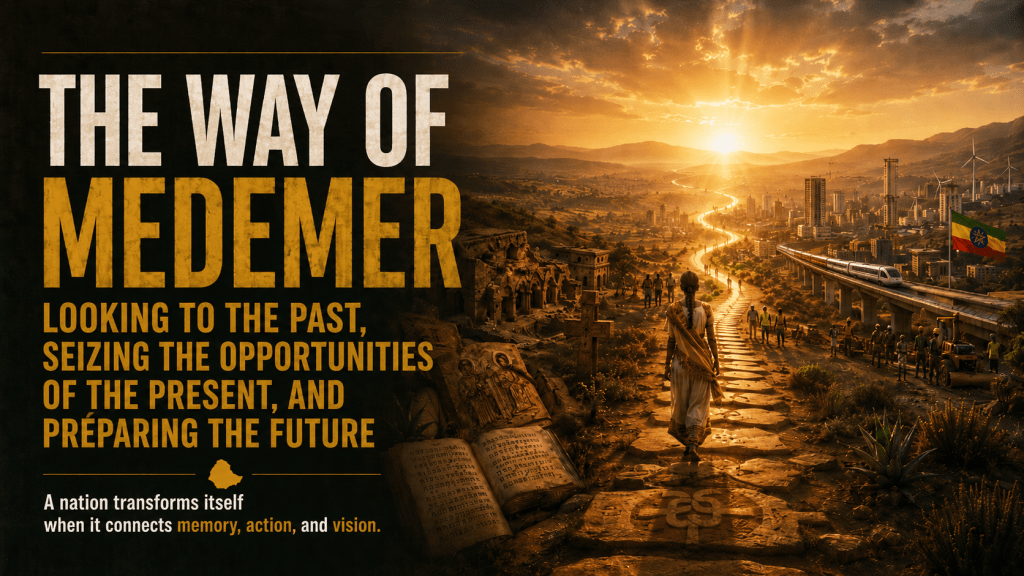
With The Way of Medemer, published in 2021, Abiy Ahmed takes an important step.
It is no longer only a matter of defining Medemer. It is now necessary to show how this philosophy can become a trajectory. The word menged refers to the path, the way, the road. The book therefore asks a practical question: how does one move from the idea to transformation?
This is probably one of the most useful intuitions in the series.
Many political projects fail because they confuse proclamation with transformation. Saying “unity” does not create unity. Saying “reform” does not produce reform. Saying “prosperity” does not create prosperity. Between the word and the result, there is a path made of institutions, decisions, compromises, conflicts, corrections, implementation, evaluation and trust.
The Way of Medemer therefore insists on the need to give direction to change. Transformation cannot be a succession of announcements. It must have coherence, method, progression and temporality.
The book implicitly organizes transformation around three moments: looking at the past, seizing the opportunities of the present and preparing the future.
Looking at the past, not in order to be imprisoned by it, but in order to understand what must be preserved, corrected or overcome.
Seizing the present, because peoples do not have the same historical windows forever.
Preparing the future, because a reform only has meaning if it transmits to the next generation a country less fragile than the one it received.
This logic gives depth to Abiy Ahmed’s thought. It avoids the trap of change as emotion. It reminds us that a nation is not transformed by momentary enthusiasm, but by an organized trajectory.
But according to critics, it appears that The Way of Medemer leaves open a decisive question: who defines the path?
A path can be shared. But it can also be traced from above and then presented as the common path. This is the whole difficulty of transformation doctrines carried by a leader in office.
In a pluralistic society marked by historical wounds, it is not enough for a head of state to say: here is the way. Citizens, regions, peoples, parties, intellectuals, young people, institutions, victims of conflict and even opponents must be able to participate in the definition of that path.
Otherwise, the way of Medemer risks becoming not the path of a people, but the path of a power asking the people to follow it.
According to critics, it also appears that gradual reform is not always enough. Refusing the clean slate is healthy. But some historical injustices cannot be corrected only by gradual adjustments. They sometimes require truth, reparation, recognition, deep reform, political guarantees and real institutional transformation.
Finally, the book carries a tension between political pedagogy and the legitimation of power. Telling the story of the path is necessary. But when the narrative is produced by the one who governs, it can enlighten society as much as justify the choices of power.
The merit of The Way of Medemer is therefore to understand that an idea is worth something only if it finds a path. Its limitation is that it does not always guarantee that this path will truly be co-written by the whole society.
Generation Medemer: what generation can carry change?
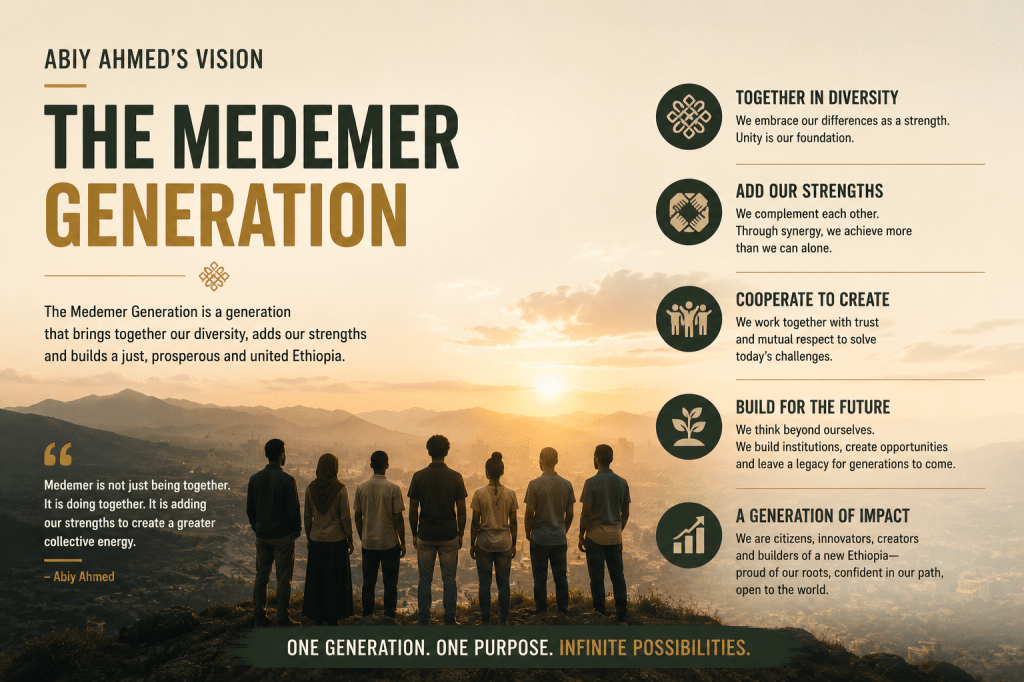
With Generation Medemer, launched in March 2023, Abiy Ahmed shifts the reflection again.
After the idea and the path, he raises the question of the generation.
What generation must Ethiopia produce in order to escape its cycles of division, historical wounds, missed opportunities and collective failures? What generation can transmit to future generations a country that is more united, more prosperous, more responsible and better positioned in the world?
This is a powerful question.
A generation is not merely an age group. It is a historical community of responsibility. It receives an inheritance, makes choices and transmits a legacy.
Some generations build. Some destroy. Some dream. Some become disillusioned. Some understand their time. Some miss their appointment with history.
In Generation Medemer, Abiy Ahmed proposes a generational reading of Ethiopian history. He distinguishes, among others, a conservative and patriotic generation marked by the spirit of Adwa; a generation of dreamers; a disillusioned generation; an intelligent and connected generation; and then the future Medemer generation.
This classification makes it possible to construct a moral history of modern Ethiopia.
The patriotic generation is said to have protected independence and national dignity. The generation of dreamers imagined a more modern and more just Ethiopia. The disillusioned generation saw promises sometimes turn into violence, authoritarianism or failure. The intelligent and connected generation has education, technology and access to the world, but risks dispersion, impatience and superficiality. The Medemer generation should create a synthesis: patriotism without closure, modernity without uprooting, intelligence without arrogance, criticism without destruction, memory without imprisonment in the past, and openness to the world without loss of self.
This is one of the most interesting aspects of Abiy Ahmed’s thought.
He does not speak only to the state. He speaks to the collective conscience. He asks a generation to ask itself what it wants to transmit.
This question obviously concerns Ethiopia. But it also speaks to many African countries.
What generation are we becoming? A generation of complaint or construction? A generation of resentment or responsibility? A generation that transmits its wounds or works to overcome them? A generation that repeats mistakes or finally agrees to learn?
But according to critics, it appears that Generation Medemer also has several limitations.
The first is generational simplification. A generation is never homogeneous. Young people in the same country do not live the same realities depending on their region, language, social class, gender, religion, relationship to the state, access to school or exposure to violence.
Speaking of a generation can therefore illuminate a collective responsibility. But it can also obscure real inequalities among members of the same generation.
The second limitation is the risk of an overly moral discourse. Speaking of hatred, love, responsibility, transmission and reconciliation is necessary. But political conflicts are not only problems of mentality. They are also linked to institutions, resources, power, land, memories, representation and security.
The third limitation lies in the temptation to place on the generation what also belongs to the state. Young people cannot become responsible if institutions crush them. They cannot build if the economy excludes them. They cannot believe in the nation if the nation does not recognize them. They cannot overcome divisions if power instrumentalizes them. They cannot transmit a positive legacy if they inherit damaged institutions.
One does not manufacture a Medemer generation by moral exhortation. One makes it possible through just institutions, solid education, real opportunities, credible justice, free speech and an open future.
A generation does not become great because it is given a name. It becomes great when it receives the truth of the past, the means of the present and the institutions needed to transmit a future more just than the one it inherited.
The Medemer State: transforming philosophy into statehood
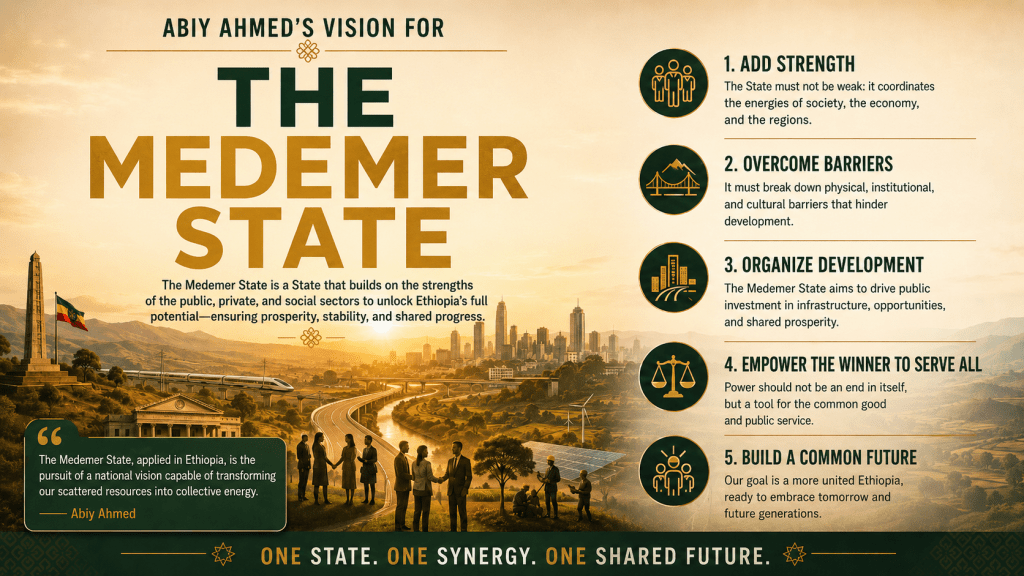
With The Medemer State, unveiled in 2025, Abiy Ahmed reaches the most institutional stage of his thought.
After the idea, the path and the generation, it is now a question of the state.
The question becomes: what would a state governed according to the Medemer philosophy look like?
This book seeks to give institutional form to Medemer. It attempts to transform a philosophy of addition into a method of governance, a development program and a governmental doctrine.
The central idea is that Ethiopia will not be able to emerge sustainably from poverty, political fragmentation, institutional weakness, external dependence and developmental delay unless it builds a state capable of adding together public, private, social and community forces around a common national project.
This is where Abiy Ahmed’s thought becomes most ambitious.
The book asks a fundamental question: why does Ethiopia remain poor despite its history, population, potential, culture and civilizational depth?
This question is essential because it moves Medemer from the moral register to the institutional and economic register. It is no longer only a matter of saying: let us be united. It is a matter of asking: why have our historical unity, national pride and potential not yet produced the expected prosperity?
The book identifies three major barriers: physical, institutional and cultural.
The physical barrier refers in particular to landlocked geography, geographical constraints and the difficulty of opening to the world.
The institutional barrier refers to the weakness of the state, legacies of power by force, administrative insufficiency and industrial delays.
The cultural barrier refers to resistance to change, difficulty in adopting new ideas, and the relationship to time, innovation, productivity and global competition.
This framework is interesting because it refuses to reduce poverty to a single factor. It sees development as a systemic question: geography, institutions, culture, economy, governance, leadership and implementation.
Another strong idea of The Medemer State is the critique of winner-takes-all politics, that is, the political culture in which the winning camp marginalizes the losers and turns the state into spoils.
This critique is particularly relevant for Africa.
In many of our countries, politics remains a war for the appropriation of the state. Whoever wins takes the positions, markets, budgets, administration, public media, security apparatus and symbols. Whoever loses is excluded, suspected, humiliated or neutralized.
If the Medemer state means leaving this logic behind, then the idea deserves attention.
But according to critics, it appears that such an ambition is only meaningful if it is guaranteed by institutions.
Is there real pluralism? Can opposition forces act freely? Are critics protected? Are institutions impartial? Does power accept limitation? Can justice resist reasons of state?
The second limitation of The Medemer State concerns the ambiguity between synergy and centralization.
A state that wants to coordinate can end up controlling. A state that wants to add together can end up absorbing. A state that speaks of unity can end up reducing contradiction to silence.
The third limitation concerns speed.
The book values creativity, rapidity, implementation and accelerated leaps toward development. This logic corresponds well to the visible transformations in Addis Ababa. It partly explains this desire to move fast, produce results, transform the landscape and show that the state is acting.
But speed also has dangers. Moving fast can mean consulting less. Building fast can mean displacing people brutally. Reforming fast can mean reducing deliberation. Modernizing fast can mean privileging the visible over the profound.
This critique has taken on a concrete dimension with the urban operations linked to the Corridor Development Project. Amnesty International has documented forced evictions in Addis Ababa and in 58 cities and urban centers across the country, referring to thousands of people displaced, a lack of genuine consultation, insufficient notice and difficulties in accessing adequate compensation.
The fourth limitation concerns the common national narrative.
A national narrative is necessary. No country can live sustainably without a shared horizon. But in a multinational, multilingual country crossed by competing memories, such a narrative cannot be imposed from above. It must be co-written, discussed, pluralized, enriched and corrected.
This is why The Medemer State raises the great question of Abiy Ahmed’s entire philosophy: how can one build a state strong enough to organize development, yet humble enough to accept contradiction, share power and allow society to co-write its own future?
The exercise of power: between transformation, centralization and persistent crises
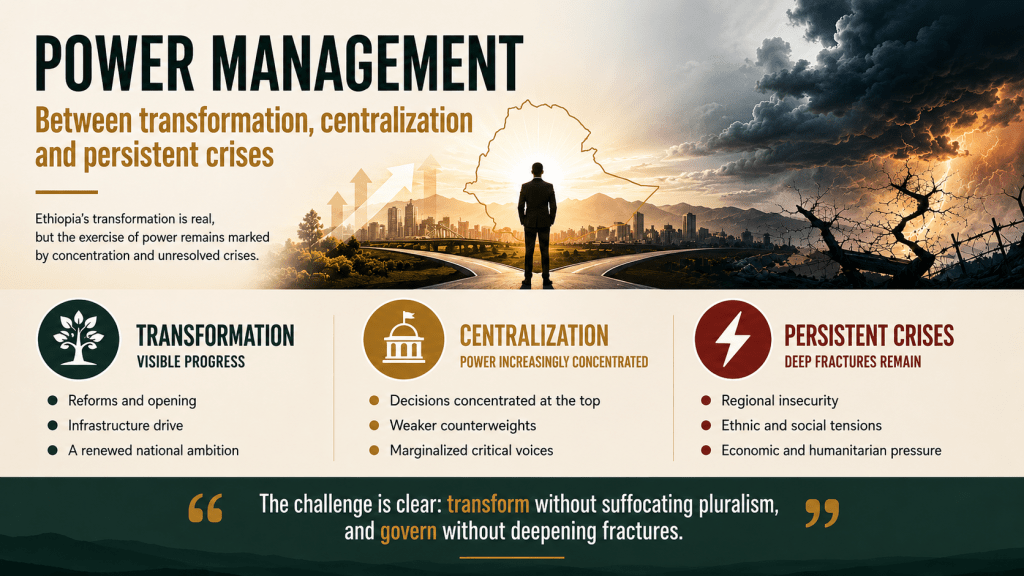
Examining the books is not enough. The doctrine must be confronted with the practice of power.
On the economic and infrastructure front, Abiy Ahmed’s record has an undeniable dimension: the Ethiopian state is seeking to accelerate. Addis Ababa is changing. Major structuring projects are being carried forward. The Grand Ethiopian Renaissance Dam, urban corridors, logistical ambitions, economic reforms and infrastructure investments all participate in a narrative of power, modernization and projection.
But on the political and human rights front, the picture is much heavier.
Recent years have been marked by consolidation of power, a weakened and fragmented opposition, security tensions in several regions and recurring accusations of restrictions on civic space.
The 2026 general elections took place in a context of insecurity, weakened opposition, the impossibility of holding the vote in certain areas, especially Tigray and parts of Amhara, and the expected dominance of the Prosperity Party led by Abiy Ahmed. More than 50 million voters were registered, but the broader political context remained tense.
Human Rights Watch has described a worrying security and humanitarian situation, with persistent hostilities in Amhara and parts of Oromia, tensions in Tigray, fragile relations with Eritrea and increased pressure on independent media and civil society.
The country also continues to face a major humanitarian crisis. Conflicts, displacement, droughts, floods, food insecurity and humanitarian funding gaps continue to weigh on millions of people. This reality reminds us of a simple truth: a state can build fast, but it cannot claim durable success if a significant part of its population remains trapped in hunger, insecurity, fear and uncertainty.
These facts do not mean that everything undertaken is negative. They mean that the Ethiopian transformation project is crossed by a major contradiction: the state wants to move fast, build, modernize and project power; but society remains crossed by conflicts, fears, wounds and demands for justice that infrastructure alone cannot absorb.
This is where power tests Medemer.
A doctrine of unity is credible if it protects plurality.
A doctrine of speed is credible if it respects citizens.
A doctrine of prosperity is credible if it does not leave millions of people in distress.
A doctrine of the state is credible if it produces institutions stronger than men.
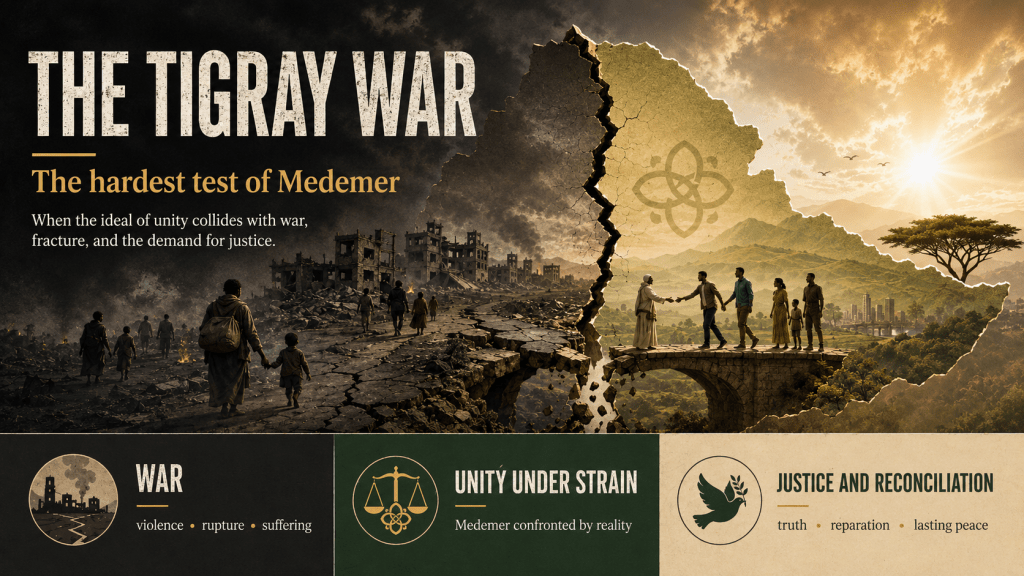
The war in Tigray: the hardest test of Medemer
The war in Tigray is, in my view, the hardest test of the Medemer philosophy.
The conflict erupted in November 2020, in a context of rupture between the federal government led by Abiy Ahmed and the Tigray authorities dominated by the Tigray People’s Liberation Front, known by the acronym TPLF. It lasted two years, until the cessation of hostilities agreement signed in Pretoria on November 2, 2022, under African mediation.
Estimates of the human toll vary greatly, but several researchers and observers speak of hundreds of thousands of deaths. The humanitarian, political and psychological consequences of the conflict remain immense.
International reports documented grave crimes committed by several parties to the conflict. The joint investigation by the Office of the United Nations High Commissioner for Human Rights, known by the acronym OHCHR, and the Ethiopian Human Rights Commission, known by the acronym EHRC, concluded that there had been serious violations of international humanitarian law and human rights, including unlawful killings, torture, sexual violence, forced displacement, arbitrary detention, restrictions on humanitarian aid and communications shutdowns.
In September 2023, United Nations experts were still warning that, nearly one year after the Pretoria agreement, atrocities, war crimes and crimes against humanity continued to be committed in the country, especially in Tigray, Amhara and Oromia.
The fundamental point is this: the war in Tigray cannot be treated as a simple security episode. It raises a major moral, political and institutional question for the Medemer philosophy.
How can one speak of national addition when one part of the country has lived through such a destructive war? How can one speak of reconciliation without full truth? How can one speak of a Medemer generation when entire generations have been traumatized? How can one speak of a Medemer state when victims demand justice, reparation, protection and recognition? How can one speak of unity when unity has sometimes been experienced as violence, suspicion or collective punishment?
The Pretoria agreement was an important step. It stopped the main fighting between the principal parties. But it did not resolve all the deep causes of the conflict. The presence or influence of armed actors not party to the agreement, territorial tensions, questions of justice, the return of displaced people, the reconstruction of Tigray, demands for truth and risks of renewed violence remain major issues.
This is why the war in Tigray requires a deeper critique.
According to critics, it appears that Medemer is vulnerable when it becomes a philosophy of unity without a sufficiently robust mechanism for addressing wounds. Unity cannot be demanded of victims without truth. Peace cannot be declared without justice. Reconciliation cannot be durable without recognition of responsibilities. And a state cannot claim to add together the forces of the country if it does not know how to protect all components of the nation, including those that contest the central power.
This is probably the greatest challenge facing Abiy Ahmed’s thought: to ensure that Medemer is not merely a proclaimed doctrine of unity, but a concrete architecture of truth, justice, reparation, pluralism and non-repetition.
A coherent architecture, but a doctrine under tension
Taken together, Abiy Ahmed’s four books form a remarkable architecture.
Medemer gives the idea: adding forces instead of opposing them. The Way of Medemer gives the path: transforming the idea into method. Generation Medemer gives the historical subject: forming the generation capable of carrying change. The Medemer State gives the institutional instrument: building the state capable of organizing this synergy.
This construction is intellectually interesting.
Few contemporary African leaders take the time to produce such an articulated doctrine. Many govern by slogans. Many improvise. Many repeat words produced elsewhere. Abiy Ahmed, for his part, tries to give grammar to his project.
This grammar rests on several strong intuitions:
A country is not built through hatred.
A fragmented society must learn to add together its forces.
Change must not mean the total destruction of the past.
Imported models do not replace the effort to think from within.
Transformation must produce visible results.
A generation must ask itself what it is transmitting.
The state must cease to be spoils and become an organizer of prosperity.
But the coherence of a doctrine is not yet its truth.
A political doctrine is not judged only by its beauty. It is judged by its ability to face reality.
And Ethiopian reality is harsh: complex federalism, identity tensions, wounded memories, armed conflicts, persistent poverty, fragile pluralism, geopolitical pressures, the need for jobs, youth expectations, the need for justice, the demand for security and the requirement of recognition.
This is where Medemer must be judged.
Unity: a necessary promise, a dangerous word
Unity is necessary.
No country can move forward sustainably if its citizens see one another as enemies. No society can transform itself if each group believes that the victory of the other is its own defeat. No state can build prosperity if its internal forces spend their time neutralizing one another.
But unity is also a dangerous word.
It can mean reconciliation.
It can also mean imposed silence.
It can mean a common horizon.
It can also mean a dominant narrative.
It can mean the addition of differences.
It can also mean the absorption of differences.
It can mean overcoming wounds. It can also mean an injunction addressed to the wounded to remain silent in the name of the future.
This is why the decisive question is not only: does Abiy Ahmed speak of unity?
The real question is: what kind of unity?
A unity that recognizes differences or a unity that suspects them? A unity that protects pluralism or a unity that demands alignment? A unity that listens to criticism or a unity that presents critics as obstacles? A unity that builds justice or a unity that asks people to forget too quickly? A unity that adds memories together or a unity that imposes the dominant memory?
This is where Medemer meets the test of power.
Because power tests ideas.
It tests patience before contradiction. It tests the sincerity of discourse on pluralism. It tests the capacity to allow opposition to exist. It tests the difference between authority and authoritarianism. It tests the boundary between national cohesion and political control. It tests the ability of a leader to build institutions stronger than his own vision.
This is why Abiy Ahmed must be read with critical admiration.
Admire the intellectual ambition.
Recognize the infrastructure dynamic.
Understand the civilizational depth of Ethiopia.
Take seriously the attempt to produce an endogenous political thought.
But also question the ambiguities.
Unity does not replace justice.
Speed does not replace deliberation.
The national narrative does not replace the recognition of wounds.
Growth does not replace pluralism.
Philosophy does not replace institutions.
Leadership does not replace checks and balances.

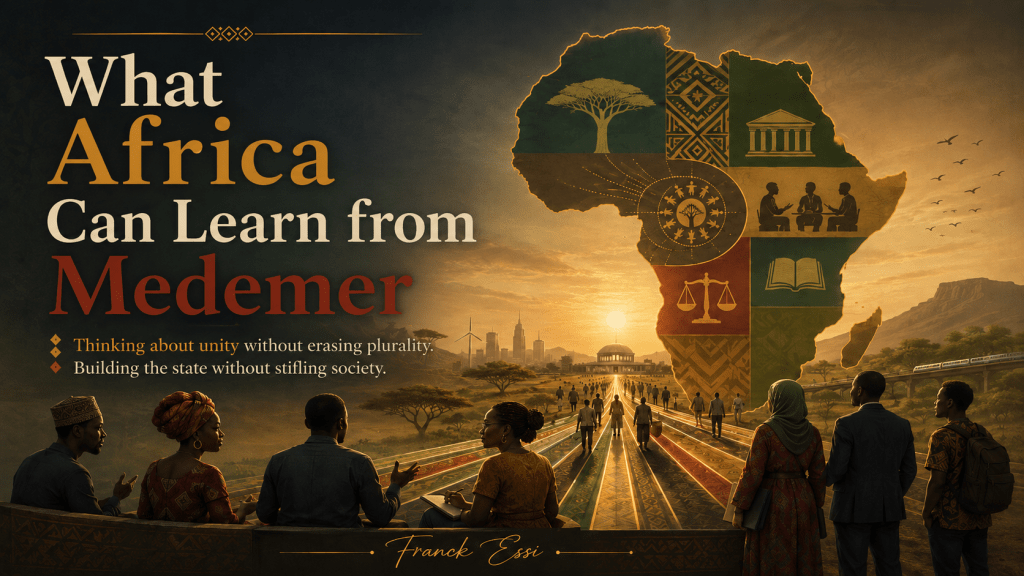
What Africa can learn from Medemer
Africa would benefit from reading Abiy Ahmed seriously.
Not in order to copy Medemer. Not in order to turn the Ethiopian experience into a universal model. Not in order to ignore Ethiopia’s contradictions. But in order to understand one thing: African countries need political thinking equal to their complexities.
We cannot continue to govern deep societies with poor slogans.
We cannot speak of unity without thinking about plurality.
We cannot speak of development without thinking about the state.
We cannot speak of youth without thinking about transmission.
We cannot speak of change without thinking about the path.
We cannot speak of sovereignty without thinking about institutions.
We cannot speak of peace without thinking about justice.
In this regard, Medemer forces us to ask useful questions, including for Cameroon.
Do we know how to add together our national forces?
Do we know how to build a common narrative without denying particular wounds?
Do we know how to refuse the clean slate without protecting old injustices?
Do we know how to form a responsible generation without suffocating it?
Do we know how to build a strong state without allowing it to absorb everything?
Do we know how to move fast without crushing society?
Do we know how to make unity something other than a word of power?
These questions are precious.
But they also invite a useful comparison with ourselves.
In Cameroon, we too have known a presidential book-vision: Communal Liberalism by Paul Biya, published in 1987. The book presented itself as doctrine, political project and vision of society. It spoke of openness, solidarity, an economy at the service of the human being, social justice and a new political society.
But nearly four decades later, what truly remains of this ambition in the concrete lives of Cameroonians?
In my view, Communal Liberalism is the very example of an intellectually formulated project that was politically stillborn because it was never seriously implemented as an institutional, economic, social and democratic architecture. It remained more of a programmatic book than a transformative program. A text more than a trajectory. A displayed doctrine more than a lived practice.
This comparison is important.
It reminds us that a political book does not change a country. A doctrine does not change a state. A vision does not transform a society. What truly transforms are institutions, public policies, the practices of power, justice, accountability, implementation, checks and balances, respect for citizens and the ability to translate words into lived experiences.
This is why the Ethiopian experience should interest us. It shows what a leader can attempt when he seeks to articulate vision, state, generation, national narrative and development. But it also reminds us that any doctrine, however ambitious, can fail if it does not respect plurality, if it does not address wounds, if it does not build credible institutions and if it does not resist the temptation to confuse national unity with adherence to power.
My intimate conviction
In my humble opinion, Abiy Ahmed is one of the contemporary African leaders who must be read seriously, precisely because he does not merely govern by decisions. He tries to govern through vision.
But that is also why he must be read with vigilance.
Because a great vision can enlighten a people. It can also, if it is not limited by institutions, end up merging with the power of the person who carries it.
Medemer is a beautiful idea when it means adding together the forces of a people.
It becomes fragile when it does not say clearly enough how differences will be protected, how wounded memories will be recognized, how oppositions will be respected, how institutions will limit power, and how justice will accompany reconciliation.
The real test of Medemer is therefore not only in Abiy Ahmed’s books.
It is not only in the roads of Addis Ababa.
It is not only in dams, corridors, airports or growth figures.
It is not only in speeches about unity, prosperity and the new generation.
The real test of Medemer lies in the capacity of the Ethiopian state to organize unity without suffocating plurality.
It lies in its capacity to produce stability without killing freedom.
It lies in its capacity to accelerate development without bypassing justice.
It lies in its capacity to build a common narrative without erasing wounded memories.
It lies in its capacity to make power not domination, but a shared promise.
Because, in the end, adding a country together does not mean asking everyone to enter a story already written.
Adding a country together means creating the conditions for all memories, all wounds, all intelligences, all regions, all generations and all voices to co-write a common future.
That, in my view, is where the true destiny of Medemer is being played out.
Franck Essi
#WhatIBelieve
#IdeasMatter
#LightUpOurMinds