By Franck Essi
——
There are political figures who enter history because of the force of events. There are others who enter it because of the depth of their thought, the coherence of their action, and the power of their example.
Amílcar Cabral belongs to the second category.
He was not only the leader of a national liberation movement. He was not only a political and military strategist. He was not only an African intellectual committed to the struggle against Portuguese colonialism. He was all of these things at once, but with one rare quality: for him, action never came before reflection. Struggle was never separated from knowledge. Politics was never reduced to the conquest of power.
Cabral understood that a people cannot be liberated through slogans, improvisations, and illusions. A people must first be understood.
This is what makes his thought still relevant today. In an Africa where political independence has not always produced real sovereignty, where elites often speak in the name of the people without truly living with them, where culture is sometimes treated as folklore even though it is a question of power, rereading Cabral is not merely a historical exercise. It is a political necessity.
——
An African born at the crossroads of several worlds
Amílcar Lopes Cabral was born on September 12, 1924, in Bafatá, in Portuguese Guinea, today’s Guinea-Bissau. His parents were from Cape Verde. This double belonging — Guinean by birth, Cape Verdean by family origin — would deeply shape his political journey. It gave him a sharp awareness of identities, differences, and the need to build political unity beyond immediate affiliations.
This origin matters. Cabral was not born in a neutral space. He was born into a world structured by colonial domination, racial hierarchy, economic exploitation, and the cultural denial of African peoples.
Very early on, he was confronted with a basic reality: under colonialism, the dominated are not only deprived of political power. They are also deprived of the right to tell their own story.
The colonizer does not only administer. He names. He classifies. He defines. He decides who is civilized and who is not. Who thinks and who must be thought for. Who commands and who must obey.
It was in this world that Cabral learned to see domination not merely as a visible balance of power, but as a deep system capable of shaping land, labor, school, language, memory, and the way people see themselves.
——
Lisbon: the student, the agronomist, and political awakening
Cabral studied agronomy in Lisbon. This detail is essential. He was not first trained as a lawyer, soldier, or pure ideologue. He was trained to study soils, crops, agricultural conditions, and the material realities of production. This scientific background would strongly influence the way he understood politics.
Where others began with speeches, Cabral began with the field.
Where others saw only masses to be mobilized, he saw concrete societies, with their histories, contradictions, knowledge, needs, and capacities.
In Lisbon, he also associated with circles of African students from the Portuguese colonies. It was in this intellectual and political environment that ties were strengthened among several future leaders of anti-colonial struggles in Portuguese-speaking Africa.
But his political awakening should not be reduced to militant friendships alone. What was being formed in Cabral was a method. He understood that colonial domination had to be studied in its entirety. It was economic, political, cultural, psychological, and social. Fighting it required more than sentimental patriotism. It required organized thought.
For Cabral, commitment did not replace knowledge. It extended it.
——-
Returning to the real country
After his training, Cabral returned to Portuguese Guinea as an agronomist. He took part in agricultural survey work that led him to travel across the territory, meet the people, observe modes of production, rural realities, living conditions, social balances, and the concrete difficulties of peasants.
This moment was decisive.
It allowed Cabral to discover the real country, the one colonial administration did not understand or did not want to understand. He saw the villages. He listened to farmers. He understood the place of land. He observed relations between social groups. He measured poverty, but also the moral, cultural, and political resources of the people.
This contact with the population gave him a fundamental conviction: one cannot claim to liberate a people one does not know.
Many speak of the people. Few take the time to listen to them. Many want to lead them. Few accept to learn from them.
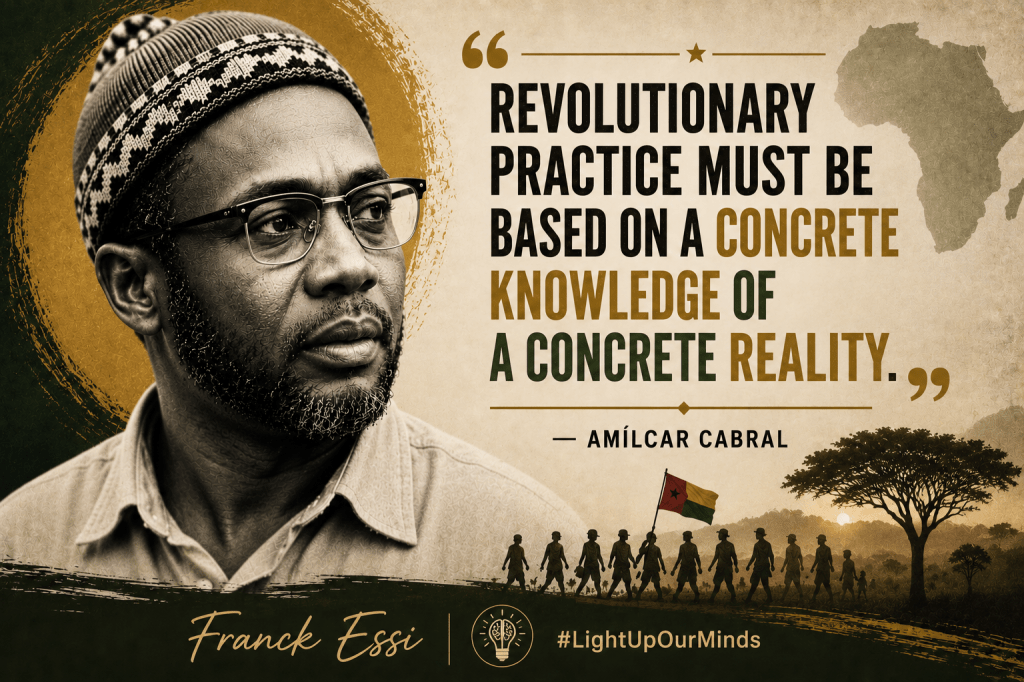
Cabral chose another path. Before speaking in the name of the people, he sought to understand how they lived. Before proposing a strategy, he studied the terrain. Before proclaiming a revolution, he measured the real conditions in which it could emerge.
This is one of the great differences between serious politics and politics of posture. The first begins with reality. The second begins with ego, slogans, staging, or opportunity.
In many African countries today, this lesson remains urgent. We sometimes see elites claiming to transform societies they barely know. We see political programs written in a language the people do not speak. We see development projects designed to satisfy donors, embassies, or international rankings more than the real needs of the people.
Cabral reminds us that politics which does not begin with the real country always ends up producing costly illusions.
——
The birth of the PAIGC and the building of an organization
In September 1956, Cabral helped found the PAIGC, the African Party for the Independence of Guinea and Cape Verde. The goal was clear: to end Portuguese colonial rule and open the way to the independence of Guinea-Bissau and Cape Verde.
But the PAIGC was not simply a party in the classical sense. In Cabral’s thinking, it had to be a political organization, a school of formation, an instrument of mobilization, a framework for unity, and a laboratory for the future state.
This point is essential. Cabral did not simply want to take power. He wanted to prepare a people to exercise power. He did not only want to drive out the colonizer. He wanted to prevent independence from becoming a mere substitution of elites.
——
Changing the face of power is not enough if the logic of domination remains intact.
This concern runs through all his action. Cabral knew that independence could be confiscated by those who claimed to serve it. He knew that nationalist elites could become, once in power, the heirs of colonial privileges. He knew that the flag could change without the lives of the people changing.
This is why organization is central to his political thought. Without organization, anger disperses. Without training, the people can be manipulated. Without collective discipline, struggle becomes a space for personal rivalries. Without institutions, victory can become a new defeat.
——-
An armed struggle without the cult of violence
The struggle led by the PAIGC gradually took an armed form, especially after colonial repression and the limits of open political action. From 1963 onward, the PAIGC waged a liberation war against Portuguese rule. Cabral became its main political and strategic leader.
But we must be clear: Cabral did not romanticize war. He did not turn violence into a revolutionary aesthetic. He did not make weapons into a political religion. Armed struggle, for him, was never an end in itself. It was part of a broader political project: to liberate, organize, educate, produce, heal, administer, and prepare the future.
This is what made the PAIGC experience distinctive. In the areas controlled by the movement, the goal was not only to fight the Portuguese army. It was also to organize a new social life, establish forms of administration, develop political education, and show that independence could begin even before its official proclamation.
——-
The purpose of struggle is not struggle. The purpose of struggle is life.
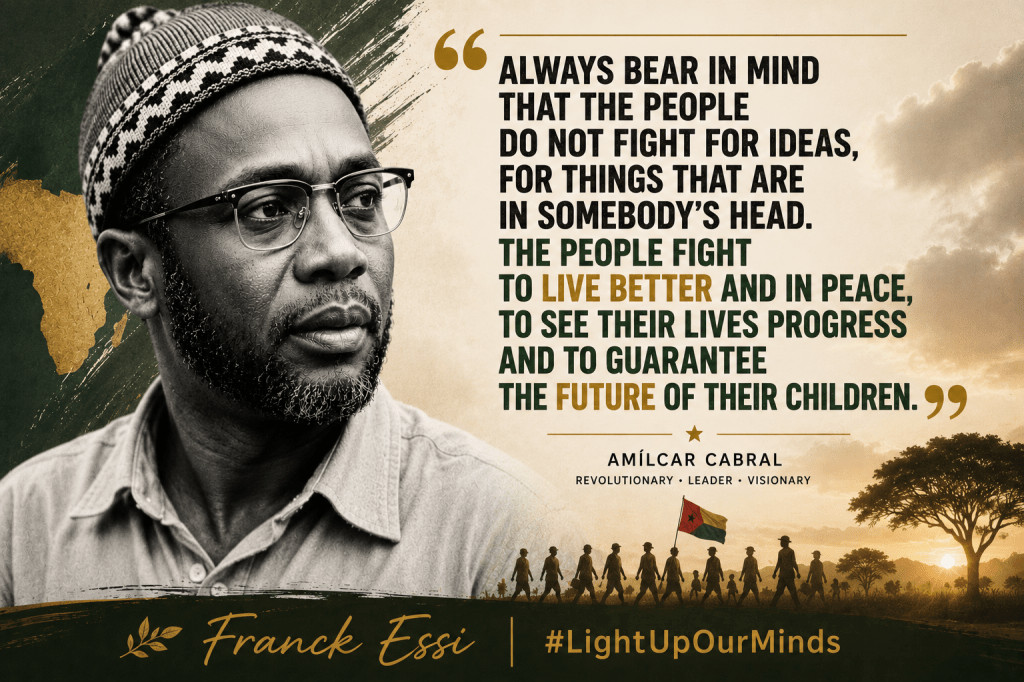
This idea is decisive. Peoples do not mobilize for long to feed the ego of a leader, applaud an abstract ideology, or die for slogans. They mobilize when they believe their dignity can be restored, their children can live better, their work can be respected, and the future can become less suffocating than the present.
The people do not eat speeches. They do not heal themselves with declarations of intent. They do not house themselves with promises.
Politics that does not eventually improve the real lives of the people sooner or later becomes a mere staging of power.
——-
Culture as the heart of liberation
One of Cabral’s greatest intellectual contributions concerns culture.
For him, colonialism was not only military occupation or economic exploitation. It was also an attempt to destroy, distort, or neutralize culture. The colonizer wants to convince the colonized that they have no history, no thought, no capacity of their own, no autonomous dignity.
Cabral therefore understood that national liberation could not be only political. It also had to be cultural.
In his major speech “National Liberation and Culture,” delivered in 1970 during the Eduardo Mondlane Memorial Lecture at Syracuse University, Cabral developed the idea that imperialist domination seeks to prevent the autonomous historical development of peoples, while national liberation allows a people to recover its historical personality.
This reflection is crucial.
Culture, for Cabral, is not decoration. It is not folklore for official ceremonies. It is not only dance, clothing, music, or symbols. It is the way a people lives, works, remembers, transmits, interprets the world, and projects itself into the future.
——-
A people that no longer believes in itself becomes available for every form of domination.
This thought speaks directly to contemporary Africa.
When our school programs tell the history of others more than our own, Cabral still speaks to us.
When our languages are despised, Cabral still speaks to us.
When our local knowledge is treated as inferior, Cabral still speaks to us.
When our leaders think about their countries only through the categories of international institutions, Cabral still speaks to us.
When African elites only feel intelligent when they repeat what comes from elsewhere, Cabral still speaks to us.
Sovereignty, therefore, does not only mean having a flag, an anthem, and a seat at the United Nations. It also means producing our own categories of thought, naming our own problems, valuing our languages, owning our memory, and building institutions rooted in our realities.
One can be legally independent and mentally dependent.
One can be politically sovereign on paper and culturally submissive in practice.
This is why Cabral’s thought remains one of the strongest African critiques of unfinished independence.
——
Truth, lucidity, and the refusal of propaganda
Cabral was suspicious of political lies. He knew that a movement can lose itself by telling militants what they want to hear rather than what they need to know.
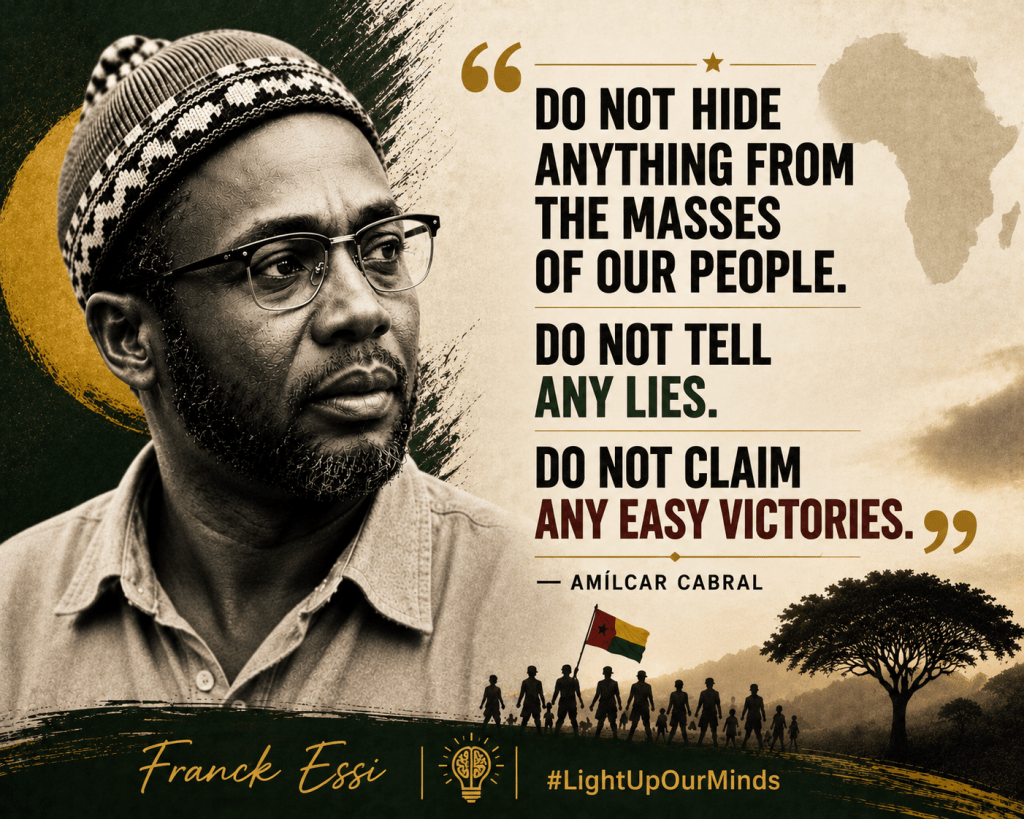
His political thought gives an important place to lucidity. Telling the truth to the people is not only a moral requirement. It is a strategic necessity. A deceived people cannot organize properly. Militants fed with illusions cannot seriously confront reality. A political leadership that disguises its mistakes eventually loses the trust of those it claims to lead.
A free society cannot be built with deceived citizens.
This phrase should be meditated upon in many African countries.
Our societies often suffer from state lies, manipulated statistics, electoral promises without follow-up, opposition movements that promise everything without explaining the difficulties, and political groups that announce victories before building the necessary balance of power.
Yet a just cause can be weakened by false methods.
Lies can mobilize for a while, but they eventually destroy trust. They can produce enthusiasm, but they do not produce consciousness. They can create an illusion of strength, but they do not build a lasting organization.
Cabral reminds us that truth is a condition of freedom.
——-
The problem of African elites
Cabral also reflected deeply on the role of elites.
This is a sensitive but central subject. Liberation movements are often led by men and women who have had access to colonial schooling, cities, books, travel, and political networks. They therefore possess cultural and social capital that the majority of the population does not have.
This creates responsibility, but also danger.
The danger is to speak in the name of the people while living far away from them. The danger is to use the struggle as a social elevator. The danger is to replace the colonial elite with a national elite that reproduces the same distance, the same privileges, and the same contempt.
Cabral had understood this risk. He knew that independence could be confiscated by those who spoke of it most eloquently. He knew that revolutionary vocabulary could hide personal ambition. He knew that some people could use the people as a stepping stone, then abandon them once they reached the top.
——-
Elites must serve the people, not use the people to serve themselves.
This question remains tragically current.
In many African countries, the problem is not only that elites lack skills. The problem is also that many skills are placed at the service of predation, individual careers, social reproduction, external dependence, or the conservation of power.
Intelligence that despises the people becomes dangerous.
Expertise without roots becomes cold technocracy.
An elite that does not transform itself morally often ends up turning the state into an instrument of private advancement.
Cabral understood that liberation also required an ethical transformation of African elites. It is not enough to have read the right books, pronounce the right speeches, or denounce the right enemies. One must also agree to break with the privileges, distances, and reflexes inherited from colonial society.
——-
Refusing the cult of the leader
Another important aspect of Cabral’s political thought is his refusal of the cult of the leader.
Of course, Cabral was a leader. He inspired, directed, theorized, and represented his movement internationally. But he knew that a serious movement cannot depend exclusively on one individual. An organization that rests on one person alone is fragile. A party that does not train its cadres becomes a court. A people that expects everything from a savior often ends up disappointed, manipulated, or disarmed.
Cabral wanted to train conscious militants, not produce followers.
He wanted to build a political organization, not a personal chapel.
He wanted to prepare a people to govern themselves, not merely to applaud their leaders.
A free people does not need worshippers. It needs citizens who are standing, lucid, organized, and capable of thinking for themselves.
This lesson is clearly relevant today. Many African movements remain trapped in the idea of the providential man. Many parties collapse as soon as their leader disappears, betrays, grows old, becomes tired, or is absorbed by the system. Many organizations have no solid internal culture, no serious political training, no democratic mechanisms, no thought capable of surviving individual ambitions.
A struggle that does not train its militants often prepares its own defeats.
Without training, militants become easy to manipulate.
Without organization, anger wears itself out.
Without democratic culture, alternation can produce a new confiscation of power.
Without citizen vigilance, the most beautiful speech can become the mask of a new domination.
——-
Assassination and unfinished independence
On January 20, 1973, Amílcar Cabral was assassinated in Conakry. He did not live to see the political outcome of the struggle to which he had devoted his life. A few months later, the PAIGC unilaterally proclaimed the independence of Guinea-Bissau in September 1973. Portugal officially recognized this independence in 1974.
His death gives his life a tragic dimension. But it also raises a fundamental question: what becomes of revolutionary thought after the death of the person who carried it?
The African experience shows that independence is never an end in itself. It can open a possibility, but it guarantees nothing. It can make sovereignty possible, but it can also lead to the confiscation of power, the militarization of the state, corruption, internal divisions, economic dependence, or the betrayal of popular hopes.
Cabral should therefore not be turned into a simple icon. An icon is celebrated. A thought must be worked through.
Quoting him is not enough.
Sharing his pictures is not enough.
Mentioning his assassination is not enough.
We must take up his questions where they still concern us: what do we really know about our peoples? What place do we give to culture in our struggles? What organizations are we building? What truth do we tell militants? What elites are we forming? What society do we want to build after the conquest of power?
Liberation is not an event. It is a process.
And that process begins with lucidity.
——
What Cabral can teach modern African militants
From the life and thought of Amílcar Cabral, African militants today can draw several important lessons.
First, we must begin with reality. Slogans are useful for mobilizing, but they cannot replace knowledge. A serious militant must know his country, its social classes, its villages, its cities, its languages, its contradictions, its economy, its history, and its wounds. A society cannot be transformed if one only knows it through social media, international reports, or salon conversations.
Second, anger must be organized. Indignation is often necessary, but it is not enough. Unorganized anger can make noise, but it cannot sustainably change the balance of power. Cabral reminds us that collective discipline, political education, strategy, and popular rootedness are indispensable.
Third, culture must be taken seriously. Domination does not pass only through institutions or the economy. It also passes through school, language, media, imagination, memory, and models of success. An African militant who neglects the cultural question risks fighting the effects of domination without touching its deepest roots.
Fourth, truth must be told to the people. Militants must not reproduce the lies of the regimes they fight. They must not announce easy victories, promise impossible changes, or hide difficulties. Mobilization based on illusion always ends in disappointment.
Fifth, we must beware of elites without moral transformation. Having degrees, speaking several languages, or mastering international codes is not enough. The real question is: in whose service do we place our skills? An elite that does not serve the people almost always ends up using the people.
Finally, we must reject the cult of the leader. African movements need leaders, but they do not need messiahs. They need solid organizations, trained cadres, internal debate, transmission, collective memory, and citizens capable of thinking for themselves.
The best way to honor Cabral is therefore not to freeze him in the past. It is to keep his method alive: observe, understand, organize, train, tell the truth, serve the people, and patiently build the conditions for real sovereignty.
Cabral is not only a figure of African history. He is a demand addressed to our present.
Franck Essi
#IdeasMatter
#WeHaveAChoice
#WeHavePower
#LetUsUseOurBrains
—–
Further reading
Amílcar Cabral, Unity and Struggle
An essential collection for understanding Cabral’s political thought: organization, culture, national liberation, militant training, relationship to the people, and the demand for truth.
Amílcar Cabral, Return to the Source
An important collection of speeches, especially on culture, identity, dignity, and national liberation. (abahlali.org)
Amílcar Cabral, “National Liberation and Culture”
A major 1970 speech that is fundamental for understanding Cabral’s view of culture as a central dimension of national liberation. (Archive des marxistes)
António Tomás, Amílcar Cabral: The Life of a Reluctant Nationalist
A useful biography for understanding Cabral beyond myth, including the political, identity-based, and historical tensions of the liberation struggle. (HURST)
Basil Davidson, No Fist Is Big Enough to Hide the Sky: The Liberation of Guinea-Bissau and Cape Verde, 1963–74
A classic work on the liberation struggle led by the PAIGC in Guinea-Bissau and Cape Verde. (Bloomsbury Publishing)
Encyclopaedia Britannica, “Amílcar Lopes Cabral”
A useful biographical overview of his birth, education, creation of the PAIGC, anti-colonial struggle, assassination, and the independence of Guinea-Bissau. (Encyclopedia Britannica)