By Franck Essi
We are almost all familiar with the saying: “Prevention is better than cure.”
We repeat it when discussing health, safety or education. Yet, both individually and collectively, we still too often wait until problems become serious before giving them the attention they deserve.
We wait until illness sets in before changing certain habits. We wait until infrastructure deteriorates before maintaining it. We wait until tensions turn into conflicts before initiating dialogue. We wait until floods destroy homes before questioning our approach to urban development. We wait until thousands of young people are left without prospects before seriously discussing education, training, employment and economic inclusion.
In many cases, we are not surprised by what happens. We are surprised by the scale reached by problems we neglected for too long.
We often know what could happen. But we do not always act in time.
What Prevention Really Means
Prevention does not mean living in fear of the future. Nor does it mean pretending that we can predict, prevent or control everything.
Some crises will remain difficult to anticipate. Others will occur despite the precautions taken. A serious prevention policy does not promise a world without risks.
Prevention means identifying known risks, detecting early warning signs, understanding root causes and acting before the damage becomes too severe.
A genuine prevention approach involves, among other things:
- collecting and analysing relevant information;
- identifying risks and the populations most exposed to them;
- understanding causes instead of focusing only on symptoms;
- establishing early warning and monitoring mechanisms;
- strengthening the capacities of individuals and institutions;
- preparing responses before an emergency occurs;
- learning from past crises to avoid repeating the same mistakes.
In other words, prevention is not merely about knowing or warning. It is about turning knowledge of a risk into timely decisions, resources and action.
We Often Mobilise Our Resources Too Late
The problem is not always that our societies have no resources with which to act. It also lies in when we decide to mobilise the resources available to us.
We sometimes find money to assist disaster victims, but not to clear drainage systems and regulate construction. We find resources to rebuild infrastructure, but not to maintain it. We mobilise considerable forces when tensions escalate, but devote very little to addressing the injustices, frustrations and exclusion that fuelled them.
Yet late intervention generally costs more. It requires more resources, causes greater suffering and produces more uncertain results.
Available research demonstrates this across several sectors.
In health, the World Health Organization estimates that an additional investment of less than one dollar per person per year in selected measures to prevent and manage noncommunicable diseases could avert nearly seven million deaths by 2030 in low- and lower-middle-income countries. Some priority interventions could generate approximately seven dollars in economic benefits for every dollar invested.[1]
In early childhood development, a study led by economist James Heckman on an intensive programme for disadvantaged children estimated an annual return on investment of approximately 13%, through its effects on education, health, employment and productivity.[2]
In peace and security, the joint United Nations–World Bank study Pathways for Peace reminds us that violent conflicts are often preceded by exclusion, grievances and tensions that could have been addressed earlier. Depending on the scenarios considered, more effective prevention could generate annual savings ranging from $5 billion to nearly $70 billion.[3]
These figures do not mean that every expenditure labelled “preventive” will automatically be effective. A poorly designed, poorly targeted or poorly implemented policy can waste resources even when introduced early.
They do show, however, that knowledge-based prevention that is properly funded, effectively implemented and regularly evaluated can save lives, reduce costs and protect the future.
Why Do We Find Prevention So Difficult?
It would be unfair to claim that African societies are unfamiliar with prevention. In many communities, collective granaries, savings groups, family solidarity, the transmission of agricultural knowledge and traditional mediation mechanisms have long helped people anticipate difficult periods and reduce risks.
Africa is not a homogeneous whole either. Institutional capacities, experiences and practices vary considerably from one country to another and within individual countries.
But we must also face reality: in many of our countries, prevention remains insufficiently integrated into individual behaviour, organisational management and the conduct of public affairs.
This weakness is not the result of some alleged cultural incapacity. It can be explained by a combination of human, economic, political and institutional factors.
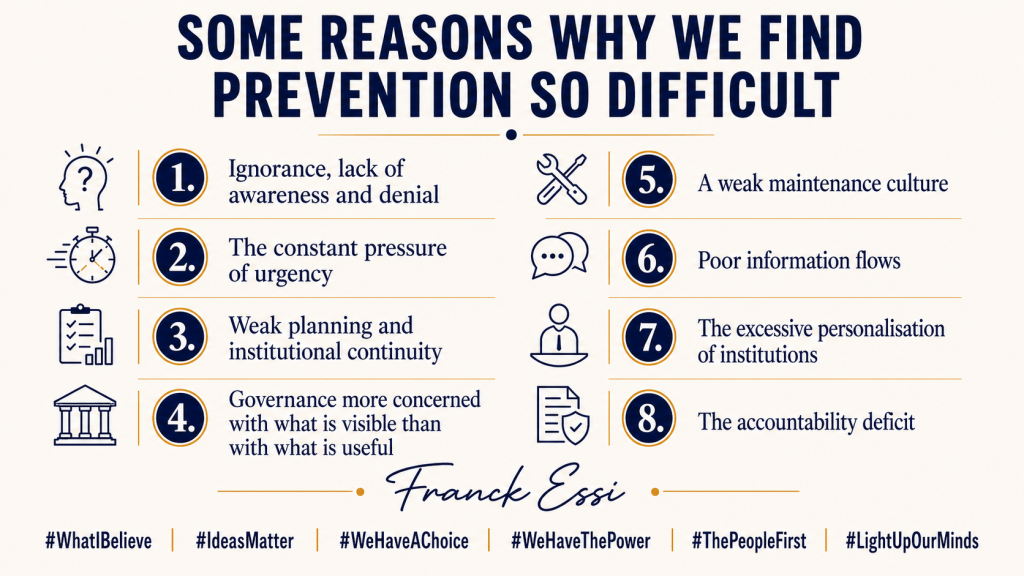
Ignorance, Lack of Awareness and Denial
We do not always prevent problems because we do not know enough about their causes, mechanisms or potential consequences.
But ignorance does not merely mean a complete absence of information.
Some people are genuinely unaware that a risk exists. Others have heard about it but lack the knowledge required to understand its seriousness. Still others know the facts but do not fully grasp their implications for their lives, organisations, communities or countries.
We may know that climate change exists without understanding its implications for agriculture, food security, migration, resource-related conflicts or urban planning. We may know that the population is growing without appreciating the additional needs this growth will create for schools, housing, employment, healthcare and infrastructure. We may hear about artificial intelligence without perceiving the depth of the transformations it is already bringing to education, work, the economy and the exercise of power.
There is, therefore, an important difference between:
- receiving information;
- understanding the phenomenon to which it relates;
- appreciating its implications and possible consequences;
- feeling personally and collectively concerned;
- deciding to act accordingly.
Information becomes a force for prevention only when it generates enough awareness to change decisions and behaviour.
Ignorance may also be compounded by denial. We sometimes know that a problem exists but prefer to minimise it because acknowledging it would require us to change our habits, incur costs, challenge certain interests or make difficult decisions.
We cannot seriously prevent what we do not know, what we poorly understand or what we refuse to acknowledge the consequences of.
The Constant Pressure of Urgency
When a family, organisation, local authority or country lacks resources, it naturally tends to devote most of them to the most immediate needs.
People must find food, pay salaries, repair broken equipment, respond to the current crisis or meet a demand that has become urgent. Under such circumstances, investing today to prevent a problem that has not yet occurred may appear secondary.
But this logic creates a vicious cycle: emergencies consume the resources that could have prevented future emergencies.
We are so busy putting out today’s fires that we no longer find the time to reduce the risk of tomorrow’s fires.
Weak Planning and Institutional Continuity
Prevention requires reliable data, a long-term vision, clearly assigned responsibilities and institutions capable of retaining the lessons of experience.
Yet, in many contexts, plans exist without consistently guiding budgets and decisions. Studies are commissioned, but their recommendations are rarely implemented. Warnings are issued, but no one appears clearly responsible for following them up. When a leader changes, priorities may also change—even when those priorities were designed to address risks that had already been identified.
An institution that fails to retain the memory of its mistakes is condemned to pay for them several times over.
Governance More Concerned With What Is Visible Than With What Is Useful
Prevention is not politically spectacular.
A rebuilt bridge, distributed relief supplies, newly inaugurated equipment or an official standing among disaster victims can be photographed. It is much harder to showcase a disaster that was prevented, an illness that did not occur or a conflict that was defused before it became violent.
The leader who publicly manages a crisis appears active. The one who quietly prevented it rarely receives the same recognition.
Prevention may also produce results that extend beyond the duration of a political term or project cycle. It requires spending today to secure benefits tomorrow—benefits for which someone else may eventually claim credit.
Prevention is rarely spectacular because its greatest victory is often a tragedy that never happened.
A Weak Maintenance Culture
We sometimes prefer building to maintaining, launching to consolidating, announcing to evaluating.
Yet much of prevention depends on ordinary and largely invisible actions: maintaining roads and drainage systems, inspecting buildings, updating equipment, regularly training teams, undergoing medical check-ups, testing emergency systems and correcting early signs of malfunction.
What we fail to maintain today will often become what we must rebuild tomorrow.
Poor Information Flows
Sometimes warning signs exist but never reach decision-makers. At other times, leaders receive the information but minimise the warnings, punish the messengers or delay decisions.
In some organisations, acknowledging a risk is perceived as an admission of weakness. Employees then learn to conceal problems until they can no longer be hidden.
A culture of prevention requires the opposite: people must be able to report an anomaly, voice a doubt or challenge a decision without immediately being considered disloyal, alarmist or incompetent.
The Excessive Personalisation of Institutions
When decisions depend primarily on the will of one individual, prevention remains fragile. It advances when the leader believes in it and disappears when that leader leaves.
Sustainable prevention must be embedded in rules, functions, budgets, oversight mechanisms and working practices.
It cannot depend solely on the exceptional vigilance of one leader. It must become an ordinary institutional capacity.
The Accountability Deficit
The same floods can recur, the same infrastructure can deteriorate and the same tensions can re-emerge without any serious assessment establishing what failed, why warnings were ignored and who was responsible for acting.
When the failure to take preventive action has no consequences for those responsible, it eventually becomes normal.
Prevention therefore also requires a culture of responsibility, evaluation and learning. This does not mean mechanically searching for someone to blame after every difficulty. It means understanding what failed, correcting defective mechanisms and ensuring that the same mistakes are not repeated.
We cannot prevent every misfortune. But we can avoid turning our lack of preparedness into fate.
Five Challenges Africa Must Anticipate
Our continent faces several transformations whose broad trends are already known and well documented. The figures must be interpreted carefully: a projection is not a prophecy, and a continental average does not describe the specific circumstances of every country.
But the scale of these trends is significant enough to demand immediate decisions.
A few decades from now, we will not be able to claim that we did not know.
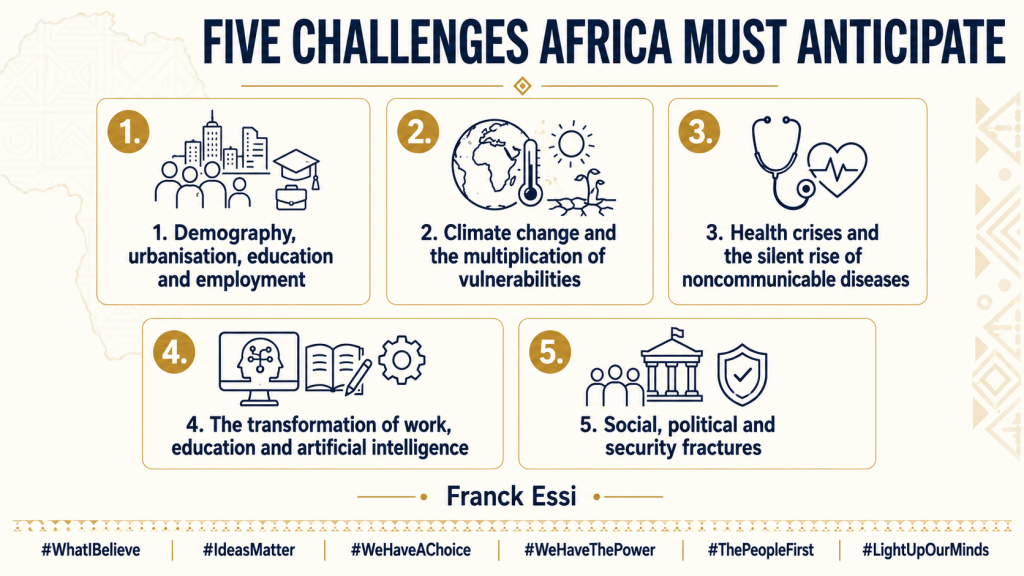
1. Demography, Urbanisation, Education and Employment
Africa’s population growth can become a tremendous source of strength. A young, well-educated, healthy and economically active population can support innovation, production and the transformation of the continent.
But this possibility is not automatic.
According to the United Nations’ population projections, the population of sub-Saharan Africa is expected to nearly double between 2022 and 2050 and exceed two billion people towards the end of the 2040s.[4] Estimates reported by the United Nations also indicate that Africa’s working-age population—those aged 15 to 64—could rise from approximately 849 million in 2024 to 1.56 billion by 2050. Africa would therefore account for almost 85% of the global increase in the working-age population over that period.[5]
This transformation could generate a demographic dividend. It could also place immense pressure on schools, healthcare systems, cities, labour markets and public institutions.
This pressure is already visible in education. In 2024, UNESCO estimated that 273 million children and young people worldwide were out of school. Sub-Saharan Africa accounts for a particularly large share of this deficit, with recent estimates indicating that approximately 98 million children and young people in the region are not attending school.[6]
Moreover, the challenge is not limited to access to education. Children must actually learn, training must correspond to changes in the economy, and qualifications must translate into useful skills.
Without adequate investment in education, health, housing, agriculture, infrastructure and productive employment, population growth could deepen insecurity, uncontrolled urban expansion, forced migration and social tensions.
The question is therefore not merely how many people our countries will have. The real question is whether our economic, social and institutional capacities will grow quickly enough to meet the needs of that population.
Prevention requires, among other things:
- linking demographic projections to future needs for schools, teachers, housing, transport, healthcare and employment;
- improving reproductive health and guaranteeing women access to education and economic autonomy;
- investing in early childhood development and foundational learning;
- adapting education and training to the present and future needs of the economy;
- planning cities before their expansion makes existing problems far more expensive to resolve;
- supporting businesses capable of creating decent jobs on a large scale.
Youth is not, by itself, a form of wealth. It becomes one when a society invests in young people’s health, knowledge, skills and capacity to act.
2. Climate Change and the Multiplication of Vulnerabilities
Climate change is no longer a distant risk. It is already affecting agriculture, water resources, health, infrastructure, labour productivity, public finances and population movements.
The World Meteorological Organization reports that, in 2024, Africa’s average surface temperature was approximately 0.86°C above the 1991–2020 average. North Africa, the continent’s fastest-warming subregion, recorded an anomaly of approximately 1.28°C.[7]
The economic consequences are already severe. According to the World Meteorological Organization, climate change-related costs can amount to as much as 5% of gross domestic product in some African countries. Earlier estimates place sub-Saharan Africa’s annual adaptation needs at between $30 billion and $50 billion during the present decade.[7][8]
Human mobility will also be affected. Under a scenario of inadequate climate and development action, the World Bank estimates that as many as 86 million people could become internal climate migrants in sub-Saharan Africa by 2050, with an additional 19 million in North Africa. In West Africa alone, the number could reach 32 million.[9]
These projections do not mean that such displacement is inevitable. They show precisely what could happen if climate adaptation, territorial development and emissions-reduction policies remain inadequate.
Waiting for every disaster to occur before distributing limited relief does not constitute a climate policy.
Prevention requires:
- protecting forests, mangroves, soils and watersheds;
- improving meteorological services and early warning systems;
- adapting seeds, agricultural practices and irrigation systems;
- securing water resources;
- regulating construction in vulnerable areas;
- building and maintaining resilient infrastructure;
- incorporating foreseeable climate migration into spatial and territorial planning;
- financing adaptation before losses become irreversible.
Climate change rarely acts alone. It exacerbates existing vulnerabilities: poverty, unplanned urbanisation, weak infrastructure, food insecurity and resource-related conflicts.
Climate prevention must therefore also be an agricultural, social, urban, economic and security policy.
3. Health Crises and the Silent Rise of Noncommunicable Diseases
Epidemics periodically remind us that a healthcare system cannot be built at the moment a crisis begins.
But health threats do not come from epidemics alone. Africa faces a double burden: infectious diseases remain widespread, while noncommunicable diseases—cardiovascular diseases, cancers, diabetes and chronic respiratory diseases—are advancing rapidly.
According to the WHO, these diseases already account for more than one-third of deaths in the African Region. The organisation has also warned that, without stronger action, they could overtake communicable, maternal, perinatal and nutritional diseases combined as the leading causes of mortality in the region by 2030.[10]
At the same time, infectious diseases are far from having disappeared. At the end of 2024, approximately 65% of the world’s 40.8 million people living with HIV were in the WHO African Region.[11]
This combination of risks places considerable pressure on healthcare systems whose human resources, equipment, geographical coverage and financing mechanisms often remain inadequate.
Health prevention requires:
- health information and education;
- vaccination and epidemiological surveillance;
- sanitation, safe drinking water and public hygiene;
- early detection and screening;
- action against the main risk factors;
- stronger primary healthcare;
- emergency stocks and response capacities;
- the training and retention of healthcare professionals;
- information systems capable of rapidly detecting worrying developments.
A responsible healthcare system should not merely treat more people. It should also prevent an avoidable number of people from requiring intensive care.
4. The Transformation of Work, Education and Artificial Intelligence
Automation, digitalisation and artificial intelligence are already transforming occupations, required skills, modes of production and power relations.
The global study published by the International Labour Organization in 2025 highlights that clerical occupations remain the most exposed to generative artificial intelligence, while exposure is also increasing in several highly digitalised professions. It further shows that, in developing economies, the immediate impact of automation may be lower because of the structure of employment, although there remains considerable potential for AI to augment human tasks.[12]
The digital divide nevertheless limits African countries’ ability to seize these opportunities. Without infrastructure, reliable electricity, affordable internet access, local data, computing capacity, research and appropriate skills, Africa risks becoming primarily a consumer of technologies designed elsewhere.
The outlook is not entirely negative. An ILO study estimates that the combination of the digital and green transitions could create millions of additional jobs worldwide by 2030, including some for young people. But these opportunities will depend heavily on skills levels and the ability of economies to manage these transformations.[13]
If our education systems continue preparing young people for jobs that are disappearing or changing, we will create part of tomorrow’s unemployment ourselves.
Prevention requires:
- strengthening foundational learning before even discussing advanced digital skills;
- developing critical thinking, creativity, cooperation and the capacity for lifelong learning;
- training teachers and reviewing curricula;
- preparing workers to transition into roles whose tasks will be transformed;
- supporting small businesses in adopting digital tools;
- investing in African research, local data and digital infrastructure;
- protecting citizens against algorithmic discrimination, manipulation, disinformation and privacy violations;
- establishing rules that place technology at the service of human progress.
The real question is no longer whether these transformations will occur. They are already here. The question is whether we will merely endure them or develop the capacities required to shape them.
5. Social, Political and Security Fractures
Conflicts do not always begin with the first clashes. They develop gradually through unresolved injustices, discrimination, exclusion, impunity, weak institutions and the absence of credible spaces for dialogue.
A society may appear calm while accumulating deep grievances.
Forced displacement provides an indication of the scale of the fractures currently unfolding. As of 30 April 2025, West and Central Africa alone hosted 12.7 million forcibly displaced or stateless people, including 8.2 million internally displaced persons and 2.9 million refugees and asylum-seekers. This total had increased by 48% since 2020.[14]
By the end of 2025, Sudan remained the world’s largest internal displacement crisis, with approximately 9.1 million people still displaced within the country.[15]
These figures reflect diverse realities. Not all conflicts have the same causes, and not all tensions lead to violence. Experience nevertheless shows that political exclusion, poorly regulated competition for resources, the absence of justice, territorial inequalities and the closure of civic space can reinforce one another.
Conflict prevention does not therefore consist solely of increasing military or policing capabilities. It also requires:
- strengthening justice and the rule of law;
- guaranteeing civil liberties and fundamental rights;
- combating discrimination and territorial inequalities;
- enabling the peaceful expression of disagreement;
- creating credible mediation mechanisms;
- addressing hate speech and disinformation without turning such measures into instruments of censorship;
- strengthening trust in elections and institutions;
- addressing the economic, social and political causes of grievances.
Sustainable peace is not merely the temporary absence of violence. It is also the result of institutions capable of addressing disagreements before they become deep fractures.
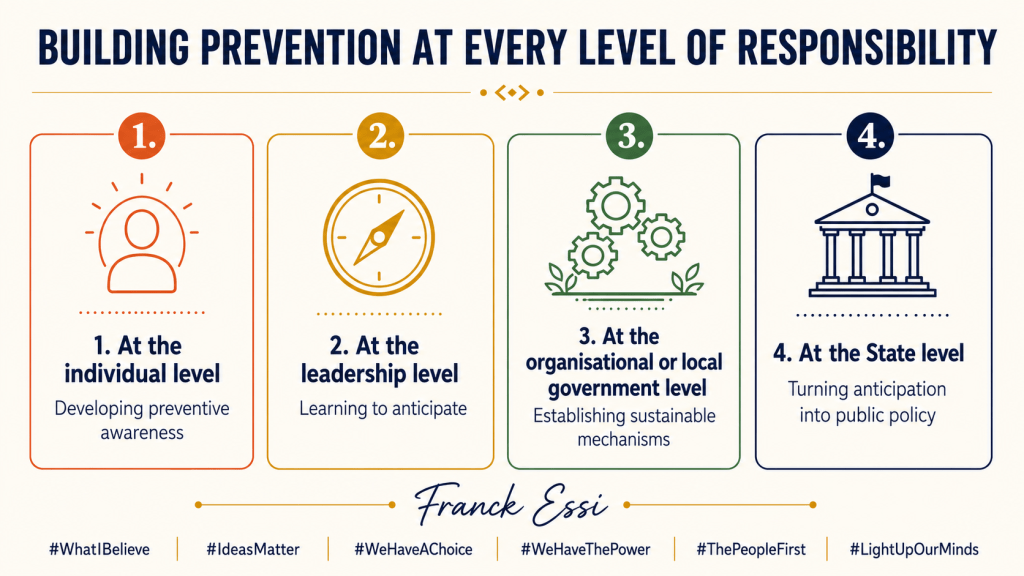
Building Prevention at Every Level of Responsibility
A culture of prevention will not be built through major national declarations alone. It must become part of how we think, decide, budget, act, oversee and evaluate.
It concerns individuals, leaders of organisations or local authorities, and heads of state. Their powers are not identical. Their responsibilities are not equivalent. But the principle remains the same: see earlier, decide earlier and act earlier.
At the Individual Level: Developing Preventive Awareness
Prevention also begins with how we manage our own lives.
It may involve taking care of our health before illness occurs, managing our resources before we fall into debt, maintaining our relationships before they break down, acquiring new knowledge before our skills become obsolete, or preparing for a transition before circumstances impose it on us.
This requires regularly asking ourselves a few questions:
- Which risks am I currently neglecting?
- What consequences might my present choices produce tomorrow?
- Which habits must I change before they become problems?
- What do I know but have not yet acted upon?
- What small action can I take now to avoid a greater difficulty later?
Individual prevention does not guarantee that everything will unfold as planned. It does, however, reduce our vulnerability and increase our ability to cope with the unexpected.
At the Leadership Level: Learning to Anticipate
A leader should not merely know how to respond quickly. A leader must develop a personal discipline of anticipation.
This means, among other things:
- regularly setting aside time for reflection instead of devoting all one’s energy to emergencies;
- asking which current decisions could create difficulties in six months, five years or ten years;
- seeking information that challenges one’s beliefs;
- listening to colleagues who are closest to realities on the ground;
- distinguishing isolated incidents from deeper trends;
- being willing to take action today whose results will become visible only later;
- preparing for succession and reducing the organisation’s dependence on one person.
A prevention-oriented leader does not merely ask, “What must we do now?” Such a leader also asks: “What are we allowing to develop through our silence, negligence or inaction?”
At the Organisational or Local Government Level: Establishing Sustainable Mechanisms
Prevention must not remain a personal quality of the leader. It must become a collective way of working.
An organisation, company or local authority can, among other things:
- establish and regularly update a map of its main risks;
- identify the early warning signs associated with every major risk;
- clearly designate those responsible for monitoring them;
- allocate an identifiable share of its budget to maintenance, training and prevention;
- create a mechanism through which employees, users and citizens can report anomalies;
- periodically organise simulation exercises;
- systematically draw lessons from incidents and crises;
- track recommendations until they have been effectively implemented.
Every major risk should be linked to four simple elements: an indicator, a person responsible, a preventive action and a deadline.
For a local authority, this could cover flood-prone areas, the condition of public buildings, sanitation, demographic change, community tensions, educational needs or food security.
An institution genuinely begins to practise prevention when risks are no longer known only to a few individuals but integrated into its procedures, budgets and decisions.
At the State Level: Turning Anticipation Into Public Policy
A head of state carries a broader responsibility. It is not enough to issue warnings or establish committees after every disaster. A national system capable of observing, forecasting, arbitrating and acting must be built.
This requires, among other things:
- incorporating demographic, climate, health, technological, economic and security risks into national planning;
- linking long-term projections to annual budgetary decisions;
- protecting maintenance and prevention budgets against the constant diversion of resources towards emergencies;
- strengthening statistical, scientific, health and meteorological institutions;
- investing in education, research and public information to raise knowledge and awareness of the issues;
- organising cooperation among central government, local authorities, businesses, researchers and communities;
- regularly publishing a national risk assessment;
- subjecting the country’s level of preparedness to parliamentary scrutiny and oversight by audit institutions;
- publicly reporting the action taken in response to warnings and recommendations;
- ensuring the continuity of essential policies beyond changes of government.
A leader must also accept a sometimes uncomfortable truth: the most important decisions made during a term of office are not necessarily those that will produce results before that term ends.
Governing is not merely about responding to the demands of the present. It is also about protecting those who are not yet old enough to vote, preparing the infrastructure that will serve people twenty years from now, and ensuring that future generations do not pay the price for today’s failures of courage.
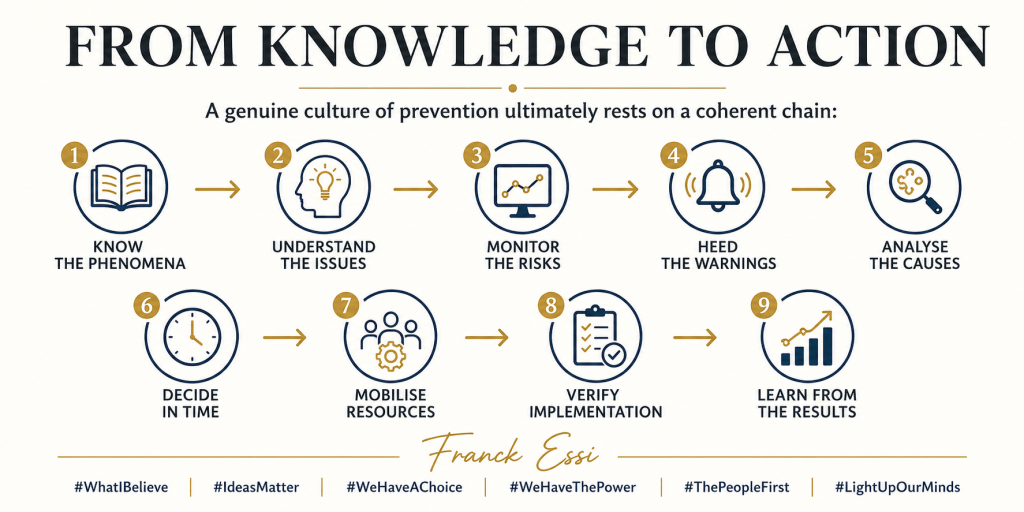
From Knowledge to Action
A genuine culture of prevention ultimately rests on a coherent chain:
know the phenomena → understand the issues → monitor the risks → heed the warnings → analyse the causes → decide in time → mobilise resources → verify implementation → learn from the results.
If any link in this chain is missing, prevention risks becoming an empty discourse.
Information without understanding is not enough. Understanding without decisions is not enough. Decisions without resources are not enough. Resources without implementation are not enough. Action without monitoring and learning is not enough either.
The question is therefore not merely whether we are aware of the risks. We already know about many of them.
The real question is whether we are prepared to change our habits, priorities, budgets, organisations and institutions before those risks become crises.
Preparing for the Future Before It Becomes an Emergency
We will not be able to prevent every crisis. Some will remain unpredictable. Others will occur despite the measures taken.
But between the illusion that everything can be controlled and the resignation that nothing can be prepared for, there is an immense space for knowledge, intelligence, responsibility and collective action.
We can reduce avoidable risks. We can limit damage. We can strengthen our response capacities. We can learn from our mistakes. Above all, we can stop waiting until foreseeable problems become disasters before giving them the attention they deserve.
Prevention is better than cure. But for this saying to become a genuine philosophy of action, we must learn to understand earlier, look further ahead, decide in time and act before the future becomes an emergency.
Franck Essi
#WhatIBelieve
#IdeasMatter
#WeHaveAChoice
#WeHaveThePower
#ThePeopleFirst
#LightUpOurMinds
References and Studies
1. World Health Organization, “Investing 1 dollar per person per year could save 7 million lives in low- and lower-middle-income countries,” 2021: Read the publication.
2. Heckman Equation, The Lifecycle Benefits of an Influential Early Childhood Program: See the findings on the 13% return on investment.
3. United Nations and World Bank, Pathways for Peace: Inclusive Approaches to Preventing Violent Conflict, 2018: Read the report.
4. United Nations Department of Economic and Social Affairs, World Population Prospects 2022 – Summary of Results: Read the report.
5. United Nations, “Unlocking the Potential of Africa’s Youth,” 2024: Read the analysis.
6. UNESCO, global data on out-of-school children and young people, updated in 2024: View the global data and the data on sub-Saharan Africa.
7. World Meteorological Organization, State of the Climate in Africa 2024, published in 2025: Read the report.
8. World Meteorological Organization, State of the Climate in Africa 2023, published in 2024: View the report overview.
9. World Bank, Groundswell – Acting on Internal Climate Migration, 2021: Read the report and the Africa-focused overview.
10. WHO Regional Office for Africa, Trends in Communicable and Noncommunicable Disease Burden and Control in Africa, 2024: Read the study.
11. World Health Organization, updated HIV data, 2024: View the dashboard.
12. International Labour Organization, Generative AI and Jobs: A Refined Global Index of Occupational Exposure, 2025: Read the study.
13. International Labour Organization, Navigating the Future: Skills and Jobs in the Green and Digital Transitions, 2024: Read the study.
14. United Nations High Commissioner for Refugees, West and Central Africa: Regional Trends—Forced Displacement in 2025: Read the report.
15. United Nations High Commissioner for Refugees, Global Trends 2025, published in 2026: View the data.

