A stand against a virus that poisons our lives and the progress of African societies
By Franck Essi
11 July 2026

For many years now, I have been deeply passionate about public affairs. That passion first led me to observe political life, to read, to listen and to try to understand what lies behind speeches, ceremonies, power struggles and official decisions. It later led me into civic activism and, eventually, into partisan political engagement.
Throughout this journey, I have met remarkable people: women and men sincerely committed to the public interest, courageous activists, conscientious civil servants, independent intellectuals and ordinary citizens capable of extraordinary sacrifices in defence of what they believe is right. But I have also discovered the almost limitless ability of some people to place their intelligence at the service of justifying the unjustifiable.
They no longer try to understand why an institution is not functioning; they explain why it is normal for it not to function. They no longer ask why a necessary decision is delayed; they explain that the delay is proof of wisdom. They no longer question the results produced by those in power; they construct theories designed to make the absence of results respectable. They no longer demand accountability from those who govern; they ask those who are governed to learn patience.
It is within this intellectual and political universe that an expression I have always considered both ridiculous and dangerous has flourished: “the President’s time.”
I know the title of this article is harsh. But I am not calling every person who uses this expression stupid. Intelligent people can defend stupid ideas. Educated people can use their knowledge to protect absurd systems. Brilliant people can devote their talent to making servitude appear more elegant.
That is, in fact, one of the great tragedies of public life: intelligence does not always protect people from submission; sometimes, it merely provides submission with a more sophisticated vocabulary.
That is the idea I want to examine here.
A phrase that reappears whenever power does not want to answer
Recently, I followed several debates on Cameroonian television channels. The question was simple: why had the government announced by the President of the Republic still not been formed? The panels included political activists, journalists, analysts and, of course, university professors.
Always the professors! One might think that, in our country, no political absurdity can become truly respectable until a professor has given it a scientific appearance.
The spectacle was both amusing and frustrating. Amusing, because some members of the ruling party appeared to be demanding a change of government more strongly than the intellectuals on the panels. At least they seemed to acknowledge that there was a problem. Perhaps they themselves hoped to join the next government, to be reassigned, repositioned or rewarded. That is possible. I cannot read people’s minds. But at least they recognised the strangeness of the situation.
Facing them, some professors defended the Head of State’s discretionary power and his famous “time” with remarkable enthusiasm. They explained that we had to wait, that the President knew, that he had information unavailable to the public, that he acted when he considered the moment appropriate and that no one should impose a timetable on him.
In other words, when the President acts, we must admire his decision. When he does not act, we must admire his caution. When he speaks, we must celebrate the depth of his message. When he remains silent, we must interpret his silence as strategy. When he succeeds, the credit belongs to him. When he fails, the blame lies with his collaborators. When no result appears, it is probably because we are not intelligent enough to understand his plan.
The Leader therefore wins every time. The people, meanwhile, continue to wait.
I do not know what each of these people personally hopes to gain. But I do know one thing: when a system concentrates appointments, promotions, honours, careers and access to resources in the hands of an almost unchecked centre of power, it mechanically creates an economy of complacency. In such a system, independent criticism becomes costly, while loyalty to power becomes profitable. Competence may help, but connections often help more. Hard work matters, but proximity sometimes matters more. Intelligence remains useful, but it becomes considerably more useful when it knows when to bow.
The problem, therefore, is not merely one of individuals. It lies in a system that makes sycophancy rational and free speech dangerous.
When “the next few days” become several months
The debate over “the President’s time” would almost be entertaining if it did not concern the life of an entire country.
Following the presidential election of 12 October 2025, Paul Biya was declared the winner by the Constitutional Council with 53.66% of the votes cast. These results were strongly contested by his main opponent, Issa Tchiroma Bakary, as well as by a significant section of public opinion. The post-election period was marked by demonstrations, violent repression, deaths and mass arrests. Human Rights Watch documented the use of lethal force and large-scale arrests, while two United Nations sources quoted by Reuters reported that 48 civilians had been killed. These figures must be treated with caution, but they establish at least one undeniable reality: the post-election crisis carried a serious human cost. [1][2][3]
On 31 December 2025, in his address to the nation, Paul Biya announced that he intended to form a government “in the coming days.” [4]
As I complete this article, on 10 July 2026, more than six months have passed and the new government has still not been formed. It would seem that the “coming days” of the presidential calendar do not resemble ordinary days. Perhaps they are longer. Perhaps they are elastic. Perhaps they belong to a special category located somewhere between administrative time, geological time and political eternity.
More seriously, the last major government reshuffle took place on 2 March 2018. An important change occurred on 4 January 2019 with the appointment of Joseph Dion Ngute as Prime Minister and several adjustments to the government. Yet a large part of the current executive architecture still dates back to that period.
Since then, ministers have died, portfolios have been managed on an acting basis, some officials have accumulated several responsibilities and strategic sectors have been run for years under supposedly temporary arrangements that eventually become permanent. In Cameroon, temporary arrangements sometimes display an astonishing ability to appoint themselves permanently.
The case of the ministry responsible for mining is particularly revealing. Following the death of Minister Gabriel Dodo Ndoke in January 2023, Fuh Calistus Gentry took over in an acting capacity. In June 2026, the ministry’s official website was still presenting him as Acting Minister. [5]
Yet it is precisely in this sector that several recent sets of data reveal staggering irregularities.

Gold disappears while institutions look the other way
In 2023, official Cameroonian statistics recorded approximately 22 kilograms of gold exports. At the same time, international trade data indicated that partner countries, mainly the United Arab Emirates, had recorded 15.2 tonnes of gold imported from Cameroon. The difference is close to a factor of seven hundred.
Between 2019 and 2023, partner countries reportedly recorded 30.9 tonnes of gold originating from Cameroon, while Cameroonian statistics listed only 175.8 kilograms as officially declared. The discrepancy therefore exceeds 30.7 tonnes. [6]
An investigation published by Data Cameroon in June 2026 goes further. By cross-referencing available data for the period from 2012 to 2023, excluding 2019 because of insufficient information, the journalists estimate that more than 57,000 kilograms of gold appeared in the declarations of partner countries without being properly traced in Cameroonian statistics.
We must be precise. This figure does not prove that 57 tonnes of gold were physically stolen from a public warehouse. It represents a considerable cumulative statistical gap between volumes declared in Cameroon and those recorded abroad. But that gap is already enough to raise fundamental questions about:
- the traceability of production;
- informal purchasing and export networks;
- porous borders;
- unauthorised trading posts;
- weaknesses in customs controls;
- the ability of SONAMINES to enforce its legal monopoly;
- lost tax revenues;
- administrative and political responsibility.
According to Data Cameroon’s estimates, the value of these cumulative discrepancies could reach approximately 4,486 billion CFA francs, equivalent to 51% of Cameroon’s 2026 State budget. Based on public cost estimates, that amount could theoretically represent nearly 179,000 modern, fully equipped classrooms, 90 regional hospitals comparable to the one in Bertoua, or electricity access for almost nine million households. [6]
These comparisons are journalistic estimates, not a definitive audit of the losses suffered by the Treasury. They nevertheless provide a striking indication of what opacity can cost a society.
Behind the tonnes of untraced gold are schools that are not built, hospitals that are not equipped, roads that are not maintained and communities that continue to live in deprivation amid their own natural wealth.
The problem is not limited to gold. Another Data Cameroon investigation, focusing on the management of quarries, describes a sector that officially generates around 400 million CFA francs annually for the Treasury and supplies major construction projects, but whose benefits remain largely opaque to local communities. In several areas, residents say they have no access to contractual obligations, do not know how much revenue is actually collected and do not know what is transferred to municipalities or communities. [7]
The investigation also notes that the 2023 EITI report could not include certain information on quarry revenues and transfers to local councils because the data were unavailable. It reports poor tax traceability, sometimes informal collection practices, weak monitoring of social obligations and communities that bear the dust, heavy trucks, road damage and environmental effects without clearly seeing the promised benefits.
The State therefore asks people to believe in revenues it does not publish, compensation they cannot see and controls whose findings cannot be found. That requires a particularly robust form of faith.
This situation is even more concerning because, in March 2024, Cameroon received an overall score described as “fairly low” in the implementation of the Extractive Industries Transparency Initiative. The country was suspended until its next validation, notably because of shortcomings relating to civil society participation and restrictions affecting freedom of expression and association in debates over extractive governance. [8]
In a normally governed State, the discrepancies observed in the mining sector should trigger:
- independent investigations;
- public parliamentary hearings;
- precise explanations from the government;
- a complete verification of volumes produced, transported and exported;
- controls over licences, purchasing offices and beneficial owners;
- publication of revenues, taxes and transfers to local authorities;
- sanctions wherever responsibility is established;
- rapid reforms of traceability mechanisms.
But when everything depends on “the President’s time,” even a national emergency must wait to be recognised by the centre of power. Trafficking does not wait. Predatory networks do not wait. Lost revenues do not wait. Environmental degradation does not wait. Communities breathing dust do not wait.
It is the institutions and the people who wait.
But what exactly is “the President’s time”?
We must first clear up an ambiguity. “The President’s time” is not a legal concept. It does not appear in the Constitution of Cameroon, does not constitute a recognised principle of public administration and is not a serious theory of development.
It is essentially a formula of political legitimisation, vague enough to make prolonged silences, delayed decisions, vacant positions, promises without deadlines, endless acting appointments, lack of explanation, lack of results and lack of accountability appear acceptable.
Its defenders generally seem to rely on four ideas:
- the President possesses information the people do not have;
- his silence proves the depth of his reflection;
- his apparent slowness is a superior form of wisdom;
- citizens should wait without a clear deadline, explanation or genuine possibility of oversight.
There is, of course, some truth in the first idea. A Head of State has access to confidential information, administrative analyses, diplomatic intelligence and data unavailable to the ordinary citizen. Some decisions also require caution. Some negotiations must remain confidential. Some crises require time. Some decisions made too quickly can be disastrous.
But this obvious truth does not justify everything.
The problem is not that a President needs time to decide. The problem begins when his time becomes a zone of irresponsibility in which there is no longer any deadline, explanation, oversight or sanction.
We must therefore distinguish clearly between:
- caution and procrastination;
- reflection and paralysis;
- discretion and opacity;
- stability and immobility;
- authority and arbitrariness;
- necessary time and unjustifiable delay.
A decision may take a long time to prepare. It cannot remain indefinitely exempt from the obligation to be explained.
Is the President really the “master of the clocks”?
The expression “the President’s time” is probably inspired, at least in part, by the French presidential tradition. In France, the President is often described as the “master of the clocks.” The expression suggests that the President chooses the political moment, defines the major sequences, determines the pace of reforms and organises the timetable of government action.
But we must avoid lazy copying.
Even in France, the President is not legally the owner of national time. Article 5 of the French Constitution entrusts the President with ensuring, through arbitration, the proper functioning of public authorities and the continuity of the State. It does not give the President the right to prevent institutions from functioning, authorise indefinite vacancies, turn silence into a constitutional principle or make his personal rhythm the sole measure of the public interest. [9]
We should also examine how the democracies we sometimes claim to imitate actually function. When a government resigns, rules and institutional practices govern its replacement. When a minister leaves office, the replacement does not depend indefinitely on mysterious presidential inspiration. When a decision is delayed, the media ask questions, Parliament summons officials, courts may exercise oversight, citizens protest, the opposition criticises and elections provide sanctions.
Nothing is perfect. Western democracies have their hypocrisies, delays, injustices, oligarchies, manipulations and crises. But they generally preserve one essential idea: power must be questioned about what it does, what it fails to do and how long it takes to act.
In our countries, we have often imported the elements most advantageous to those who govern:
- presidential power;
- the prestige of office;
- appointment powers;
- the centralisation of the State;
- the privileges attached to the top;
- the strength of security institutions.
But we have weakened what was supposed to balance them:
- checks and balances;
- parliamentary oversight;
- judicial independence;
- press freedom;
- transparency;
- ministerial responsibility;
- institutional deadlines;
- electoral sanction.
We imported the crown and forgot the brakes.
Discretionary power is not arbitrary power
There is another confusion that must be clarified. Every government has a certain degree of discretion. Governing does not consist of mechanically applying formulas written in advance. Situations are complex, information may be incomplete and several options may be legally possible. The executive must therefore be able to arbitrate, choose, negotiate, adapt and sometimes decide quickly.
That is, in part, what discretionary power means.
But discretionary power is not arbitrary power. The difference is fundamental. Discretionary power allows an authority to choose between several options authorised by law and compatible with the public interest. Arbitrary power allows a leader to do whatever he wants, whenever he wants, without having to explain his choices or answer for their consequences.
In a serious State, even when an authority has room for judgement, it must act:
- in accordance with the Constitution and the law;
- in pursuit of the public interest;
- within reasonable timeframes;
- without abuse of power;
- under the supervision of the relevant institutions;
- with an obligation to explain and deliver results.
Discretionary power is a responsibility. Arbitrary power is an unchecked privilege.
This distinction is all the more important because the Cameroonian Constitution states something very clearly. Article 2 declares that national sovereignty belongs to the Cameroonian people. It specifies that no section of the people and no individual may claim its exercise. It also states that the authorities responsible for governing the State derive their powers from the people. [10]
This means that the President does not own Cameroon, the State, its institutions, its public resources or the nation’s time.
He temporarily receives from the people a responsibility that must be exercised in the people’s interest.
How could the country’s time belong to one individual when sovereignty itself belongs to the people?

The time wasted by the State is paid for by citizens
Time is never a neutral resource in public life. When an individual wastes his own time, the consequences may remain personal. When a State wastes time, the consequences spread across society.
A delayed decision may mean:
- medicines that are not delivered;
- teachers who are not assigned;
- infrastructure that continues to deteriorate;
- public contracts that remain blocked;
- businesses that lose money;
- investors who abandon projects;
- public funds that disappear;
- incompetent officials who remain in office;
- victims who continue to wait for justice;
- populations that continue to endure a crisis;
- essential reforms repeatedly postponed.
In an excessively centralised system, a single delayed decision at the top can immobilise an entire chain of decisions. The minister waits, the director waits, the governor waits, the senior divisional officer waits, the mayor waits, the administration waits, the business waits and the citizen waits. While everyone waits, those who benefit from disorder continue moving forward.
The time wasted by those who govern is never empty. It is filled with costs borne by those who are governed.
This question is directly linked to development. François Perroux offered what has become a classic definition of development: “the combination of mental and social changes in a population that enable it to increase its real total product cumulatively and sustainably.” [11]
This definition reminds us that development is not merely an increase in gross domestic product. It requires a transformation of collective capacities, institutions that learn, administrations that cooperate, leaders who anticipate, citizens who participate, organisations that assess their results and systems capable of correcting their mistakes.
Development therefore requires:
- clear objectives;
- defined responsibilities;
- reasonable deadlines;
- adequate resources;
- indicators;
- evaluations;
- corrective mechanisms;
- a genuine obligation to deliver results.
It is difficult to reconcile development with a system in which every important decision rises to a centre of power that is itself subject to no precise timetable.
Development requires institutions capable of functioning when the President sleeps, travels, remains silent, hesitates, falls ill, leaves office or dies.
That is precisely what institutions are for: they allow a society not to depend entirely on the health, mood, availability or preferences of one individual.
Is this model truly African?
The concentration of presidential power is sometimes justified in the name of African culture. We are told that Africa has always respected chiefs, that our societies need authority and that democracy, checks and balances and limitations on power are Western inventions poorly adapted to our realities.
We must be cautious with such generalisations. Africa has never been a single society. Our precolonial societies were diverse. Some were highly centralised. Others were organised around councils, assemblies, lineage authorities, limited chieftaincies, initiation societies, mediation mechanisms or complex forms of power-sharing.
We should not idealise those societies. They experienced their own injustices, exclusions, violence, hierarchies and contradictions. But it is equally false to present African history as one long tradition of obedience to all-powerful chiefs.
In many societies, the chief was not merely expected to command. He was expected to consult, listen, arbitrate, protect, redistribute, respect certain balances, preserve the community and answer, in one form or another, for his actions. The Ghanaian philosopher Kwasi Wiredu notably highlighted the importance of consensus-building in certain African political traditions, while also generating legitimate debate about the possibilities and limitations of such models. [12]
The traditional public deliberation process itself was not, in principle, a celebration of delay. Its purpose was to allow speech to circulate, positions to move closer together, conflicts to be mediated and the social bond to be preserved. A chief who refused to listen could lose legitimacy. A chief who no longer protected the community betrayed his function. A chief who redistributed nothing and served only his own interests gradually ceased to be a chief and became a predator.
We should therefore be suspicious of this alleged “African tradition” that is always invoked to justify obedience but rarely to recall the obligations of the chief.
A tradition that retains only the privileges of authority and forgets its duties is no longer a tradition. It is manipulation.
Contemporary African hyper-presidentialism probably owes far less to some mysterious African cultural essence than to several historical inheritances: colonial centralisation, command administration, the permanent state of exception, one-party rule, presidencies without effective term limits, postcolonial personalisation of power and the deliberate weakening of oversight institutions.
What some people describe as African tradition is often a mixture of colonial authoritarianism and postcolonial predation.
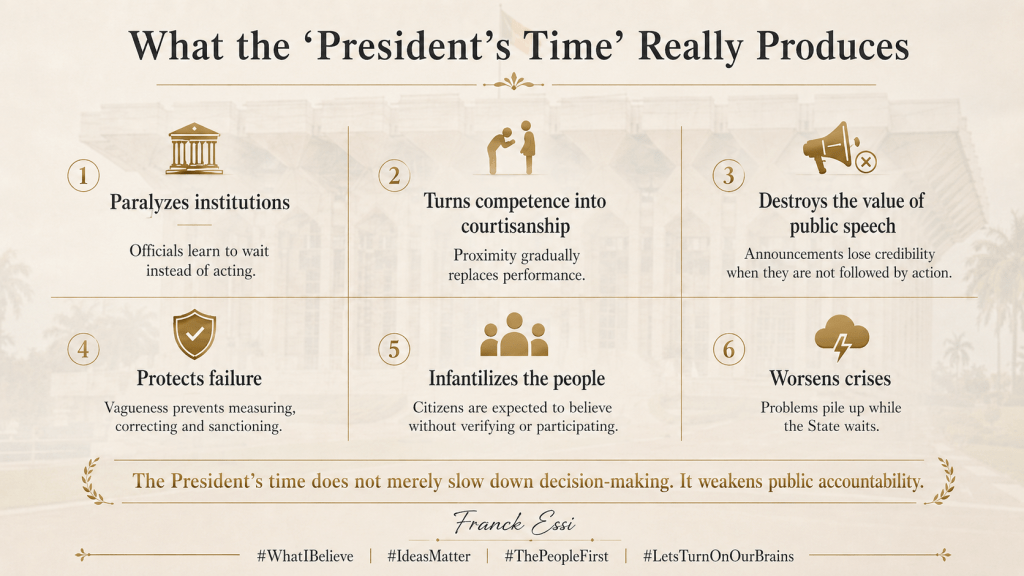
What “the President’s time” actually produces
An idea must always be judged by its consequences. What does this conception of power produce in practice?
It paralyses institutions
When all important decisions depend on the centre of power, officials below it learn to wait. They avoid taking initiatives and sometimes fear making a political mistake more than producing a technical failure. Inaction becomes a form of personal protection: problems are not solved, they are transferred upward, and the upper level then transfers them into silence.
In an excessively centralised system, doing nothing may become safer than doing the right thing.
It replaces competence with sycophancy
When appointments depend mainly on presidential favour, public officials invest less in results than in gaining access to power networks. They work on their positioning, cultivate relationships, learn the right words, praise the right people, denounce the right opponents and sometimes develop a genuine skill: surviving politically without producing results.
Proximity then replaces performance, and personal loyalty gradually takes the place of service to the State.
It destroys the value of public speech
When a President announces a decision “in the coming days” and several months pass without explanation, it is not merely one promise that is weakened. It is the word of the State itself that loses value. A State also functions through trust. Citizens, businesses, administrations and partners must be able to believe that an official announcement genuinely commits the person making it.
A State that does not respect its own words gradually teaches citizens not to believe it.
It protects failure
Without precise objectives, no failure can be clearly measured. Without deadlines, no delay officially exists. Without indicators, no poor performance can be identified. Without hearings, no explanation is compulsory. Without sanctions, no responsibility exists.
Vagueness then becomes a technology for preserving power.
It infantilises the people
Citizens are asked to believe without verifying, wait without knowing the deadline, obey without understanding and accept without participating. The people are no longer treated as the holders of sovereignty, but as children to whom serious adults need not explain everything.
The people are not political minors condemned to remain forever under the guardianship of those who govern them.
It worsens crises
Crises do not wait for the moment chosen by those in power. Poverty advances, unemployment takes root, infrastructure deteriorates, conflicts deepen, criminal networks adapt and frustrations accumulate. When the crisis finally erupts, those who refused to act often explain that it was unpredictable.
An ignored crisis does not disappear. It quietly works to become more difficult to resolve.
We must move from the President’s time to the people’s time
This destructive conception must be confronted with another idea: the people’s time.
We must immediately clarify what this means. The people’s time is not the dictatorship of impatience. It does not mean that a government should react to every rumour, surrender to every pressure or decide under the influence of every collective emotion. The people themselves can be wrong, manipulated, divided, demand contradictory things or favour immediate satisfaction at the expense of their long-term interests.
Speaking of “the people’s time” does not therefore mean abolishing reflection, expertise, caution or planning. It means that the pace of public action must be judged according to the needs, rights, suffering and aspirations of the population.
A patient waiting for treatment does not live in the same time as a senior official sitting comfortably in office. A pregnant woman travelling kilometres to find a maternity ward does not live in the same time as an administration that has been promising a health centre for ten years. An unemployed young person does not live in the same time as a minister whose salary, benefits and official vehicle are guaranteed. A business suffocated by administrative delays does not live in the same time as the department that misplaced its file. A family displaced by war does not live in the same time as those who have been repeating for years that the situation is under control.
The people’s time begins when institutions understand that waiting has a human cost.
Putting the people first as a principle of governance
In a previous article, I defended the idea of “People First!” Not as a sentimental slogan, a campaign formula or a way of flattering every expression of anger by pretending that the people are always right, but as a framework for judging political decisions according to their concrete effects on the social majority. [13]
The people I am referring to are not a mystical entity. I mean primarily those who live from their work, have little influence over decision-making centres and possess few means of protecting themselves from policies imposed upon them.
To say “People First!” means asking:
- Who truly benefits from this decision?
- Who bears its cost?
- What does it change in everyday life?
- Does it improve access to health, education, water, energy, justice and security?
- Does it protect the most vulnerable?
- Were citizens consulted?
- Can those responsible be questioned?
- Are results measured?
- Can failures be corrected and sanctioned?
People First is not an emotion. It is an institutional discipline.
The people’s time is the temporal expression of that discipline. It requires the State to judge the speed or slowness of its action not according to the comfort of its leaders, but according to the consequences borne by the population.
A decision may require six months when its complexity demands it. But those six months must be explained. Stages must be defined. Responsibilities must be known. Citizens must be able to understand what is being done. Delays must be identifiable. Mistakes must be corrected.
What is unacceptable is not merely a long process. It is time without responsibility.

What inclusive institutions teach us
In Why Nations Fail, Daron Acemoglu and James A. Robinson offer an important distinction between inclusive and extractive institutions. Inclusive institutions allow relatively broad political participation, protect rights, encourage initiative and limit excessive concentrations of power. Extractive institutions concentrate resources and decisions in the hands of a minority that organises the rules for its own benefit. [14]
This theory does not explain the entire history of nations. Geography matters, international relations matter, colonialism matters, natural resources matter, political cultures matter and economic choices matter.
But the central idea remains powerful: societies struggle to progress when institutions exist mainly to protect those who govern rather than create opportunities for those who are governed.
“The President’s time” belongs to the logic of extractive institutions because it concentrates at the top:
- information;
- decision-making;
- appointments;
- the political timetable;
- the power to act;
- the right to explain;
- the right to remain silent;
- the capacity to sanction others without being sanctioned.
The people’s time, by contrast, requires a distribution of responsibilities, institutions capable of acting, professional administrations, local authorities with genuine powers, ministers accountable for their results, a Parliament that exercises oversight, a judiciary that protects rights, a press that investigates and citizens who participate.
An inclusive State does not ask the people to wait indefinitely for a signal from above. It organises society’s collective capacity to act.
Other practices are possible in Africa
Hyper-presidentialism is sometimes presented to us as an African inevitability. It is not.
No African country is perfect. All democracies on the continent experience shortcomings, tensions, inequalities, violence, manipulation or fragility. But several experiences show that power can change hands without the State collapsing.
In Botswana, the 2024 elections brought an end to nearly six decades of rule by the same party. The outgoing President, Mokgweetsi Masisi, accepted defeat and promised to support the incoming administration. The electoral process had weaknesses identified by observers, but the peaceful transfer of power demonstrated that a State can survive the defeat of a long-dominant party. [15]
In Ghana, the December 2024 election also produced another peaceful transfer of power. The ruling party’s candidate, Mahamudu Bawumia, conceded defeat even before the final declaration of results, helping to ensure a peaceful transition. Once again, the process was not perfect and incidents were reported. But the political system demonstrated that leaders can lose an election without concluding that the country has been stolen from them. [16]
These examples do not mean that Botswana and Ghana have solved all their problems. They demonstrate something simpler: the stability of a country is not measured by how long one man remains in power. It is measured by the ability of institutions to function before him, with him and after him.
Democracy does not guarantee that the best people will always govern. It guarantees neither competence, honesty nor social justice. But it possesses at least one essential virtue: it affirms that power must be open to questioning, limitation, correction and replacement.
Democracy does not proclaim that the people are infallible. It proclaims that no leader should be regarded as infallible.
Those who reject democracy should never forget this fundamental virtue. Even when imperfect, democracy asserts the principle of the people’s primacy and organises, at least in theory, the accountability of those who govern before those in whose name they exercise power.
The people’s time requires the refoundation of the State
It is not enough, however, to replace one expression with another. It is not enough to denounce “the President’s time” and proclaim “the people’s time.” A new way of governing cannot depend solely on the goodwill of a future President.
We have already spent too much time waiting for the providential man: the one who will understand everything, decide quickly, punish the corrupt, choose the best people, genuinely love the population and repair several decades of dysfunction by himself. That man probably does not exist. And even if he did, he would eventually die, leave office or be replaced.
A serious society does not build its future on the permanent hope of finding a good master. It builds institutions that prevent even a bad leader from destroying everything.
That is why moving from the President’s time to the people’s time requires a genuine refoundation of the State and governance in Cameroon. This is not simply about a cabinet reshuffle, replacing tired faces with younger ones or appointing new people into the same institutions, under the same rules, with the same incentives and practices.
Nor is it about another opportunistic constitutional amendment designed to address the regime’s internal problems or organise succession at the top.
Refounding the State means rebuilding the relationship between power, institutions and the people.
It means reaching, through a democratic, inclusive and sufficiently consensual process, a new political compact:
- a compact that makes popular sovereignty effective;
- a compact that limits power without making the State powerless;
- a compact that organises responsibility;
- a compact that protects rights;
- a compact that recognises our unity in diversity;
- a compact that allows institutions to function when the President remains silent, travels, hesitates, falls ill, leaves office or dies.
This refoundation should make it possible to build:
- an executive capable of acting, but genuinely accountable;
- a government subject to objectives, deadlines and evaluations;
- a Parliament capable of investigating, questioning and exercising oversight;
- a judiciary sufficiently independent to protect the law against the powerful;
- a professional administration based on competence and merit;
- local authorities with real powers and resources;
- transparent management of public finances and natural resources;
- genuinely credible electoral institutions;
- free media and a protected civil society;
- regular mechanisms for citizen participation;
- clear procedures for accountability;
- a culture of evaluation, learning and correction.
We must also refound our understanding of power. An appointment must no longer be viewed as a reward. A ministry is not private property. A public company is not a fund for distributing benefits to friends. An administration is not a place for political resettlement. Public office is not an honorary title.
To govern must mean serving, anticipating, planning, deciding, explaining, listening, protecting, producing results, acknowledging mistakes and being accountable.
Cameroon must no longer be administered like a royal court in which everyone waits for a favour. It must be governed like a Republic in which everyone carries out a mission.
My deepest conviction
My deepest conviction is that “the President’s time” is not merely an unfortunate expression. It is the summary of a particular conception of the State.
A conception in which the centre decides and the rest of the country waits. A conception in which institutions do not function by themselves, but only through impulses from above. A conception in which officials serve a person more than they serve a mission. A conception in which stability eventually comes to mean immobility, silence is presented as wisdom, slowness as depth and the absence of results as a strategy that the people are supposedly too impatient to understand.
I do not believe that all of Cameroon’s problems will disappear with the appointment of a new government. Nor do I believe that a simple change of President will be enough to transform our country. Individuals matter. Their vision, competence, integrity, capacity for work and courage matter. But a country that depends entirely on the quality of one man remains a fragile country.
The real challenge, therefore, is not merely to change the person looking at the clock. It is to change the system that allows one man to own all the clocks.
Changing individuals without changing institutions may simply give old practices a new face. Replacing one master with another does not make the people sovereign. Appointing new ministers within a system that gives them neither real autonomy, public objectives nor an obligation to deliver results does not transform governance. Holding another election within an electoral system that does not inspire confidence does not resolve the crisis of legitimacy. Creating new institutions without changing practices merely produces new buildings, new budgets, new vehicles and new titles.
The refoundation Cameroon needs must go much further. It must transform:
- the rules, but also the mindsets;
- the institutions, but also the behaviour;
- the law, but also the practices;
- the way we govern, but also the way citizens understand power.
We must abandon the idea that a great leader is one who concentrates every decision. A great leader is also one who builds institutions capable of functioning without him.
We must abandon the idea that discipline means remaining silent before the leader. Republican discipline means respecting the rules, the mission of institutions and the public interest.
We must abandon the idea that demanding accountability is a form of disrespect. To demand accountability from a public official is to recognise that the responsibility he exercises does not belong to him personally.
Finally, we must abandon the idea that the people should wait forever because the President supposedly has his own time.
The people also have a time.
It is the time:
- of the child who needs a school today;
- of the patient who needs treatment now;
- of the woman who must give birth in dignity;
- of the young person seeking training, employment and a reason not to leave;
- of the farmer who needs a road to take produce to market;
- of the entrepreneur waiting for an administrative decision;
- of the victim demanding justice;
- of communities demanding peace;
- of citizens who want to know what the State is doing with their money, their resources and their future.
I am not asking the State to govern in haste. I am asking it to stop turning slowness into a virtue.
I am not asking for weak government. I am asking for power strong enough to act and sufficiently constrained not to become arbitrary.
I am not asking for the street to govern in place of institutions. I am asking institutions to govern in the name of the people, under their oversight and in their interest.
I am not asking for the disappearance of the presidential office. I am asking it to recover its true meaning: serving the Republic rather than becoming indistinguishable from it.
The true clock of a Republic is not located in the President’s office. It beats in the everyday life of the people. It beats in schools, hospitals, courts, markets, businesses, villages, working-class neighbourhoods and families. It beats in frustrations, suffering, hopes and lives that pass while the State waits.
That is the clock our institutions must finally learn to hear.
The President does not own the nation’s time. The government does not own the State. Those who govern do not own Cameroon. They are temporarily entrusted with responsibility for it.
That responsibility must now be exercised within a profoundly refounded State, subject to popular sovereignty, focused on meeting collective needs and judged by its results.
People First. Their time. Their rights. Their needs. Their dignity. And, finally, a State truly at their service.
Franck Essi
#WhatIBelieve
#IdeasMatter
#LetsTurnOnOurBrains
References and sources
- Reuters, “Cameroon’s Biya declared vote winner, opposition reports gunfire,” 27 October 2025.
Read the article - Human Rights Watch, “Cameroon: Killings, Mass Arrests Follow Disputed Elections,” 12 November 2025.
Read the article - Reuters, “Cameroon security forces killed 48 in election protests, UN sources say,” 4 November 2025.
Read the article - Presidency of the Republic of Cameroon, Address to the Nation, 31 December 2025.
Read the address - Ministry of Mines, Industry and Technological Development, official activities of Fuh Calistus Gentry, Acting Minister, June 2026.
Visit the ministry’s website - Data Cameroon, “Trafficking: More than 57,000 kg of gold fraudulently disappeared from Cameroon in 11 years,” 16 June 2026.
Read the investigation - Data Cameroon, “Governance: Opacity in quarry management benefits public officials,” 1 July 2026.
Read the investigation - Extractive Industries Transparency Initiative, “Cameroon achieves fairly low score in EITI implementation,” 1 March 2024.
Read the decision - French Republic, Constitution of 4 October 1958, Article 5.
Read the Constitution - National Assembly of Cameroon, Constitution of the Republic of Cameroon, Article 2.
Read the Constitution - François Perroux, “Obstacles to Growth and Development,” Revue Tiers Monde, 1966.
Read the text - Kwasi Wiredu, “Democracy and Consensus in African Traditional Politics,” 1995.
Read a presentation of the text - Franck Essi, “People First! Towards Political Analysis That Finally Serves the Majority,” 15 April 2026.
Read the article - Daron Acemoglu and James A. Robinson, Why Nations Fail: The Origins of Power, Prosperity, and Poverty, Crown Publishers, 2012.
Read a presentation of the book - Commonwealth Observer Group, Botswana General Elections, 2024.
Read the analysis - Commonwealth Observer Group, Ghana General Election, 2024.
Read the report

