Many people want change.
Yet very few truly understand how deep transformations happen in history.
We often tend to believe that a society changes because the ideas being defended are right, because injustice is visible, because people are suffering, or simply because “the people have spoken.”
Unfortunately, human history rarely works that way.
Systems do not disappear simply because they are unjust. They retreat when organized forces make preserving them more difficult, more costly, or more dangerous than transforming them.
In other words:
Good ideas that are not backed by real power often end up as intelligent complaints.
WHAT IS A BALANCE OF POWER?
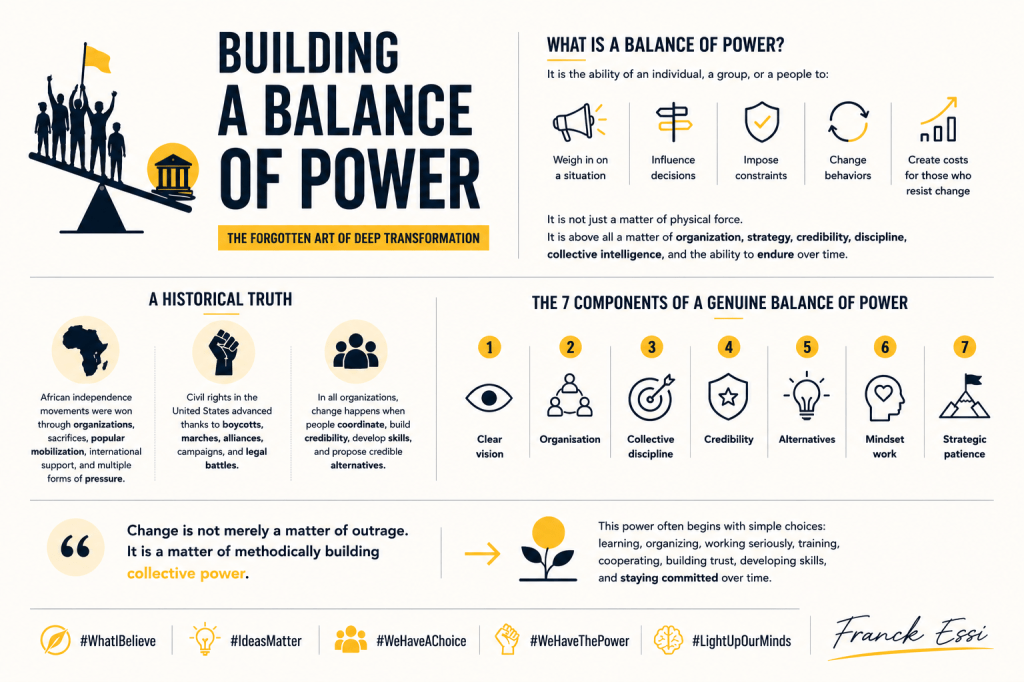
A balance of power is the ability of an individual, a group, an organization, or an entire people to exert real influence over a situation.
It is the ability to shape a decision, impose a constraint, change a behavior, or create a political, economic, social, or symbolic cost for those who resist change.
Contrary to a widely held belief, a balance of power is not limited to violence or physical confrontation.
In democratic, civic, and social struggles, it can be built ethically, responsibly, through organization and without violence.
Above all, it is a matter of organization, mobilization, credibility, strategy, discipline, collective intelligence, and the ability to endure.
We can be peaceful and still build power.
We can be nonviolent and still exert real pressure.
We can reject brutality without giving up firmness.
AN ESSENTIAL HISTORICAL TRUTH
No major social advance has ever been achieved through speeches alone.
This does not mean that ideas, speeches, or convictions are useless. They are essential. They provide direction, build awareness, sustain hope, and give us the words to name injustice.
But ideas alone are not enough.
The struggles for African independence, for example, were not limited to petitions or stirring patriotic appeals. They required strong organizations, networks, sacrifices, popular mobilization, international support, and different forms of political and economic pressure.
Likewise, civil rights in the United States did not advance because racism suddenly became morally unacceptable to everyone.
They advanced because women and men organized. They built boycotts, marches, media campaigns, alliances, legal battles, and the capacity to disrupt the normal functioning of an unjust system.
In several African countries, civic, trade-union, student, religious, and community mobilizations have also opened cracks in systems that appeared completely locked.
They did not always achieve everything.
They did not always win immediately.
But they confirmed an essential truth: when a society organizes, rises to its feet, builds alliances, and accepts the need to endure, it can change the calculations of those in power.
Even in a company, an association, or a trade union, major changes rarely happen simply because one person is right.
They happen when people coordinate, build credibility, develop their skills, create alternatives, and make it impossible for their proposals to be ignored.
THE TRAP OF OUTRAGE WITHOUT STRATEGY
In many African contexts, and particularly in Cameroon, we sometimes make a dangerous mistake.
We confuse the expression of anger with the construction of power.
But posting is not organizing.
Denouncing is not building structure.
Going viral is not the same as being influential.
And being right does not yet mean having the power to transform reality.
A Facebook Live is not a structured movement.
A slogan is not a strategy.
A wave of collective emotion, however powerful, is not necessarily a lasting balance of power.
This is one of the reasons so many mobilizations quickly run out of steam.
They often lack organization, clear objectives, a step-by-step strategy, discipline, strong social roots, and the psychological preparation needed for a long struggle.
This does not mean that outrage is useless.
It can be the first sign of a moral awakening. It reminds us that a society is not dead, that consciences still reject injustice, and that citizens have not completely resigned themselves.
But when outrage becomes neither organization, nor strategy, nor collective action, nor perseverance, it often ends up going in circles.
Anger can awaken people. Only organization enables them to endure.
THE COMPONENTS OF A GENUINE BALANCE OF POWER
1- A CLEAR VISION
People rarely mobilize around vagueness.
A serious balance of power requires a clear reading of the problems, an understanding of the system, goals people can grasp, and a recognizable direction.
When everyone calls for “change,” but no one knows precisely what must change, why it is necessary, how it should be achieved, or what the priorities are, the mobilization becomes fragile.
So let us not shout “change” without asking: change what, to achieve what, with whom, by what means, and for whose benefit?
A clear vision does not guarantee victory. But the absence of vision almost always prepares the ground for confusion.
2- ORGANIZATION
Emotion can bring people together. Only organization enables them to endure.
To organize is to assign roles, train members, coordinate actions, manage resources, establish decision-making mechanisms, and preserve continuity despite difficulties.
Even movements born spontaneously must eventually organize if they want to survive and produce results.
Without organization, mobilization depends on the mood of the moment.
With organization, it can learn, correct its mistakes, protect its gains, and prepare the next steps.
3- COLLECTIVE DISCIPLINE
Powerful systems often count on the fatigue, divisions, egos, internal conflicts, frustrations, and impatience of their opponents.
They know that a movement without discipline quickly becomes easy to manipulate, infiltrate, or destroy.
Discipline does not mean blindness.
Nor does it mean silencing every criticism or following leaders without thinking.
It means coherence, consistency, respect for shared objectives, and the ability to act intelligently, including under pressure.
We can debate without destroying one another.
We can disagree without losing sight of what matters most.
We can correct mistakes without sabotaging collective action.
4- CREDIBILITY
Over time, people are unlikely to follow those who constantly improvise, contradict themselves, fail to work seriously, or already reproduce the very behavior they denounce.
We must, however, remain lucid: when anger, fear, poverty, or despair dominate, people may also follow inconsistent actors.
This is precisely why serious agents of change must build a deeper, stronger, and more demanding form of credibility.
Building a balance of power therefore also means developing competence, ethics, rigor, and genuine moral and organizational credibility.
The ideas and the record of leaders matter!
We should not listen only to what people promise. We must also look at what they have done, how they treat their colleagues, and how they relate to money, power, truth, and disagreement.
5- THE ABILITY TO BUILD ALTERNATIVES
Criticizing a system is not enough.
Societies change more easily when credible ideas, serious proposals, alternative models, new practices, and concrete examples emerge.
A balance of power becomes stronger when it combines resistance with the ability to propose.
An opposition that knows only how to denounce will eventually exhaust itself.
An opposition capable of proposing can become a genuine alternative.
This applies to political parties, but also to trade unions, associations, civic organizations, and social movements.
It is not enough to say what is wrong. As far as possible, we must also show what can be done differently.
6- WORKING ON MINDSETS
Many systems survive because they live inside people’s minds.
A people can suffer under a system while fearing it, normalizing it, reproducing it, or becoming convinced that no alternative is possible.
This is why every lasting transformation also requires cultural, educational, psychological, and political work.
Changing a society is not only about changing its leaders or its laws.
It also means transforming its collective imagination, habits, beliefs, relationship with fear, sense of dignity, and understanding of what is possible.
A people that no longer believes in its own capacity to act becomes easier to govern against its own interests.
Consciousness-raising is therefore not secondary. It is an integral part of the balance of power.
7- STRATEGIC PATIENCE
Deep transformations are rarely immediate.
Old systems have resources, networks, entrenched institutional habits, media allies, and survival mechanisms that allow them to resist for a long time.
Building a balance of power therefore requires endurance, learning, constant adaptation, and a great deal of perseverance.
Many people give up because they underestimate the resilience of systems, the time needed to transform them, and the psychological cost of long struggles.
Strategic patience is not passivity.
It means knowing how to wait without falling asleep, move forward without rushing, learn without becoming discouraged, and prepare the next steps without losing sight of the goal.
WHAT WE MUST UNDERSTAND COLLECTIVELY
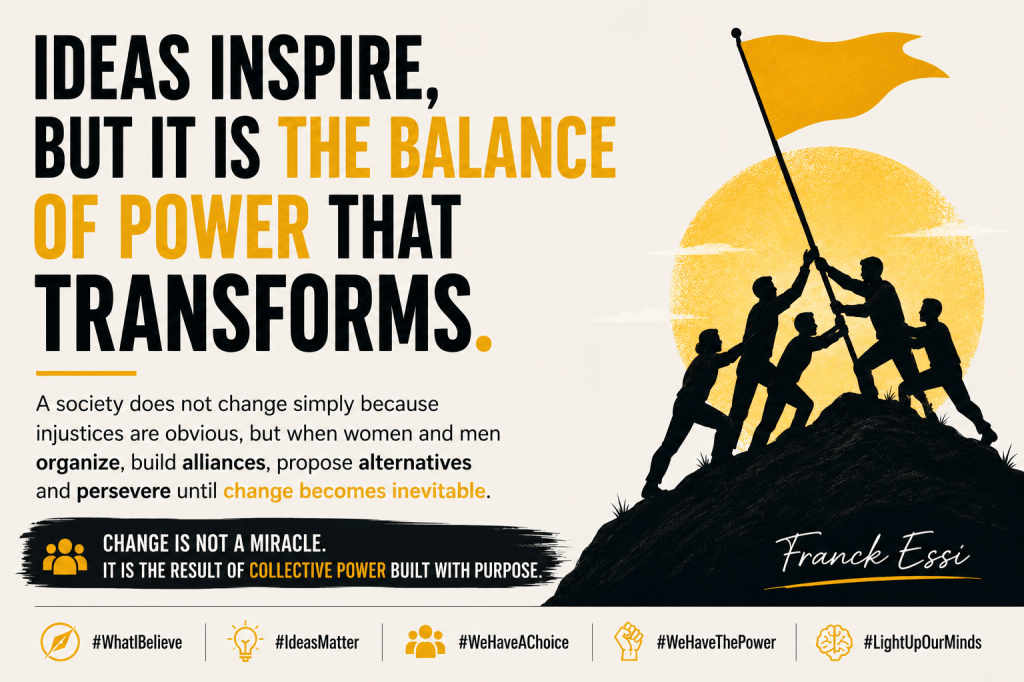
A society does not change simply because people are suffering.
If suffering alone were enough to produce change, many of our countries would already have been profoundly transformed.
A society changes when consciences awaken, organizations emerge, solidarities are built, skills are developed, alternatives become credible, and a sufficiently mature balance of power eventually forces open the path to change.
Change is therefore not merely a matter of outrage.
It is a matter of methodically building collective power.
And that power often begins with simple things: learning, organizing, working seriously, training others, cooperating, building trust, developing skills, and enduring over time.
For citizens, activists, trade unions, political parties, associations, social organizations, and all agents of change, the challenge is clear.
It is not enough to want things to change.
We must learn how to build the conditions that make change possible.
It cannot be repeated often enough: when people rise, things can change.
But if a people standing upright is not to remain merely a passing crowd, it must become a conscious, organized, credible, disciplined, and enduring force.
Because, in the end, great historical transformations are rarely miracles.
More often than not, they are the result of patiently constructed balances of power.
Franck Essi
#WhatIBelieve
#IdeasMatter
#WeHaveAChoice
#WeHaveThePower
#LightUpOurMinds
 franckessi.com