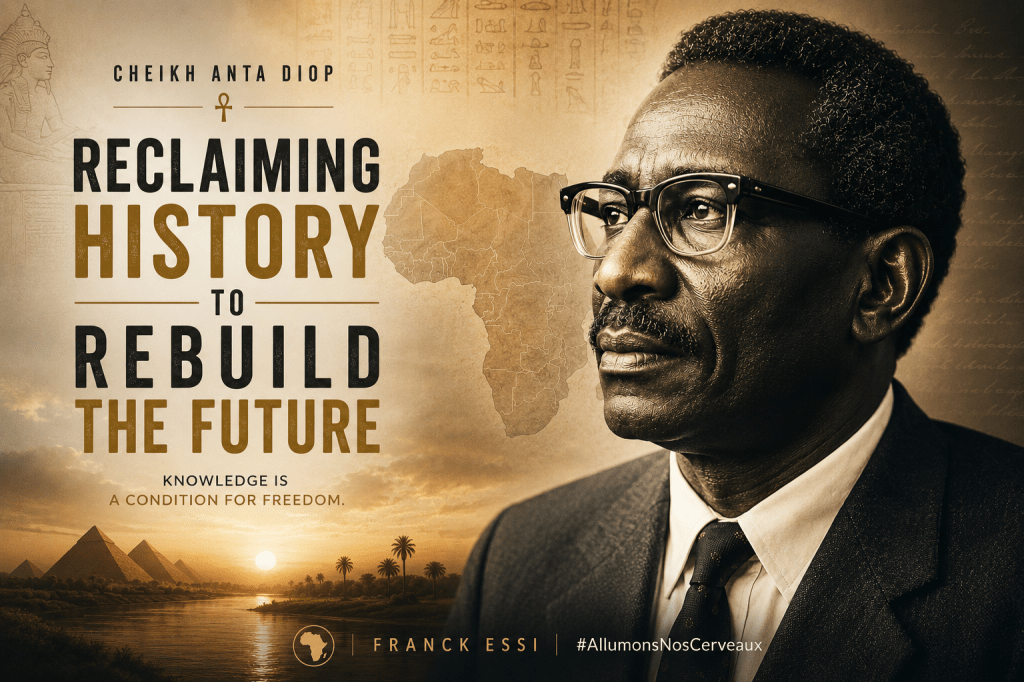
Some people write books.
Others change the way entire generations see the world.
Cheikh Anta Diop belongs to the latter category.
A historian, anthropologist, physicist, linguist, politician, and Pan-African thinker, he devoted most of his life to a struggle that extended far beyond academic circles: the struggle for Africa’s rightful place in the history of humanity.
At first glance, his work may seem focused on the past. In reality, it was primarily about the future. At its core was a simple question: How can a people build their future when they have been taught to doubt themselves?
This question runs through all of his work. It also explains why, decades after his passing, his writings continue to shape debates about history, identity, sovereignty, and development across the African continent.
A Life Dedicated to Knowledge
Cheikh Anta Diop was born on December 29, 1923, in Caytou, near Diourbel, Senegal. He grew up in a colonial context where the history taught to Africans was largely written by others and often to their disadvantage. Early on, he developed a conviction that would never leave him: political domination is almost always accompanied by intellectual domination.
In 1946, he left for France to pursue higher education. His academic journey remains remarkable to this day. While many scholars choose a single specialty, Diop explored multiple disciplines: history, philosophy, linguistics, anthropology, Egyptology, mathematics, chemistry, and physics.
This was not simply the choice of a curious student. It reflected a deeper intuition: Africa’s major challenges cannot be addressed without drawing simultaneously on the humanities and the sciences.
This interdisciplinary approach would become one of the defining characteristics of his work.
A Struggle Against Historical Erasure
To understand the importance of Cheikh Anta Diop, one must recall the intellectual climate of his time. For decades, a significant portion of Western scholarship portrayed sub-Saharan Africa as marginal to the history of civilizations. African achievements were often minimized, ignored, or attributed to external influences.
This narrative was not without consequences. When a people are told for generations that they have contributed little of significance to human history, they may eventually internalize that perception.
For Diop, this was never merely a historical issue.
It was political.
It was cultural.
It was psychological.
It directly affected a people’s ability to believe in themselves.
This is why he undertook a vast body of research aimed at reexamining the origins and contributions of African civilizations.
Ancient Egypt: Far More Than a Debate About the Past
Cheikh Anta Diop’s name is most often associated with his work on Ancient Egypt. He argued that Pharaonic Egypt must be fully reintegrated into African history and cannot be separated from the rest of the continent as it often had been.
This thesis generated intense debate. Yet reducing his work to a dispute over the origins of the ancient Egyptians misses the broader point. What interested him was not merely the identity of an ancient people. It was the way historical narratives shape contemporary consciousness.
In major works such as Negro Nations and Culture (1954), The Cultural Unity of Black Africa (1959), The African Origin of Civilization (1967), and Civilization or Barbarism (1981), he sought to demonstrate that African peoples had made significant contributions to world history.
His goal was not to replace one myth with another.
It was to restore Africa to a history from which it had often been excluded.
A Method Rooted in Demonstration
One of Cheikh Anta Diop’s greatest strengths was his method. At a time when many identity-related debates relied primarily on ideology, he consistently sought to produce evidence-based arguments.
To do so, he drew upon:
- comparative linguistics;
- anthropology;
- archaeology;
- history;
- the study of institutions;
- African cultural traditions;
- modern scientific methods.
Few people realize, for example, that he was deeply interested in scientific dating techniques and contributed to the development of scientific research in Senegal, particularly in the field of radiocarbon dating.
This dimension of his legacy is often underestimated.
At its core, one of Diop’s central messages was that Africans must produce knowledge rather than merely consume knowledge produced elsewhere.
It is in this spirit that he issued his famous call:
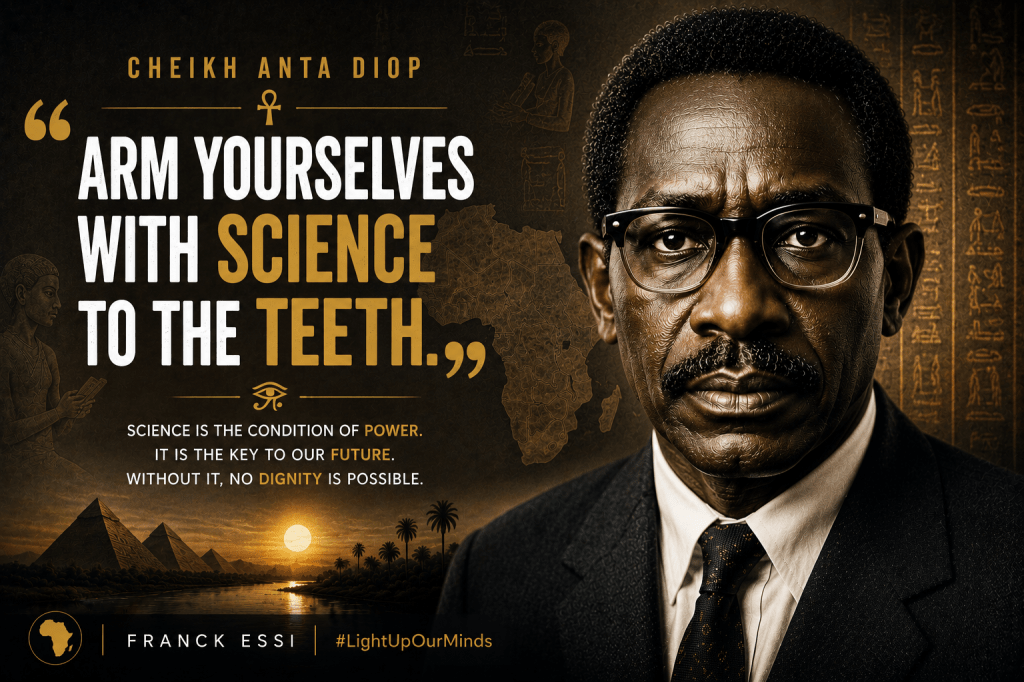
“Arm yourselves with science to the teeth.”
This phrase probably captures his vision of emancipation better than any other.
A Body of Work That Continues to Inspire Debate
Like all major intellectual works, Cheikh Anta Diop’s scholarship has not escaped criticism. Some of his arguments have been confirmed or enriched by later research. Others have been challenged or qualified.
This is normal.
Science advances through debate, the testing of arguments, and the continual reassessment of knowledge. Recognizing this does not diminish his importance. On the contrary, one hallmark of great thinkers is their ability to open debates that endure.
After Cheikh Anta Diop, it became far more difficult to discuss human history seriously without taking African contributions into account. In that sense, his impact extends well beyond any individual conclusion he reached.
Thinking About Africa’s Future
Cheikh Anta Diop was not concerned only with the past. He also reflected deeply on the conditions necessary for Africa’s development: education, science, industrialization, African languages, regional integration, economic sovereignty, and the capacity to produce knowledge.
For him, political independence alone was not enough.
A country may have a flag, a government, and national institutions while remaining intellectually, technologically, or economically dependent.
True sovereignty requires more.
It requires mastery of knowledge.
African Unity as a Strategic Project
Among Cheikh Anta Diop’s most powerful ideas was that of African unity. Once again, his approach was often more pragmatic than many assume. He did not defend unity solely in the name of brotherhood or shared memory. He defended it because he believed it was a condition for power.
In The Economic and Cultural Foundations of a Federal State in Black Africa, he argued that the challenges facing Africa frequently exceed the capacities of isolated and fragile states. Scientific research, industrial development, defense, infrastructure, trade, and diplomatic influence all require a broader continental vision.
More than sixty years after the publication of that work, this reflection remains remarkably relevant.
A Few Powerful Lessons for Our Time
Cheikh Anta Diop’s legacy extends far beyond historical debates.
He reminds us that knowledge is a condition of freedom.
He reminds us that science is a condition of sovereignty.
He reminds us that identity only has meaning if it enables us to act upon reality.
He reminds us that development is not merely a matter of infrastructure or economic growth, but also of collective confidence and the capacity to produce ideas.
Finally, he reminds us that Africa’s challenges often require African solutions conceived at a continental scale.
What I Believe
What strikes me most about Cheikh Anta Diop is not simply his determination to rehabilitate Africa’s past.
It is his determination to prepare Africa’s future.
His work does not invite us to live in nostalgia. It invites us to regain enough confidence to create: to create knowledge, institutions, technologies, businesses, public policies, and solutions adapted to our realities.
Ultimately, perhaps the question he leaves us with is this:
Do we today possess the ambition, discipline, and institutions necessary to produce the future we claim to desire?
A people who no longer produce their own ideas often end up importing those of others.
A people who no longer produce their own knowledge often become dependent on the knowledge of others.
And a people who lose confidence in their ability to create may gradually lose their ability to shape their own destiny.
This is perhaps why Cheikh Anta Diop continues to speak so powerfully to our time. Not because he asks us to admire what our ancestors once achieved, but because he asks us what we are prepared to build for those who will come after us.
Franck Essi
#IdeasMatter
#WeHaveAChoice
#WeHaveThePower
#LightUpOurMinds
References and Further Reading
- Cheikh Anta Diop, Negro Nations and Culture (1954).
- Cheikh Anta Diop, The Cultural Unity of Black Africa (1959).
- Cheikh Anta Diop, The Economic and Cultural Foundations of a Federal State in Black Africa (1960).
- Cheikh Anta Diop, The African Origin of Civilization: Myth or Reality (1967).
- Cheikh Anta Diop, Civilization or Barbarism: An Authentic Anthropology (1981).
Online Resources
- urlUNESCO – General History of Africa Projecthttps://www.unesco.org/en/general-history-africa
- urlCheikh Anta Diop University (UCAD)https://www.ucad.sn
- urlEncyclopaedia Britannica – Cheikh Anta Diophttps://www.britannica.com/biography/Cheikh-Anta-Diop
- urlPrésence Africaine Publishing Househttps://www.presenceafricaine.com
- urlOpen Library – The African Origin of Civilization: Myth or Realityhttps://openlibrary.org/books/OL22344376M/The_African_origin_of_civilization
- urlOpen Library – Negro Nations and Culturehttps://openlibrary.org/works/OL2335917W/Nations_n%C3%A9gres_et_culture
 franckessi.com