By Franck Essi
——
In our activist organizations, we often talk about commitment, sacrifice, courage, mobilization, and social transformation. All of these are important. Yet there is a simple truth that we sometimes overlook: a just cause is not enough to produce just outcomes. We also need clarity, method, discipline, and planning.
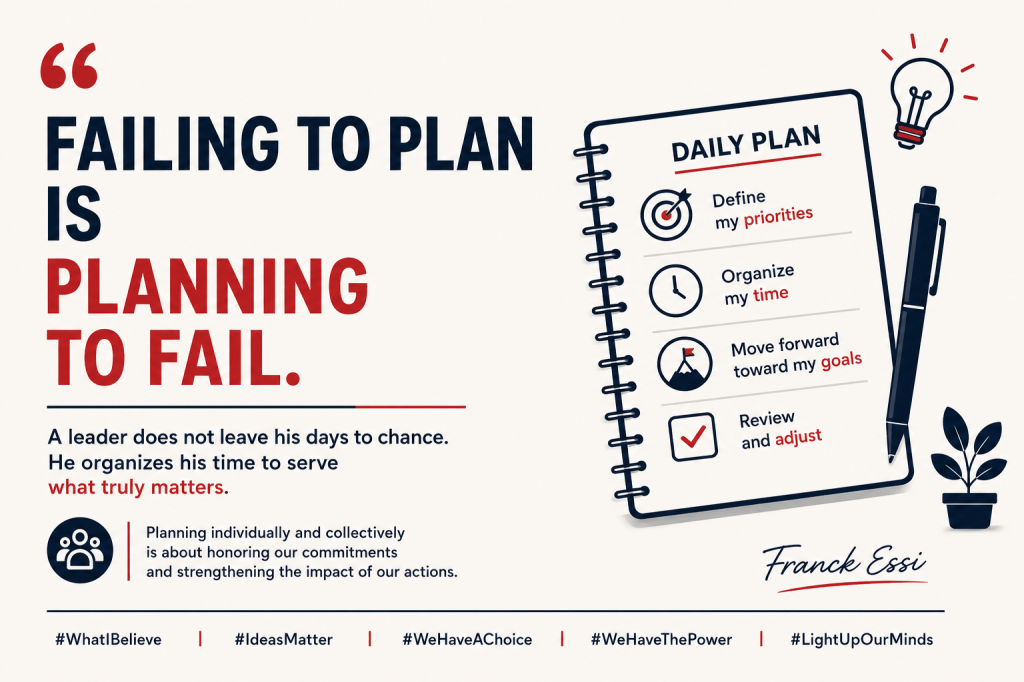
Failing to plan is planning to fail.
This statement may sound harsh, but it highlights something fundamental for anyone involved in an organization, a civic movement, a political party, an association, or a community initiative. We can have good intentions and achieve very little. We can be sincere and still be ineffective. We can be highly motivated and yet disorganized. We can multiply meetings, messages, phone calls, and activities without making real progress toward our objectives.
That is why planning is not an administrative luxury. It is an activist necessity.
——
Planning Begins with Ourselves
Before planning becomes collective, it is first personal. An activist who does not plan their day often ends up living according to other people’s priorities. Other people’s urgencies become their priorities. Distractions replace commitments. Intentions remain in the mind but never become concrete actions.
In an activist organization, this may seem trivial. Yet it is decisive. The person who was supposed to call three new supporters forgets. The one who was supposed to write a report postpones it. The one who was supposed to mobilize participants waits until the last minute. The one who was supposed to prepare a presentation arrives without clear ideas.
Little by little, it is not only tasks that fail. The collective credibility of the organization begins to weaken.
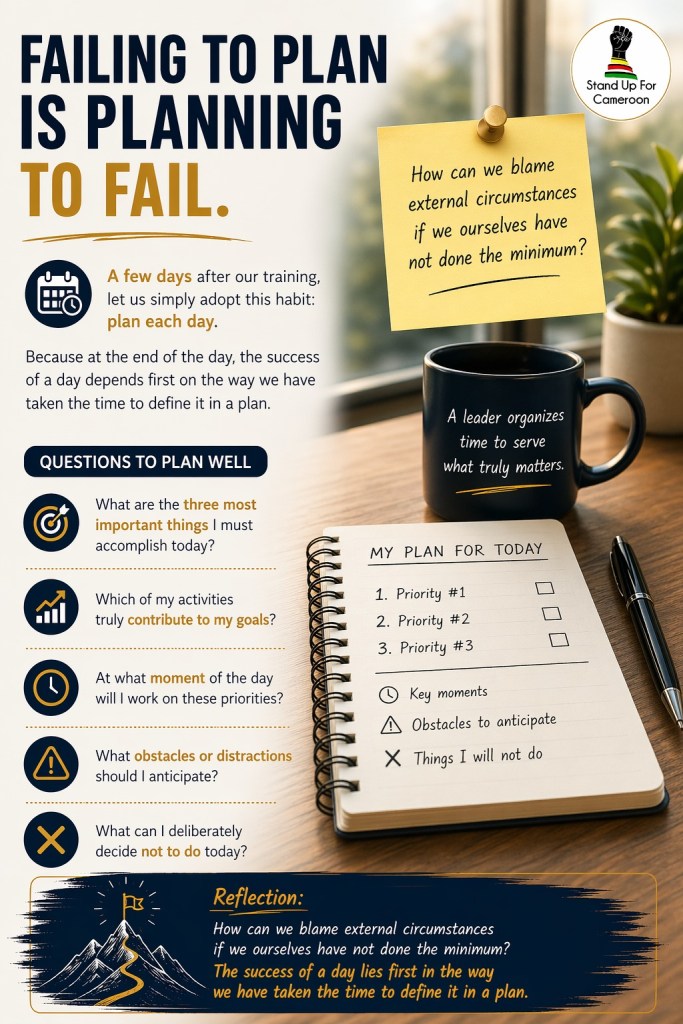
Planning individually is therefore not simply about managing time better. It is about honoring the commitment we have made to others. Every day, a few simple questions can help guide us:
- What are the three most important activist actions I must accomplish today?
- Which task, however small, can move our collective objective forward?
- Who do I need to call, follow up with, inform, or support?
- What distractions or obstacles should I anticipate?
- What can I deliberately choose not to do today in order to remain focused on what matters most?
These questions do not change the world by themselves. But they change our relationship with action. And that is often where change begins.
——
An Organization Without a Plan Exhausts Its Members
In many activist organizations, members do not necessarily lack commitment. More often, they lack clarity. They are not always sure what the priorities are, who is responsible for what, or what needs to happen before, during, and after an activity.
As a result, energy becomes scattered. The same people end up doing everything. Others wait. Meetings multiply. Decisions are not followed through. Frustrations grow.
In the end, we may blame a lack of commitment when the real problem is a lack of organization. A serious activist organization cannot function solely on emotion, urgency, or improvisation. Emotion may spark engagement, but only organization can transform that engagement into lasting strength.
——
Collective Planning Clarifies the Mission
Good collective planning should answer a few simple questions:
- What exactly is our objective?
- What results are we trying to achieve?
- What actions must we take?
- Who is responsible for what?
- What resources do we need?
- What are the deadlines?
- How will we monitor implementation?
- How will we capture lessons learned afterward?
Consider a simple example. If an organization wants to mobilize one hundred people for a civic gathering, it is not enough to say, “Let’s mobilize.”
Someone must call previous participants. Someone must contact new supporters. Someone must prepare the invitation message. Someone must manage the venue. Someone must welcome participants. Someone must take pictures. Someone must write the report. Someone must ensure follow-up after the event.
Without this, everything falls on a few individuals, the activity becomes exhausting, and the organization learns very little. With a plan, everyone knows what they are expected to do. The action becomes clearer, the energy becomes more useful, and accountability becomes more visible.
——
Planning Does Not Kill Spontaneity
Some people believe that planning makes action cold, rigid, or bureaucratic. I believe the opposite.
Planning well is not about preventing life from happening. It is about giving ourselves the means to respond to life more effectively.
A solid plan does not eliminate surprises. It helps us avoid being overwhelmed by them. It allows us to adjust, adapt, and return to our objectives when distractions appear.
Within an activist organization, planning should remain practical, understandable, and alive. A plan that nobody reads is useless. A plan that nobody follows is useless. A plan that nobody evaluates is useless.
——
Discipline Makes the Difference
At its core, planning raises a question of honesty: are we truly prepared to align our practices with our ambitions?
We want to transform our communities, our institutions, and our countries. But can we organize a meeting properly? Can we meet deadlines? Can we follow through on commitments? Can we evaluate our actions? Can we keep our word?
These may seem like small things. Yet great causes often fail because of small, repeated acts of neglect.
An activist organization does not grow solely because of the strength of its ideas. It also grows because of the quality of its practices.
That is why planning is an activist act. It is a refusal to confuse agitation with action, presence with contribution, or goodwill with responsibility.
Any organization that wants to endure and produce meaningful results should regularly return to this simple discipline: planning our days, our tasks, our activities, and our commitments—both individually and collectively—with humility, rigor, and consistency.
At the end of the day, one question deserves to be asked:
How can we blame external circumstances if we have not done the minimum that depended on us?
Very often, the success of a day, an activity, or an organization depends first on the time we took to define it through a plan.
Franck Essi
#WhatIBelieve
#IdeasMatter
#WeHaveAChoice
#WeHaveThePower
#LightUpOurMinds