By Franck Essi
A foundational intellectual encounter
Jean Ziegler died on June 10, 2026, in Geneva, at the age of 92. With his passing, it is not only a Swiss sociologist, professor, parliamentarian, committed writer, and former United Nations Special Rapporteur on the Right to Food who has left us. It is a voice. A “rough” voice, “sometimes excessive,” “often contested,” but profoundly faithful to oppressed peoples. A voice that refused to see the suffering of the dominated turned into statistics, economic crimes disguised as fatality, and global predation presented as a simple rule of the market.
My encounter with Jean Ziegler was not physical. It was intellectual, political, almost initiatory. It took place at the beginning of my university studies, through his book Main basse sur l’Afrique. La recolonisation — often rendered in English as Pillage on Africa: Recolonization. I remember it especially because that reading was connected to two key moments that accelerated my commitment.
The first was a sentence by Frantz Fanon. The famous sentence: “Each generation must, out of relative obscurity, discover its mission, fulfill it, or betray it.” That sentence seized me. It was displayed on the notice board of the Kwame Nkrumah Club at the University of Douala, a board on which quotations were regularly posted to provoke reflection, awaken consciousness, nourish discussion, and remind students that the university should not be only a place for obtaining degrees, but also a place for shaping historical consciousness.
That sentence did not simply please me. It challenged me. It almost summoned me. It raised a question I could no longer avoid: what is the mission of our generation? Were we going to discover it, fulfill it, or betray it? Were we going to pass through our time as mere spectators, or would we accept our part in the struggle for dignity, justice, sovereignty, and the liberation of our peoples?
That sentence led me to join the Kwame Nkrumah Club. And it was within that framework that one of the first readings proposed to me was precisely Jean Ziegler’s Main basse sur l’Afrique.
That reading was foundational. It did not simply inform me. It displaced me. It gave me words to understand realities I had sensed without yet knowing how to name them. It helped me see that Africa’s tragedies could not be explained only by visible crises, the leaders of the moment, or official speeches. One had to look further: at the long history of dispossession, extroverted economies, unfinished states, confiscated sovereignties, relay elites, international mechanisms of predation, but also at the responsibility of peoples to become subjects of their own history.
Since that intellectual encounter with Jean Ziegler, one thing has remained: a simple but decisive conviction. One cannot love Africa while refusing to understand the chains that bind it. One cannot desire the liberation of peoples without learning to name the forces that organize their dependence.
Jean Ziegler taught me that peoples are not poor, humiliated, displaced, hungry, or dependent by accident. They are so because a world order organizes their dispossession, disguises that dispossession as fate, and then asks the victims to remain silent in the name of realism, stability, the market, or reason of state.
A constant solidarity with oppressed peoples
Jean Ziegler was one of the great voices of peoples crushed by the world order.
He did not speak of the poor, the hungry, peasants, African peoples, Latin American peoples, Palestinians, refugees, exploited workers, and humiliated nations as objects of study. He spoke of them as historical subjects. As wounded peoples, but standing. As dominated peoples, but not defeated. As peoples caught in unjust power relations, but capable of resistance, dignity, and liberation.
His solidarity went to oppressed peoples. Always. Not to powerful states. Not to markets. Not to banks. Not to institutions that administer suffering without always attacking the mechanisms that produce it. His solidarity went to those whom the world order condemns to live bent over: landless peasants, hungry children, indebted peoples, humiliated nations, rejected refugees, criminalized resisters, anonymous victims of great decisions taken far away from them.
That is perhaps what made his voice so precious. Jean Ziegler refused the great operation of camouflage through which the powerful transform economic crimes into fatality, predation into market rules, domination into technical constraints, plunder into investment, dependence into partnership, humiliation into geopolitical reality, and popular suffering into mere statistics.
He understood that modern oppression does not always appear with the brutal face of the tyrant. It can wear the banker’s suit, the diplomat’s smile, the technocrat’s language, the creditor’s coldness, the multinational corporation’s arrogance, the authority of expert reports, the reassuring vocabulary of international institutions, and sometimes even the good conscience of humanitarianism.
It is against this violence — often invisible, often legal, often respectable — that Jean Ziegler built his work.
We should not turn him into a saint. Saints do not always help us think. Jean Ziegler had his excesses, controversies, blind spots, debatable loyalties, and sometimes abrupt formulations. But great voices of struggle are not decorative objects. They are forces of disturbance. They are not made to reassure us. They are made to prevent us from sleeping peacefully in an unjust world.
A life between the university, politics, the United Nations, and the struggles of peoples
Jean Ziegler was born in Switzerland in 1934. He became a sociologist, professor, writer, parliamentarian, and committed actor in international debates. His path was not that of an intellectual locked in a library, even though he was a man of books. Nor was it that of an activist who rejected institutions, even though he fiercely criticized their hypocrisies. He stood at the intersection of several worlds: the university, the Swiss Parliament, the United Nations, social movements, struggles in the South, the critique of neoliberal globalization, and the fight for human rights.
What stands out, beyond the titles, is the deep coherence of his path. Jean Ziegler used the spaces to which he had access to speak for those who were not invited into them.
He used the university to reveal mechanisms of domination. He used writing to name invisible violence. He used the parliamentary platform to question the responsibilities of his own country. He used the United Nations to speak about hunger, debt, economic oppression, and human dignity. He used his notoriety to defend peoples the world often prefers not to hear.
His itinerary tells us something important: intellectual commitment is not only about having correct ideas. It is about placing one’s position, knowledge, voice, and possible privileges at the service of those who do not have access to the places where decisions are made.
That is why Jean Ziegler was an intellectual of combat. Not in the sense of someone who abandons rigor for anger. But in the sense of someone who refuses to let rigor become an excuse for not choosing the camp of human dignity.
Pillage on Africa: Recolonization — recolonization, protonation, and fictitious sovereignty
Among Jean Ziegler’s books that I have read, Main basse sur l’Afrique. La recolonisation — Pillage on Africa: Recolonization — occupies a special place. This book was foundational for me.
It helped me understand that Africa could not be thought only through its visible crises, its immediate leaders, or official speeches. One had to look at the long history of dispossession: colonization, imposed borders, extroverted economies, confiscated independence, multinational corporations, military agreements, financial dependencies, protected regimes, fragile states, and local elites often serving as transmission belts for external interests.
The subtitle, Recolonization, already says the essential. For Ziegler, the formal independence of many African states did not always produce the real sovereignty of peoples. Direct domination was often replaced by more indirect, more subtle, sometimes more effective forms: economic domination, financial domination, military domination, symbolic domination, domination through markets, banks, agreements, experts, local elites, and narratives that present dependence as destiny.
The central concept of the book is protonation.
One must be precise: Ziegler does not simply speak of a “proto-nation” as a nation in formation. He speaks of protonation. This notion designates a rudimentary, dependent social formation, organized from outside, which produces some symbols of national sentiment but lacks the strength, means, and autonomous will to choose a sovereign historical destiny.
Protonation, as I understand it through Ziegler, designates an impeded nation: a state that exists legally, but whose people have not yet conquered real control over their economy, institutions, imagination, and destiny.
This is an extremely fertile idea for thinking about Africa and Cameroon.
It invites us not to confuse the legal existence of the state with the real existence of the nation. A country may have a flag, an anthem, an administration, an army, borders, a seat at the United Nations, and a constitution, without yet being a fully constructed nation. A nation requires something else: a common consciousness, shared memory, a collective project, organized solidarity, legitimate institutions, sovereign decision-making capacity, and a sense of belonging that transcends fragmented identities without denying them.
Ziegler also helps us better understand the role of comprador bourgeoisies. In my own political vocabulary, I would also speak of predatory comprador elites.
By this, I mean those local elites who do not build national sovereignty, but serve as intermediaries between external interests and internal dispossession. They do not primarily create a national economy, productive power, collective consciousness, or social justice. Rather, they organize their own enrichment by facilitating external forces’ access to resources, markets, land, contracts, privileges, and strategic decisions.
They are not only corrupt. They are functional to dependence. They are the internal managers of an external order. They sometimes speak the language of patriotism, but administer dependence. They sometimes wear national colors, but serve interests that prevent the nation from becoming sovereign.
That is why Pillage on Africa: Recolonization remains, for me, an essential book. It helps avoid two simplifications. The first would be to say that all our misfortunes come from outside. The second would be to say that all our misfortunes come only from ourselves. Ziegler forces us to think together external domination and internal betrayal.
The lesson for today is clear: Africa does not only need legal independence. It needs real sovereignty, constructed nations, organized peoples, and patriotic elites capable of breaking with the function of brokerage in the world order.
The New Rulers of the World and Those Who Resist Them: who really governs the world?
In The New Rulers of the World and Those Who Resist Them, Ziegler widens the lens. The problem is no longer only Africa. It is the global architecture of power.
The rulers of the world are no longer only kings, presidents, generals, colonial governors, or diplomats of great powers. They are also financial oligarchies, transcontinental corporations, banks, investment funds, speculators, international economic institutions, operators of global trade, and private actors capable of deciding the fate of millions of human beings without ever asking for their consent.
Ziegler shows a central contradiction of our time: never has humanity produced so much wealth, and never has that wealth been so powerfully captured by a minority. The world overflows with goods, but entire peoples are kept in misery. Technology advances, but dignity retreats for millions. Global production increases, but access to essential goods remains blocked for the poorest.
The great question posed by this book is simple: who really governs the world?
This question is fundamental to any democratic thinking. A genuine democracy presupposes that peoples can decide the major orientations of their destiny. But how can we speak of democracy when essential decisions are taken in boardrooms, financial markets, opaque negotiations, multilateral institutions, or clubs of the powerful?
Ziegler forces us to face this contradiction. He reminds us that modern domination often works through democratic dispossession. The people are not always deprived of the right to vote. Sometimes their vote is deprived of the ability to truly change things.
But the title of the book has a second essential part: “those who resist them.”
Jean Ziegler does not see only the rulers of the world. He also sees the forces that confront them: social movements, trade unions, peasants, critical intellectuals, mobilized peoples, citizens’ organizations, alter-globalization activists, courageous leaders, local communities, solidarity networks, and women and men who refuse to consider the established order as insurmountable.
Here appears an important idea: fronts of refusal. These fronts are not merely organizations. They are places of consciousness, courage, solidarity, and action. They gather those who refuse to let the world be abandoned to predators.
The lesson for today is clear: it is not enough to denounce the rulers of the world. We must build those who resist them.
Long Live Power! or the Delights of Reason of State: reason of state against the reason of peoples
In Vive le pouvoir ! ou les délices de la raison d’État — Long Live Power! or the Delights of Reason of State — Jean Ziegler attacks another monster: reason of state.
Reason of state is the logic through which the state justifies lies, betrayal, repression, renunciations, wars, shameful alliances, and guilty silences in the name of a superior interest presented as beyond discussion. It turns the preservation of power into the supreme value. It makes arbitrariness look like necessity. It forces citizens to bow before decisions they do not always understand, but which they are told are indispensable.
Ziegler shows that the state performs a formidable operation: it naturalizes itself. It presents itself as obvious, necessary, protective, almost sacred. It tells us, in substance: outside me, chaos; outside me, insecurity; outside me, the war of all against all. Thus, even when it oppresses, even when it lies, even when it crushes, the state demands recognition and obedience in the name of stability.
This reflection is highly important for our countries.
How many times have we heard that freedom must wait in the name of stability? That justice must be postponed in the name of order? That democracy must be delayed in the name of peace? That protest is dangerous because it weakens the state? That citizens must remain silent because power knows better than them what is good for the nation?
Reason of state then becomes another name for the confiscation of the people.
But Ziegler does not fall into simplistic criticism. He knows that the state can also protect. The state can build schools, hospitals, roads, social security systems, protections for workers, and redistributive institutions. The state can be an instrument of progress. But it can also become an opaque machine, a force of domination, a bureaucracy that devours society and places its own survival above the dignity of citizens.
The current lesson of Long Live Power! or the Delights of Reason of State is therefore precious: we must always ask whether the state serves the people, or whether it demands that the people serve its own preservation.
For Cameroon, this question is central. We must not sacralize the state to the point of forgetting that it can be captured. We must not confuse administration with nation, order with justice, stability with peace, legality with legitimacy, continuity of power with protection of the people.
Turn the Guns Around! Choosing Sides: sociology as a weapon
In Retournez les fusils ! Choisir son camp — Turn the Guns Around! Choosing Sides — Jean Ziegler gives another essential key to his work: knowledge is never neutral.
For him, sociology is not a decorative activity. It is not an exercise in academic distinction. It is not an elegant way of commenting on the world. It is an instrument. It can liberate or oppress. It can reveal the mechanisms of domination or serve to justify them. It can arm consciences or put them to sleep.
Here Ziegler joins an idea that is dear to me: ideas matter because they can become material forces when they seize consciousness.
For Ziegler, the intellectual must not merely seduce. He must arm. Not to spread hatred, but to give peoples the means to understand what crushes them. To arm consciousness against false evidence. To arm citizens against state lies. To arm the dominated against discourses that teach them resignation.
Turn the Guns Around! Choosing Sides is also a book about choosing one’s camp. One cannot pretend to understand injustice while remaining eternally on the balcony of history. There comes a moment when understanding requires taking a position. Not a blind, sectarian, or dogmatic position, but a moral one: the position that refuses to let knowledge serve the powerful against the people.
The lesson for today is clear: the intellectual who understands the chains and refuses to name them eventually becomes complicit with those who maintain them.
The Rebels: Against the World Order — when the dominated discover they can fight
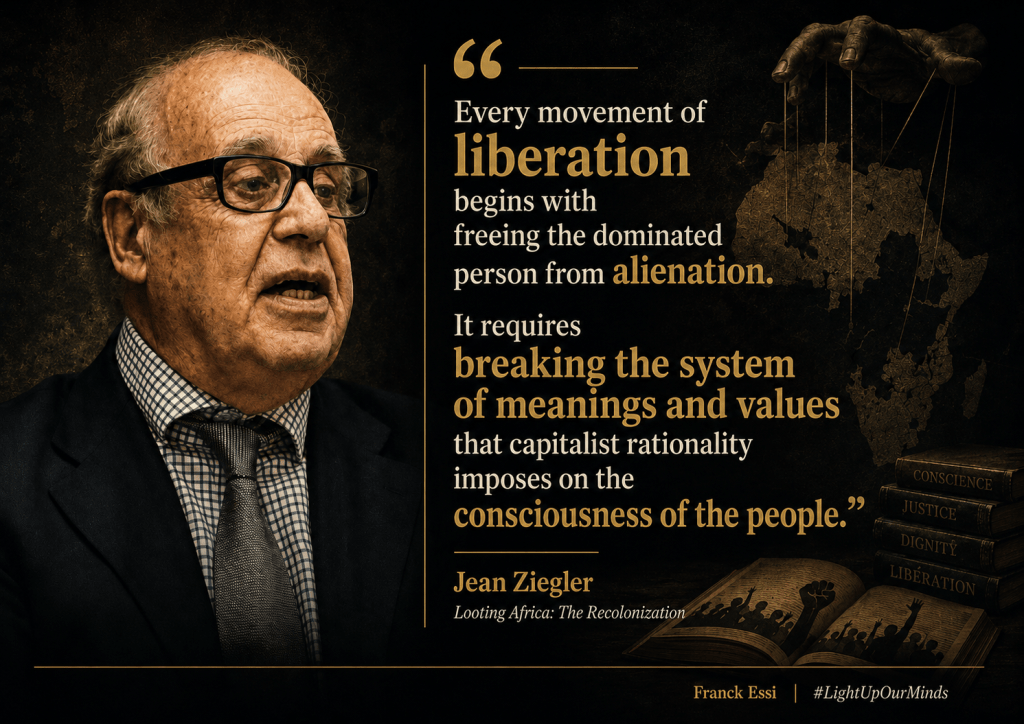
In Les Rebelles. Contre l’ordre du monde — The Rebels: Against the World Order — Ziegler focuses on armed national liberation movements in the Third World. He analyzes experiences such as the Sandinista Nicaragua, Amílcar Cabral’s PAIGC, Angola, Mozambique, the Polisario, Cuba, Eritrea, and other liberation movements.
The core of the book is simple: oppressed peoples do not endure their chains forever. At a certain point, a new consciousness emerges. Men and women understand that their humiliation is not an individual fatality, but the product of social, political, economic, and military mechanisms. They understand that what crushes them can be analyzed, fought, destroyed, and replaced.
That is how liberation movements are born.
For Ziegler, these movements are neither simple parties, nor simple armies, nor simple peasant revolts. They are new social formations. They produce consciousness, organization, strategy, discipline, memory, a culture of sacrifice, and the promise of a new society.
There is a very important lesson here for current struggles.
Revolt alone is not enough. Anger alone is not enough. Suffering alone is not enough. To become a historical force, suffering must be understood. Anger must be organized. Revolt must be oriented. The people must move from complaint to consciousness, from consciousness to organization, from organization to the balance of power, from the balance of power to transformation.
Ziegler is lucid: liberation movements can also betray their promises. After victory, the vanguard can become bureaucracy. The movement can become apparatus. The revolution can be devoured by reason of state. Liberation can be confiscated by those who claimed to embody it. This is one of the great tragedies of the history of peoples.
But this lucidity does not destroy the necessity of resistance. It simply reminds us that liberation is not limited to driving out a dominator. It requires building a more just, freer, more equal society, and constantly watching those who speak in the name of the people.
The Victory of the Defeated: Oppression and Cultural Resistance
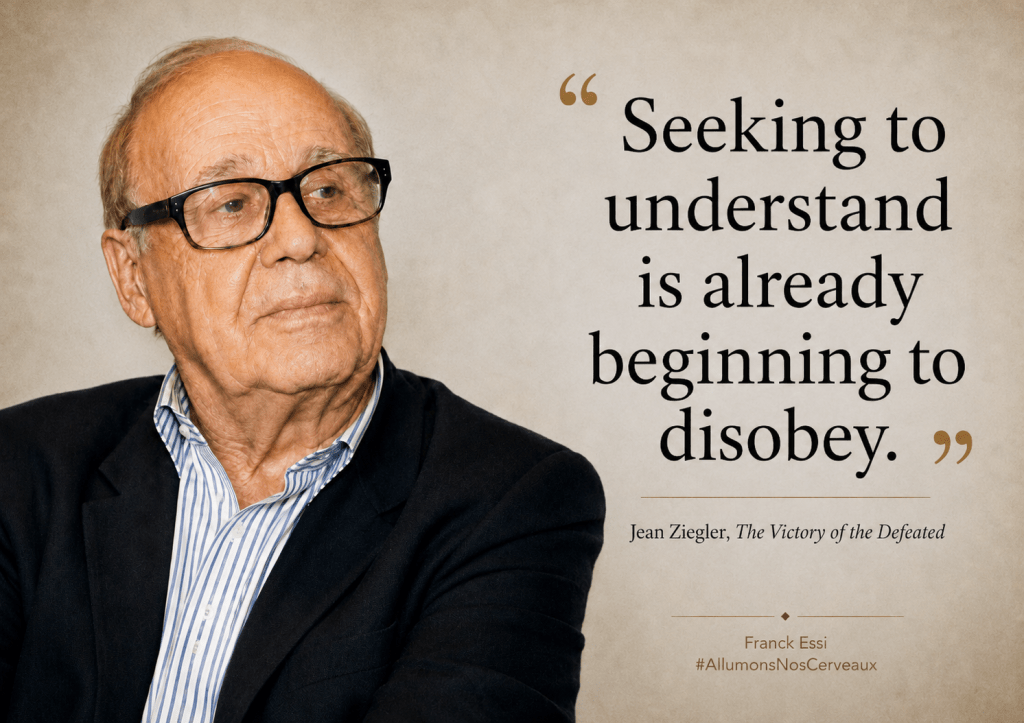
In La Victoire des vaincus. Oppression et résistance culturelle — The Victory of the Defeated: Oppression and Cultural Resistance — Ziegler shifts the analysis toward culture. He shows that in the Southern hemisphere, contradictions are not only economic or political. They are also cultural.
The shock of market modernity shakes traditional societies. But these societies do not always disappear docilely. They resist because they carry coherence, warmth, memory, a way of inhabiting the world, and a capacity to produce meaning. Ziegler understands that culture is not decoration. It is a battlefield.
This idea is essential.
Too often, liberation is reduced to a question of state power, economic growth, or institutional reforms. But a people can have a state and lose its soul. It can have infrastructure and lose its memory. It can enter modernity and become uprooted. It can imitate others to the point of no longer knowing what it wants to become itself.
Ziegler does not defend sterile identity withdrawal. He does not say that peoples must reject the universal, progress, science, or modernity. Rather, he shows a deep tension: peoples desire liberation, access to the universal, and modern dignity; but they also fear uprooting, the dilution of their identities, the erasure of their memories, and the destruction of their own forms of coherence.
It is within this tension that part of Africa’s future is at stake.
Culture can be instrumentalized by authoritarian powers, ethnic withdrawal, or sterile conservatisms. But it can also become a force of rebirth. It can nourish courage, dignity, imagination, solidarity, and a people’s capacity to refuse to be defined only by the categories of its dominators.
The place given to Thomas Sankara in this book is significant. Sankara is not presented only as a political leader. He also appears as a figure of cultural and political revolution: a man who understood that liberating a country does not mean merely changing its administration, but transforming imaginations, rehabilitating collective memories, changing social relations, liberating women, mobilizing peasants, and giving the people back the desire for history.
The lesson for today is clear: African liberation must be economic, political, and institutional, but it must also be cultural. A people that loses its memory, its narratives, its symbolic dignity, and its ability to name itself becomes easier to govern from outside.
Betting on Famine: Why the World Still Goes Hungry — hunger as a political crime
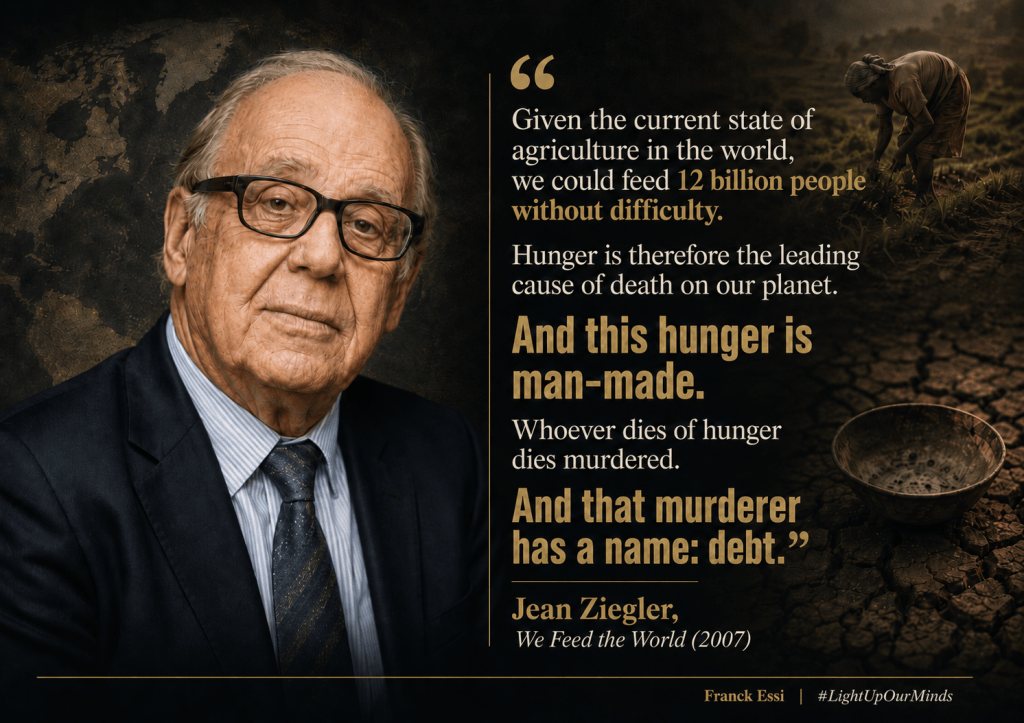
With Betting on Famine: Why the World Still Goes Hungry, the English title of Destruction massive. Géopolitique de la faim, Jean Ziegler gives one of the most brutal formulations of his thought: hunger is not fate. It is manufactured. It is organized. It is made possible by decisions, structures, markets, speculation, power relations, political cowardice, and institutional complicity.
This book matters because it refuses compassion without consequence. It is not enough to feel sad before images of hunger. We must understand why, in a world capable of producing enough food, millions of human beings are denied access to food. The problem is therefore not only production. It is access, distribution, purchasing power, land, speculation, agricultural policies, commercial relations, and the domination of large agribusiness corporations.
Ziegler denounces the enemies of the right to food: speculators on basic foodstuffs, biofuel trusts, actors who grab land, institutions lacking means or courage, states that tolerate the intolerable, and oligarchies that transform bread, rice, wheat, maize, and land into objects of profit.
This is where the critique of hunger meets the broader critique of the world order. Hunger is not an isolated theme in Ziegler’s work. It is one of the most unbearable manifestations of the structural violence of globalized capitalism.
The lesson for today is clear: defending the right to food does not only mean distributing food. It means defending food sovereignty, protecting peasants, fighting land grabbing, regulating speculation, rebuilding local agriculture, and placing human life above profit.
For Africa, this lesson is decisive. A continent with so much land, so many peasants, so much agricultural knowledge, and so much rural youth cannot continue to depend massively on food imports, unstable global markets, and agricultural policies often designed elsewhere. Food sovereignty is a question of dignity, security, freedom, and power.
Capitalism Explained to My Granddaughter: making simple what appears complicated
In Capitalism Explained to My Granddaughter (in the Hope That She Will See Its End), Jean Ziegler makes an important pedagogical choice. He does not address specialists only. He speaks to a child, and therefore to everyone. He wants to make intelligible what experts often make obscure. He wants to show that capitalism is not a technical abstraction, but a system that organizes production, property, accumulation, competition, innovation, domination, and the distribution of wealth.
Ziegler does not deny the creative power of capitalism. He recognizes its capacity for innovation, for mobilizing talents, for scientific and technical development. But he refuses to let that power justify an order that simultaneously produces abundance for a few and misery for many.
Here appears a strong idea: the problem is not only that capitalism produces wealth. The problem is that it organizes the capture of that wealth by a minority, while leaving multitudes in the anxiety of survival.
This book is precious because it reminds us that political education must be accessible. There is no point in denouncing the world order in a language only a few initiates can understand. Peoples need simple, clear, powerful tools to read what is happening to them.
The lesson for today is clear: critical intelligence must be democratized. A people cannot fight a system it does not understand.
The Crime Lords: The New Mafias against Democracy
In Les Seigneurs du crime. Les nouvelles mafias contre la démocratie — The Crime Lords: The New Mafias against Democracy — Jean Ziegler widens the scope of his accusation once again. He no longer speaks only of multinationals, debt, hunger, or imperialism. He speaks of organized crime as a direct threat to democracy.
This book matters because it shows that organized crime is not merely a marginal pathology. It can become an economic, financial, and political power. It infiltrates markets, corrupts institutions, weakens justice, buys protection, intimidates citizens, privatizes sectors of the state, transforms dirty money into respectable money, and imposes its law in silence.
Ziegler speaks here of a democratic immune deficiency. The expression is powerful. A democracy needs values, solidary citizens, robust institutions, an independent judiciary, a common public good, and a culture of responsibility. When these defenses weaken, mafias prosper. They do not prosper only because they are violent. They prosper because societies become vulnerable to money, fear, blackmail, cynicism, and corruption.
This book has obvious relevance for our societies. Democracy does not die only through military coups. It can also die through dirty money, criminal markets, predatory networks, captured administrations, bought consciences, corrupted elites, organized fear, and the moral collapse of institutions.
The lesson for today is clear: defending democracy does not mean only organizing elections. It also means protecting the rule of law against dirty money, the criminalization of the economy, systemic corruption, and the mafia capture of the state.
Hatred of the West: wounded memory, humiliation, and double standards
In La Haine de l’Occident — usually rendered as Hatred of the West — Jean Ziegler addresses a sensitive question: why do many peoples of the South show deep mistrust, and sometimes radical hostility, toward the West?
His answer is not a simplistic justification of hatred. It is an attempt at historical understanding. He shows that this hatred comes from a wounded memory: the slave trade, colonization, humiliations, plunder, massacres, economic domination, double standards on human rights, selective interventions, moral arrogance, refusal to face reparations, and the persistence of a world order perceived as heir to past oppressions.
Ziegler shows that the West does not always understand this anger because it does not see itself humiliating others. It proclaims the universal, but often practices double standards. It speaks of human rights, but sometimes protects its interests. It condemns some crimes, but turns a blind eye to others. It asks the South to forget, while the South still carries in its memory the long wounds of domination.
This book is precious because it forces us out of two simplifications. The first would be to say that every critique of the West is necessarily irrational. The second would be to turn hatred into a political program. Ziegler proposes another path: understand the roots of anger, recognize wounds, assume historical responsibilities, refuse double standards, and rebuild dialogue on the basis of justice.
The lesson for today is clear: there can be no sincere dialogue between North and South without memory, truth, responsibility, moral and political reparation, and coherence between proclaimed values and real practices.
For Africa, this reflection is essential. It is not about building our future on hatred. But neither is it about accepting amnesia. A wounded memory that is not recognized can become destructive anger. An assumed memory can become a force for justice, dignity, and reconstruction.
Lesbos, the Shame of Europe: human rights betrayed at the borders
In Lesbos, la honte de l’Europe — Lesbos, the Shame of Europe — Jean Ziegler returns to one of the great threads of his work: shame as a political revealer.
This time, the shame concerns contemporary Europe. A Europe that proclaims human rights, but organizes at its borders spaces of sorting, confinement, waiting, humiliation, and suffering for refugees. A Europe that speaks of human dignity, but treats exiles as administrative problems. A Europe that celebrates freedom of movement for goods and capital, but builds barriers against human beings fleeing war, misery, persecution, or the collapse of their countries.
The hot spots of Lesbos become, under Ziegler’s pen, the symbol of a major moral contradiction: Europe claims to be a civilization of rights, but betrays its principles precisely where they should be most necessary.
This book speaks about refugees, but it also speaks about us. The way a society treats the vulnerable foreigner says something deep about what it has become. The border is a revealer. It shows what grand speeches are worth when faced with those who have neither force, nor money, nor powerful passports, nor diplomatic protection.
The lesson for today is brutal: a civilization is judged by how it treats those who knock at its door. If it responds with humiliation, the bureaucracy of suffering, the criminalization of exile, and organized fear, then its speeches on human rights become suspect.
For Africa, this book resonates strongly. Refugees, migrants, and exiles are not merely people on the move. They are often the human products of an imbalanced world order: wars, economic collapse, dictatorships, poverty, climate change, the destruction of local agriculture, commercial dependencies, and political violence. One cannot understand migration without understanding the disorders of the world that produce it.
Swiss Whitewash: telling hard truths to his own country
There is one thing that gives Jean Ziegler particular strength: he did not reserve his anger for distant countries. He did not denounce only dictators of the South, abstract multinationals, international institutions, or imperial powers. He also knew how to look at his own country and tell it hard truths.
That is what he does in La Suisse lave plus blanc — often rendered as Swiss Whitewash — but also in Switzerland Exposed and The Swiss, the Gold, and the Dead: How Swiss Bankers Helped Finance the Nazi War Machine. He dismantles the myth of a Switzerland that is only neutral, clean, humanitarian, peaceful, democratic, and innocent. He shows another Switzerland: the Switzerland of banks, banking secrecy, money laundering, doubtful capital, stolen fortunes, dictators’ funds, drug money, and the financial respectability given to wealth born of the suffering of others.
This is an essential dimension of his courage.
It would have been comfortable for a Swiss intellectual to denounce corrupt Africa, tropical dictators, violent regimes, or failed states of the South. It would have been comfortable to speak of the misfortunes of the world without touching Swiss prosperity. But Ziegler does the opposite. He shows that Switzerland is not outside the disorder of the world. It is sometimes one of the places where that disorder is recycled, camouflaged, protected, and made respectable.
In Swiss Whitewash, he distinguishes several forms of money: clean money, produced by normal transactions; grey money, linked to tax evasion or misappropriation; and black money, linked to trafficking, crimes, dictatorships, or illicit activities. What interests him is not only the individual morality of the banker. It is the systemic function of the financial center: to transform doubtful money into clean money, predation into investment, economic crime into respectability.
Switzerland becomes, in Ziegler’s work, the symbol of a violence that looks clean. A violence without shouting, without tanks, without bellicose speeches, but capable of giving a second life to the proceeds of plunder.
This critique is all the stronger because it touches the image the Swiss have of themselves. Ziegler shows that Swiss consensus, fear of conflict, the sacralization of neutrality, the power of banks, and national conformism can produce a society that believes itself innocent while participating in deeply destructive mechanisms. He also shows that in such a context, the critical intellectual is quickly perceived as an enemy of the nation.
This is a huge lesson.
True intellectual courage does not consist only in accusing others. It also consists in looking at the complicities of one’s own camp.
This lesson applies to everyone. The European intellectual must question the banks, companies, states, and institutions of the North that profit from global predation. The African intellectual must criticize imperialism, but also the local elites who serve as relays of dependence. The citizen activist must denounce external powers, but also internal complicities. A true patriot does not protect the lies of his country. He helps it become more just by forcing it to look at what it refuses to see.
That is why Ziegler’s critique of Switzerland is not merely a national score-settling. It is a universal lesson: no society can claim to defend justice if it refuses to examine the privileges, silences, and profits that link it to the injustice of the world.
Paths of Hope: hope as a discipline of struggle
In Chemins d’espérance. Ces combats gagnés, parfois perdus mais que nous remporterons ensemble — Paths of Hope: Battles Won, Sometimes Lost, but We Shall Win Them Together — Jean Ziegler offers, in a sense, an assessment of his struggles. The subtitle is already a program.
This book matters because it shows that Ziegler was not only a man of denunciation. He was also a man of hope. But his hope was not naïve. It was not decorative. It was not easy consolation. It was a discipline of struggle.
Ziegler speaks of the United Nations, the 2030 Agenda, multilateral diplomacy, international justice, imperial strategy, vulture funds, Palestine, war, peace, and the responsibility of each person. He sees clearly that the United Nations is weakened, often powerless, sometimes trapped in the contradictions of states and the domination of globalized financial oligarchies. But he does not abandon the idea that a world order founded on law, social justice, peace, and freedom remains one of humanity’s necessary horizons.
There is a fruitful tension here.
Ziegler does not believe that international institutions alone can save peoples. But he does not abandon the idea of international law either. He knows that private oligarchies are powerful, that states can be cowardly, that great powers can instrumentalize institutions, that economic interests can neutralize moral commitments. But he also knows that peoples, social movements, courageous judges, honest diplomats, activists, citizens, and intellectuals can still open breaches.
That is hope in Ziegler.
Hope is not believing that everything will be fine. It is refusing to leave the future to the powerful.
For our African struggles, this lesson is precious. We must neither abandon ourselves to cynicism nor take refuge in illusion. We must look at the hardness of the world directly, without renouncing the possibility of transforming it. We must know how to lose without surrendering. We must know how to win without becoming corrupt. We must know how to hope without becoming naïve.
The key concepts I retain from Jean Ziegler
Across these books, several concepts structure Ziegler’s thought and remain useful for reading our time.
Protonation: it helps us think the impeded nation, fictitious sovereignty, the formally independent but materially dependent state.
Recolonization: it names indirect forms of domination that follow classical colonization: debt, markets, military agreements, multinationals, relay elites, symbolic dependencies.
Comprador bourgeoisies: they designate local elites serving as intermediaries between external domination and internal exploitation.
Predatory comprador elites: this formulation insists on their double function: predatory internally, comprador in their relationship with the outside.
Reason of state: it helps us understand how the state sometimes justifies the unjustifiable in the name of its own survival.
Fictitious sovereignty: it describes the situation of states that possess the attributes of independence without truly controlling their fundamental choices.
Democratic dispossession: it describes the process through which peoples may retain the right to vote but lose real control over the decisions that determine their future.
The cannibal world order: it designates an order that feeds on the life, labor, land, resources, dignity, and sometimes hunger of peoples.
Cultural resistance: it reminds us that peoples also resist through memory, language, narratives, symbolic dignity, and forms of life.
The front of refusal: it designates the political and moral fraternity of those who refuse to accept the world order as fate.
Democratic immune deficiency: it helps us understand why some societies become unable to resist corruption, dirty money, organized crime, and state capture.
Wounded memory: it names the historical memory of peoples humiliated by slavery, colonization, plunder, and the double standards of the West.
The insurrection of consciences: it designates the moment when peoples stop accepting the unacceptable as normal.
Organized hope: it reminds us that hope only has meaning when it becomes lucidity, strategy, organization, and collective action.
These concepts give us a grammar for reading the world. They help us understand that domination does not always begin with tanks. It sometimes begins with words, contracts, debts, dependencies, relay elites, banks, treaties, official narratives, and institutions that make the unacceptable appear normal.
What Ziegler says today to Cameroon and Africa
Jean Ziegler speaks powerfully to contemporary Africa. He speaks to Cameroon. He speaks to peoples still searching for their path toward real sovereignty.
He tells us that formal independence is not enough. Having a flag is not enough. Having a state is not enough. Having an administration is not enough. Having elections is not enough. Having natural resources is not enough. Having a highly educated elite is not enough.
We must build peoples capable of deciding.
We must build institutions that protect the common good. We must build economies that serve dignity. We must build states that are not merely apparatuses of domination, but instruments of popular sovereignty. We must build nations that are not merely official slogans, but real political communities.
For Cameroon, the question of protonation is particularly fertile. We have a state. But have we sufficiently built a political nation conscious of itself, in solidarity with itself, capable of projecting itself into a common destiny? We have institutions. But are they at the service of the people or at the service of the reproduction of a system? We have resources. But do they produce shared dignity or accumulation for a few? We have a common history. But have we made it into a common narrative? We have citizens. But are they truly given the power to be authors of their future?
These questions are essential.
They show that liberation is not only about changing leaders. It is also about nation-building, economic sovereignty, political education, popular organization, social justice, historical memory, and institutional refoundation.
Through Ziegler, we understand that the Cameroonian question is not only the question of political alternation. It is also the question of transforming a captured state into a conscious nation, an administered population into a sovereign people, a rich territory into a community of destiny.
Reading Ziegler with critical fidelity
Reading Jean Ziegler does not mean accepting everything from him. That would contradict critical thinking. His strength was his commitment to the oppressed. His limitation could sometimes be that he identified camps too quickly, distributed responsibilities too quickly, or did not always dwell enough on the internal contradictions of certain regimes or movements presented as resistant.
But this limitation does not destroy his contribution. Rather, it invites us to extend his indignation with more rigor, more complexity, and more democratic demands.
We must therefore read Ziegler with critical fidelity.
Fidelity to his courage. Fidelity to his refusal of indifference. Fidelity to his solidarity with humiliated peoples. Fidelity to his ability to name dominations. But also a critical stance toward his possible shortcuts, debatable enthusiasms, and eventual simplifications.
The best way to honor a thought of combat is not to repeat it mechanically. It is to extend it by making it more accurate, more rigorous, and more useful to present struggles.
This applies to Ziegler as it does to all great committed intellectuals. They must not become untouchable icons. They must remain companions on the road in our effort to understand and transform the world.
The true tribute
The true tribute to Jean Ziegler does not consist in celebrating him as a sympathetic figure of the global left. It does not consist in repeating a few strong sentences. It does not consist in turning him into a convenient statue, admired but neutralized.
The true tribute consists in taking up what he taught us to do: name dominations, reveal complicities, defend peoples, refuse fatality, question debt, protect sovereignty, listen to resistances, denounce oligarchies, defend refugees, rehabilitate collective memories, criticize our own camp too, and remind the world that human dignity is worth more than profits, markets, and diplomatic balances.
Jean Ziegler is dead. But the rulers of the world are still here. The peoples who resist them are still here too.
And perhaps it is within this tension that the task of our generation lies: not to accept that Africa remains a continent of wealth without sovereignty, peoples without power, youth without horizons, land without peasants, states without vision, nations formally independent but really dependent.
We must reread Ziegler not to complain more, but to think more clearly. Not only to accuse, but to act better. Not to hate the world, but to refuse the unjust order that disfigures it. Not to wait for a savior, but to build peoples capable of standing upright.
Jean Ziegler is dead. But his work continues to ask our time a brutal question: how long will peoples still accept being governed by forces they have not elected, indebted by choices they did not make, plundered by interests they do not control, humiliated by borders that reject them, and consoled by speeches that change nothing about their condition?
The best tribute to Jean Ziegler is not to repeat his anger. It is to transform that anger into lucidity, that lucidity into organization, and that organization into a collective power of liberation.
For a people that understands the chains that bind it has already begun to prepare the gestures of its liberation.
#WhatIBelieve
#IdeasMatter
#WeHaveAChoice
#WeHaveThePower
#LightUpOurMinds
References for further reading
- Jean Ziegler, Main basse sur l’Afrique. La recolonisation — Pillage on Africa: Recolonization.
- Jean Ziegler, The New Rulers of the World and Those Who Resist Them.
- Jean Ziegler, Vive le pouvoir ! ou les délices de la raison d’État — Long Live Power! or the Delights of Reason of State.
- Jean Ziegler, Retournez les fusils ! Choisir son camp — Turn the Guns Around! Choosing Sides.
- Jean Ziegler, Les Rebelles. Contre l’ordre du monde — The Rebels: Against the World Order.
- Jean Ziegler, La Victoire des vaincus. Oppression et résistance culturelle — The Victory of the Defeated: Oppression and Cultural Resistance.
- Jean Ziegler, Betting on Famine: Why the World Still Goes Hungry.
- Jean Ziegler, Capitalism Explained to My Granddaughter (in the Hope That She Will See Its End).
- Jean Ziegler, Les Seigneurs du crime. Les nouvelles mafias contre la démocratie — The Crime Lords: The New Mafias against Democracy.
- Jean Ziegler, La Haine de l’Occident — Hatred of the West.
- Jean Ziegler, Lesbos, la honte de l’Europe — Lesbos, the Shame of Europe.
- Jean Ziegler, La Suisse lave plus blanc — Swiss Whitewash.
- Jean Ziegler, Switzerland Exposed.
- Jean Ziegler, The Swiss, the Gold, and the Dead: How Swiss Bankers Helped Finance the Nazi War Machine.
- Jean Ziegler, Chemins d’espérance. Ces combats gagnés, parfois perdus mais que nous remporterons ensemble — Paths of Hope: Battles Won, Sometimes Lost, but We Shall Win Them Together.
- Thomas Sankara, The Debt Speech, introduced by Jean Ziegler.