By Franck Essi
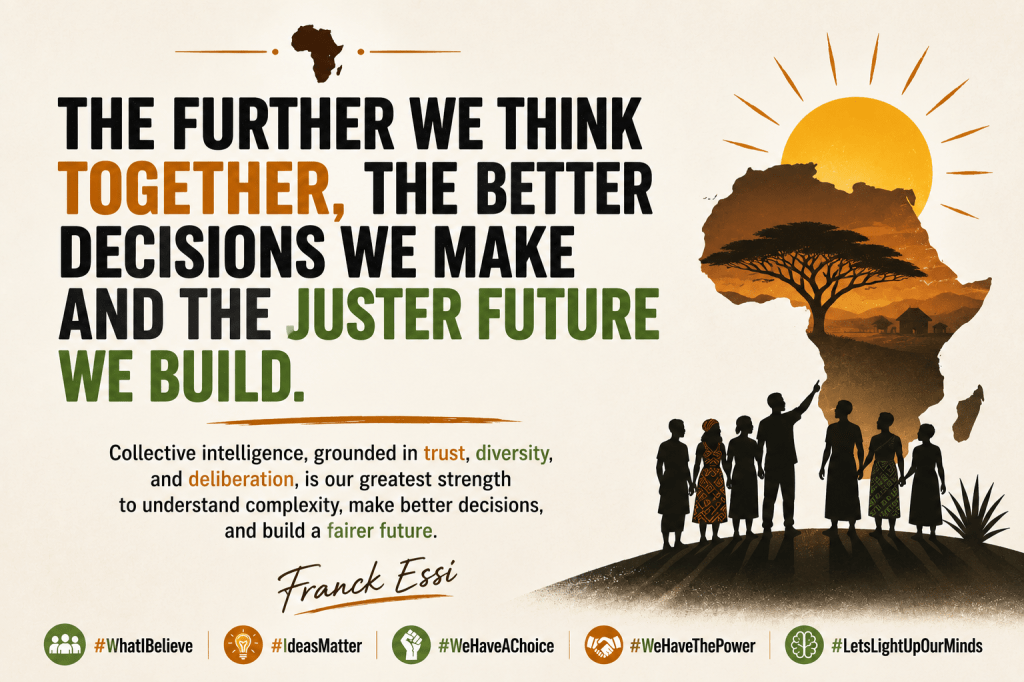
One of the great paradoxes of our time is that we have probably never had so many educated, skilled, connected, and qualified people, yet many organizations continue to produce results far below the level of talent they bring together.
This paradox can be observed everywhere:
- In businesses;
- In public institutions;
- In political parties;
- In citizen movements;
- In civil society organizations;
- And sometimes even in entire states.
We encounter brilliant individuals, recognized experts, competent professionals, committed activists, and people genuinely driven by a desire to contribute. Yet, all too often, the collective remains weak. Information does not flow effectively. Conflicts consume valuable energy. The same mistakes are repeated. Decisions are made by a few, with little collective learning. The talent exists, but it does not reinforce itself.
This is why the central argument of this article is simple: the main challenge facing many organizations is not merely finding intelligent, competent, or committed people. It is creating the conditions that allow individual intelligences to be transformed into collective intelligence.
In other words, it is not enough to gather capable people. We must also learn how to help them think, learn, decide, and act together.
In that sense, collective intelligence is also deeply connected to my understanding of authentic democracy. Not democracy reduced to elections, procedures, slogans, or the mechanical rule of numbers, but democracy understood as the reign of persuasion, deliberation, listening, constructive disagreement, and shared reasoning.
Inclusive institutions that organize meaningful participation and mobilize the intelligence of the greatest possible number of people are not only more democratic. They are also closer to truth because they allow more fragments of reality to be seen, heard, tested, and connected.
AN IDEA OLDER THAN WE OFTEN THINK
Collective intelligence is often presented as a modern concept associated with management theories, digital technologies, or new organizational practices. This perception is partly true, but it is also incomplete.
Long before contemporary books on collective intelligence were written, many human societies had already understood that no individual possesses all the wisdom necessary to address the complex challenges of a community.
Across many African societies, important decisions were often preceded by extensive discussions within families, communities, councils of elders, mediation processes, or public deliberations under the palaver tree. The goal was not simply to decide. The goal was to understand: to understand the problem, its implications, the different perspectives involved, and the possible consequences of the available options.
These systems were certainly not perfect. Like all human institutions, they had their limitations. Yet they embodied a profound insight: the quality of a decision often depends more on the quality of the collective process that produces it than on the status of the individual who makes it.
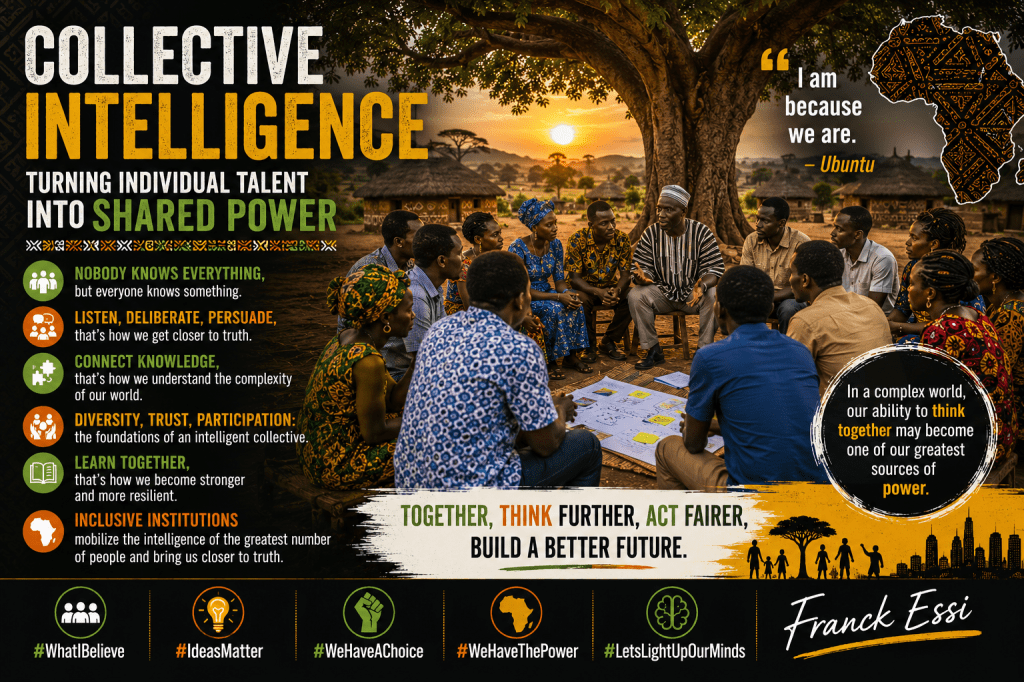
The philosophy of Ubuntu expresses this insight particularly well. “I am because we are.” This phrase is often interpreted as a call for solidarity. It is also a theory of human knowledge. It reminds us that our understanding of the world is built through our relationships with others. Our ideas develop through exchange, our certainties are refined through dialogue, and our solutions improve through the experiences of others.
In other words, intelligence is not merely individual. It is also relational.
PIERRE LÉVY: INTELLIGENCE IS DISTRIBUTED EVERYWHERE
One of the most influential French-language works on the subject is Collective Intelligence: Mankind’s Emerging World in Cyberspace by Pierre Lévy, published in 1994.
Lévy’s central argument is that intelligence is distributed throughout society. Nobody knows everything, but everyone knows something. The challenge for a community, an organization, or a society is therefore to recognize, value, coordinate, and mobilize the knowledge dispersed among its members.
This idea is transformative because it challenges the traditional assumption that intelligence is concentrated at the top. In many organizations, it is still assumed that the most valuable knowledge resides primarily with leaders, experts, consultants, executives, or senior officials.
Lévy invites us to think differently. Useful intelligence is often spread throughout the entire organization. It may be found in leadership, but also:
- Among grassroots activists;
- Among frontline workers;
- Among newly recruited members;
- Among veterans who carry institutional memory;
- Among women whose perspectives are sometimes overlooked;
- Among technicians who understand practical realities;
- Among citizens who experience the consequences of decisions firsthand.
An organization becomes intelligent when it learns how to connect these distributed forms of knowledge and transform them into collective action.
ÉMILE SERVAN-SCHREIBER: GROUPS CAN BE SMARTER THAN INDIVIDUALS
In his book Supercollective: The New Power of Collective Intelligence (2018), Émile Servan-Schreiber draws on contemporary research in cognitive science, organizational behavior, and collective intelligence.
His central argument is that groups can achieve better results than the individuals who compose them, provided they are properly organized.
This means that a group is not automatically intelligent. It can be brilliant, but it can also be foolish. It can produce wisdom, but it can also produce conformity, collective illusions, and poor decisions. Everything depends on how it functions.
This is a crucial lesson for our organizations. Bringing people together in the same room, creating a WhatsApp group, or organizing a meeting does not automatically generate collective intelligence.
Collective intelligence requires:
- Methods;
- Rules;
- A culture of dialogue;
- Deliberate collaboration;
- The ability to integrate diverse contributions into a shared understanding.
ANITA WOOLLEY: WHAT MAKES A GROUP INTELLIGENT
Research conducted by Anita Woolley and her colleagues, published in Science in 2010, identified what they describe as a collective intelligence factor.
Their conclusions are particularly illuminating. The most effective groups are not necessarily those composed of individuals with the highest IQs. Rather, they are groups where:
- Members genuinely listen to one another;
- Participation is balanced;
- No one consistently dominates discussions;
- Members display social sensitivity;
- Diverse perspectives are valued;
- Disagreement can be expressed without fear.
This discovery is profound. It suggests that collective intelligence depends less on the genius of a few individuals than on the quality of interactions among group members.
Many organizations devote significant energy to recruiting talented people while paying little attention to relationships, dialogue, and learning processes. Yet a group composed of highly intelligent individuals can produce weak collective intelligence. Conversely, ordinary individuals can achieve extraordinary results when they learn to think and act together.
EDGAR MORIN: COMPLEXITY REQUIRES CONNECTING KNOWLEDGE
Through works such as Introduction to Complex Thought and The Seven Complex Lessons in Education for the Future, Edgar Morin helps us understand why collective intelligence has become so important.
His central idea is that reality is complex. Human, political, economic, social, and environmental phenomena are rarely isolated. They are made up of interactions, contradictions, uncertainties, feedback loops, and unintended consequences.
In such a world, simplistic thinking becomes dangerous. It separates what should be connected, isolates what functions together, and reduces reality to overly simplistic explanations.
The great challenges of our time cannot be understood from a single point of view. They require us to connect different forms of knowledge:
- Connecting economics and politics;
- Connecting culture and institutions;
- Connecting history and present realities;
- Connecting technical expertise and lived experience;
- Connecting experts and citizens;
- Connecting strategy and practice.
This is where Morin’s thinking converges with the idea of collective intelligence. Faced with complexity, no individual can see everything. But a well-organized collective can combine perspectives, correct blind spots, and develop a richer understanding of reality.
This is also why democratic deliberation matters so much. When it is authentic, it does not merely count opinions. It confronts them, refines them, tests them, and sometimes transforms them.
A society that deliberates seriously gives itself a better chance of approaching truth than a society where a few individuals decide alone, however brilliant they may believe themselves to be.
THE DANGER OF GROUPTHINK
There is, however, an important warning: not every collective dynamic produces intelligence.
The psychologist Irving Janis showed that highly cohesive groups can make disastrous decisions when they prioritize consensus over critical thinking.
When disagreement becomes difficult, learning declines. When loyalty is confused with silence, mistakes multiply. When criticism is treated as betrayal, organizations become intellectually fragile.
A truly intelligent organization is therefore not one where everyone always agrees. It is one where disagreement can be expressed, explored, and transformed into deeper understanding.
PETER SENGE: THE LEARNING ORGANIZATION
In The Fifth Discipline, Peter Senge develops the concept of the learning organization.
A learning organization does not simply execute tasks. It learns from experience, studies its mistakes, documents its lessons, develops its members, and transforms challenges into opportunities for improvement.
Rather than depending on the intelligence of a few leaders, it builds systems that allow the entire organization to learn and evolve.
This idea is particularly important for organizations seeking social or political change. Organizations that fail to learn inevitably repeat the same mistakes. Those that learn become, over time, more adaptive, resilient, and effective.
WHAT NATURE TEACHES US
Nature also provides powerful examples of collective intelligence. Ant colonies, bee swarms, schools of fish, and flocks of birds demonstrate how individuals with limited information can collectively produce highly effective outcomes.
This phenomenon is often referred to as swarm intelligence. No individual controls the entire system. Yet interactions among individuals generate a form of collective wisdom.
This lesson is valuable. It suggests that the strength of a system does not necessarily reside in a single center of command. It may also reside in:
- The quality of its interactions;
- The quality of its information flows;
- Its capacity for continuous adaptation.
Human societies are obviously more complex than ant colonies. They are shaped by values, cultures, emotions, ambitions, conflicts, and power relations.
Yet nature reminds us of an important principle: the intelligence of a system often depends less on the power of a single element than on the quality of the relationships among its elements.
WHY OUR ORGANIZATIONS NEED IT
This reflection is particularly relevant in African contexts.
Many organizations possess talented, courageous, and committed people. Yet they remain fragile because they depend excessively on a handful of individuals:
- A few people think for everyone;
- A few people decide for everyone;
- A few people hold most of the institutional memory;
- A few people control most of the information;
- A few people almost single-handedly embody the organization.
This situation may create an appearance of efficiency in the short term. But it weakens the organization in the long term. When these individuals become exhausted, leave, make mistakes, or disappear, the entire organization suffers.
Building collective intelligence is therefore also about building resilience. It means ensuring that an organization depends not merely on a few minds, but on a living community capable of learning, thinking, and acting together.
It also means accepting that inclusive institutions are not only morally preferable. They are strategically wiser.
When more people can contribute meaningfully to understanding shared problems, the organization increases its chances of seeing reality more fully and acting more responsibly.
HOW DO WE BUILD COLLECTIVE INTELLIGENCE?
Collective intelligence does not emerge by decree. It is built through deliberate practices.
Organizations must:
- Cultivate trust;
- Organize participation;
- Value diversity;
- Encourage listening;
- Promote constructive debate;
- Document learning;
- Create spaces for collective reflection.
Without trust, people hide their doubts, mistakes, disagreements, and sometimes even critical information.
Without genuine participation, organizations deprive themselves of a large share of the knowledge available to them.
Without diversity, they expose themselves to greater blind spots and collective errors.
HOW DO WE DEVELOP AND SUSTAIN IT?
Developing collective intelligence requires habits and structures:
- Better meetings;
- Regular reflection sessions;
- Spaces where questions can be asked without humiliation;
- Knowledge-transfer mechanisms across generations;
- Internal training;
- Working groups;
- Communities of practice;
- Strategic debates;
- Honest evaluations after major initiatives.
But it also requires an ethic: the humility to recognize that we do not know everything, the courage to speak honestly, the patience to listen carefully, the discipline to transform ideas into decisions, and the responsibility to transform decisions into action.
Without these qualities, collective intelligence remains little more than an attractive slogan.
THE GREAT LESSON
What Ubuntu, Pierre Lévy, Émile Servan-Schreiber, Anita Woolley, Edgar Morin, Peter Senge, and even nature itself teach us is that collective intelligence is neither a trend nor a managerial luxury.
It is a necessity for navigating complexity.
It reminds us:
- That nobody knows everything;
- That everyone can contribute;
- That the quality of a collective depends on the quality of its relationships;
- That complexity requires connecting knowledge;
- That disagreement can be a resource;
- That persuasion is superior to imposition when we seek durable and legitimate solutions;
- That deliberation is one of the highest forms of collective lucidity.
It also reminds us that the strongest organizations are not necessarily those that gather the most brilliant individuals, but those that know how to cultivate shared intelligence.
Ultimately, the question is not simply whether we have competent people.
The real question is: have we built organizations capable of mobilizing, connecting, and multiplying the capacities of all their members?
This may well be one of the greatest challenges facing our political parties, citizen movements, civil society organizations, public institutions, businesses, and states.
For in a world that has become too complex to be understood by any single individual, our ability to think together may become one of our greatest sources of power.
And perhaps this is why authentic democracy remains one of humanity’s most demanding and promising inventions: because, at its best, it rejects the arrogance of isolated certainty and organizes the collective search for better answers.
Franck Essi
#WhatIBelieve #IdeasMatter #WeHaveAChoice #WeHaveThePower #LetsLightUpOurMinds
References and Further Reading
- Pierre Lévy, Collective Intelligence: Mankind’s Emerging World in Cyberspace (1994): https://www.editionsladecouverte.fr/l_intelligence_collective-9782707142696
- Émile Servan-Schreiber, Supercollective: The New Power of Collective Intelligence (2018): https://www.fayard.fr/documents-temoignages/supercollectif-9782213707945
- Anita Woolley et al., “Evidence for a Collective Intelligence Factor in the Performance of Human Groups”, Science (2010): https://pubmed.ncbi.nlm.nih.gov/20929725/
- Edgar Morin, Introduction to Complex Thought: https://www.seuil.com/ouvrage/introduction-a-la-pensee-complexe-edgar-morin/9782020144483
- Edgar Morin, The Seven Complex Lessons in Education for the Future (UNESCO): https://unesdoc.unesco.org/ark:/48223/pf0000117740_eng
- Irving Janis, Victims of Groupthink (1972): https://archive.org/details/victimsofgroupth0000jani
- Peter Senge, The Fifth Discipline: https://www.penguinrandomhouse.com/books/160/the-fifth-discipline-by-peter-m-senge/
- Mehdi Moussaïd, Simon Garnier, Guy Theraulaz & Dirk Helbing, “Collective Information Processing and Pattern Formation in Swarms, Flocks and Crowds”: https://arxiv.org/abs/1005.3507
 franckessi.com