By Franck Essi
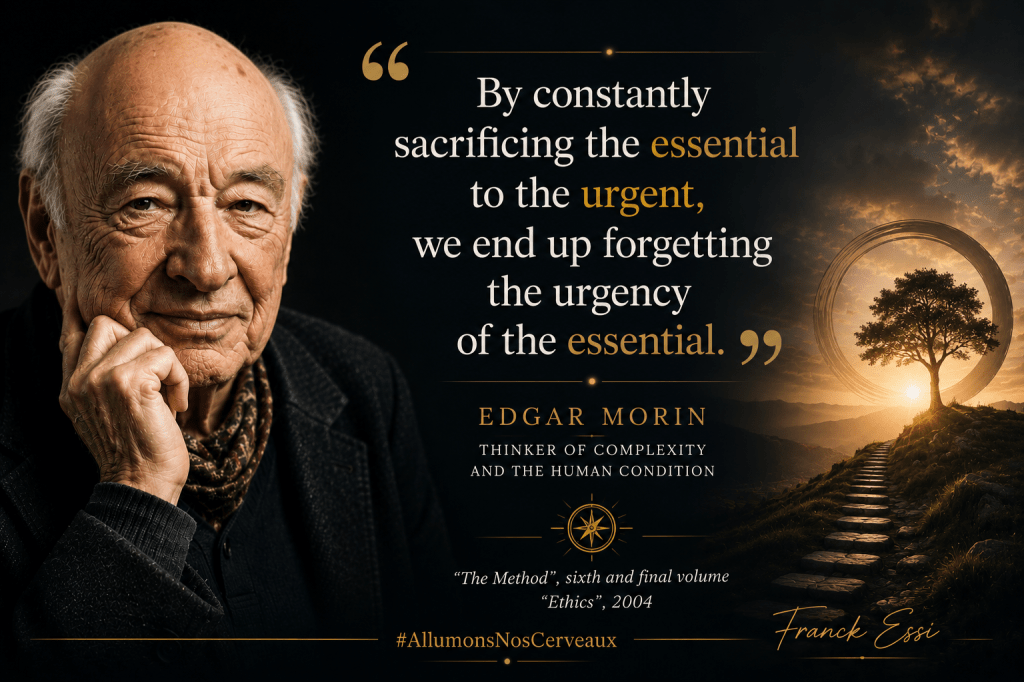
There are people we meet in person. And then there are those we encounter through their books, their lectures, their interviews, their courses, their ideas, and the questions they help us ask ourselves. Edgar Morin belongs to the latter group for me.
I never met him. Nor do I presume to know a significant portion of his immense body of work, so vast, rich, and demanding is it. But I have read him. I have listened to him. I have watched hours and hours of lectures, interviews, and dialogues he gave over the decades. I also had the pleasure, a few years ago, of taking several introductory online courses on his thought and, above all, his method, offered by ESSEC. I have pondered many of his reflections, his warnings, his intuitions, and his proposals.
And like many others, no doubt, I would have loved to meet him. I would have loved to talk with him. I would have loved to be around him. Because Edgar Morin embodied, in my eyes, something that is becoming rare: the alliance of the intellectual, the sage, and the humanist. The intellectual who seeks to understand before judging. The sage who accepts uncertainty rather than taking refuge in certainties. The humanist who refuses to despair of humanity despite its errors, its violence, and its failings.
Upon Edgar Morin’s death, many paid tribute to the philosopher, the sociologist, the thinker of complexity, and the author of The Method. All of this is true. But what strikes me most is that behind the diversity of his work, he was fundamentally pursuing the same question: how to learn to live humanely in a complex, uncertain, and profoundly interdependent world?
This question runs through all his work. It also runs through his entire life. And it is probably more relevant today than it has ever been.
A life in contact with history
Born in 1921 as Edgar Nahoum, Edgar Morin has lived through more than a century of human history. Few thinkers have witnessed so many upheavals: the rise of fascism, the Second World War, the Resistance, the Cold War, decolonization, the expansion of globalized capitalism, May 68, the digital revolution, the ecological crisis, the Covid-19 pandemic, and the rise of artificial intelligence.
But to reduce Edgar Morin to a mere witness of the century would be a mistake. He participated in his time. He engaged with it. He sometimes made mistakes. And he tried to learn from them.
One of the defining experiences of his life was the early death of his mother when he was still a child. This wound never left him. It permeates a significant part of his thinking on the human condition, the fragility of existence, and the relationship to death.
Later, during World War II, he joined the Resistance. Like many young people of his generation, he was then drawn to communism, which at the time appeared as an alternative to fascism and social injustices. But he gradually discovered the limitations, the blind spots, and the excesses of the Soviet system. Unlike many, he neither sought to conceal its errors nor to justify them. He made them an object of reflection.
In his book Autocritique, published in 1959, he reflects on his own illusions and the intellectual mechanisms that can lead sincere people to adhere to erroneous worldviews. This book seems particularly important to me today. At a time when everyone seems compelled to defend their own side at all costs, Edgar Morin reminds us that there is an intellectual virtue even more important than loyalty to a cause: loyalty to the truth.
Admitting one’s mistakes is not a weakness. It is often a sign of maturity.
A researcher of reality before being a theorist
Another dimension of Morin seems to me to be often underestimated. He is frequently presented as a philosopher, sociologist, or thinker of complexity. But we sometimes forget to what extent he was also an investigator of reality.
He was not only a man of concepts. He was also a man of action. He liked to observe societies as they actually live: villages, towns, families, cultural practices, daily behaviors, collective imaginaries, the silent transformations that run through societies.
His famous study of the Breton commune of Plozévet remains emblematic in this regard. While many intellectuals spoke of the people in abstract terms, Morin went to see for himself. He observed, questioned, listened, and tried to understand how economic, technological, and cultural changes were concretely transforming daily life.
This approach remains remarkably relevant. Because we live in a world where opinions are numerous but observation is often rare; a world where certainties circulate faster than investigations; a world where judgments often precede understanding.
Morin reminds us of a simple requirement: before explaining reality, we must begin by looking at it.
An exceptional academic career
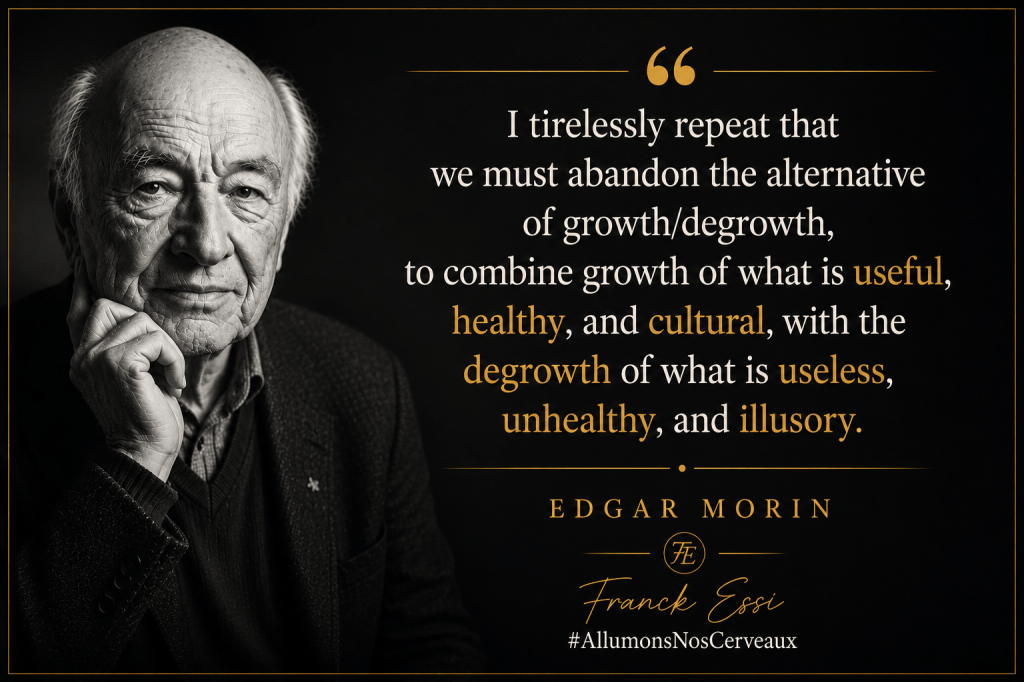
Edgar Morin’s academic career is also unique. Unlike many prominent French intellectuals, he did not follow the traditional academic path. He was neither a graduate of the École Normale Supérieure nor a professor. He only held a bachelor’s degree. And yet, he went on to become a research director at the CNRS, one of France’s most prestigious scientific institutions.
Over time, his work earned him more than forty honorary doctorates worldwide. For those unfamiliar with academia, an honorary doctorate is an exceptional distinction awarded by a university to an individual whose intellectual, scientific, artistic, or humanistic contributions are deemed outstanding.
In other words, universities around the world recognized Edgar Morin as a thinker whose contribution far transcended traditional disciplinary boundaries. This, too, is a lesson. Degrees matter. Rigor matters. Method matters. But the value of a thought is not measured solely by academic credentials. It is also measured by its capacity to illuminate reality, to open new perspectives, and to help human beings better understand their condition.
An immense body of work serving a single quest
Edgar Morin’s work is difficult to summarize because it spans several fields: sociology, anthropology, philosophy, education, politics, ecology, cinema, mass culture, knowledge, death, life, and the future of humanity. But it is not scattered. Behind this diversity lies a profound quest: to understand humanity in its complexity and to conceive of the world as a web of relationships.
In Man and Death , Morin explores one of the great mysteries of our condition: our relationship to finitude. He shows that the human being is not only a biological being who dies, but also a symbolic being who gives meaning to death, who surrounds it with rites, stories, beliefs, fears, dreams and hopes.
In Cinema or the Imaginary Man , he understands very early on that images are not mere entertainment. They construct our desires, our identifications, our myths, our fears, our heroes, and our relationship to reality. In the age of social media, short videos, generative artificial intelligence, and mass-produced imaginaries, this intuition is remarkably relevant.
In Autocritique , he makes his own political journey an object of lucidity. He does not only speak of communism. He speaks of the possible blindness of intelligence when it becomes a prisoner of an ideology, a group, a camp, or a hope that has become dogma.
In Commune en France: la métamorphose de Plozévet , he shows the sociologist at work: not the one who imposes a theory on society, but the one who immerses himself in the social body to understand the mutations of daily life.
In The Method , his monumental six-volume work, he proposes a profound reform of thought. It is not simply a matter of accumulating knowledge. It is about learning to connect knowledge, to understand the interactions, contradictions, loops, uncertainties, and unexpected effects of our actions.
In Earth-Homeland , he invites us to think of humanity as a community of shared destiny. This idea is more relevant today than ever. Climate change, pandemics, migrations, wars, food crises, artificial intelligence, global inequalities, and the fragility of ecosystems remind us that no people can sustainably save themselves alone.
In The Seven Complex Lessons in Education for the Future , he proposes to rethink education around a few fundamental requirements: knowing the risks of error and illusion, promoting knowledge capable of connecting, teaching the human condition, teaching earthly identity, facing uncertainties, learning understanding and building an ethic of humankind.
In The Way , he does not simply diagnose the crises. He proposes to explore the paths to another possible civilization: reform of thought, reform of education, reform of politics, reform of the economy, ecological reform, reform of life.
In Journeying Towards the Essential , he returns to more internal questions: wisdom, death, spirituality, the unpredictable, joy, creativity, the depth of life and the need to learn to exist in an unstable world.
There is therefore a coherence in this work. Morin did not simply write on several subjects. He attempted, throughout his life, to understand what connects the subjects to each other.
The method: learning to connect
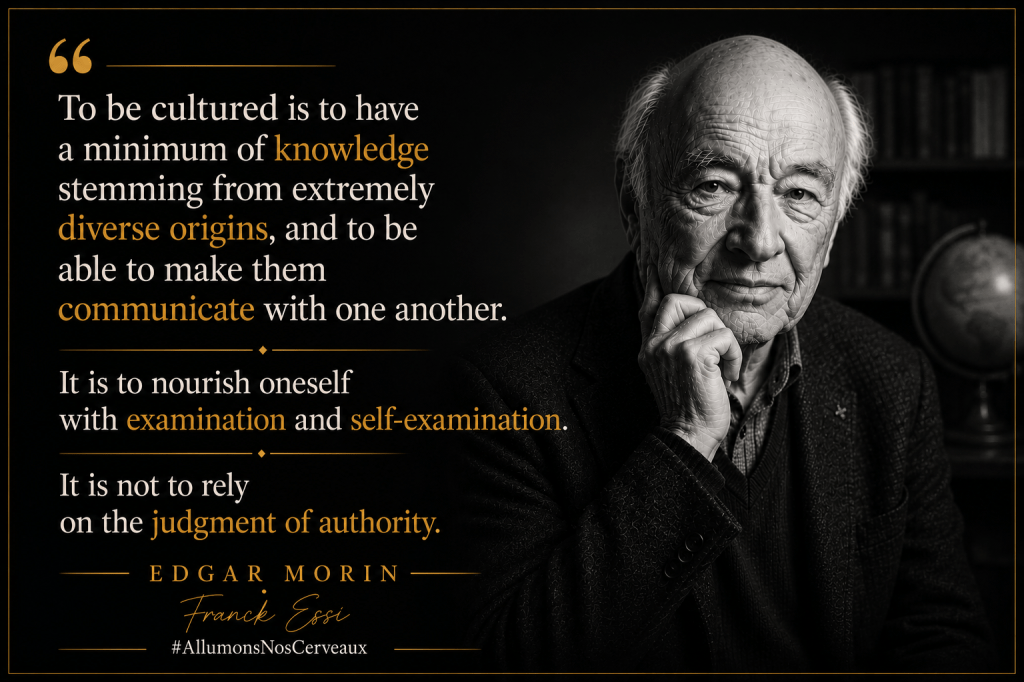
The best-known concept associated with Edgar Morin is that of complex thought. It must be stated clearly: complex thought is not complicated thought. It is thought that refuses to distort reality.
She asks us to understand that human affairs are almost never caused by a single factor. A political crisis is never solely political. It is also economic, social, historical, cultural, psychological, institutional, and sometimes geopolitical. A school crisis is never simply a matter of teachers or students. It also relates to the family, the state, inequalities, social imaginaries, the relationship to knowledge, language, digital technology, and the vision of society.
Let’s take the example of contemporary Africa. African democratic crises cannot be understood solely through the lens of the ill will of a few leaders. We must also consider colonial history, the incomplete construction of states, weak institutions, economic dependencies, geopolitical dynamics, internal divisions, poverty, social frustrations, power dynamics, fear of change, and sometimes the inability of alternative forces to develop methods, organizations, and strategies commensurate with the challenges.
This perspective doesn’t justify anything. But it allows for better understanding. And what we understand better, we can better transform.
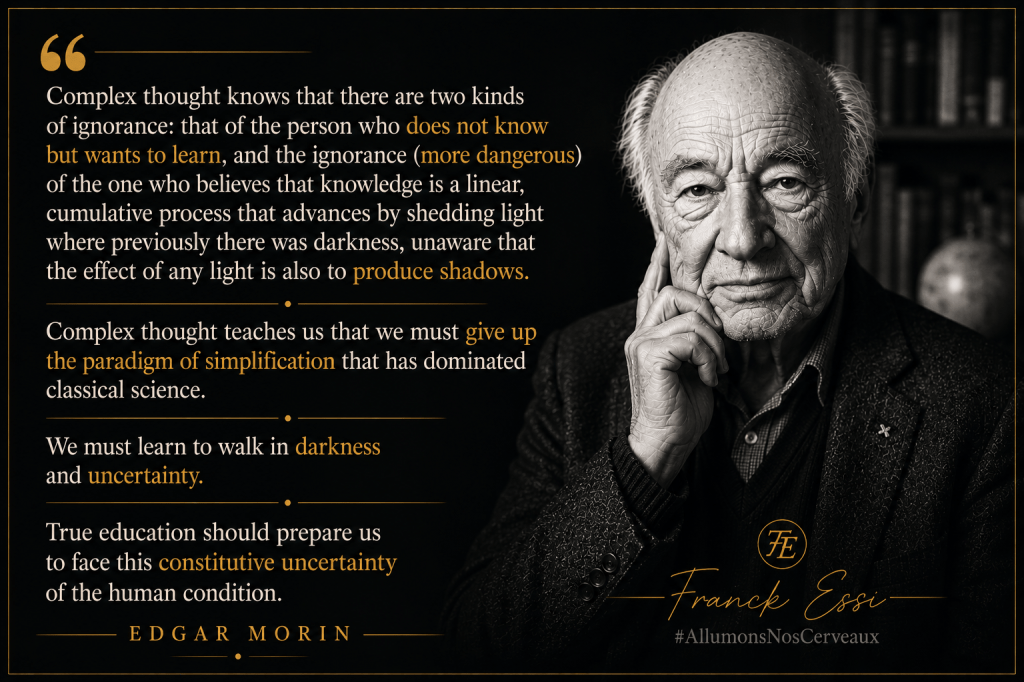
Complex thinking unfolds through several essential stances. First, there is reconnection , which consists of reconnecting what we have separated: knowledge, generations, peoples, the individual and the collective, the economy and ecology, politics and ethics, the local and the global. Then there is dialogic thinking , which allows us to think together about contradictory but inseparable realities: order and disorder, reason and emotion, autonomy and dependence, the individual and society. Finally, there is the ecology of action , according to which an action, as soon as it enters the world, partially escapes the intention of the one who initiated it.
This last point is crucial. Good intentions can backfire. Necessary reforms can have unintended negative consequences. Legitimate mobilization can be hijacked. Just words can be misunderstood. Technology designed to connect people can also foster surveillance, manipulation, addiction, and disinformation.
Morin teaches us that responsible action is action that accepts to monitor itself.
The Seven Complex Lessons in Science: An Educational and Civilizational Program
In *The Seven Complex Lessons in Education for the Future *, Edgar Morin offers much more than a school curriculum. He provides a compass for shaping human beings capable of inhabiting an uncertain world. These seven key areas of knowledge should be revisited in all schools, universities, civic education programs, political organizations, and any space where the future is being prepared.
The first piece of knowledge concerns the blind spots of understanding: error and illusion. Morin reminds us that no knowledge is definitively protected from error. Our perceptions can deceive us. Our emotions can influence our judgments. Our ideologies can filter the facts. Our affiliations can prevent us from seeing what is inconvenient. In this age of fake news, conspiracy theories, digital manipulation, and artificial intelligence, learning that we can be wrong becomes a fundamental democratic skill.
The second area of knowledge concerns the principles of relevant understanding. It is not enough to simply accumulate information. One must learn to contextualize it, to connect the parts to the whole and the whole to the parts. We often train specialists capable of mastering a fragment of reality, but incapable of understanding the interactions between problems. Yet, the major crises of our time do not respect disciplinary boundaries. Climate change affects the economy, health, agriculture, energy, cities, migration, social justice, and global governance.
The third area of knowledge invites us to teach about the human condition. Morin reminds us that human beings are simultaneously biological, psychological, social, cultural, historical, and, for some, spiritual. We teach a great deal about the world, but far too little about what it means to be human: to love, to suffer, to hope, to die, to belong, to create, to err, to learn, to live with others. An education that neglects the human condition risks producing skills devoid of wisdom.
The fourth area of knowledge concerns our Earthly identity. We belong to families, peoples, cultures, and nations. But we also belong to the same Earth. This idea may seem obvious. It is not, however, in our practices. Climate change, pandemics, migrations, wars, and economic interdependencies remind us that humanity shares a common home. Teaching about Earthly identity is not about denying homelands. It is about understanding that homelands themselves must learn to inhabit a broader community of shared destiny.
The fifth piece of knowledge is how to confront uncertainty. For a long time, education sometimes gave the impression that knowledge meant eliminating uncertainty. Morin, on the contrary, invites us to understand that uncertainty is part of life, history, science, politics, and action. The Covid-19 pandemic, economic crises, wars, technological disruptions, and climate upheavals remind us that the future is never entirely predictable. This should not paralyze us. It should make us more clear-sighted, more flexible, and more capable of adjusting our course.
The sixth skill is teaching understanding. Understanding is not excusing. Understanding means giving ourselves the means to avoid reducing others to caricatures. It means learning to listen, to contextualize, to recognize the fears, wounds, interests, and perceptions that reside within human beings. In polarized societies, where social media often encourages humiliation and condemnation, teaching understanding becomes a political imperative.
The seventh area of knowledge is the ethics of humankind. Morin invites us to consider three dimensions together: the individual, society, and the human species. A good society must not crush the individual. A free individual must not destroy society. And no society can ignore the common destiny of humanity. This ethics of humankind is perhaps one of the great tasks of the 21st century: learning to reconcile personal freedom, social solidarity, and planetary responsibility.
These seven areas of knowledge are not just ideas for schools. They are a program for civilization. They tell us that education should not only produce graduates. It must develop individuals capable of understanding, engaging in dialogue, questioning, connecting, acting, and living with others.
The Way: Moving beyond mere denunciation
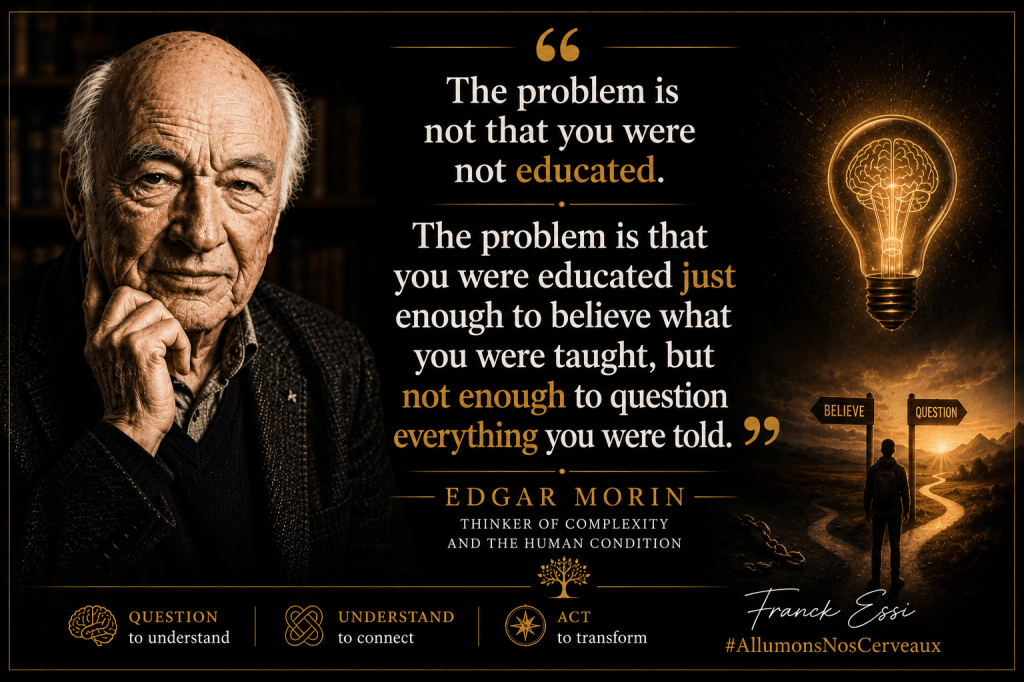
In The Way , Edgar Morin doesn’t simply state that the world is in a bad way. He shows that the crises of our time are intertwined: ecological crisis, economic crisis, social crisis, political crisis, crisis of civilization, crisis of thought, crisis of humanity itself. But he refuses to give in to despair.
He doesn’t offer a single solution. Rather, he speaks of multiple paths to be linked: reform of thought, reform of education, ecological reform, economic reform, political reform, social reform, and reform of daily life. This approach is valuable because it avoids two pitfalls: fatalism and oversimplification.
Fatalism says: all is lost. Simplism says: you just have to do one thing. Morin invites us to do something else: to identify initiatives, experiences, creative resistance, social innovations, forms of solidarity, learning institutions, practices of sobriety, new pedagogies, more humane economies, citizen movements and attempts at living democracy, and then learn to connect them.
This is a very powerful idea for our African societies. We often have admirable, but scattered initiatives: alternative schools, cooperatives, citizen movements, social entrepreneurs, women’s associations, young innovators, community actors, researchers, artists, religious leaders, local communities, farmers, caregivers, teachers who are already inventing pieces of the answers.
But these fragments often remain isolated. The question, therefore, is not simply: what needs to be invented? The question is also: how do we connect what already exists to create a historical force?
Journeying towards what is essential: the depth of a life
In Journeying Towards the Essential , Edgar Morin also emerges as a man of profound thought. He doesn’t just reflect on systems, crises, and civilizations. He also considers existence, interiority, the unpredictable, wisdom, death, joy, creativity, and the difficulty of learning to live.
This dimension is important. Because it is not enough to transform institutions if human beings remain prisoners of greed, fear, ego, hatred, closed-mindedness, and insensitivity. It is not enough to change structures if we do not also work on our way of being in the world.
This does not mean that we should take refuge in a spirituality that abandons social and political struggles. It means that any lasting external transformation also requires an internal transformation: learning to listen, to doubt, to love, to decenter oneself, to resist brutality, to inhabit uncertainty, to make room for joy, and not to lose sight of our humanity in the necessary struggles.
Morin thought deeply about death. But he never saw it as a negation of life. He saw it as a constitutive dimension of life. The awareness of death reminds us that life is fragile, that time is limited, that those we love are not eternal, that civilizations themselves can decline, that certainties can crumble, that nothing is ever truly secure.
But this awareness can also make us more alive. It can help us to love more, not to waste our lives on superficiality, not to reduce existence to consumption, not to confuse success with accumulation, not to forget joy, tenderness, friendship, gratitude, beauty and brotherhood.
There was something rare about Morin: a tragic lucidity that did not destroy hope. He saw the dangers. But he continued to believe in what was possible.
Morin, democracy and collective intelligence
Morin’s thought is also valuable for democracy. Not just democracy reduced to voting, formal institutions or electoral competitions, but democracy as a culture of deliberation, persuasion, fruitful contradiction and collective intelligence.
A vibrant democracy cannot function with citizens trapped in simplistic certainties, with factions that no longer listen to one another, with institutions that fail to learn, and with elites who disregard the complexity of reality. It requires citizens capable of doubting without giving up, of debating without humiliating, of opposing without dehumanizing, of deciding without claiming to know everything.
This is why complex thinking is also democratic thinking. It compels us to recognize that no single person possesses the entirety of reality. It compels us to listen to multiple perspectives, not to relativize everything, but to gain a deeper understanding. It compels us to build institutions that harness the intelligence of the greatest number, instead of reducing decision-making to a few closed circles.
In this sense, Morin speaks powerfully to societies still searching for their path to genuine democracy. Democracy cannot be merely a procedure; it must become a method of collectively producing clarity.
The relationship with institutions: learning or becoming fossilized
Edgar Morin also helps us to think about institutions. An institution can protect, transmit, organize, stabilize, and civilize. But it can also bureaucratize, rigidify, stifle, blind, and reproduce the very problems it claims to solve.
A school can cultivate free minds or produce mere repeaters. A political party can organize participation or manufacture obedience. An administration can serve the public or protect itself. A citizens’ organization can unleash potential or reproduce the authoritarian systems it opposes.
The question is therefore not only: what kind of institutions do we want? The question is also: how do we make our institutions capable of learning?
A living institution must be able to listen, correct, evaluate, engage in dialogue, integrate different forms of knowledge, welcome criticism, and transform itself. An institution that never doubts itself becomes dangerous.
The relationship to injustice: indignation is not enough
Edgar Morin was not indifferent to injustice. But he knew that indignation alone was not enough. Indignation can awaken, set in motion, and make visible what was hidden. But it does not replace analysis, organization, strategy, or method.
In our societies, we often experience righteous anger: anger against poverty, against injustice, against humiliation, against corruption, against inequality, against institutional violence, against the erosion of democratic rights. But anger, if left unchecked, can become a directionless force.
Morin teaches us that we must understand the systems that produce injustice: interests, beliefs, institutions, habits, fears, dependencies, imaginaries, and power relations.
A just cause requires a just intelligence.
Why Morin speaks so strongly to our time
Our era makes Edgar Morin even more necessary. We live in a world where crises respond to one another: climate change, wars, migrations, pandemics, inequalities, democratic fragilities, digital polarization, artificial intelligence, loneliness, loss of meaning and distrust of institutions.
We have more information than ever before, but not necessarily more understanding. We have more technological connections, but not necessarily more human connection. We have more experts, but not necessarily more collective wisdom. We talk more about humanity, but not always more humanity in our actions.
The major problem of our time may not be solely economic, ecological, or political. It is also a problem of thought. We too often continue to approach a complex world with intellectual tools designed to simplify, separate, classify, and reduce.
That is why Morin’s thought is not just a thought to admire. It is a thought to be put into practice.
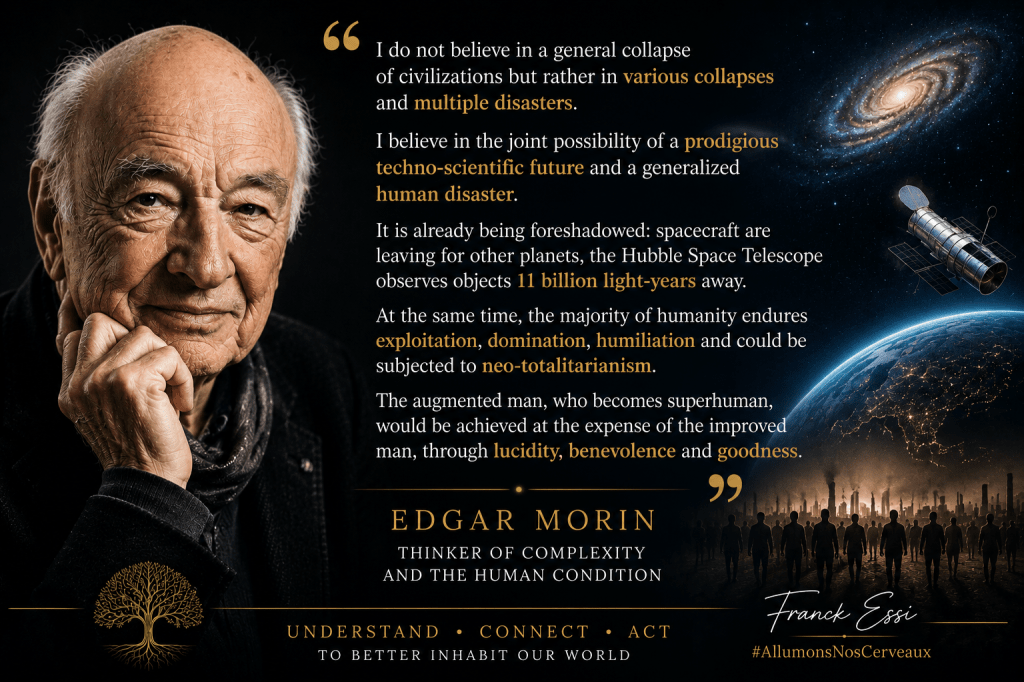
Key lessons for activists, leaders, educators and citizens
1. Thinking beyond slogans. Slogans can mobilize, but they can also impoverish thought. A people who want to liberate themselves must learn to think beyond formulas.
2. Connect before you decide. Before making a decision, you must understand the connections. Many bad decisions stem from good intentions hampered by misunderstandings.
3. Accept uncertainty without giving up on action. Uncertainty is not an excuse for inaction. It is an invitation to act with clarity, prudence, flexibility, and the ability to correct course.
4. Build learning institutions. An organization that doesn’t know how to learn ends up repeating its mistakes. An institution that refuses criticism ends up losing its ability to serve.
5. Beware of just causes without just methods. A just cause can be weakened by bad methods. Transformation requires passion, but also discipline, listening, strategy, and thought.
6. Make education a civilizational priority. Education should not only produce graduates. It must produce beings capable of understanding, engaging in dialogue, questioning, connecting, acting, and living with others.
7. Seek what is essential. In a world saturated with noise, speed, distractions, and emergencies, seeking what is essential becomes an act of resistance. What is essential is what makes us more human.
The true tribute
I never met Edgar Morin. Yet, like millions of people around the world, I sometimes felt as if I were walking alongside him. Not because he told us what to think, but because he taught us how to think.
The greatest tribute we can pay him, therefore, is not to celebrate him, to multiply his quotes, or to adopt a few concepts that have become popular. True homage lies in taking his method seriously: accepting the complexity of reality, learning to connect the dots, acknowledging our mistakes, developing institutions capable of learning, building more intelligent forms of action, cultivating dialogue rather than condemnation, and preferring lucidity to the comfort of certainty.
Because the tragedy of figures like Edgar Morin is often the same. They are admired, celebrated, quoted. Their ideas are taken up. But their approach is rarely followed to its conclusion.
We celebrate complex thought while continuing to think simply. We talk about dialogue while continuing to caricature our opponents. We invoke collective intelligence while reproducing organizations that stifle diverse viewpoints. We pay homage to great thinkers without accepting the transformations they demand of us.
Yet this is where true fidelity to their legacy begins. Not in the praise we offer them, but in the changes we are willing to make in the way we think, learn, act, lead, campaign, love, and inhabit the world.
By Franck Essi
#WhatIBelieve
#IdeasMatter
#WeHaveTheChoice
#WeHaveThePower
#TurnOnOurBrains
References for further reading
- Edgar Morin, Self-Criticism , Seuil.
- Edgar Morin, Man and Death , Seuil.
- Edgar Morin, Cinema or the Imaginary Man , Minuit.
- Edgar Morin, Commune in France: the metamorphosis of Plozévet , Fayard.
- Edgar Morin, The Method , Seuil.
- Edgar Morin, Terre-Patrie , Seuil.
- Edgar Morin, The Seven Complex Lessons in Education for the Future , UNESCO / Seuil: https://unesdoc.unesco.org/ark:/48223/pf0000117740_fre
- Edgar Morin, The Way: For the Future of Humanity , Fayard: https://www.fayard.fr/livre/la-voie-9782213655604/
- Edgar Morin and Marc de Smedt, Cheminer vers l’essentiel , Albin Michel.
- CNRS, “The long intellectual journey of Edgar Morin”: https://news.cnrs.fr/articles/the-long-intellectual-journey-of-edgar-morin
- UNESCO, “Edgar Morin: Teaching Complexity”: https://www.unesco.org/fr/articles/edgar-morin-enseigner-la-complexite
- Complexity Intelligence Network, resources on Edgar Morin: https://www.intelligence-complexite.org
 franckessi.com