By Franck Essi
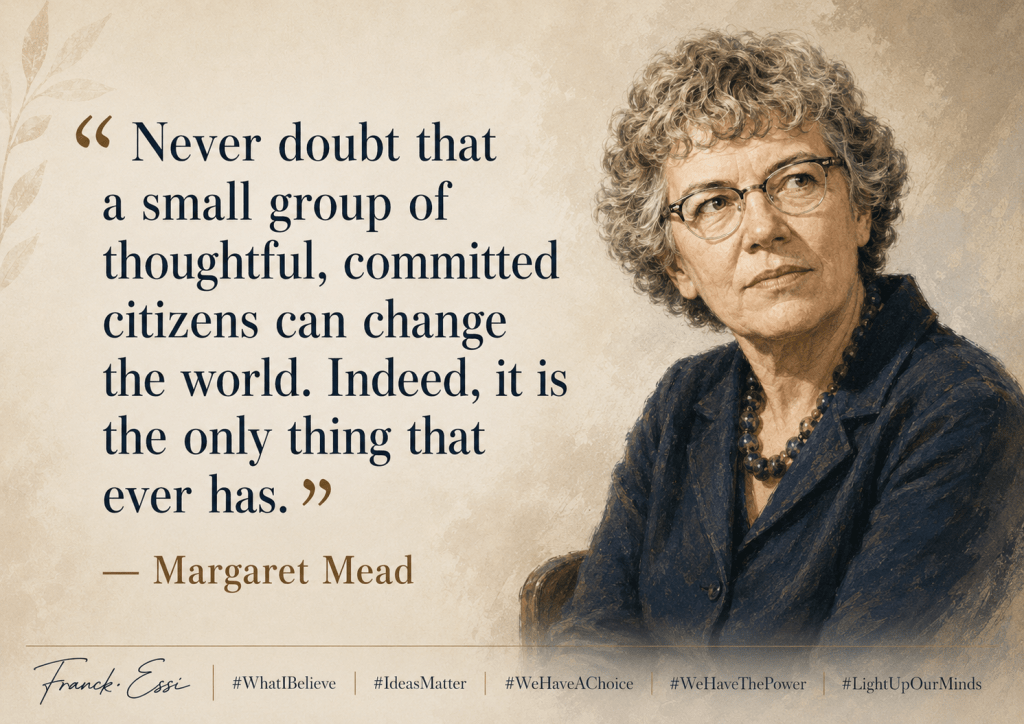
There comes a moment, in every difficult struggle, when those who refuse to give in to resignation ask themselves a simple, almost brutal question: what is the point of continuing when we are still so few?
I believe this question is deeply human. It is not necessarily a sign of weakness. It is not necessarily a lack of courage. It does not always mean that one has lost faith in the cause one is defending. Sometimes, it expresses fatigue. Sometimes, it expresses lucidity. Sometimes, it is simply a demand for truth toward oneself.
One can be right and still feel alone. One can see injustice clearly and realize that many people prefer to look away. One can understand the urgency of change and still see, all around, fear, caution, indifference, calculation or resignation. One can defend a just cause and sometimes feel as if one is speaking into emptiness.
This experience is not specific to one country. It runs through the history of peoples. It runs through African struggles. It also runs through the history of Cameroon. Before certain ideas became obvious, they were often minority ideas. Before peoples stood together, a few women and men often began almost alone.
This does not mean that all minorities are right. It does not mean that every committed minority will necessarily change history. There are also minorities trapped in their own certainties, unable to speak to society, unable to organize, unable to learn. We must therefore remain cautious.
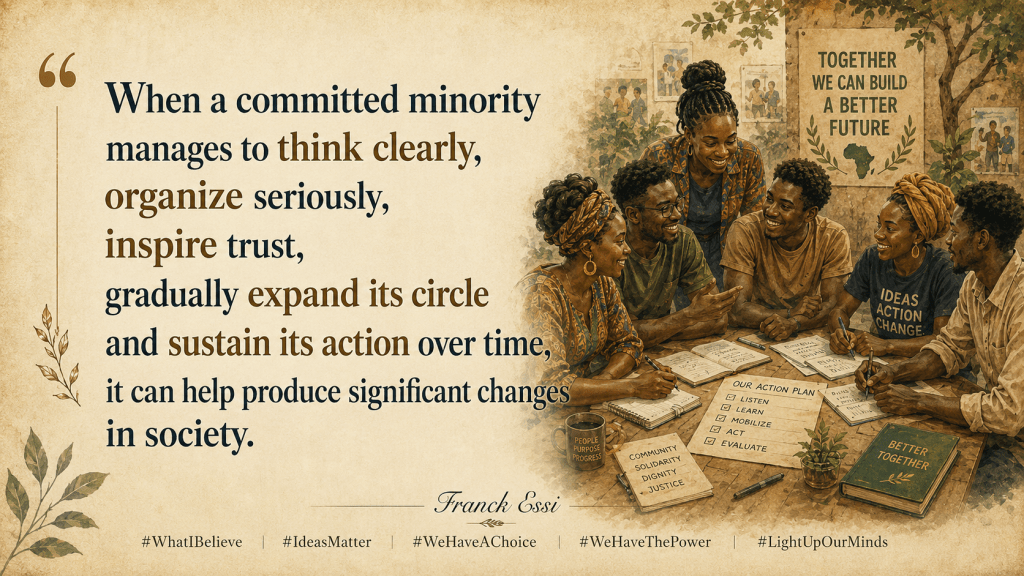
But it seems to me that history teaches us at least this: when a committed minority manages to think clearly, organize seriously, inspire trust, gradually expand its circle and sustain its action over time, it can help produce significant changes in society.
Before changes become possible, there often have to be minorities capable of:
- thinking before the majority understands;
- holding on before the crowds join;
- explaining before ideas become obvious;
- organizing before the balance of power becomes visible;
- convincing before change appears possible;
- lasting before history begins to shift.
This is why we must never confuse the small number at the beginning with the uselessness of the struggle. A minority can remain marginal when it merely takes comfort in being right among its own believers. But it can also become fruitful when it gradually manages to transform:
- diffuse suffering into collective consciousness;
- collective consciousness into organization;
- organization into trust;
- trust into participation;
- participation into a balance of power;
- a balance of power into institutional change.
This is the passage I want to reflect on here: under what conditions can committed minorities help produce real changes in society?
The notion of critical mass allows us to enter this reflection. It does not refer only to numbers. It also refers to several essential conditions:
- the quality of consciousness;
- the strength of organization;
- the credibility of actors;
- the discipline of action;
- the ability to broaden participation;
- strategic intelligence;
- the ability to transform a just cause into a social force;
- the ability to transform a temporary victory into lasting change.
In other words, the real question is not only: how many are we today? The real question may be more demanding:
- What are we doing with those who are already here?
- What kind of consciousness are we building?
- What kind of trust are we inspiring?
- What kind of organization are we preparing?
- What strategy are we following?
- What forms of action are we making possible?
- What institutions do we want to help bring into existence so that change is not merely a moment of emotion, but a lasting transformation?
1. A minority does not change society simply because it is right
One can be right and remain marginal. One can defend a just cause and not be heard. One can denounce an unjust system and still fail to make it retreat. This may seem paradoxical, but it is one of the great lessons of history: the righteousness of a cause is not enough to guarantee its victory.
There are peoples who suffer for decades without their suffering automatically producing political change. There are citizens who know that things are going badly, but who do not yet have the words, the analytical frameworks, the organization or the collective trust needed to act together.
Suffering can take many forms:
- individual anger;
- diffuse unease;
- silent humiliation;
- social frustration;
- a sense of injustice;
- a feeling of powerlessness;
- a temporary revolt;
- collective fatigue.
But as long as this suffering is not named, understood and organized, it can remain politically weak. That is why a committed minority must first do the work of clarification. It must help society understand what is wrong, why it is wrong, who benefits from this disorder, why this disorder is not inevitable, and how it could be transformed.
Social movement theory often refers to this as framing: the ability of a movement to give political meaning to scattered forms of suffering.
Suffering that is not named often remains private. Suffering that is understood becomes political. Suffering that is organized can become historical.
This idea seems decisive to me. Many peoples do not lack anger. What they sometimes lack is a shared reading of their own situation. They know that prices are rising, that institutions do not protect them, that injustices are multiplying, that rights are fragile, that predatory elites are prospering. But as long as all this is experienced as a sum of individual misfortunes, the system can continue to function.
Change begins when citizens understand that their suffering is not merely a series of separate accidents, but the symptoms of a political, economic, social and institutional order that can be contested and transformed.
The history of Cameroon speaks directly to us here. The Union of the Peoples of Cameroon did not merely carry a demand for independence. It helped build a national consciousness around several powerful ideas:
- sovereignty;
- reunification;
- national dignity;
- political emancipation;
- the critique of colonial domination;
- the demand for real, not merely formal, independence.
The UPC therefore carried out a work of consciousness. It named the problem, politicized suffering, built a national imagination and carried the Cameroonian question onto several fronts: popular, trade union, political, diplomatic and international.
But this national consciousness was violently repressed before it could become fully institutional. The lesson is painful but essential: a just idea is not enough; a strong consciousness is not enough; a legitimate cause is not always enough. Organization, networks, memory, a balance of power and institutions capable of embodying that idea over time are also necessary.
A critical mass that fails to become institutional can be crushed, distorted, erased, co-opted or silenced. This is one of the great tragedies of our history. It reminds us that lucidity is indispensable, but that it must be accompanied by the capacity to organize and transmit memory.
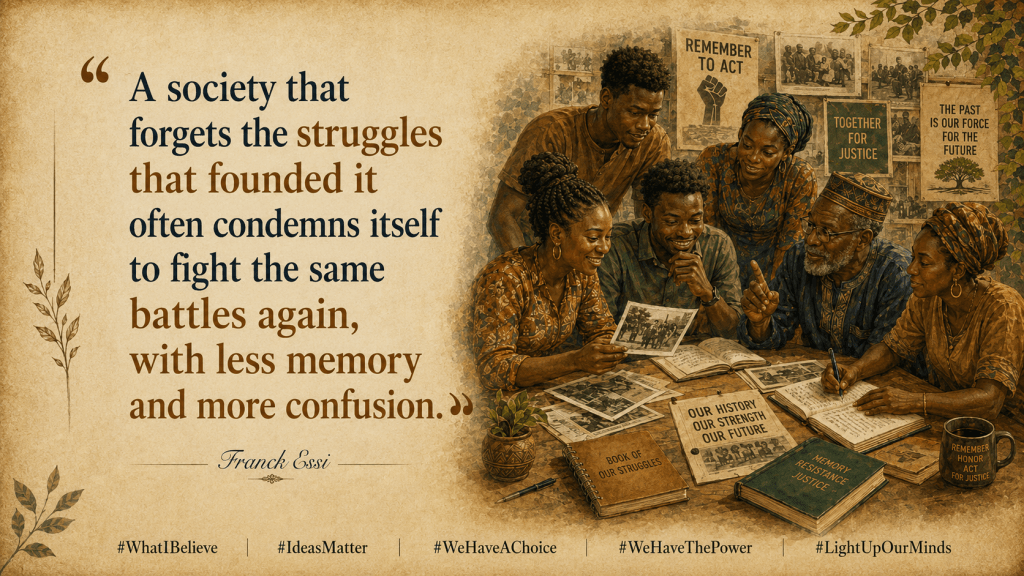
A society that forgets the struggles that founded it often condemns itself to fight the same battles again, with less memory and more confusion.
2. A minority must become credible before it can become majoritarian
There is a major difference between a convinced minority and a convincing minority. A convinced minority may be right in its own corner, speak to its own militants, reassure itself through the purity of its positions and lament the incomprehension of others. A convincing minority, however, learns how to speak to society.
It does not give up its ideas, but it makes them:
- understandable;
- credible;
- accessible;
- transmissible;
- embodied;
- connected to people’s real lives.
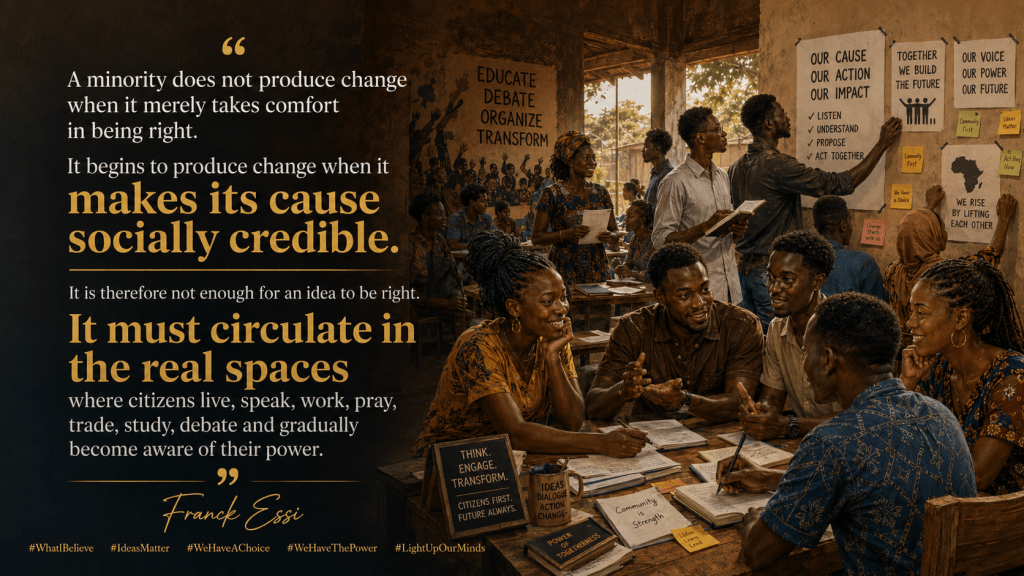
This is an essential condition for critical mass. A minority does not produce change when it merely takes comfort in being right. It begins to produce change when it makes its cause socially credible.
This requires patient work: pedagogy, example, coherence, embodiment, presence in society and the building of trust. It is not enough to have a correct discourse. Behaviours must inspire trust. It is not enough to have a vision. There must be forms of action in which citizens can recognize themselves. It is not enough to denounce. One must also show that another path is possible.
Research on the diffusion of ideas and innovations shows that new practices do not spread only because they are rational or just. They circulate through networks of trust. People often change when they see people close to them, or people they consider credible, adopting an idea, a behaviour or a new way of acting.
It is therefore not enough for an idea to be right. It must circulate in the real spaces where citizens live, speak, work, pray, trade, study, debate and gradually become aware of their power.
This circulation requires relays in several spaces of society:
- families;
- neighbourhoods;
- workplaces;
- trade unions;
- associations;
- citizen organizations;
- churches;
- mosques;
- faith communities;
- universities;
- media;
- digital networks;
- markets;
- professions;
- ordinary spaces of discussion.
The example of Senegal, particularly around the mobilizations of 2011–2012, is instructive. Citizen movements such as Y’en a Marre and other social forces did not merely express anger against an attempt to confiscate power. They helped translate that anger into civic action.
This translation took several forms:
- registration on electoral lists;
- youth mobilization;
- defence of the Constitution;
- pressure on institutions;
- monitoring of the electoral process;
- use of popular culture;
- politicization through rap, slogans and accessible forms of communication.
This passage is important. Anger could have remained a collective emotion. It was transformed into concrete political behaviour. Rap, popular language, slogans, youth networks, citizen alliances and electoral mobilization helped circulate a simple idea: democracy is not protected merely by commenting on current affairs; it is protected through organized citizen engagement.
Indignation is not enough. Indignation must become action, action must become pressure, pressure must produce results, and results must become lasting vigilance.
Senegal therefore reminds us that democracy is not defended only in speeches. It is defended by citizens who are organized, informed, vigilant and capable of turning their frustration into civic action. It also reminds us of another thing: youth is not merely a demographic category. It becomes a historical force when it produces consciousness, culture, discipline and forms of action adapted to its time.
3. Critical mass emerges when fear begins to retreat
In many authoritarian or highly locked political systems, the problem is not always that citizens approve of the existing order. Very often, many citizens disapprove in silence. They see abuses. They criticize in private. They complain in families, taxis, offices, markets or closed networks. But they do not always cross the threshold into public engagement.
Why? Because they are afraid. They are afraid of losing their jobs, being arrested, being isolated, being betrayed, being misunderstood, being repressed, being abandoned or paying the price of engagement alone. They also remain silent because they believe they are alone, because they think nothing will change, because they do not yet see a credible organization, or because they have sometimes seen too many failures, too many betrayals, too much repression and too many broken promises.
The role of a committed minority is then to break this solitude. When citizens see that other people think like them, speak like them, refuse like them, organize like them and hold on despite difficulties, something begins to change. Fear does not immediately disappear, but it ceases to be the only organizing principle of collective life.
A critical mass often begins with this simple discovery: we are not alone.
This discovery may seem minimal. It is nevertheless decisive. In a system of domination, one of the most powerful mechanisms of social control is the psychological isolation of citizens. Each person thinks they are alone in seeing, alone in understanding, alone in being indignant, alone in wanting something else. When this illusion of solitude begins to crack, the power of fear also begins to crack.
We can reread the “ghost towns” of the 1990s in Cameroon through this lens. In a context of democratic demands, contestation of the single-party system and calls for political opening, they expressed a form of social and economic non-cooperation.
Concretely, this meant that:
- shops closed;
- transport slowed down or stopped;
- ordinary activities were suspended;
- the normal functioning of the system was disrupted;
- part of society refused to continue as if nothing was happening.
It was not only a protest. It was also a collective message. Part of society clearly stated that it no longer wished to participate normally in the functioning of a contested political order.
This mobilization helped secure important concessions, including the opening to multiparty politics and the expansion of certain spaces of expression. But it also reveals a fundamental limitation: a critical mass can force a system to adapt without successfully transforming it.
Cameroon experienced political opening without a genuine refoundation of the state. Multiparty politics was legalized, but the system of power remained deeply centralized. Freedoms were proclaimed, but the rules of the game were not transformed in depth.
This is sometimes the most subtle trap of authoritarian systems: to concede enough to survive, but not enough to truly democratize.
The history of the 1990s therefore reminds us that fear can retreat, society can mobilize, concessions can be obtained, but all this remains fragile if the balance of power does not lead to a refoundation of the rules of the game.
4. Critical mass is not necessarily the majority: what Chenoweth’s work suggests
We often hear that a people can only change its destiny when the majority mobilizes. I think this idea needs to be nuanced. Of course, the broader a mobilization is, the more weight it can carry. Of course, lasting change eventually requires significant social support. But research on social movements and civil resistance suggests that transformation can begin before the numerical majority is actively engaged.
This is where the work of Erica Chenoweth, often carried out with Maria J. Stephan, is particularly important. In their now classic study of resistance campaigns between 1900 and 2006, they found that nonviolent campaigns achieved their goals in approximately 53% of cases, compared with about 26% for violent campaigns. Their work also helped popularize a widely discussed idea: in their dataset, no campaign that had mobilized around 3.5% of the population in an active and sustained way had failed to bring about major political change.
This idea is powerful because it reminds us that critical mass is not necessarily a majority. In some contexts, an active, disciplined, visible, organized and persistent minority can weigh far more than a passive, silent or scattered majority. What matters is not only private opinion. What matters is the capacity for collective action.
But an important nuance must immediately be added. The 3.5% rule is not a magic formula. It is not an exact science. It is not an automatic law of history. It is not enough to gather 3.5% of a population for a regime to fall, institutions to change or justice to prevail.
Peoples are not equations. Societies are not machines. Political regimes do not fall automatically because an abstract percentage has been reached. There are always several factors to consider:
- the history of the country;
- the level of fear;
- the capacity for repression;
- social divisions;
- economic interests;
- identity manipulation;
- international power relations;
- the quality of organizations;
- the discipline of movements;
- the clarity of objectives;
- the capacity to last;
- the ability to transform mobilization into a political and institutional project.
The real lesson from Chenoweth, therefore, is not that there is a mathematical recipe for victory. The real lesson is elsewhere: an active, organized and persistent minority can become more powerful than a passive majority.
Numbers matter, but numbers without organization can scatter. Anger matters, but anger without discipline can be manipulated. Visibility matters, but visibility without strategy can become exhausted.
Critical mass is therefore not merely a numerical threshold. It is also a threshold of:
- consciousness;
- trust;
- organization;
- collective courage;
- strategic capacity;
- active participation;
- social legitimacy.
A large crowd can impress. But if it does not know what it wants, if it does not know how to last, if it does not know how to protect its coherence, if it does not know how to transform its energy into precise political objectives, it can be dispersed, co-opted or exhausted.
South Africa illustrates this powerfully. The end of apartheid was not the result of one man, even though Nelson Mandela became its global symbol. Nor was it the result of a single event. It was the result of a long accumulation:
- internal resistance;
- political organizations;
- trade unions;
- student movements;
- churches;
- militant press;
- international solidarity;
- economic boycott;
- sanctions;
- diplomatic pressure;
- global moral mobilization.
Apartheid was a system. It could not therefore be defeated by mere indignation. Another system of pressure had to be built: internal, external, political, economic, moral, cultural and diplomatic.
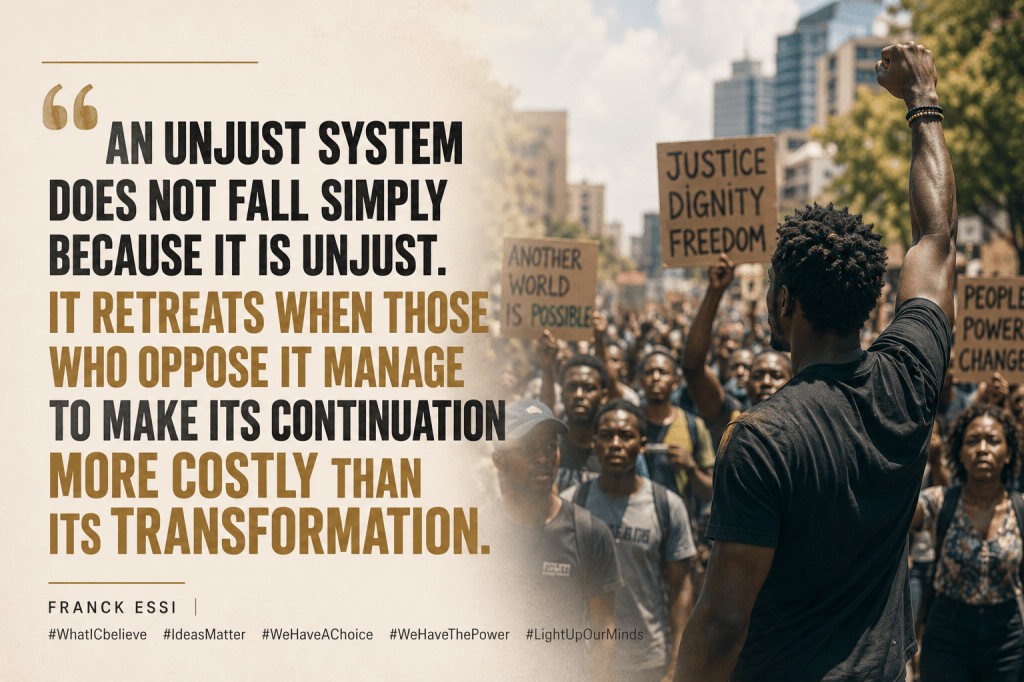
An unjust system does not fall simply because it is unjust. It retreats when those who oppose it manage to make its continuation more costly than its transformation.
This is where the notion of critical mass fully makes sense. It does not simply describe the moment when many people think the same thing. It describes the moment when enough people, enough organizations, enough networks, enough ideas, enough forms of action, enough internal and external pressure, enough collective trust and enough strategic discipline converge to modify the calculations of power, the behaviour of institutions and the perception of citizens.
5. Strategic nonviolence broadens the circle of participation
In authoritarian contexts, some people think nonviolence is a form of naïveté. I believe this is a mistake. Nonviolence is not passivity. It is not resignation. It is not the absence of a balance of power.
Strategic nonviolence is an organized way of building a broader, more inclusive and often harder-to-isolate balance of power.
This is one of the reasons that may explain the results observed by Chenoweth and Stephan. Violent struggle generally narrows the circle of participants to those who can or want to enter armed confrontation. Nonviolent struggle, when well organized, allows the participation of several social categories:
- students;
- teachers;
- workers;
- traders;
- peasants;
- women;
- young people;
- older people;
- artists;
- religious leaders;
- civil servants;
- lawyers;
- journalists;
- ordinary citizens.
This breadth of participation is decisive. It allows the movement to move beyond the logic of an isolated group and become a social dynamic. It can also produce several political effects:
- making the moral contradiction of power more visible;
- exposing the violence of the system when it represses peaceful citizens;
- creating fractures within the system;
- encouraging defections;
- increasing the political cost of injustice;
- broadening the legitimacy of the movement.
But nonviolence requires something difficult: self-mastery. Mastery of anger, language, forms of action, provocations, objectives, collective discipline and duration.
This does not mean that we should abstractly condemn peoples who explode after years of humiliation. We must always keep in mind that there are several forms of violence:
- the cold violence of systems that impoverish, exclude, humiliate and slowly destroy lives;
- the visible violence of populations who, unable to bear more, let their anger explode;
- the violence of repressive apparatuses that, in the name of maintaining order, often maintain an unjust order.
But to build a lasting critical mass, it is necessary, as much as possible, to broaden participation, preserve the moral legitimacy of the movement, prevent the legitimate anger of the people from being used against the people themselves, avoid the traps of provocation, protect the objectives of the struggle and maintain collective discipline.
Strategic nonviolence is therefore not weakness. It is a discipline of collective power.
This requires great political maturity. It is not about asking the oppressed to be polite toward injustice. It is about understanding that the way one struggles can strengthen or weaken the cause. A movement that loses its legitimacy, falls into the traps of provocation, fails to protect its objectives and does not control its forms of action risks giving power the arguments it needs to isolate, criminalize and break it.
Strategic nonviolence, when properly understood, is therefore not a morality of weakness. It is an intelligence of the balance of power. It allows people to say no firmly, refuse to cooperate with injustice, disrupt the unjust order, while keeping the door open to the participation of the greatest number.
6. A critical mass should think about the aftermath of victory before victory itself
This may be one of the most important points. Many peoples have risen. Many have forced power to retreat, obtained concessions, secured alternation or opened transitions. But not all have managed to transform those moments into lasting change.
Why? Because a system does not always disappear when its leaders change. It can survive in administrations, habits, mentalities, networks of interest, trapped laws, weak institutions, the political poverty of citizens, clientelist practices, authoritarian reflexes and relations of economic and social domination.
That is why alternation is necessary, but not sufficient. It is necessary because no power should believe it owns the state. But it is insufficient because a change of persons can leave the rules, practices and logic of the system intact.
This is what several African experiences seem to teach us:
- South Africa ended institutional apartheid, but continues to carry heavy economic and social legacies.
- Burkina Faso pushed back an attempt to perpetuate power, but the challenge of institutional stabilization remains immense.
- Cameroon obtained multiparty politics in the early 1990s, but without a deep refoundation of the state.
- Senegal has experienced alternations, but recurrent crises remind us that nothing is definitively secured.
It is therefore not enough to obtain political parties; fair rules of the game are needed. It is not enough to have elections; sincere elections are needed. It is not enough to proclaim freedoms; freedoms must be guaranteed. It is not enough to bring down one man; we must transform the institutions that allow men to confiscate power. It is not enough to win a moment; duration must be organized.
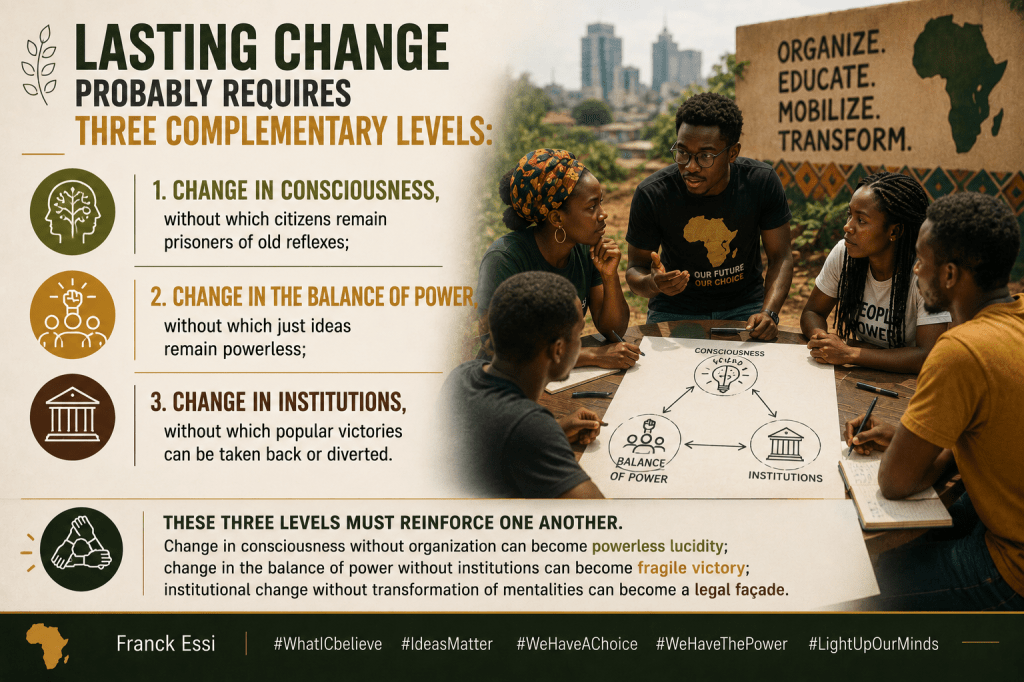
Lasting change probably requires three complementary levels:
- change in consciousness, without which citizens remain prisoners of old reflexes;
- change in the balance of power, without which just ideas remain powerless;
- change in institutions, without which popular victories can be taken back or diverted.
These three levels must reinforce one another. Change in consciousness without organization can become powerless lucidity; change in the balance of power without institutions can become fragile victory; institutional change without transformation of mentalities can become a legal façade.
That is why a committed minority that wants to produce serious change should, as much as possible, think about the aftermath of victory before victory itself. It should ask how to contest, but also how to rebuild; how to push back an abuse, but also how to prevent its return; how to open a breach, but also how to build institutions; how to mobilize, but also how to govern differently; how to obtain a victory, but also how to protect that victory.
This is often where many movements fail. They know how to denounce. They know how to mobilize. They know how to exert pressure. But they have not always prepared the ideas, cadres, teams, institutions, rules, methods and political culture needed to transform a popular victory into lasting change.
7. Unaddressed grievances can become deep fractures
Another important condition for social change, it seems to me, is the ability of a society to address grievances before they become ruptures. When a system refuses to listen, recognize and correct injustices, it does not always produce stability. It often produces an apparent peace under which frustrations accumulate.
The Anglophone crisis in Cameroon offers a painful lesson. Initially, the 2016 mobilization began notably with demands carried by lawyers and teachers around legal, educational, linguistic, institutional, identity-related and historical issues. These demands expressed an older malaise concerning the place of the Anglophone regions within the Cameroonian state. What could have been a moment of dialogue, recognition and correction gradually became a major crisis.
The lesson here is not to glorify rupture or violence. On the contrary. The lesson is that a serious state must know how to address weak signals before they become fires.
A serious society must create mechanisms for dialogue, justice, recognition, reform, reparation, crisis prevention and the institutional handling of frustrations. Any system that refuses to listen to peaceful demands often strengthens those who say that speech is useless.
That is why a democratic critical mass should always seek to transform:
- grievances into institutional solutions;
- anger into deliberation;
- frustrations into reform;
- wounds into justice;
- humiliations into national reconstruction.
A society does not hold together sustainably through imposed silence. It holds together through justice, recognition, institutions, trust and the capacity to correct its imbalances before they become ruptures.
This applies to Cameroon, as it does to many other African societies. Peoples do not always explode because they love disorder. They often explode because normal channels of correction have been blocked for too long. A state that refuses dialogue when demands are peaceful may later have to manage crises that are more serious, longer and more costly.
This is why building a democratic critical mass is not only about mobilizing against something. It is also about learning to transform social contradictions into political solutions, historical wounds into reparative memory, collective frustrations into fairer institutions, and popular anger into a democratic project.
8. A few requirements for a committed minority to become fruitful
I prefer to formulate this point with caution. This is not about lecturing anyone. Nor is it about pretending that there is a simple recipe that allows a committed minority to become a critical mass. Every society has its history, wounds, fears, balances of power and possibilities.
But it seems to me that a committed minority becomes more fruitful when it does not merely speak loudly, remain right in its own corner, believe itself pure or despise those who are not yet with it. A minority becomes fruitful when it gradually becomes convincing.
It becomes convincing when it knows how to:
- speak beyond itself;
- explain without humiliating;
- organize without crushing;
- welcome without dissolving itself;
- last without becoming fossilized;
- remain disciplined without killing debate;
- transform contestation into a project;
- build paths so that others can join the struggle.
In our African societies, and particularly in Cameroon, the question is therefore not only how many we are today. The real question may be more demanding:
- What are we building with those who are already here?
- What quality of consciousness are we developing?
- What political culture are we transmitting?
- What collective discipline are we cultivating?
- What trust are we inspiring in those who hesitate?
- What forms of action are we making possible for each person to join?
- What institutions are we preparing so that victory is not only a moment, but a lasting transformation?
One can be few in number and already prepare the future if one knows how to train, organize, document, transmit, build networks, produce clear ideas, remain faithful to an ethical line, reject destructive shortcuts and learn to make fear retreat.
But one can also be numerous and change nothing sustainably if one merely shouts, refuses to think, despises organization, confuses anger with strategy, visibility with effectiveness, alternation with refoundation, and crowd with critical mass.
This is why numbers are not enough. Consciousness, method, discipline, strategy, memory, organization and institutions are needed.
A committed minority must therefore accept work that is often thankless:
- training when others only want slogans;
- explaining when others only want shortcuts;
- organizing when others only want emotions;
- holding on when others grow tired;
- clarifying when others confuse everything;
- gathering without dissolving itself;
- resisting without losing itself;
- negotiating without selling itself;
- fighting without becoming what it is fighting against.
This may be what distinguishes fruitful minorities from sterile minorities. The former build paths so that others can move forward. The latter sometimes merely contemplate their own indignation.
What I take from this reflection
From all the above, it seems to me that several lessons can be drawn.
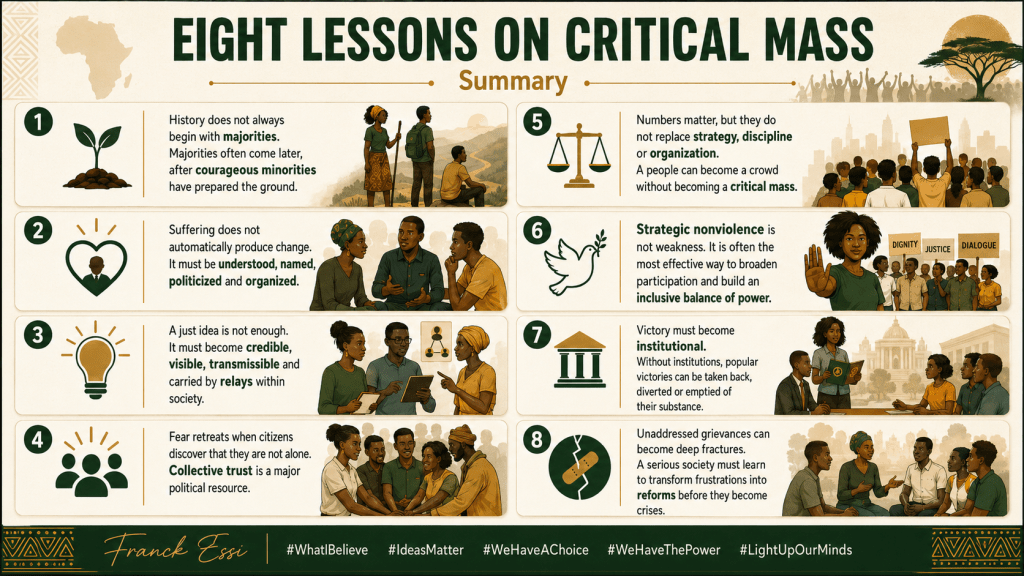
First, history does not always begin with majorities. Majorities often come later, after courageous minorities have prepared the ground.
Second, suffering does not automatically produce change. It must be understood, named, politicized and organized.
Third, a just idea is not enough. It must become credible, visible, transmissible and carried by relays within society.
Fourth, fear retreats when citizens discover that they are not alone. Collective trust is a major political resource.
Fifth, numbers matter, but they do not replace strategy, discipline or organization. A people can become a crowd without becoming a critical mass.
Sixth, strategic nonviolence is not weakness. It is often the most effective way to broaden participation and build an inclusive balance of power.
Seventh, victory must become institutional. Without institutions, popular victories can be taken back, diverted or emptied of their substance.
Eighth, unaddressed grievances can become deep fractures. A serious society must learn to transform frustrations into reforms before they become crises.
These lessons speak to Africa. They speak to Cameroon. They speak to all those who refuse to confuse:
- resignation with wisdom;
- caution with fear;
- anger with strategy;
- alternation with transformation;
- protest with refoundation;
- crowd with critical mass.
They remind us that lasting change is not merely an explosion of anger. It is a process. It requires ideas, people, networks, sacrifices, institutions, time, discipline, memory and perseverance. Above all, it requires women and men who accept to begin before the crowds join them.
My Deep Conviction : not despising small beginnings
I believe we must not despise small beginnings. Not every minority is destined to change history. But no great transformation began as a majority on the very first day.
What matters is not only being numerous. It is becoming clear enough, organized enough, credible enough, disciplined enough and persevering enough for others to join without feeling that they are jumping into the void.
Critical mass, as I understand it here, is the moment when a cause stops being merely just and becomes socially powerful. It is the moment when an idea stops being merely proclaimed and becomes carried by bodies, voices, practices, networks, organizations and institutions in the making. It is the moment when fear begins to change sides. It is the moment when an organized minority opens a passage in history.
This is why we must continue. Not out of naïveté, not out of militant romanticism, not because victory is automatic, but because history shows that peoples who change their destiny often begin with minorities who refuse to be intimidated by their small number.
Minorities that think, organize, learn, endure, inspire and gradually become a critical mass.
And when a critical mass is born, what once seemed impossible can begin to become possible.
#WhatIBelieve
#IdeasMatter
#WeHaveAChoice
#WeHaveThePower
#LightUpOurMinds
References for further reading
On civil resistance, nonviolence and the 3.5% rule
- Erica Chenoweth & Maria J. Stephan, Why Civil Resistance Works: The Strategic Logic of Nonviolent Conflict, Columbia University Press, 2011.
Link: Book presentation by Erica Chenoweth - Erica Chenoweth & Maria J. Stephan, “Why Civil Resistance Works: The Strategic Logic of Nonviolent Conflict,” International Security, vol. 33, no. 1, 2008.
Link: PDF available via ICNC - Harvard Kennedy School, Carr Center, “The 3.5% Rule: How a Small Minority Can Change the World.”
Link: Carr Center article on the 3.5% rule - Erica Chenoweth, “The Future of Nonviolent Resistance,” Carr Center Discussion Paper, 2020.
Link: Carr Center PDF - Gene Sharp, From Dictatorship to Democracy: A Conceptual Framework for Liberation, The Albert Einstein Institution, 1993.
Link: ICNC presentation page - Gene Sharp, The Politics of Nonviolent Action, Porter Sargent, 1973.
Link: ICNC presentation page
On tipping points, diffusion of ideas and social movements
- Damon Centola, Joshua Becker, Devon Brackbill & Andrea Baronchelli, “Experimental Evidence for Tipping Points in Social Convention,” Science, 2018.
Link: Article in Science - Everett M. Rogers, Diffusion of Innovations, 5th edition, Free Press, 2003.
Link: Publisher’s page, Simon & Schuster - David A. Snow & Robert D. Benford, “Ideology, Frame Resonance, and Participant Mobilization,” International Social Movement Research, vol. 1, 1988.
Link: GESIS record - Robert D. Benford & David A. Snow, “Framing Processes and Social Movements: An Overview and Assessment,” Annual Review of Sociology, 2000.
Link: PDF version - Doug McAdam, Political Process and the Development of Black Insurgency, 1930–1970, University of Chicago Press, 1982; 2nd edition, 1999.
Link: University of Chicago Press page
On Cameroon, the UPC, ghost towns and the Anglophone crisis
- Richard A. Joseph, Radical Nationalism in Cameroun: Social Origins of the U.P.C. Rebellion, Oxford / Clarendon Press, 1977.
Link: Cambridge Core review / bibliographic notice - ARTICLE 19, Cameroon: A Transition in Crisis, 1997.
Link: PDF report - Global Nonviolent Action Database, “Cameroonians general strike for democratic elections, 1991.”
Link: Case file on ghost towns - Human Rights Watch, World Report 1992 – Cameroon.
Link: Cameroon section of HRW report - International Crisis Group, “Cameroon’s Anglophone Crisis at the Crossroads,” 2017.
Link: ICG report - ACCORD / ReliefWeb, “The Anglophone Dilemma in Cameroon,” 2017.
Link: Article via ReliefWeb
On the African examples mentioned
- Anti-Apartheid Movement Archives, “Boycott South African Goods.”
Link: Anti-Apartheid Movement archives - Participedia, “Mobilising the African Youth: Lessons from the Y’en a Marre Movement.”
Link: Participedia case study - James Genova, “Y’en A Marre! Senegal in the Season of Discontent,” Origins, Ohio State University, 2012.
Link: Origins article - USIP, Eloïse Bertrand, Mobilization, Negotiation, and Transition in Burkina Faso, 2021.
Link: USIP PDF - Global Nonviolent Action Database, “Burkina Faso protesters remove Blaise Compaoré from power, 2014.”
Link: Swarthmore case file