What Africa Must Build to Stop Enduring Its History
By Franck Essi
NB: A reflection on the need to adopt the mental model of change from the inside out, at the individual, community, state and continental levels.

There are, fundamentally, two major ways of thinking about change.
The first consists in waiting for something to come from the outside: a savior, an election, international aid, a decision from above, a shift in the global context, a reform imposed by circumstances, a foreign power more benevolent than the previous ones, a providential leader or a miraculous opportunity.
This way of thinking is not always lazy. It is sometimes the result of long defeats, many humiliations, a succession of betrayals, the exhaustion of peoples, the violence of systems, poverty, fear and the feeling that everything is locked. It must therefore be understood before it is criticized. But it has one dangerous consequence: it places the human being, the community, the state or the continent in a position of waiting.
We then look at the world as a spectacle. We comment on events. We hope for a reversal. We accuse the powerful. We complain about leaders. We are outraged by injustice. We wait for things to change. Then, very often, nothing really changes, or things change only on the surface without modifying the deeper logics that produce dependency, powerlessness and resignation.
The second way of thinking about change is more demanding. It begins with a less comfortable question: what must change within us, among us and within our institutions for the change we hope for to become possible?
This is what the inside-out perspective means.
From the inside out.
Not as a personal development formula. Not as an inspiring slogan to ease our conscience. Not as a way of telling dominated peoples that they are responsible for all the injustices they suffer. But as a mental model of power.
Because an individual, an organization, a community, a state or a continent can only sustainably emerge from dependency when it develops, within itself, the capacities that make such an emergence possible.
It is often said that “change is a door that only opens from the inside.” This sentence is powerful because it reminds us of one simple thing: we can denounce those who built the walls, those who placed the locks, those who watch the door, those who benefit from confinement. Sometimes, we must do so with force. But in the end, one question remains: who, from the inside, will organize the force capable of opening the door?
It is from this question that we must look at Africa today.
We live in a moment of history where external constraints seem to be strengthening everywhere. Distant wars produce close consequences. Geopolitical tensions disrupt the prices of fuel, food, fertilizers and financing. Debt reduces the room for maneuver of many states. Supply chains become instruments of power. Major powers compete over the critical minerals needed for batteries, electric vehicles, digital technologies and the energy transition. The climate crisis hits hard countries that have contributed very little to creating it. In several parts of the world, including Africa, hunger, forced displacement, insecurity and institutional fragility remind us that the most vulnerable peoples often pay the highest price for the disorders of the world.
It would therefore be naive to pretend that the outside does not matter. The outside matters. It weighs. It constrains. It sometimes dominates. It often manipulates. It exploits when the balance of power is favorable to it. Africa’s history, from slavery to contemporary forms of economic, monetary, military, technological, cultural and diplomatic dependency, forbids us from holding a discourse that would pretend that African peoples are solely responsible for the dead ends in which they find themselves.
But it would be just as dangerous to explain everything by the outside. By looking only at what happens to us from outside, we risk no longer seeing what we must transform within. By denouncing foreign powers, multinationals, international financial institutions, former colonial powers, comprador elites or global relations of domination, we can end up forgetting a decisive question: what is it, within us, among us, in our organizations, in our states and in our societies, that makes this domination possible, lasting or easy?
This entire reflection therefore starts from one conviction: even when everything does not depend on us, nothing serious, deep and lasting will happen without us. Peoples who expect everything from the outside end up enduring their history. Those who transform themselves from within begin to take it back into their own hands.
Thinking from the inside out does not mean denying the outside
We must begin by removing this ambiguity, because it is important. To say that lasting change moves from the inside out does not mean that everything depends only on the individual, on willpower, discipline, motivation or the ability to “think positive.” That would be a very poor and even dangerous way of understanding things. Social conditions, institutions, history, poverty, repression, the quality of education, the structure of the economy, international relations of domination and mechanisms of power profoundly shape the possibilities for action available to individuals and peoples.
But saying this must not lead us into the opposite error, which consists in thinking that almost everything depends first on others, on external circumstances, the global context, partners, donors, foreign powers, leaders in office or historical chance. The outside exists and must be analyzed. But it must not become the total explanation of our powerlessness, still less the permanent alibi for our inaction.
The inside-out perspective says something more precise: even when everything does not depend on us, nothing serious, deep and lasting will happen without us. It invites us, therefore, to look not only at what happens to us, but at what we build as capacity in order to respond to what happens to us.
The mental model from the outside in consists in waiting for circumstances to change before changing oneself, one’s community, one’s organization or one’s country. The mental model from the inside out consists in first building the internal capacities that make it possible to act upon circumstances. The issue is therefore not to choose between the inside and the outside. The issue is to understand their relationship.
The outside weighs more heavily when the inside is weak, disorganized, fragmented, corrupt, dependent or without vision. Conversely, the more the inside is structured, the more it becomes capable of resisting, negotiating, producing, deciding, creating balances of power and transforming its environment. Change from the inside out is therefore the mental model of peoples who refuse to endure indefinitely.

The model of waiting traps us
Many of our dead ends come from the fact that we too often wait for change to begin elsewhere. We wait for the state to change before becoming more responsible ourselves. We wait for leaders to change before organizing ourselves. We wait for donors to finance before acting. We wait for the world to become fairer before building. We wait for institutions to become perfect before getting involved. We wait for others to respect us before we begin to respect ourselves.
This way of thinking is understandable, especially in societies where ordinary citizens have often been betrayed, humiliated, repressed, despised or abandoned. But it can become a mental prison when it places us in a permanent position of waiting, commenting, complaining or expressing outrage without building. Yet a people that always waits for change to come from elsewhere ends up becoming a spectator of its own destiny.
This does not mean that we should not demand external changes. We must demand them. We must demand that the state do its job, that leaders be held accountable, that foreign partners stop supporting unjust systems, that multinationals respect peoples, workers, resources and the environment, and that international institutions stop reproducing rules that keep poor countries in dependency.
But all this is not enough. If we demand everything from the outside without building within ourselves the capacities to understand, act, produce, organize, control and endure, our demand eventually lacks power. One can shout for a long time against a closed door. But if no one organizes to make the key, force the lock or build another exit, shouting becomes a habit.
In many African countries, this waiting takes very concrete forms. We wait for the right president, the right minister, the right partner, the right project, the right reform, the right economic climate or the right financing. Meanwhile, the habits that produce powerlessness often remain intact: weak citizen organization, absence of accountability, economic dependency, improvisation, lack of collective discipline, weakness of local production, contempt for competence and fragmentation of forces for change.
The model of waiting is comfortable because it allows us to point out what is wrong without always looking at what we must build. The model of internal construction is more difficult because it forces us to enter into work, duration, method, organization, learning and responsibility.
The individual: no longer living only as the product of circumstances
Let us be very clear: the individual does not choose everything. One does not always choose one’s country of birth, family, neighborhood, the quality of one’s school, the state of the economy, poverty, the violence of institutions or the absence of opportunities. It would therefore be unfair and even cruel to tell people that their situation depends only on them.
But it is just as dangerous to tell them, explicitly or implicitly, that they can do nothing until the whole system has changed. The inside-out perspective, at the individual level, begins when one understands that there is always a part, sometimes small but decisive, on which one can act. This part may be the effort to learn, to read, to train, to better understand the world, to master a skill, to control certain habits, to choose one’s environment, to better use one’s time, to make oneself useful, to work on one’s speech, to strengthen one’s discipline or to refuse to let the humiliations suffered become a definitive identity.
In a country where public education is weakened, the individual who thinks from the inside out does not simply curse the school system. They also look for paths through which they can continue to learn. In an economy where jobs are scarce, they do not simply wait for a competitive exam, a recommendation, an appointment or a political promise. They ask themselves what skills they can build, what real problems they can help solve, what value they can produce and with whom they can associate.
The questions to ask, at the individual level, are therefore simple but demanding: what must I learn? What discipline must I build? What habit must I break? What skill can make me more useful? What part of my time, energy and intelligence am I willing to take back from distraction, fear, complaint or resignation?
We live in a paradoxical time. The same phone can serve permanent dulling of the mind or continuous learning. It can be a prison of distraction or a library. It can be an instrument of chatter or a tool for training, creation, mobilization, sales, writing, organization and production. The difference does not lie only in the object. It also lies in the mental model of the person using it.
This also applies to civic engagement. A young person who wants to change their country can limit themselves to commenting on the news, insulting leaders, spreading outrage and waiting for the day when “the people will rise.” They can also decide to train themselves, read the political history of their country, understand how institutions work, learn how to organize a meeting, mobilize without manipulating, persuade without humiliating, work with others, endure over time and transform their anger into civic competence.
Individual change from the inside out therefore does not mean saying: “I will succeed alone against everyone.” That would confuse responsibility with individualism. It means rather saying: I will build within myself the capacities that will make me more useful to myself, to my family, to my community and to my people. Change from the inside out does not produce individuals who save themselves alone. It produces individuals capable of connecting with others to transform the collective conditions of their dignity.
The community: transforming circumstantial solidarity into collective capacity
What is true for the individual is also true for communities. In many of our neighborhoods, villages, associations, extended families or local communities, there is considerable social energy. People mobilize for funerals, weddings, health emergencies, rotating savings groups, contributions, ceremonies, worship, celebrations and family solidarities. This energy is not negligible. It shows that our societies are not dead. They still know how to rise for certain causes.
The question is why this social energy so rarely becomes lasting civic, economic and political power. Many African communities do not lack solidarity. They often lack mechanisms to transform that solidarity into lasting collective power.
A community that thinks only from the outside in expects everything from the state, the mayor, the member of parliament, the minister, the NGO, the diaspora, the traditional leader, the local elite or the passing benefactor. It may be right to demand a school, a road, water, electricity, a health center, security, civil registry services, justice and public services. These demands are legitimate because citizens have rights and because the state has obligations.
But if the community only waits, it becomes easily manipulated. Someone can come and promise it a road at every election. Someone can divide it with a few envelopes. Someone can buy its silence. Someone can set its families, clans, religious groups, villages, elites and young people against one another. Someone can turn its poverty into an instrument of control.
A community that thinks from the inside out does not renounce demanding from the state. On the contrary, it becomes more capable of demanding because it organizes itself better. It can create a neighborhood association, a citizen watch committee, a parents’ group around the school, a cleanliness initiative, a small cooperative, a local solidarity mechanism, a dialogue platform, a register of priority problems, an organized delegation to the municipality or a mechanism to monitor public promises.
Let us take a simple example. A neighborhood that suffers from insecurity, lack of public lighting, water cuts, poor sanitation or the abandonment of its school can continue to complain, each person on their own. But it can also begin to document the problems, identify priorities, mobilize residents, question the municipality, follow up on commitments made and publicly expose unfulfilled promises. In the first case, complaint remains scattered. In the second, it begins to become organization.
The questions to ask, at the community level, are therefore the following: what weakens us collectively? What can we organize without waiting? What solidarities can we transform into lasting mechanisms? What problems must we document? Who must be held accountable? With whom must we associate? How do we move from scattered complaint to structured collective action?
The point is not to replace the state with communities. It is to ensure that communities cease to be only spaces of suffering and gradually become spaces of organization. An organized community does not only beg. It documents. It proposes. It questions. It follows up. It monitors. It negotiates. It politically sanctions when possible. Complaint says what is wrong. Organization begins to say what we are ready to change.
It cannot be repeated enough: a disorganized people is easy to govern against itself.
The state: sovereignty is not a discourse but a capacity
African states themselves can be prisoners of a mental model from the outside in. When everything goes wrong, they often explain their difficulties by the international context, global crises, wars, oil prices, rising food prices, interest rates, donors, rating agencies, the IMF, the World Bank, China, Europe, the opposition, undisciplined citizens or climate change.
There is sometimes truth in these explanations. Today’s world is genuinely unstable. Distant wars can have very concrete effects on the price of bread, fuel, fertilizers or financing. Climate shocks can destroy harvests. Debt can suffocate public budgets. Geopolitical tensions can make economic decisions more difficult.
But a state that adopts the mental model of change from the inside out does not stop there. It asks another question: why are we so vulnerable to these shocks? Why does a war thousands of kilometers away so quickly threaten our food security? Why does the rise in fertilizer prices on the global market weaken our farmers so much? Why do we import massively what we could produce or transform? Why do we export raw materials that we could add value to locally? Why do we collect taxes poorly? Why are our budgets so often barely readable to citizens? Why do our administrations humiliate those they are supposed to serve? Why are our public policies often better written in documents than implemented in everyday life?
These questions are essential because they shift the debate. They do not deny external constraints. They simply refuse to make those constraints a permanent excuse for internal powerlessness.
Sovereignty is not what a state says about itself. It is what it is capable of doing for its people without kneeling before others. It is measured by the ability to feed its population, train its youth, care for its citizens, produce reliable data, collect taxes fairly, protect public resources, deliver justice, plan, execute, evaluate and sanction abuses.
A state that speaks of sovereignty but depends on the outside to finance its essential priorities, feed its population, build its infrastructure, add value to its resources, train its strategic skills or produce its own data is not yet fully sovereign. It speaks of sovereignty. That is not the same thing.
The questions to ask, at the level of the state, are therefore decisive: what are we truly capable of producing? What do we still depend on others to do? What can we finance by ourselves? What do we know how to transform locally? Which institutions truly protect the citizen? Which mechanisms prevent predation? What accounts does the state render to the majority? What part of our sovereignty is proclaimed and what part is effectively organized?
This does not mean that a state must do everything alone. No serious state lives outside the world. Cooperation is necessary. Trade is necessary. Alliances can be useful. But a state that cooperates without internal capacity often finds itself in dependency. A state that negotiates without productive capacity almost always negotiates from a position of weakness.
This is why change from the inside out, at the level of the state, first means patiently building internal capacities that make sovereignty real, useful and verifiable in the life of the people. A state is not sovereign because it speaks loudly. It is sovereign when it feeds, heals, trains, protects, administers, produces, negotiates and delivers justice with a minimum of dependency and a maximum of accountability.
Africa: moving from potential to organized power
Africa likes to say that it is the future of the world. It has good reasons to think so. It is young. It is rich in natural resources. It has immense agricultural potential. It is at the heart of issues related to the energy transition, biodiversity, future markets, cultural creativity, demography, digital technology and global geopolitical recomposition.
But potential is not power. Potential is what one can become. Power is what one has already succeeded in organizing.
If Africa continues to sell mainly raw materials, massively import processed products, depend on external financing, underinvest in science, technology, industry, agriculture, education, health, administration and regional institutions, it will remain a continent important to others but insufficiently powerful for itself.
The central African question is therefore simple: how do we transform our potential into organized capacities?
This applies first to natural resources. The world needs cobalt, lithium, copper, manganese, graphite, rare earths and other resources required for batteries, electric vehicles, digital technologies and the industries of the future. Many of these resources are found in Africa. The outside-in mentality will simply say: the major powers want to plunder Africa again. This is partly true, and it must be said. But the inside-out mentality adds a more demanding question: what industrial policies, energy infrastructure, technical skills, social and environmental standards, negotiating capacities, regional value chains and control institutions must we build so that this time our resources become a collective power?
This also applies to food security. Africa has land, water, youth, farmers’ knowledge, domestic markets, agroecological diversity and considerable production potential. Yet several African countries remain highly vulnerable to food crises, conflicts, international prices, droughts, floods, imports and logistical disruptions. The question is therefore not only to know who blocks global markets or manipulates prices. The question is also why we have not sufficiently built our own capacities for production, storage, processing, irrigation, agricultural research, logistics, early warning, rapid decision-making and protection of the most vulnerable.
This also applies to youth. Saying that Africa is young is not enough. Youth can become a demographic dividend. It can also become immense social and political frustration if it is not trained, organized, employed, listened to and involved in building solutions. A continent does not become powerful because it has many young people. It becomes powerful when it transforms its youth into productive, scientific, civic, cultural, entrepreneurial, technical and moral capacity.
Finally, this applies to African integration. We speak a great deal about African unity, the continental market, pan-African sovereignty and South-South cooperation. But unity is not decreed only in summits. It is built through roads, railways, ports, common standards, payment systems, coordinated industrial policies, connected universities, regional value chains, peace mechanisms, credible institutions and the effective free movement of people, ideas, goods and services.
The questions to ask, at the continental level, are therefore unavoidable: what do we want to produce together? What do we want to transform together? What do we want to negotiate together? Which value chains do we want to master? Which infrastructure will truly connect our peoples? Which regional institutions can protect our common interests? What place do we want to occupy in the world that is coming?
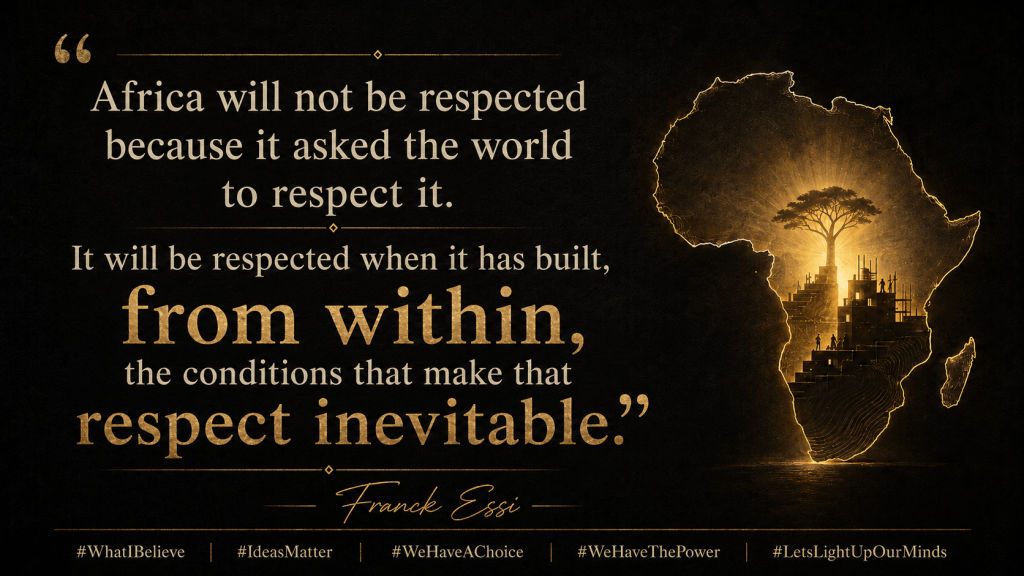
Africa will not be respected because it has asked the world to respect it. It will be respected when it has built, from within, the conditions that make this respect inevitable.
The people first as the test of truth for change
Here we must return to a simple compass: the people first.
Internal change has no political value if it produces no external effect in the life of the majority. The point is not to train a few high-performing individuals in an unjust society. It is not to produce elites more skilled in managing the same disorder. It is not to replace one predatory minority with another more eloquent minority. It is not to repaint the façade of a system that continues to crush the same people.
The real question is always the following: what does this change for the people?
Does the child in the village have a better school? Does the rural woman have easier access to land, credit, markets, health and security? Does the young person find useful training and dignified work? Does the citizen obtain an administrative document without humiliation? Does the farmer sell their produce better? Does the hospital provide better care? Does the municipality respond better? Does the state render more accounts? Do natural resources generate more local value? Does justice protect the weak against the powerful? Does sovereignty descend from speeches into real life?
It is at this level that we see whether change is serious. It is not enough to say that we are changing. It is not enough to proclaim rupture. It is not enough to denounce the enemies of the people. It is not enough to invoke youth, women, farmers, workers, entrepreneurs, the poor or the forgotten. Change must be verified in their concrete existence.
Change is not true because it is announced. It is true when it becomes useful to those who do not have the means to buy their own protection.
Looking at what depends on us without forgetting what exceeds us
Adopting the mental model of change from the inside out does not mean falling into the illusion that wanting is enough to be able. It means learning to distinguish clearly between what depends on us, what does not depend on us, and what we can build in order to reduce our vulnerability to what does not depend on us.
Four questions can help us:
▶ What does not depend on us, but must be understood lucidly?
We must study balances of power, economic constraints, historical dependencies, international mechanisms, structures of domination and external risks. Lucidity is not the enemy of responsibility.
▶ What depends on us and what have we neglected for too long?
This is often where real change begins: a habit to break, a skill to build, an organization to structure, a rule to apply, a truth to face, a responsibility to assume, a collective discipline to establish.
▶ What capacity must we build to reduce our vulnerability?
The way out of dependency always passes through a new capacity: producing, processing, financing, training, healing, organizing, monitoring, negotiating, protecting, transmitting, deciding, evaluating.
▶ How does this capacity improve the life of the majority?
Without this last question, change can become an elite exercise, a technical performance or empty rhetoric. The people must remain the test of truth for change.
This method is simple. But it changes everything because it forces us to leave complaint without abandoning lucidity, to reject victimhood without denying victims, to fight the outside without forgetting the inside, and to build instead of merely commenting.
What this changes in the way we struggle
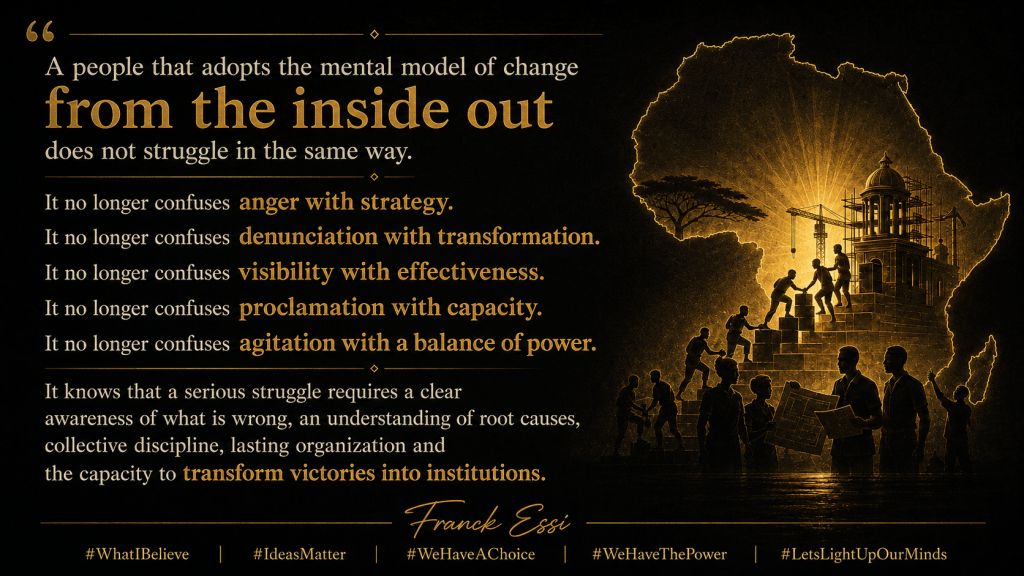
A people that adopts the mental model of change from the inside out does not struggle in the same way. It no longer confuses anger with strategy. It no longer confuses denunciation with transformation. It no longer confuses visibility with effectiveness. It no longer confuses proclamation with capacity. It no longer confuses agitation with a balance of power. It knows that a serious struggle requires a clear awareness of what is wrong, an understanding of root causes, collective discipline, lasting organization and the capacity to transform victories into institutions.
Many peoples rise up. Not all liberate themselves sustainably.
The reason is simple: it is not enough to knock down a door. One must also build the house in which the people will live with dignity after the door has been opened. It is not enough to overthrow a man, a clan or a regime. One must also transform the rules, the practices, the institutions, the political economy, the culture of power and the relationship between citizens and the state.
When this internal transformation does not happen, external changes become fragile. We can change leaders without changing the logic. We can change discourse without changing practices. We can change the flag without changing dependency. We can change generations without changing political culture. We can even make a revolution and reproduce the very mechanisms we claimed to abolish.
This is why change from the inside out is demanding. It does not only ask: what are we against? It also asks: what are we capable of building? With what method? With what resources? With what institutions? With what discipline? With what ethics? With what real effect for the majority?
My deep conviction
My deep conviction is that many of our dead ends come from a profound imbalance. We often know how to denounce what happens to us from the outside, but we work less seriously on what we must build from within. We know how to name the forces that dominate us, but we do not always build the capacities that would make us less dominable. We know how to proclaim sovereignty, but we do not always produce the food, knowledge, institutions, industries, data, technologies, rules and solidarities that make sovereignty real.
We know how to say that Africa is rich, but we do not yet organize this wealth enough for it to transform the lives of Africans. We know how to say that youth is the future, but we do not yet train this youth enough for it to become a productive, civic, intellectual and moral power. We know how to say that the people matter, but we do not always build the institutions that allow the people to decide, monitor, sanction, create and live with dignity.
This is why the inside-out perspective is essential. It is not a soft formula for calm times. It is a hard requirement for peoples who want to stop enduring their history. It tells us to begin with what is within our power, not in order to ignore what exceeds us, but in order to become progressively capable of confronting it. It tells us not only to ask the world to change, but to build within ourselves, around us and within our institutions what will make that change possible.
Africa does not only need to be defended against the forces that crush it. It needs to become, from within, a force capable of standing upright in its individuals, its communities, its states, its regional institutions, its economies, its imaginaries and its peoples.
Because change is a door that only opens from the inside.
The great question, therefore, is not only who closed the door. The great question is when we will finally decide to build, together, the inner force capable of opening it.
So that the people may no longer be only those in whose name others speak, but those with whom change is built, those through whom change becomes possible, and those for whom change becomes useful.
Everything else is… everything else.
Franck Essi
#WhatIBelieve
#IdeasMatter
#WeHaveAChoice
#WeHaveThePower
#LetsLightUpOurMinds