By Franck Essi, July 10, 2026

There are crises that can be seen immediately.
We see damaged roads. We see dilapidated schools. We see hospitals without equipment. We see slow administrations. We see weakened institutions. We see poverty. We see violence. We see fear. We see anger.
But there are deeper, quieter and more dangerous crises.
They are the crises that begin in people’s minds, in everyday habits, in the small phrases we repeat, in the arrangements we gradually come to see as normal.
When a competitive exam is rigged and people say, “That is how things work here,” it is not only an exam that has been damaged. It is the very idea of justice that has retreated.
When a competent person is pushed aside because they do not have the right name, the right network, the right sponsor or the right affiliation, it is not only a career that is broken. It is merit that is humiliated.
When a citizen has to pay to receive a service to which they are entitled, it is not only petty corruption. It is the State that ceases to serve the public.
When a leader violates the rules and those close to him say, “You must understand, others do worse,” it is not only a fault that is excused. It is a collective norm that is destroyed.
This is what is at stake here.
Principles, values, norms and standards are not useless ornaments of public discourse. They are not words we place in constitutions, charters, laws, official speeches or strategic plans merely to look serious.
They are what prevent a society from gradually turning into a jungle.
A society that renounces its principles does not become more realistic. It becomes more fragile.
An organization that disregards its norms does not become more efficient. It becomes more arbitrary.
A State that tramples on its standards does not become more sovereign. It becomes more brutal, more opaque, more unjust and, sooner or later, weaker.
What we normalize eventually governs us
Very often, in conversations I have with people who present themselves as enlightened, I am struck by two things.
The first is a deep ignorance of certain principles, values, norms and standards that are nevertheless written into our texts, present in our traditions or long accepted as necessary reference points for living together.
The second, even more serious, is that when these elements are known, many people consider them secondary.
We then hear phrases that have become almost banal:
- “We have to be realistic.”
- “That is not how things work here.”
- “Principles are good for speeches.”
- “You cannot lead with values.”
- “Rules are made to be bypassed.”
- “You have to know how to adapt.”
These phrases can sound intelligent. They can even give the impression of a certain maturity, as though the person saying them understands life better than others. As though they were less naive. As though they had understood what idealists have not yet understood.
And yet, very often, what we call realism is only the polite name for renunciation. What we call pragmatism is sometimes the gradual acceptance of the unacceptable. What we call adaptation is sometimes a way of surrendering to disorder, before pretending to be surprised when disorder takes over the whole society.
That is the problem.
Societies do not always collapse suddenly. They can also come undone slowly, through repeated small concessions. A lie accepted today. An injustice excused tomorrow. A rule bypassed the day after. An abuse defended because it comes from our side. Mediocrity promoted because it is loyal. Competence sidelined because it disturbs.
Then, one day, we discover that no one believes in public speech anymore, that no one trusts institutions anymore, that no one respects rules anymore, that no one is truly shocked by injustice anymore.
And we pretend to be surprised.
What exactly are we talking about?
We need to take the time to clarify the words, because much confusion comes from the fact that we use closely related notions as if they were identical.
A value says what a society, a family, an organization or a community considers important, noble, desirable and worthy of being transmitted. Honesty, solidarity, courage, truth, loyalty, respect for one’s word, protection of the weakest and a sense of honor are values. They tell us what we admire, what we want to cultivate, what we would like to see embodied in human behavior.
A principle, however, goes further in organizing action. It transforms a value into a fundamental orientation. It says what must guide decisions, limit power, protect people and structure collective life.
For example, justice may be a value; but when we affirm that all citizens must be equal before the law, we formulate a principle.
Solidarity may be a value; but when we affirm that a society must protect the most vulnerable, we formulate a principle.
Truth may be a value; but when we affirm that public officials must account for their actions transparently, we formulate a principle.
We could therefore say, quite simply, that values inspire the moral life of a society, while principles orient and frame action. Values say what we consider worthy. Principles say what we must respect so that this dignity does not remain a mere wish.
A norm, then, translates a principle into a concrete rule of behavior. If equality before the law is a principle, then the norm will state that a file must not be treated differently depending on whether the person is rich, poor, close to power or without connections. If accountability is a principle, then the norm will state that a person in charge must produce reports, justify the use of resources and answer for their actions.
A standard, finally, sets a minimum level of requirement, quality or seriousness. It allows us to say that an election must not merely be organized, but must meet minimum conditions of transparency, fairness and credibility. It allows us to say that a school must not merely exist as a building, but must enable real learning. It allows us to say that a hospital must not merely bear the name of a hospital, but must guarantee a minimum level of reception, hygiene, safety and dignity for patients.
These four elements therefore form a simple chain: values give the soul, principles give the direction, norms organize behavior and standards set the level of requirement.
Without values, a society loses its soul.
Without principles, it loses its direction.
Without norms, it loses the rules of life in common.
Without standards, it loses the sense of minimum requirement.

These reference points are not foreign to African societies
This must be clearly recalled: principles, values, norms and standards are not foreign inventions imposed on African societies that supposedly knew only disorder, arbitrariness or informality.
That is false.
Of course, we must not idealize our traditions. Our ancient societies had their greatness, but also their limits, their injustices, their forms of violence and their contradictions.
But it would be false to believe that the demand for regulation, responsibility, the keeping of one’s word, respect for social balances, mediation and protection of the community is foreign to our history.
In many African societies, a person’s word was binding. Authority was not supposed to be only a privilege, but also a responsibility. The chief was not meant only to command. He had to protect, arbitrate, listen and preserve certain balances. The palaver, when faithful to its deeper spirit, was not a mere waste of time. It was a way of seeking repair, appeasement and the continuity of the social bond.
There was also, in our proverbs and community practices, a strong idea: the individual cannot do everything in the name of personal interests without eventually harming the community. Whoever holds authority must pay attention to what their power produces in the lives of others.
Our traditions do not tell us that everything was perfect before. They simply remind us that no society can live for long without reference points, limits, duties, rules and an idea of what is just.
What we now call “rights” or “principles” often came at a very high cost
We too easily forget that many things that seem obvious to us today were not always obvious.
The idea that a human being must not be reduced to slavery cost centuries of suffering, resistance, revolts, intellectual campaigns and political struggles. Before human dignity was proclaimed as a principle, millions of lives were crushed, families were torn from their lands, peoples were dehumanized and resistants paid with their lives for refusing to be treated as things.
The idea that a people must be able to participate in determining its own destiny also came at a high cost. Anti-colonial struggles were not mere debates of ideas. They involved imprisonment, exile, death, broken families, monitored activists, humiliated leaders and repressed peoples. Those who fought for independence did not only want a new flag. They carried a principle: a people must not be governed forever against its will.
Workers’ rights were not kindly granted either. Paid leave, limits on working hours, workplace safety, the right to make demands, the idea of a decent wage and protection against certain abuses were obtained through long struggles, strikes, sanctions, dismissals, repression and family sacrifices. When someone today dismisses labor standards in the name of efficiency, they often forget that those standards were born from the suffering of people who were treated almost like machines.
The same applies to women’s rights. Nothing was simple. It took generations of courage for women to be able to go to school, inherit, work, vote, speak in public, participate in decisions, refuse certain forms of violence and exist beyond the role others had decided for them. Here again, lives were marked by humiliation, rupture, silent resistance, and family, social and political struggles.
We must therefore be careful.
What some people today call “details,” “formalities,” “abstract principles” or “unnecessary requirements” sometimes represents the outcome of centuries of struggle.
What was won through hard struggle can be lost through negligence, cynicism, fear, fatigue or complicity.
False realism: when renunciation disguises itself as intelligence
There is a false realism that destroys societies from within.
It consists in saying: since rules are violated, let us violate them too. Since others cheat, let us cheat better than they do. Since corruption exists, let us find our own share. Since institutions are weak, let us use networks. Since the powerful lie, let us lie at our own level. Since injustice is everywhere, let us at least try to be on the side of those who benefit from it.
This way of thinking may seem practical. But in reality, it repairs nothing. It worsens everything.
It gradually turns citizens wounded by disorder into small agents of disorder. It turns potential victims of injustice into ordinary accomplices of injustice. It turns organizations into spaces of cunning. It turns institutions into façades. It turns peoples into tired, distrustful and disillusioned crowds.
We all know simple examples.
We want to enroll our child in a school, but first we look for whom to call. We want to obtain an administrative document, but we ask who can “follow up” the file. We want to win a contract, but we are less interested in the quality of the offer than in the person who can influence the decision. We want to be promoted, but we invest more in personal loyalty than in competence. We want the country to change, but at our own small level we reproduce the very practices we denounce in others.
This is where the inconsistency becomes obvious.
We cannot renounce principles every day and then be surprised that society is collapsing.
We cannot normalize corruption and complain about poverty. We cannot despise truth and complain about misinformation. We cannot humiliate rules and complain about arbitrariness. We cannot ridicule competence and complain about mediocrity. We cannot destroy education and be surprised by ignorance. We cannot weaken institutions and then be surprised that the strongest, richest, most armed or best-connected individuals take up all the space.
Yet this is too often what we do.
We want the fruits of social cohesion without accepting the demands of social cohesion. We want peace without justice. Development without integrity. Efficiency without standards. Trust without truth. Strong institutions without strong rules. Respected States without respectable leaders.
This cannot work sustainably.
Proclaiming is not enough, but renouncing is worse
We must be clear-sighted.
We know that many principles are proclaimed without being applied. We know that leaders speak of justice while organizing injustice. They speak of democracy while confiscating power. They speak of transparency while protecting opacity. They speak of the rule of law while governing through fear. They speak of merit while promoting mediocre but loyal people. They speak of sovereignty while handing their peoples over to external interests.
We know all this.
But precisely because those who proclaim principles without applying them have already produced so much damage, what should we think of those who now explain that we should no longer even burden ourselves with these principles?
Hypocritical proclamation is serious. But open renunciation is even more serious.
The one who lies while invoking truth still recognizes that truth matters. The one who violates justice while speaking of justice still recognizes that justice remains a reference. The one who confiscates democracy while speaking of democracy still recognizes that democracy remains desirable.
But the one who openly claims that none of this matters anymore prepares a society without a compass. A society where nothing remains but force, money, fear, cunning, belonging to the right network and the ability to cause harm.
Such a society can survive for a while. It can even give the impression that it functions. But it destroys itself slowly, because it becomes unable to produce trust, protect the weak, retain talent, respect honest people, correct its mistakes and transmit anything other than predatory resourcefulness to future generations.
Institutions exist to transform principles into practices
An institution does not exist merely to host offices, titles, vehicles, stamps, budgets, ceremonies and organizational charts.
A serious institution exists to transform principles into rules, rules into practices, practices into habits, and habits into culture.
That is what makes it possible to limit the whims of individuals.
A serious institution makes it possible to say to the chief: you cannot do everything. It makes it possible to say to the rich: you cannot buy everything. It makes it possible to say to the powerful: you cannot crush everything. It makes it possible to say to the activist: the cause does not justify everything. It makes it possible to say to the civil servant: the position does not belong to you. It makes it possible to say to the citizen: freedom also implies responsibility.
In a family, this sometimes begins very simply: by not always siding with the child who shouts the loudest. In a school, it begins by refusing to buy grades or normalize cheating. In a company, it begins by promoting serious work rather than flattery. In a political party, it begins by distinguishing discipline from servility. In a State, it begins by refusing to make the law harsh for opponents and flexible for friends.
It is in these concrete things that principles live or die.
The noble meaning of History: deepening, not regressing
The meaning of History is not automatic.
We must not naively believe that humanity always moves toward more justice, more freedom, more truth and more dignity. History can move forward, but it can also move backward. Societies can become more civilized, but they can also become more brutal. Peoples can rise, but they can also be dragged toward fear, hatred, lies, servile obedience and violence.
But the noble meaning of History, as I understand it, consists in constantly striving toward a better realization of the principles that make human life more dignified.
It consists in pushing back arbitrariness, limiting the violence of the powerful, protecting the weak, expanding rights, strengthening duties, making power more responsible, institutions fairer and societies more capable of looking at themselves honestly.
This does not mean that principles, values, norms and standards can never be reviewed. They can be revised, clarified, contextualized and broadened. But they must not be revised in the direction of regression. They must not be used to justify injustice, normalize arbitrariness, weaken human dignity or give intellectual cover to cynicism.
A just revision deepens the requirement. A disguised regression weakens the requirement. They are not the same thing.
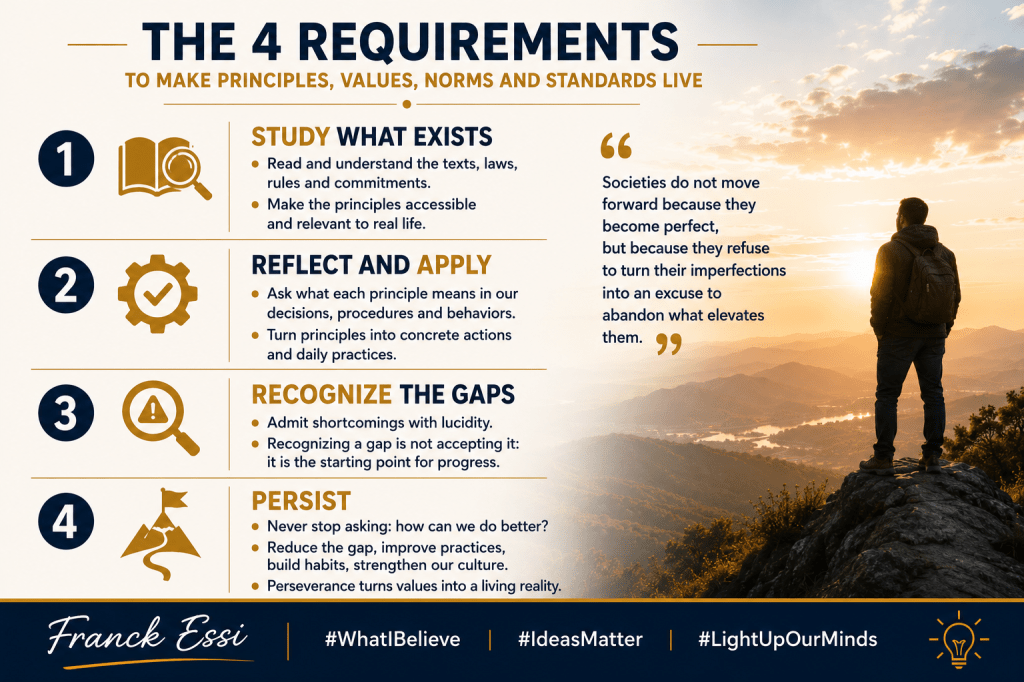
Study, apply, acknowledge gaps and persevere
It is not enough to say that principles, values, norms and standards are important. We must also learn to know them, understand them, place them in their history, confront them with our realities and constantly search for ways and means to apply them.
The first requirement is to study what exists.
Many people speak of the State, democracy, justice, good governance, citizenship, ethics, transparency, accountability or the common good without ever taking the time to read the texts that organize these notions. We have constitutions, laws, regulations, charters, codes of conduct, traditions, international commitments, professional rules, community norms, administrative and institutional standards. They may be insufficient. They may be imperfect. They may be poorly applied. But one cannot seriously claim to defend, criticize, improve or apply them without first knowing them.
We must therefore read. Study. Compare. Discuss. Understand. Translate into accessible language what texts often say in difficult language. Bring great principles down into the real lives of citizens, families, administrations, organizations, communities and States.
The second requirement is to constantly reflect on the ways and means of applying them. Because it is not enough to proclaim equality before the law. We must ask how it becomes real at an administrative counter, in a police station, in a court, in a competitive exam, in a school, in a hospital or in access to a public contract. It is not enough to say that we believe in merit. We must ask how we recruit, how we promote, how we evaluate and how we sanction. It is not enough to say that we believe in transparency. We must ask how information circulates, who has access to it, within what timeframe, in what form and with what consequences.
This is where serious work begins.
A principle is not truly respected simply because it is written somewhere. It begins to live when a society patiently asks itself: what does this mean concretely in our decisions, procedures, behaviors, trade-offs and daily practices?
The third requirement is to lucidly acknowledge gaps without turning them into excuses for renunciation.
It may happen that a government is not yet able to fully guarantee justice, transparency, efficiency or equal treatment. It may happen that a community is not yet able to make inclusion, listening, solidarity or respect for all truly live. It may happen that an organization is not yet able to perfectly apply its own values. It may happen that an individual is not always able to live up to the principles they proclaim.
This must be acknowledged.
But acknowledging a gap is not the same as accepting it permanently. Recognizing a difficulty is not the same as settling into it. Admitting that we have not yet succeeded is not the same as deciding that it no longer matters.
A serious society is not a society that applies all its principles perfectly overnight. It is a society that refuses to turn its failures into fate, its delays into doctrine, its weaknesses into culture and its renunciations into realism.
The fourth requirement, therefore, is to persevere.
To persevere is to return constantly to the question: how can we do better? How can we reduce the gap between what we proclaim and what we practice? How can we transform a value into behavior? How can we transform a principle into a rule? How can we transform a rule into a habit? How can we transform a habit into collective culture?
For a government managing a State, this means that it is not enough to proclaim the rule of law, good governance, social justice or national sovereignty. Institutions, budgets, public policies, controls, sanctions and accountability mechanisms must be organized in that direction. To govern seriously is not only to decide. It is to create the conditions through which proclaimed principles gradually become lived experiences for citizens.
For a community, this means that it is not enough to speak of solidarity, respect for elders, protection of the weakest or unity. One must ask how conflicts are resolved, how the most vulnerable are treated, how speech circulates, how abuses are corrected and how responsibilities are shared. A community that always protects the powerful and always asks the weak to remain silent eventually destroys the very values it claims to defend.
For an organization, this means that it is not enough to display values on a wall, in a strategic document or on a website. One must look at how people are recruited, how decisions are made, how money is managed, how conflicts are handled, how mistakes are acknowledged, how leaders account for their actions and how people are treated daily. An organization is not measured by the values it proclaims, but by the practices it installs.
For individuals, this means that it is not enough to denounce the failures of society, the State, leaders, political parties, administrations or other citizens. We must also look at what we do, at our own level, with truth, money, the word we give, loyalty, merit, justice, power, responsibility and the common good. No one transforms a society alone. But each person can, at their own level, stop feeding what they denounce.
In the end, making principles, values, norms and standards live requires a simple but demanding collective discipline:
- study what exists;
- understand the meaning of what is proclaimed;
- identify the gaps between texts, speeches and practices;
- search for concrete ways of applying them;
- acknowledge difficulties without renouncing;
- correct patiently;
- persevere in deepening the level of requirement.
This is how societies truly move forward.
Not because they become perfect.
But because they refuse to turn their imperfections into an excuse for abandoning what elevates them.
My Deep Conviction
My intimate conviction is that nothing durable can be built against principles.
True realism does not consist in abandoning principles. It consists in building the concrete conditions for their application. True pragmatism does not consist in trampling on values. It consists in finding the political, institutional, cultural, educational and social means to make them live. True maturity does not consist in laughing at norms. It consists in understanding that they protect the weak against the arbitrariness of the strong, institutions against the whims of individuals, and societies against their own disorder.
Principles do not automatically guarantee justice. But abandoning them almost always guarantees arbitrariness. Values are not enough to transform a society. But a society with no shared values quickly becomes a brutal marketplace of competing interests. Norms do not solve everything. But without norms, force takes the place of law. Standards do not create excellence by themselves. But without standards, mediocrity gradually becomes acceptable.
We must therefore pay attention to what we normalize, because what we normalize eventually governs us. We must pay attention to what we call realism, because realism can sometimes be only the polite name for our renunciation. We must pay attention to what we accept in the name of caution, loyalty, belonging, survival or immediate efficiency.
By accepting the unacceptable for too long, a society eventually no longer knows what should still shock it.
The struggle, therefore, is not to choose between principles and reality. The struggle is to transform reality so that it increasingly conforms to the principles that make human life dignified, society livable and the State respectable.
That, in my view, is the noble meaning of History: not an automatic march toward progress, but a permanent effort to ensure that humanity does not renounce what elevates it.
By Franck Essi
#WhatIBelieve
#IdeasMatter
#WeHaveAChoice
#WeHaveThePower
#LightUpOurMinds


