Reflections of a Concerned African on Xenophobia, Poverty and the Scapegoat Trap in South Africa
By Franck Essi
8 July 2026
There are African countries we look at with particular attention, because they carry more than their own destiny. South Africa is one of those countries.
For many Africans of my generation, it remains one of the continent’s great political symbols: the country of the struggle against apartheid, the country of Mandela, Steve Biko, Winnie Mandela and Desmond Tutu, but also one of the few African states capable of weighing in on major international debates.
In recent years, South Africa has often inspired, in me as in many others, a certain African pride. It has given us the feeling that an African state could still speak strongly in a world dominated by power relations.
This pride is linked in particular to several elements:
- its initiative on the Gaza case before the International Court of Justice;
- its role within BRICS+;
- its positioning in favour of a world order less dominated by the West;
- its ability to stand up to certain diplomatic pressures, including those from the Trump administration;
- its image as an African power capable of assuming an autonomous international voice. [1]
That is precisely why the xenophobic violence that periodically resurfaces in South Africa affects me so deeply.
How can we understand that a country which speaks so forcefully in the name of international justice can allow such brutal hostility against other poor Africans to flourish in some of its popular neighbourhoods?
How can we understand that a nation which benefited from African solidarity during the years of struggle against apartheid can today see Africans threatened, humiliated, chased away or attacked because they are foreigners, or simply presumed to be so?
I do not write these lines as a specialist on South Africa. I write them as an African who observes this great country with admiration, respect, concern and, at times, sadness.
I have had the opportunity to visit South Africa twice. Each time, I was struck by the contrast between the beauty of the country, the strength of its infrastructure, the sophistication of some urban spaces, and the almost constant warnings about insecurity. You are reminded to be careful when moving around. You are given firm instructions. You are told to keep the car windows closed, especially at stops, traffic lights, roundabouts or in certain neighbourhoods.
These experiences do not make me an expert. But they allowed me to feel something that statistics alone do not always convey: insecurity in South Africa is not merely a subject of public debate; it is a daily social experience, an atmosphere, a form of caution incorporated into ordinary gestures.
It would therefore be absurd to deny that many South Africans live in a harsh, tense society marked by fear, uncertainty and social violence. But recognising this reality does not mean accepting that this fear should be turned against the most vulnerable.
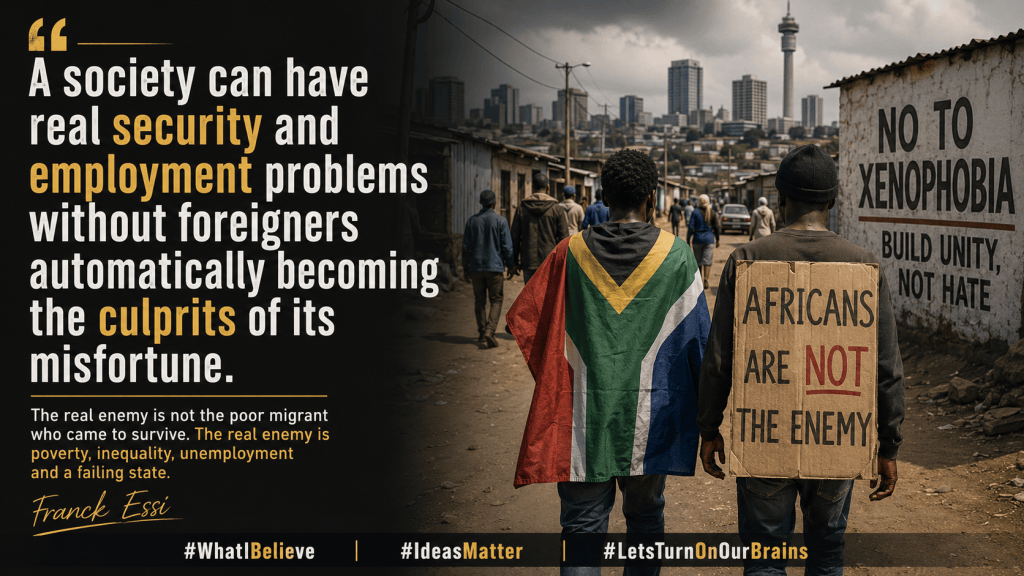
A society can have real security problems without foreigners automatically becoming the culprits of its misfortune.
It would be unfair to reduce South Africa to xenophobic violence. But it would be equally unfair to pretend that such violence says nothing profound about the country’s social, political and moral condition.
For years, we have witnessed recurring waves of xenophobia. The episodes are not always identical. Contexts change, actors change, immediate triggers change. But something keeps coming back: African migrants periodically become the visible targets of deep social anger.
The violence of 2008, the waves that followed in 2015, 2019, 2021–2022, and then the more recent mobilisations, appear to trace a troubling continuity. In 2008, Human Rights Watch recalled that xenophobic attacks left 62 people dead and caused large-scale displacement. [2]
When a society regularly experiences surges of hatred against poor foreigners, we must look beyond the event itself. We must question the suffering being expressed, but also the target that this suffering chooses for itself.
An African Power Crossed by Deep Fractures
To understand what is at stake, we must first look at South Africa as it is today: a major African power, but also a deeply fractured society.
Demographically, the country had around 63.1 million inhabitants in mid-2025. The black African population represented around 82% of the total population, while coloured, white, Indian or Asian populations constituted the other major groups inherited from the country’s social and political history. [3]
The term coloured deserves explanation, because it may sound surprising in French or outside the South African context. In South Africa, it does not simply refer to “skin colour” in the ordinary sense. It is a category inherited from colonial history and apartheid, used to designate mixed-race populations whose historical trajectories are complex and include African, European, Malay, Khoisan, formerly enslaved and other backgrounds.
These categories are heavy with history. They remind us that South Africa was not only a racialised state in the past; it remains a society where the economic and social effects of that history are still visible in many areas:
- urban space;
- income;
- property;
- education;
- access to senior leadership positions;
- inheritance and wealth transmission;
- the everyday relationship to economic power.
Politically, South Africa entered a new period after the 2024 elections. For the first time since the end of apartheid, the ANC lost its absolute majority in Parliament, paving the way for a government of national unity. [4]
This change is not insignificant. It reflects the vitality of South African democracy, the exhaustion of a historic party, accumulated social frustration and citizens’ impatience in the face of unemployment, insecurity, housing, corruption and public services.
Economically, South Africa remains one of the largest and most sophisticated economies on the continent. It has a developed financial sector, a still significant industrial base, a strategic mining sector, recognised universities, powerful companies and an active economic diplomacy.
But this power coexists with weak growth, massive unemployment and an extremely high concentration of wealth.
In 2025, real GDP, meaning economic output adjusted for inflation, grew by around 1.1%. In the first quarter of 2026, the economy grew again by 0.5%, supported in particular by finance, agriculture, trade and transport. [5]
These figures portray an economy that continues to function, but one that does not sufficiently transform the lives of the majority.
South Africa’s problem is not the complete absence of wealth. The problem is how that wealth is produced, controlled, transmitted and distributed.
Available household income data is revealing. In 2023, the average annual income of a South African household was estimated at around 204,359 rand, with a median income of 95,770 rand. But behind this average lie considerable disparities: households headed by white people had an average income of around 676,375 rand, compared with 143,632 rand for households headed by black Africans. [6]
In other words, according to this data, the average income of a household headed by a white person appears almost five times higher than that of a household headed by a black African person.
These figures do not exhaust the full social complexity of the country. But they say something very powerful: the political end of apartheid has not been enough to produce deep economic justice.
The concentration of wealth appears even more striking. Specialised studies estimate that the richest 10% hold more than 85% of household wealth, while the richest 1% hold around 55%. [7]
In such a configuration, speaking of social crisis without speaking of property, capital, inheritance, education, urban location and economic power means remaining at the surface of things.
In such an unequal society, the poor migrant can easily become visible. But the real centres of wealth and power often remain far less accessible to popular anger.
BEE: A Necessary Response, but an Unfinished Transformation
One cannot speak about the distribution of wealth in South Africa without addressing the economic transformation policies introduced after apartheid, particularly Black Economic Empowerment and then Broad-Based Black Economic Empowerment.
Their initial logic seems difficult to dispute: one could not exit a racialised political order while leaving intact the economic structure produced by that order.
These policies aimed in particular to promote:
- black South Africans’ access to company ownership;
- their access to senior management positions;
- their participation in public procurement;
- skills development;
- support for black-owned enterprises;
- inclusion in supplier chains;
- broader participation of historically excluded groups in the formal economy. [8]
It would be unfair to say that nothing has changed. A black middle class has developed. Black executives now occupy important positions. Black entrepreneurs have emerged. Skills development, supplier support and economic inclusion mechanisms have been implemented.
But the record remains mixed.
On the one hand, BEE responded to a historical necessity. On the other hand, it has not been enough to transform the structure of the economy in depth.
Recent data on management positions show that white South Africans remain heavily overrepresented at the top of companies. The Commission for Employment Equity again stressed in 2026 that the upper levels of decision-making, particularly top management and senior management, remain strongly marked by racial and gender hierarchies. [9]
Recurring criticism also points to fronting practices, artificial compliance, circumvention, the concentration of benefits among a connected minority, and a transformation more visible in certain indicators than in the daily lives of the poor. Reuters also reported in 2026 that B-BBEE remains controversial, with some critics arguing that it has enriched a politically connected minority without sufficiently resolving economic inequalities. [10]
My feeling, based on what I have been able to read quickly, is therefore the following: BEE may have opened doors, but it has not yet transformed the economic house in which the majority of poor South Africans are still waiting for their place.
It is in this space of waiting, frustration and partially fulfilled promises that anti-migrant narratives become effective.
When a society promises economic justice but does not distribute it sufficiently, anger eventually seeks a closer, more visible and more vulnerable target.
Real Social Anger, but a Questionable Target
The anger of part of South Africa’s poor does not come from nowhere.
It is rooted in a society where inequalities are immense, unemployment remains massive, popular neighbourhoods still bear the marks of apartheid, and young people often look at the promises of democracy without experiencing their benefits.
In the first quarter of 2026, the official unemployment rate was estimated at 32.7%. The number of employed people decreased by 345,000, while the number of unemployed people increased by 301,000. [11]
The situation of young people is even more worrying. Statistics South Africa indicated that in the first quarter of 2026, 4.7 million young people aged 15 to 34 were unemployed. [12]
These figures speak for themselves. They describe a crisis of the future. They speak of families under pressure, neighbourhoods where waiting turns into despair, and young people who live in a democratic country but do not always feel included in its economy.
But recognising the depth of suffering does not mean validating every direction that suffering may take.
Anger can be legitimate in its causes and dangerous in its targets.
This is perhaps one of the current South African tragedies: understandable social anger sometimes seems to turn away from the structures that produce poverty in order to strike people who are themselves vulnerable.
Anti-Migrant Movements: Real Problems, Wrong Explanations
Anti-migrant mobilisations are not all identical. They form an ecosystem of movements, slogans, social media networks, neighbourhood groups and more or less structured political formations.
Among the most visible in recent years are Operation Dudula, March and March, Put South Africa First, as well as other local campaigns repeating similar arguments.
From what I have been able to read, their arguments generally revolve around a few recurring themes:
- migrants are said to be taking South Africans’ jobs;
- they are said to accept lower wages;
- they are accused of overburdening hospitals, schools and public services;
- they are associated with crime or certain forms of trafficking;
- they are said to dominate certain segments of informal trade;
- they are accused of illegally occupying housing or buildings;
- the state is accused of being unable to control borders and documents;
- South African citizens are said to be abandoned at home in favour of foreigners.
These arguments should not be caricatured too quickly. Some express a real demand for the state: border control, serious administrative management, the fight against fraud, enforcement of labour law, protection of workers, regulation of trade, order in cities, and security in neighbourhoods.
No country can function without rules.
Asking the state to control borders, fight fake documents, enforce labour law or protect public services is not in itself xenophobic.
What becomes xenophobic is transforming these legitimate demands into general hatred against foreigners, especially when they are poor, black and African.
What becomes dangerous is when private groups claim the right to check papers, close shops, block access to services, intimidate people or impose their own conception of public order.
Human Rights Watch documented, in 2026, new waves of attacks and intimidation against foreigners in South Africa, including actions targeting access to public services such as healthcare. [13]
The difficulty is that these movements thrive on a mixture of real problems and wrong explanations.
The real problems exist: unemployment, poverty, crime, state failure, poor migration governance, pressure on certain public services, and competition in the informal economy.
But the idea that migrants are the central cause of these problems is far more questionable.
The political power of the scapegoat lies precisely there: it transforms real suffering into a falsely obvious explanation.
What the Numbers Require Us to Nuance
In anti-migrant discourse, the idea of an “invasion” often returns. It strikes the imagination because it creates the feeling of massive dispossession: jobs supposedly taken, hospitals overwhelmed, neighbourhoods transformed, shops captured, security threatened.
But the available data calls for far more caution.
According to official 2022 census figures, South Africa had around 2.4 million people born outside the country, or around 3.9% of the population. Another Statistics South Africa estimate, based on the 2022/2023 Income and Expenditure Survey, refers to around 3.1 million foreign-born people, or about 5.1% of the population. [14]
These figures do not settle everything. Data on irregular migration is always difficult to establish with perfect precision, and every state must be able to better understand the realities of its territory.
But the available orders of magnitude do not support alarmist claims that sometimes speak of 15 to 30 million irregular migrants. [15]
Migrants are visible, but they are not demographically dominant.
This nuance is essential.
In cities, markets, popular neighbourhoods, small shops, construction, domestic work or the informal economy, migrants may be very visible to local populations. This social visibility can create tensions, especially in a context of poverty.
But visibility must not be confused with primary responsibility for the crisis.
It is also necessary to avoid placing everyone in the same category:
- economic migrants;
- refugees;
- asylum seekers;
- people in an irregular administrative situation;
- documented residents;
- naturalised citizens;
- South Africans born outside the country.
When public debate erases all these distinctions, it often prepares more confusion than justice.
Are Foreigners Stealing Jobs?
This is probably the strongest and most politically effective accusation.
In a country where official unemployment exceeds 32%, the idea that foreigners are “stealing” jobs easily finds emotional ground.
But the available elements invite us to distinguish perception from economic reality.
Migrants are present in certain sectors: informal trade, construction, domestic work, restaurants, agriculture, services and small urban jobs. They can therefore be perceived as direct competitors by poor South Africans who are themselves trying to survive in the same economic spaces.
However, the available studies and analyses do not allow us to conclude that migrants are the main cause of South Africa’s unemployment.
The problem seems rather to come from much deeper structural factors:
- an economy that does not create enough jobs;
- growth that is too slow;
- a highly unequal education system;
- weak absorption of young people into the labour market;
- a productive structure unable to integrate low-skilled people on a large scale;
- an urban geography still marked by apartheid;
- public institutions that do not always succeed in enforcing rules.
One argument does deserve to be heard: in some sectors, employers may prefer to hire migrants, sometimes because they accept more precarious conditions or because they are more vulnerable.
But in that case, the problem is not limited to the migrant’s presence. It also concerns employers, labour law, inspections, precariousness, weak unionisation and the state’s inability to enforce fair rules.
When an employer exploits a poor migrant against a poor South African worker, the main responsibility does not lie only with the migrant. It also lies with the system that makes such exploitation possible.
Expelling migrants would not mechanically create an economy capable of absorbing millions of unemployed people.
The real question is therefore not how to drive out poor foreigners, but how to create enough decent jobs for South Africans while governing migration properly.
Are Foreigners Responsible for Crime?
The other central accusation concerns crime. Here too, several truths must be held together.
First, there are obviously foreigners involved in offences. No human group is outside crime. It would be absurd to deny any involvement of foreign nationals in certain illegal activities.
But this fact does not allow us to conclude that foreigners are responsible for South African crime as a whole.
Crime in South Africa has deep causes: the history of violence, extreme inequality, urban poverty, local criminal economies, weak policing in certain areas, distrust of the state, gangs, unemployment, social violence and impunity.
Prison data must also be read with caution. The World Prison Brief indicates that foreign prisoners represented 14.9% of South Africa’s prison population on 31 December 2025. [16]
This figure is not insignificant and deserves analysis. But it does not by itself prove that foreigners produce crime.
The prison population does not directly measure all crimes committed. It may be influenced by several factors: pre-trial detention, lack of documents, difficulty obtaining bail, lack of a stable address, weaker access to good legal defence, and confusion between migration offences and violent crime.
The link between migration and insecurity exists as a governance issue. But it becomes a political lie when all migrants are turned into permanent suspects.
The serious response is institutional: better policing, more effective justice, more precise data, the fight against criminal networks, labour inspections, document regulation and regional cooperation.
It cannot be general suspicion against millions of people.
The Migration Question Exists, but It Does Not Explain Everything
It would be irresponsible to deny that South Africa faces real migration challenges.
Every state has the right and duty to organise its borders, documents, asylum procedures, labour market, access to public services, the fight against fraud, the fight against abuse and cooperation with neighbouring countries.
But it would be equally questionable to make migrants the central cause of South Africa’s difficulties.
Mass unemployment, poverty, the housing crisis, crime, corruption, the weakness of certain public services, local governance difficulties and historically inherited inequalities cannot reasonably be attributed primarily to migrants.
The question to ask is therefore not only: how many foreigners are there?
It is deeper: why does a migrant minority become, in certain moments of crisis, the preferred explanation for much broader social problems?
It seems to me that the answer lies partly in the weakening of trust in the state.
When the state does not protect enough, does not create enough jobs, does not guarantee dignified public services, does not control its own procedures, does not fight corruption sufficiently and no longer produces a credible explanation for social suffering, people look for a visible cause.
And very often, that visible cause becomes the foreigner.
Xenophobia thrives where structural problems seek a human face to accuse.
When the Street Claims to Replace the Law
Recent violence does not emerge from a historical vacuum. It is part of a longer sequence.
But the recent period seems to mark a worrying stage: it is no longer only a matter of local explosions of violence, but also of more organised anti-migrant mobilisation.
ACLED recorded 61 anti-migrant mobilisation events between April and mid-June 2026, particularly under the impetus of the March and March movement. [17]
In late June 2026, anti-migrant marches led to more than 900 arrests. According to Reuters, South African police authorities referred to 120 marches, 108 of which were described as peaceful, while 12 required police intervention. [18]
The state also deployed 3,405 soldiers from 28 June 2026, at an estimated cost of 54.6 million rand. [19]
These figures show that xenophobia is not only a moral problem. It also becomes a public security problem, a budgetary cost, a factor of social fragmentation, a threat to the rule of law and an issue for the country’s international image.
It does not only cost migrants. It costs the whole society.
We must distinguish between two things: the legitimate management of migration by the state, and the claim by private groups to police borders, neighbourhoods, shops or hospitals themselves.
The first belongs to public action. The second directly threatens the rule of law.
When a group of citizens decides who must show papers, who has the right to sell, rent, move around, work or access a service, we are no longer dealing with migration policy.
We enter a dangerous zone where the law is replaced by intimidation and citizenship becomes a weapon against those weaker than oneself.
The right to demonstrate is legitimate. Criticism of migration policies is legitimate. The demand for a more effective state is legitimate.
But none of these legitimate claims can justify people being threatened, chased away, humiliated or attacked because they are foreign or presumed to be foreign.
A state that allows private groups to decide who has the right to live, work, move around or seek healthcare is no longer merely facing a migration crisis. It is facing a crisis of the rule of law.
The South African Pan-African Contradiction
There is a particular pain in this situation.
South Africa benefited from African solidarity during the years of struggle against apartheid. African countries welcomed its militants, supported its organisations, carried its cause onto the international stage and sometimes paid a high price for that solidarity.
To see poor Africans today threatened, chased away or humiliated in South Africa cannot leave us indifferent.
This does not mean that South Africa should abandon all migration policy. No serious country can function without rules, documents, procedures, controls and administrative capacity.
But there is an essential difference between:
- governing migration and hating migrants;
- enforcing the law and handing human beings over to the crowd;
- defending citizens’ rights and denying the dignity of foreigners;
- building public policy and encouraging collective suspicion.
South Africa cannot wish to be a great African power while allowing Afrophobia to flourish in its popular neighbourhoods.
This contradiction does not concern South Africans alone. It questions all Africans.
It forces us to ask what Pan-Africanism really means when it is no longer just a matter of diplomatic speeches, but of concrete relations between poor Africans in cities, markets, neighbourhoods and workplaces.
Consequences That Go Beyond the Immediate Victims
Xenophobic violence first destroys individual lives: displaced families, lost shops, abandoned homes, interrupted incomes, children out of school, people who no longer dare to go to work, seek treatment or file complaints.
But its consequences go further.
Inside the country, it can produce weaker social cohesion, growing mistrust between neighbours, the rise of vigilantism, disruption of local economies, the normalisation of collective violence and a diversion of attention away from the deeper causes of the crisis.
Externally, it damages South Africa’s relations with other African countries.
Foreign nationals have been repatriated by their countries, some governments have warned their citizens, and the issue has taken on a continental diplomatic dimension. Associated Press reported in early July 2026 that Nigeria had announced the deaths of two of its nationals in the context of this violence, and that several African countries had taken repatriation or warning measures. [20]
For example, Ghana decided to postpone bilateral meetings with South Africa because of rising anti-migrant violence. [21]
Xenophobia is an internal defeat that quickly becomes an external crisis.
It affects the country’s image, moral authority, African soft power, Pan-African credibility and the trust of other African peoples.
The Responsibility of Elites
It would be too easy to blame only the crowds.
Crowds never think in a vacuum. They are fed by speeches, silences, ambiguities, electoral calculations and sometimes by the inability of institutions to provide concrete answers.
When political leaders speak of migrants as if they were the main cause of unemployment, they probably know what they are activating.
When they too easily associate immigration, crime and social collapse, they risk making violence thinkable.
When they condemn attacks while repeating the narratives that make those attacks plausible, they feed a dangerous ambiguity.
The South African authorities have condemned the violence, recalled that the enforcement of migration laws belongs to the state and not to private groups, and announced security measures. This is necessary.
But the deeper question remains: how long will African states continue to discover the consequences of their own failures only when those failures become violent?
A society does not become xenophobic in one day.
It can become so when frustrations accumulate, when inequalities reproduce themselves, when public services deteriorate, when simplistic narratives become normal, and when elites prefer to designate culprits rather than solve problems.
People do not become violent simply because they suffer. They can become violent when their suffering receives the wrong explanation.
What This Can Teach Us as Cameroonians and Africans
This crisis does not concern South Africa alone.
It speaks to all African countries where popular suffering can be diverted toward the wrong targets.
In Cameroon too, we know the temptation of scapegoating. When the system fails, people sometimes blame:
- a region;
- an ethnic group;
- a linguistic community;
- internally displaced persons;
- the diaspora;
- young people;
- civil servants;
- traders;
- opposition figures;
- foreigners;
- “strangers” or “non-natives”.
The situations are obviously not identical. Each country has its history, tensions, wounds and specific forms of symbolic or material violence.
But the scapegoat mechanism can be recognised in many societies in crisis.
Every society in crisis eventually looks for someone to blame. The real question is whether it will have the lucidity to search for the deeper causes or the ease of striking the most exposed.
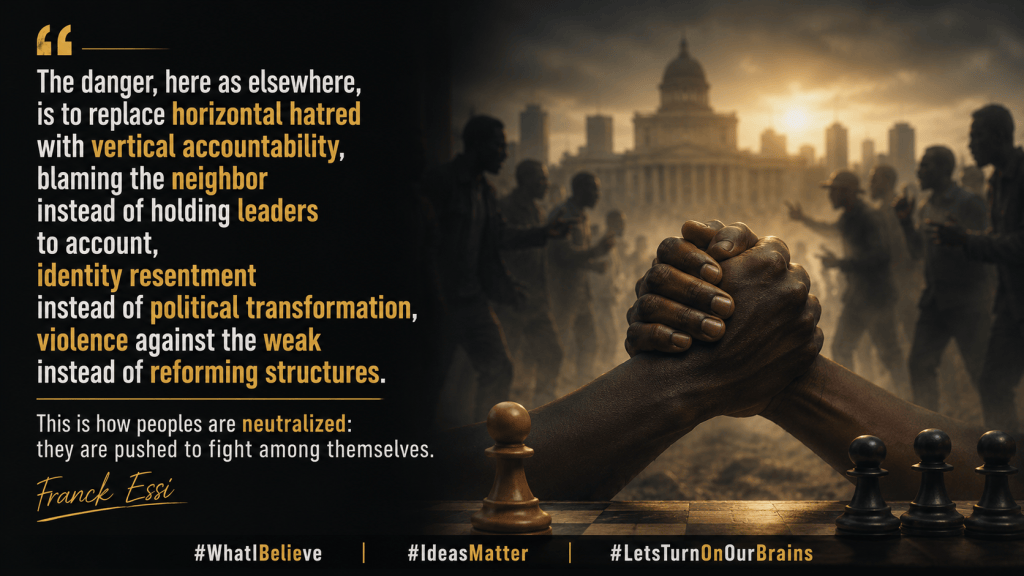
The danger, here as elsewhere, is to substitute horizontal hatred for vertical accountability, accusations against the neighbour for questioning those who govern, identity resentment for political transformation, violence against the weak for structural reform.
This is how peoples can be neutralised: they are pushed to fight among themselves.
Giving the Right Explanation to Suffering
Politics often begins with the explanation of misfortune.
Whoever controls that explanation largely controls the direction of anger.
If people are told that their problem comes from the migrant, they will attack the migrant.
If they are told that their problem comes from an unjust economic model, a failing state, corrupt governance and the absence of serious social policies, then their anger can become a force for transformation.
That is why political education is decisive.
A people that suffers without understanding can become dangerous to itself. A people that suffers and understands can become a historical force.
The issue is therefore not to deny migration problems. South Africa probably needs to better organise its borders, documents, asylum procedures, labour market, public services, regional cooperation and justice and security mechanisms.
But it must do so without hatred, without vigilantism, without lies and without dehumanisation.
Real migration policy does not need xenophobia. It needs the state, data, justice, cooperation and respect for human dignity.
Refusing the Ease of Hatred
The African migrant in South Africa is not a concept.
He or she is often a father, a mother, a child, a worker, a refugee, a trader, a student, a person who fled poverty, war, political crisis or the absence of a future.
To see this person only as a threat is already to lose part of our humanity.
Africa has suffered enough from imposed borders, colonial divisions, internal wars, narrow nationalisms, identity manipulation and violence between the poor.
It does not need to add to its wounds a war of the poor against the poor.
True political courage is not to teach the poor to hate other poor people.
True political courage is to help them understand why they are poor, who benefits from their anger, and how to transform that anger into a power for change.
The anger of the poor can be a force of liberation. But when it misidentifies its enemy, it becomes a weapon against the innocent.
I do not write, therefore, to lecture South Africa.
I write because what is happening in this great country concerns us all.
I write because African crises often have local forms, but common mechanisms.
I write because every time the poor are pushed to hate other poor people, the whole of Africa should be concerned.
South Africa may be warning us. It is up to us to hear that warning with lucidity, humility and courage.
Franck Essi
8 July 2026
#WhatIBelieve
#IdeasMatter
#LetsTurnOnOurBrains
Notes and References
[1] International Court of Justice, official case file: Application of the Convention on the Prevention and Punishment of the Crime of Genocide in the Gaza Strip — South Africa v. Israel: https://www.icj-cij.org/case/192.
On BRICS, see the official presentation of the 2026 presidency: https://www.brics2026.gov.in/about-us/.
On tensions between Donald Trump and BRICS, see Reuters, Trump threatens extra 10% tariffs on BRICS as leaders gather in Rio, 7 July 2025: https://www.reuters.com/world/china/leaders-growing-brics-group-gather-rio-summit-2025-07-06/.
[2] Human Rights Watch, World Report 2009: South Africa, section on the 2008 xenophobic attacks: https://www.hrw.org/world-report/2009/country-chapters/south-africa.
See also Human Rights Watch, South Africa: New Waves of Xenophobic Attacks, 20 May 2026: https://www.hrw.org/news/2026/05/20/south-africa-new-waves-of-xenophobic-attacks.
[3] Statistics South Africa, Mid-year population estimates 2025: https://www.statssa.gov.za/publications/P0302/P03022025.pdf.
[4] Parliamentary Monitoring Group, Election Results and Allocation of Seats in Parliament, National Assembly and Provincial Legislatures 2024: https://pmg.org.za/blog/Election%20Results%20and%20Allocation%20of%20Seats%20in%20Parliament%20National%20Assembly%20and%20Provincial%20Legislatures%202024.
See also Reuters, South Africa’s ANC to invite other parties to form government of national unity, 6 June 2024: https://www.reuters.com/world/africa/south-africas-anc-invite-other-parties-form-government-national-unity-ramaphosa-2024-06-06/.
[5] Statistics South Africa, GDP expands by 0,5%, 9 June 2026: https://www.statssa.gov.za/?p=19603.
[6] Statistics South Africa, Income & Expenditure Survey 2022/2023, 29 January 2025: https://www.statssa.gov.za/?p=17995.
[7] Aroop Chatterjee, Léo Czajka and Amory Gethin, Wealth Inequality in South Africa, 1993–2017, World Bank: https://openknowledge.worldbank.org/bitstreams/4e572124-f2e2-49d9-89e7-900c94a39e00/download.
[8] Department of Trade, Industry and Competition, information on B-BBEE: https://www.thedtic.gov.za/financial-and-non-financial-support/b-bbee/broad-based-black-economic-empowerment/.
[9] South African Government / Commission for Employment Equity, Labour market structure remaining hierarchical in terms of race and gender, 2026: https://www.gov.za/news/media-statements/employment-and-labour-labour-market-structure-remaining-hierarchical-terms.
[10] Reuters, South Africa proposes new way for firms to comply with Black empowerment policy, 29 January 2026: https://www.reuters.com/world/africa/south-africa-proposes-new-way-firms-comply-with-black-empowerment-policy-2026-01-29/.
[11] Statistics South Africa, Quarterly Labour Force Survey, Quarter 1: 2026: https://www.statssa.gov.za/publications/P0211/P02111stQuarter2026.pdf.
See also Reuters, South Africa’s official unemployment rate rises to 32.7% in first quarter, 12 May 2026: https://www.reuters.com/world/africa/south-africas-official-unemployment-rate-rises-327-first-quarter-2026-05-12/.
[12] Statistics South Africa, South Africa’s youth remain vulnerable in the labour market, 2026: https://www.statssa.gov.za/?p=19526.
[13] Human Rights Watch, South Africa: New Waves of Xenophobic Attacks, 20 May 2026: https://www.hrw.org/news/2026/05/20/south-africa-new-waves-of-xenophobic-attacks.
[14] Statistics South Africa, Understanding South Africa’s Immigrant and Internal Migration Patterns, 19 February 2025: https://www.statssa.gov.za/?p=18042.
Africa Check, How many foreign-born people are there in South Africa?, 18 July 2025: https://africacheck.org/infofinder/explore-facts/how-many-foreign-born-people-are-there-south-africa.
[15] Institute for Security Studies, Anti-migrant myths that have been allowed to fester in South Africa, 19 June 2026: https://issafrica.org/iss-today/anti-migrant-myths-that-have-been-allowed-to-fester-in-south-africa.
[16] World Prison Brief, South Africa — Total prison population, data on foreign prisoners: https://prisonstudies.org/country/south-africa?language_content_entity=en-gb.
[17] ACLED, Is South Africa experiencing its highest peak of anti-migrant mobilization?, 23 June 2026: https://acleddata.com/expert-comment/south-africa-experiencing-its-highest-peak-anti-migrant-mobilization.
[18] Reuters, Over 900 arrested during South African anti-migrant protests, 1 July 2026: https://www.reuters.com/world/south-african-police-say-they-arrested-over-900-people-during-anti-migrant-2026-07-01/.
[19] Reuters, South Africa deploys troops to bolster security during anti-migrant protests, 3 July 2026: https://www.reuters.com/world/africa/south-africa-deploys-troops-bolster-security-during-anti-migrant-protests-2026-07-03/.
[20] Associated Press, Nigeria says 2 nationals were killed during anti-migrant violence in South Africa, 5 July 2026: https://apnews.com/article/5448f808e7830b254de8c70038c08af7.
[21] Reuters, Ghana delays South Africa meetings over anti-migrant violence, 7 July 2026: https://www.reuters.com/world/africa/ghana-delays-south-africa-meetings-over-anti-migrant-violence-2026-07-07/.

