Franck Essi, October 5, 2026
What has been happening for several years with Cameroonian teachers should not be viewed merely as a professional dispute. Delays in administrative processing, salary arrears, difficult career progression, poor working conditions, the situation of precarious staff, and problems with teacher deployment certainly tell us something about the teaching profession. But they also tell us something about the capacity of our State to plan, administer, honour its commitments, and prepare for the future.
The question is therefore much broader: can we seriously seek to refound the State, rebuild the Nation, and transform governance without at the same time refounding the institution that educates those who will tomorrow make that State function, live out that Nation, and exercise that governance?
I do not believe so.
By refounding, I do not simply mean correcting a few visible dysfunctions or adding new measures to old ones. To refound is to reconsider the purpose of an institution, the rules that organize it, the resources allocated to it, the results expected from it, and the responsibilities of those who bring it to life.
It is precisely in this sense that the education question seems to me inseparable from the refounding of Cameroon.
THE TEACHERS’ CLAIMS HAVE BECOME A NATIONAL ISSUE
We must first understand what teachers are actually demanding.
When the OTS movement — On a Trop Supporté, or “We Have Endured Too Much” — gained momentum in 2022, it brought to light problems that many teachers had long experienced individually: delayed financial coverage, salary arrears, administrative bottlenecks, stalled promotions, and difficult working conditions.
Since then, the demands have broadened. The Collective of Teachers’ Organizations of Cameroon — COREC brings together numerous professional and trade union organizations. In its Manifesto, its declaration of March 19, 2025, and the strike notice issued on the same date, it no longer raises only the question of teachers’ rights. It also raises the question of transforming the education system as a whole.
Three levels of demands clearly emerge:
- Immediate professional and social concerns: salaries, arrears, career progression, allowances, social protection, private-sector teachers, and so-called “parents’ workers”.
- Institutional reforms: teacher status, training, recruitment, promotions, working conditions, and social dialogue.
- Refounding the education system itself: a National Education Forum, curricula, languages, assessment systems, twenty-first-century skills, financing, and stronger links between school, the economy, and society.
The move from the first to the third level is, in my view, essential.
The teachers’ crisis is no longer calling merely for administrative corrections. It now raises the question of the educational model itself.
On April 1, 2025, teachers’ organizations formally submitted a consensual proposal for a new status to the government. MINFOPRA itself indicated that teachers were calling for a form of recognition that was not merely financial, but also concerned the status and organization of the profession.
What matters here is the shift in the debate: the teachers’ crisis is no longer only asking the State to settle what it owes teachers. It is forcing the country to ask what kind of education system it wants.
WHAT THE CONDITION OF TEACHERS TELLS US ABOUT THE STATE
As of December 31, 2023, the State’s salary arrears were estimated at FCFA 293.9 billion, of which around FCFA 166.8 billion concerned primary and secondary education staff. By the end of June 2025, the State reported that it had cleared FCFA 78.5 billion in salary arrears since the beginning of the year, of which FCFA 45.4 billion, or 57.9%, benefited basic and secondary education staff.
These efforts should be acknowledged. But the more important question is this: how do we prevent the same dysfunctions from recurring?
A functional State should be able to:
- know its actual teacher needs;
- recruit and deploy accordingly;
- process administrative acts and careers promptly;
- guarantee regular payment of entitlements;
- monitor skills and anticipate future needs.
Refounding the State also means this: doing properly, regularly, and efficiently what the State is normally supposed to do.
But the contract must be reciprocal. A teacher who is respected, fairly paid, trained, and supported must also be a teacher who is present, competent, prepared, committed to professional ethics, and open to a fair assessment of his or her work.
Dignity must go with standards. Rights must go with responsibilities.
THE REAL TEST: WHAT CHILDREN ACTUALLY LEARN
The education crisis, however, cannot be reduced to the teachers’ crisis.
According to UNICEF’s country programme document adopted in 2026, around 1.1 million children were out of school in Cameroon in 2024, 61% of them girls. Among pupils completing primary school, 60% did not reach the minimum proficiency level in reading and 67% did not meet basic standards in mathematics.
The World Bank also estimates, on the basis of the latest available data before Covid-19 school closures, that learning poverty affected around 72% of Cameroonian children at the end of primary-school age: they were unable to read and understand an age-appropriate simple text, taking into account children who were out of school.
These figures should force us to shift part of our attention.
We often talk about the number of teachers recruited, classrooms built, examinations organized, pass rates, and budgets mobilized. We must also ask: what can a Cameroonian child actually do after several years in school?
Can the child:
- read and understand;
- write, calculate, and reason;
- search for and verify information;
- cooperate in solving a problem?
Building a school is not an end in itself. Recruiting a teacher is not an end in itself. Executing an education budget is not an end in itself.
The true measure of the system is what the child learns and what the child becomes.
WHY REFOUNDING EDUCATION IS CENTRAL TO REFOUNDING CAMEROON
School does not transmit knowledge alone. It helps shape three essential dimensions of any society:
- skills: what people know and know how to do;
- representations: what they think about themselves, their history, their country, and others;
- behaviours: their relationship to work, rules, authority, responsibility, and disagreement.
This is where the link with refounding becomes direct.
Refounding the State requires new capacities. We can improve public administration, decentralize, digitalize services, and create better institutions. But these institutions will still need teachers, technicians, engineers, doctors, farmers, judges, entrepreneurs, administrators, and citizens who are sufficiently educated to make them work.
Refounding the Nation also requires shared representations. In a country as diverse as Cameroon, school must enable children to understand our precolonial history, German colonization, French and British rule, the struggles for independence, the history of the UPC, reunification, the different trajectories of Anglophone and Francophone Cameroon, our languages, cultures, achievements, and wounds.
A Nation that is unable to teach its history honestly may one day be forced to confront politically what it failed to explain pedagogically.
Refounding governance finally requires new behaviours. If, for fifteen years, we teach future citizens that whoever holds authority is always right, that a question is insolence, and that contradiction is disobedience, then we are transmitting a particular culture of power.
We cannot demand tomorrow citizens who are responsible, creative, capable of initiative and democratic participation if we have mainly trained them to memorize, repeat, and obey.
School should also teach that one can respect someone without always agreeing with them, that rules apply to everyone, that admitting an error is not weakness, and that every form of authority carries responsibility.
Democracy also begins in the classroom.
School will obviously not refound Cameroon on its own. Families, the media, religious and social organizations, the economy, and political institutions also shape behaviour. But no lasting refounding will succeed if school continues to reproduce the very shortcomings that society claims it wants to overcome.
TOWARDS A PACT FOR EDUCATIONAL REFOUNDING
The National Education Forum demanded for several years by teachers’ organizations could be an important moment. But a forum is not a solution in itself. It would only be meaningful if it led to clear choices, a timetable, financial commitments, public indicators, and an independent monitoring mechanism.
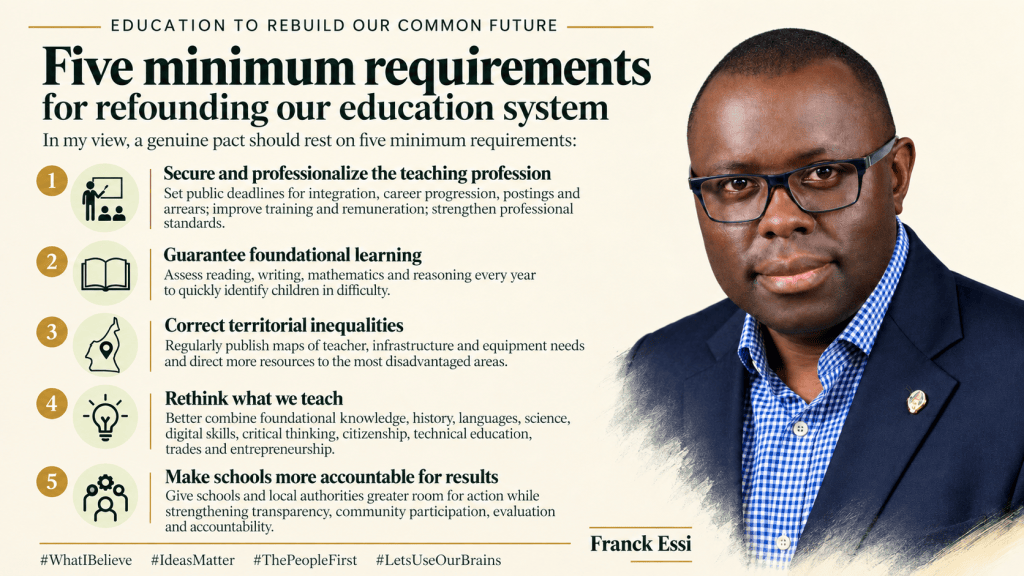
In my view, a genuine pact should rest on five simple commitments:
- Secure and professionalize the teaching profession: establish public deadlines for integration, career progression, postings, and arrears; improve training and remuneration; but also strengthen professional standards.
- Guarantee foundational learning: assess reading, writing, mathematics, and reasoning every year so that children in difficulty are identified early.
- Correct territorial inequalities: regularly publish maps of teacher, infrastructure, and equipment needs and direct more resources towards the most disadvantaged areas.
- Rethink what we teach: better combine foundational knowledge, history, languages, science, digital skills, critical thinking, citizenship, technical education, trades, and entrepreneurship.
- Make schools more accountable for results: give schools and local authorities greater room for action while strengthening transparency, community participation, evaluation, and accountability.
WHAT I BELIEVE
I believe that the teachers’ crisis tells us something about the quality of our State. The learning crisis tells us something about the effectiveness of our education system. What we teach children about themselves, their history, and others contributes to building our Nation. And the way we teach them to live with rules, authority, disagreement, and responsibility already prepares the Governance of tomorrow.
We can change a Constitution in a few months and reorganize institutions in a few years. But transforming the skills, behaviours, and representations of a society takes a generation.
That is why educational refounding must not come after the refounding of Cameroon as just another sectoral reform.
It must be one of its pillars.
The real question is therefore not only: what kind of school do we want?
It is also: what kind of Cameroonians do we want to help form, and what kind of Cameroon do we want to make possible through them?
That is why I believe that refounding education is already beginning to refound Cameroon.
Franck Essi
#WhatIBelieve
#IdeasMatter
#ThePeopleFirst
#LetsUseOurBrains