By Franck Essi | 15 October 2026
Thirty-nine years after his assassination, Thomas Sankara’s legacy challenges us to rethink political power, sovereignty, integrity and the transformation of our societies. Beyond admiration for a leader who became a symbol, what can we learn from his experience as we seek to build the Cameroon and the Africa we want?
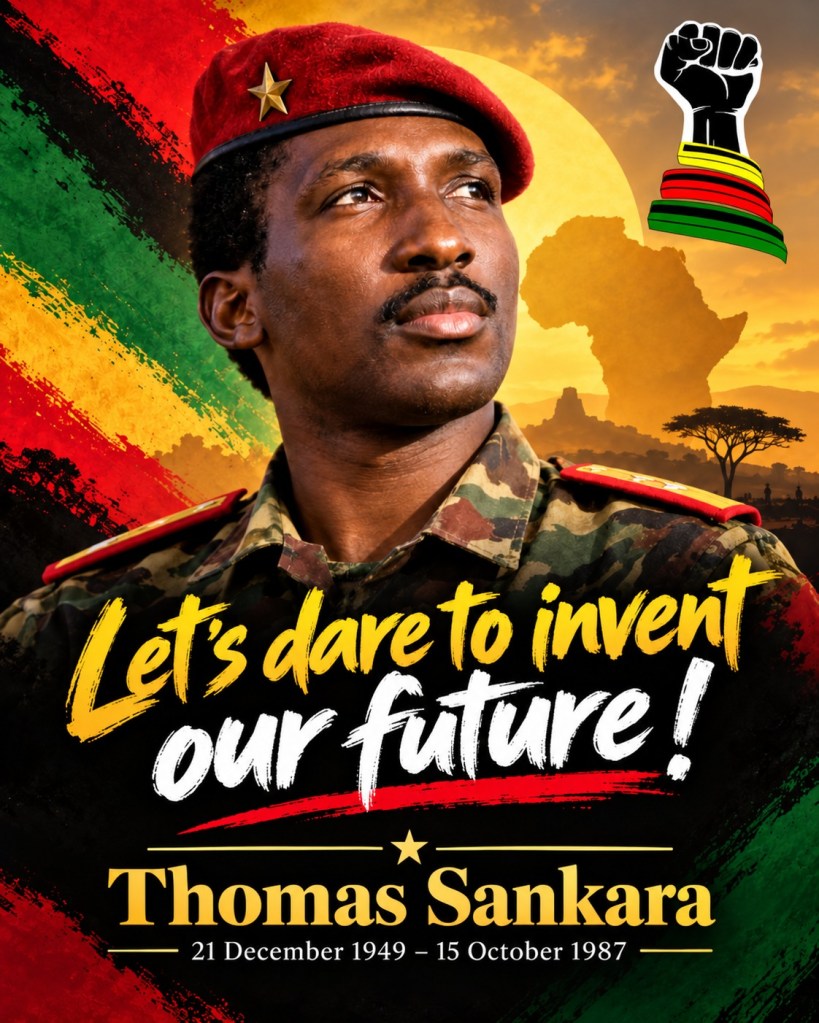
On 15 October 1987, Thomas Sankara was assassinated in Ouagadougou. He was just 37 years old. Nearly four decades later, his name remains a symbol of political courage, dignity, integrity and sovereignty for many Africans.
His enduring place in our collective memory deserves reflection. Sankara governed for only four years, yet his experience continues to inspire generations who never lived through his presidency. It remains relevant to debates about African independence, social justice, accountable leadership and the role of the State in transforming society.
But honouring Sankara should mean more than celebrating an individual or repeating his speeches. What matters is understanding the ambitions behind his leadership, examining both his achievements and contradictions, and drawing meaningful lessons for the challenges we face today.
A bold ambition: transforming society
Thomas Sankara became Head of State on 4 August 1983, at the age of 33, following a military coup. He embarked on a far-reaching transformation of the country then known as Upper Volta, renamed Burkina Faso — the “Land of Upright People” — in 1984.
His political project was rooted in a powerful conviction: independence should be more than a legal status or a national symbol. It should bring tangible changes to the economy, society and people’s everyday lives.
During his four years in power, his government introduced a series of reforms and nationwide mobilization campaigns.
In health and education, it launched mass vaccination and literacy campaigns intended to expand access to essential services.
On the economic front, it promoted agricultural production, locally made goods and greater national self-reliance, seeking to reduce dependence on imports and strengthen the country’s productive capacities.
Sankara also made women’s emancipation a major political priority, challenging discriminatory practices and encouraging women’s participation in public life.
Environmental protection featured prominently in his policies, particularly through reforestation programmes and efforts to combat desertification.
His government also promoted integrity in public administration, challenging the privileges enjoyed by political leaders, unnecessary prestige spending and the misuse of public office for personal enrichment.
Not all these policies achieved their intended results. Some encountered resistance, while others generated controversy because of how they were implemented. It would therefore be misleading to portray this experience as an unqualified success.
Nevertheless, it reflected a political commitment that remains highly relevant: public policy should be a means of bringing about tangible improvements in people’s lives.
Perhaps this is one of Sankara’s most important lessons. A political project should be judged not only by its speeches and stated intentions, but also by the changes it brings about in the everyday lives of citizens.
Sovereignty must be built, not merely proclaimed
Thomas Sankara challenged foreign domination, economic dependency and international debt arrangements that constrained African countries’ ability to determine their own future.
He advocated a vision of sovereignty that went beyond the formal attributes of independence. For Sankara, a people’s ability to shape its own destiny had to be built through economic capacity, productive activity, education and control over national resources.
This remains particularly relevant to our countries today.
Political sovereignty loses much of its meaning unless it is accompanied by a genuine capacity to produce what we need, educate our people, provide healthcare, ensure food security and determine our own development priorities.
A country may have a flag, a national anthem, its own institutions and a legally sovereign government, while remaining heavily dependent on foreign countries for essential needs. It may proclaim political independence while its economy remains fragile, its resources are insufficiently developed and its citizens struggle to access basic services.
Sovereignty must therefore be understood as an ongoing process of building national capabilities.
This requires investment in education, research, skills development, infrastructure and production. It also demands responsible management of public resources, effective institutions and economic policies that progressively improve living standards.
But this ambition also requires us to take responsibility for our own actions.
We cannot credibly oppose dependency while allowing corruption, inefficiency and the mismanagement of our own resources to perpetuate the very conditions that keep us dependent.
Challenging external domination is necessary wherever it exists. But doing so must never become an excuse to avoid examining our own responsibilities, decisions and governance practices.
Genuine sovereignty requires both a clear understanding of external constraints and a strong sense of responsibility in managing our national affairs.
A legacy that deserves honest and critical reflection
Admiration for Sankara should not prevent us from critically examining his record.
His government was also marked by restrictions on civil liberties, tensions with trade unions and authoritarian practices. These realities form part of the historical record and must be considered in any serious assessment of his legacy.
It would be contradictory to defend dignity, justice and freedom while accepting that these principles can be indefinitely subordinated to the will of a political leader, even one driven by sincere convictions and transformative ambitions.
A leader’s personal integrity is no substitute for civil liberties, institutional checks and balances, or effective mechanisms for holding those in power accountable.
This distinction is fundamental.
A leader may be personally honest and genuinely committed to serving the people without necessarily presiding over a democratic political system. Similarly, a transformation driven from the highest levels of government may produce significant achievements without establishing the conditions needed to sustain them over time.
The central issue, therefore, is how to embed change in lasting institutions.
How can we ensure that integrity does not depend solely on the personal virtues of those in office? How can citizens exercise meaningful oversight, challenge public decisions and participate in shaping collective priorities? How can we build institutions that outlast individual leaders and safeguard the achievements of political transformation?
In my view, lasting political transformation cannot depend solely on the courage, convictions or exceptional qualities of an individual.
It must be built on informed and organized citizens, accountable institutions, protected rights, and effective mechanisms for democratic participation and oversight.
Sankara’s legacy should therefore be neither idealized nor dismissed. Only through a serious and balanced examination can we draw lessons that are genuinely useful for the future.
What lessons for the Cameroon we want?
For those of us involved in Stand Up For Cameroon, the most meaningful way to honour Sankara is not to repeat his speeches or glorify his personality. It is to confront the questions raised by his experience.
Why do we seek and exercise political power: to serve the people or to use the people for our own benefit?
This question should lie at the heart of every political commitment.
It leads to several equally fundamental questions.
How can we turn Cameroon’s considerable resources into schools that truly educate, hospitals that provide quality healthcare, decent jobs and better living conditions for citizens?
How can we build genuine sovereignty through stronger productive capacities, better skills, greater creativity and responsible management of public resources?
How can we promote integrity in political leadership while building institutions capable of preventing, detecting and sanctioning abuses of power, regardless of who commits them?
How can we ensure that citizens, particularly young people and women, participate meaningfully in decisions that shape their future?
And, above all, how can we ensure that political change no longer depends exclusively on the will of one individual or a small group, but becomes a collective process sustained by institutions, democratic rules and citizens empowered to defend their rights?
These questions are especially important for Cameroon, a country facing deep governance challenges, social and political divisions, shortcomings in public service delivery, and a crisis of trust between citizens and public institutions.
Cameroon does not need a saviour or a strongman. It needs informed, organized and engaged citizens, strong democratic institutions, and a system of governance genuinely dedicated to the public interest.
This is why, through Stand Up For Cameroon, we advocate a democratic and transformative political transition aimed at rebuilding our Nation, reforming the State and fundamentally transforming Governance.
The objective is not simply to replace those who hold political office. It is to transform how power is understood, organized, exercised and held accountable. It is about building a political system in which institutions serve citizens and national resources are used, first and foremost, to improve people’s lives.
Serving the people: an enduring political responsibility
Thirty-nine years after his assassination, Thomas Sankara continues to challenge us.
His experience reminds us that politics can embody an ambition to transform society, that sovereignty must translate into practical capabilities, and that integrity in public office is a fundamental responsibility.
But it also reminds us that the convictions of a leader, however strong, cannot replace civil liberties, citizens’ rights and democratic institutions.
The challenge is not merely to find leaders who genuinely want to serve the people. It is also to build a political system in which power cannot be systematically diverted away from the public interest.
Our political ambitions must be measured against these two responsibilities: personal commitment and institutional transformation.
The most meaningful tribute we can pay to Thomas Sankara is therefore to uphold a simple but demanding principle: serve the people, transform society, and never treat political power as personal property or as a means of exploiting those we are meant to serve.
Glory and honour to Thomas Sankara!

